

Article
Sulfate showdown: high‑pressure membranes vs hungry microbes in nickel mine water
Industry: Nickel_Mining | Process: Acid_Mine_Drainage_(AMD)_Treatment
On one side, high-pressure pumps push mine water through dense polymer films. This strips out sulfate ions with ruthless efficiency. On the other, sulfate-reducing bacteria quietly convert the same contaminant into sulfide. This precipitates metals and leaves solids behind. Both camps are making their case in nickel operations. There, acid mine drainage (AMD, acidic, metal-rich wastewater from sulfide ore exposure) pushes sulfate into the grams-per-liter range.
Reverse osmosis (RO) and nanofiltration (NF) are pressure-driven “membrane” processes. They promise predictable, high removal. Biological sulfate reduction (BSR) is the anaerobic conversion of sulfate (SO₄²⁻) to sulfide (HS⁻) by sulfate-reducing bacteria (SRB). It leans on low energy and potential metal recovery. The choice is less about whether they work and more about power price, land, and what to do with the waste stream.
Nickel miners in Indonesia face a regulatory oddity. Permen LH No. 9/2006 does not set a sulfate limit ([nikel.co.id]. However, general water quality norms and Tier‑1 uses (for example drinking and irrigation) in practice demand 300–500 mg/L sulfate (the WHO guideline is ~250 mg/L). Therefore operators are pushed toward treatment that works.
Baca juga:
Cara Menghilangkan Air Bau Lumpur: Kimia, Biofilter & Ventilasi
Membrane sulfate rejection performance
RO physically rejects dissolved ions, including sulfate. Pilot work with commercial RO membranes (Toray BLN) showed 95–96% salt rejection (mdpi.com). In practice an RO plant fed with 2–3 g/L sulfate can produce permeate below 100 mg/L. That usually meets 250–500 mg/L discharge targets (scielo.org.za). The trade‑off is a small concentrate stream, usually less than 10% of influent, that holds most of the sulfate.
NF, with larger pores, removes less sulfate (roughly 70% rejection, often followed by RO polishing for strict limits; mdpi.com). In nickel AMD service, operators frequently spec modular membrane systems with RO/NF skids; for brackish‑strength feeds (maximum TDS of 10,000), brackish-water RO units are common, with nano filtration as a selective sulfate step when hardness removal at lower pressure is beneficial.
Pretreatment is non-negotiable. Suspended iron hydroxides and scale-forming cations foul membranes if the front-end barriers are missing. Plants pair dual-media filtration, such as sand/silica filters, with fine cartridge filters or even ultrafiltration (UF) before RO. Divalent sulfate teams up with calcium and barium to form stubborn scales (CaCO₃, BaSO₄). Therefore operators dose antiscalants. Dedicated programs and membrane antiscalants keep recovery rates up, and membrane cleaners restore performance between CIP cycles. Commercial elements from brands like Toray and Filmtec Dupont are widely used in these skids.
RO economics and concentrate handling
RO’s operating cost (OPEX) is mostly energy and pretreatment chemicals. Literature on mine drainage RO reports OPEX in the hundreds of USD per thousand cubic meters for small pilots. Large desalination RO plants run at about $0.3–$0.6/m³ under ideal conditions. A modeling study of AMD reclamation estimated total CAPEX on the order of USD 30–50/ton (of treated water) and OPEX of about $200–400/kL for full desalination, fine-tuned by byproduct recovery (mdpi.com). The figures depend heavily on the site, the feed composition and the recovery ratio. In practice, full RO treatment (neutralization, multi-stage RO and concentrate handling) can cost on the order of $0.5–1.0 per m³, depending on power cost and recovery rate. Energy intensity comes up again and again. One section cites electricity at about 0.05–0.15 kWh/m³. A comparative summary cites about 1–3 kWh/m³. Both are presented as given (scielo.org.za; mdpi.com).
Brine disposal is the other big line item. Concentrates go to evaporation ponds or crystallizers, or they are trucked off-site. In South Africa, an RO-only sulfate step treated about 1.5 g/L gypsum-saturated AMD to meet 250–500 mg/L sulfate discharge limits. It delivered potable-quality water, but at high utility cost and operational complexity: multiple stages, high-pressure pumps and concentrate handling (scielo.org.za; mdpi.com). A detailed South African study also noted that neutralization alone used about 67% of the chemicals in sulfate-removal schemes. Upstream pH control matters, whatever the downstream technology (scielo.org.za).
Biological sulfate reduction performance
In BSR, sulfate‑reducing bacteria work under anaerobic conditions and convert SO₄²⁻ to HS⁻ using an electron donor (for example ethanol, methanol, lactate, or hydrogen). The produced sulfide precipitates metals as sulfide solids. It is also captured as H₂S and converted to elemental sulfur. Configurations range from passive wetlands and pond reactors to active, engineered bioreactors (fixed‑bed or fluidized).
Removal can be near‑quantitative. Bench and pilot studies usually report 90–99% sulfate removal at steady state. A high‑rate hydrogenotrophic membrane bioreactor (MBfR) reached 92–97% sulfate removal (1.7–3.7 g S·m⁻³·d) under strong pH control (pmc.ncbi.nlm.nih.gov). Passive ponds with organic media have lower loading rates (for example less than 0.1–1 g S/L·d). However, they can remove more than 90% of sulfate over weeks of retention. Effluent from well‑tuned BSR usually lands below 50–100 mg/L sulfate. The pH must be neutral, but SRB processing usually gives a near‑neutral pH by itself.
Active BSR plants look like conventional biological treatment trains. Sites use wastewater biological digestion know‑how with fixed-bed bio‑reactors for controlled residence time. They may seed systems with starter bacteria and adjust donor regimes with nutrient blends. Downstream, primary solids separation in a clarifier lets sulfide sludges be dewatered and handled as solids rather than saline brine.
Baca juga:
RAS Hemat Air: Cara Reuse Air Backwash hingga 96%
BSR costs, byproducts, and land footprint
Passive BSR CAPEX is mostly earthworks (lined ponds and simple piping). Operating costs stay low if waste or low-cost substrates (wood chips, manure, molasses) are available. A South African review estimated passive BSR O&M at ~ZAR 4.5/m³ (≈$0.25/m³) with generic waste carbon. Supplementing with higher-grade donors (molasses, ethanol) raises costs to R7–R11/m³ (≈$0.4–0.6/m³) (scielo.org.za).
For active BSR (Thiopaq®‑type reactors), OPEX is higher. The cost is usually driven by hydrogen or acetate supply (scielo.org.za). Published estimates put SRB treatment cost at roughly $0.20–0.30 per kg SO₄ removed when using H₂ as donor. The cost is about half if using ethanol (0.20 vs. 0.26 USD/kg SO₄) (pmc.ncbi.nlm.nih.gov). Electricity needs are minimal (pumps for recycling, etc.), labor is low, and disposal cost is mainly sulfide sludge. That sludge may contain recovered metals that can offset costs.
BSR trades brine for solids, but it needs space: hundreds to thousands of square meters per megaliter of flow. Passive systems are simple and work well. Active units add control but still avoid high‑pressure complexity. Odor control is needed for H₂S off‑gas. Enclosed reactors usually integrate gas management.
RO vs BSR: effectiveness and costs
Removal efficiency is not the differentiator. RO can achieve more than 95% removal in a single pass (often more than 98% with two‑pass NF/RO; mdpi.com). BSR can approach 100% with sufficient contact time; the hydrogenotrophic MBfR cited above delivered 92–97% (pmc.ncbi.nlm.nih.gov). Mature passive or active beds have reported similar efficiencies at scale (scielo.org.za; scielo.org.za). BSR effluent may need polishing (e.g., aeration) to convert residual H₂S to elemental sulfur and to remove trace metals.
Capital cost (CAPEX) leans in biology’s favor for passive systems. RO skids carry pressure vessels, high‑pressure pumps, and instrumentation. A medium RO plant (1,000 m³/d) can land at $2–5 million including pretreatment and civil works. Active SRB reactors for multi‑million‑liter capacity can cost at least $1–2 million, usually lower than RO. An ettringite precipitation plant (chemical, with no brine) was noted as lower CAPEX than an RO facility in a South African comparison (scielo.org.za).
Operational complexity also differs. RO needs trained operators, membrane cleaning schedules, and close pretreatment control. Sulfate removal via RO is well‑understood in municipal contexts but quite new as AMD treatment. Fewer operators have direct experience. BSR can be simpler (especially passive ponds) but is sensitive to donor depletion and needs H₂S management.
Selection criteria and deployment context
Water quality and flowrate shape the choice. For small flows or modest discharge standards (sulfate in the few‑hundred mg/L range), low‑tech BSR is usually preferable because the cost is low. This is especially true at remote or closure sites where land is available (scielo.org.za). RO/NF is justified when the site needs high‑quality reuse water or the limits are very strict (for example, below 50 mg/L). It then delivers potable‑grade permeate reliably.
Sulfate strength and metals matter. Very high sulfate (several g/L) raises the BSR donor demand and the reactor size. RO can handle high strength by staging. However, concentrate management gets harder. High metal loads can inhibit the SRB or need metal removal upstream. BSR naturally precipitates metals as sulfides, while RO carries them into the concentrate until they precipitate. Where metal recovery is a goal (for example, Ni, Co), the sulfide sludge from BSR can be an asset (scielo.org.za).
Site and climate tilt the choice. Tropical conditions (for example, Indonesia) support biological activity all year, which helps BSR. In cold climates, or where donor logistics are fragile, membranes may be more reliable. In the wet tropics of Indonesia, RO brine disposal with evaporation ponds is tricky. BSR turns the sulfate into solids instead. Environmental guidance puts weight on waste minimization. Mintek’s cloSURE process, for instance, uses manure to cut operating costs (scielo.org.za).
Hybrid trains and integration
Many flowsheets go hybrid. Conventional lime neutralization first removes iron and raises pH. This usually leaves gypsum‑saturated effluent at ~1.5 g/L sulfate (scielo.org.za). From there, either RO/NF or BSR is added to hit the sulfate limit. South African mines have run lime → RO to meet hard discharge limits (scielo.org.za). Where low‑cost donor streams are available, for example waste molasses, a BSR polishing step is cost‑effective (scielo.org.za). When space is limited or sulfate must be minimized scrupulously, RO takes the nod. Sometimes NF prefiltration comes before it.
Quick comparison highlights
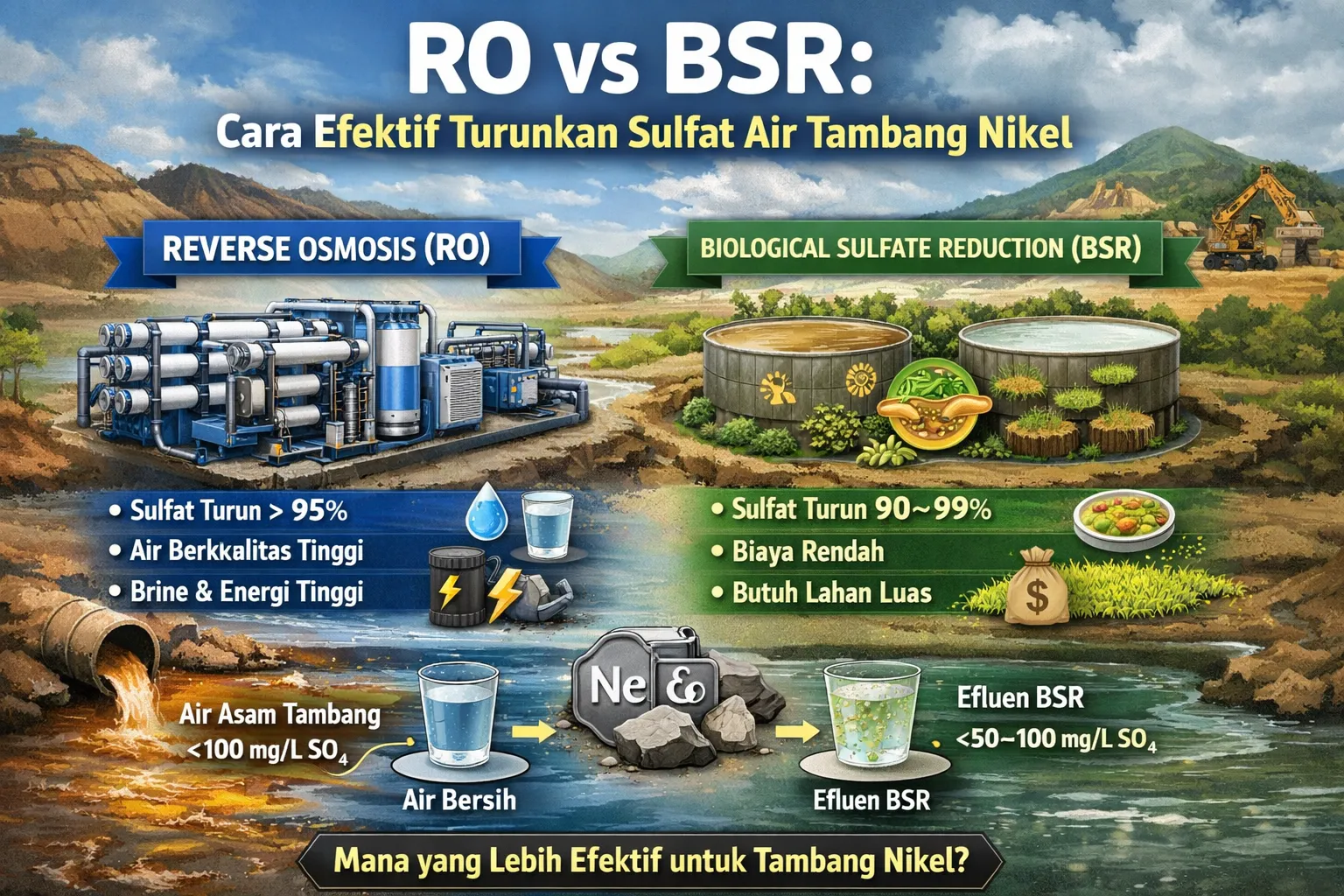
- Sulfate removal: RO removes about 95–99% per pass (mdpi.com). BSR removes about 90–99% with sufficient retention (pmc.ncbi.nlm.nih.gov).
- OPEX: RO is high (electricity about 1–3 kWh/m³, about $0.5–1/m³). Passive BSR is low ($0.2–0.3 per kg SO₄ with H₂, about $0.3–0.6/m³, R4.5–R11/m³) (pmc.ncbi.nlm.nih.gov, scielo.org.za).
- CAPEX: RO is high (pressure vessels, pumps, instrumentation). BSR is moderate (ponds/tanks, low‑grade reactors).
- Footprint: RO is small (compact skid). BSR is large (hectares possible).
- Waste: RO gives concentrated brine (high sulfate/TDS). BSR gives sulfide sludge (potential metal recovery) plus minor off‑gas.
- Complexity: RO is high (trained operators, pretreatment). BSR is low–moderate (sizing/modeling, donor logistics).
- Typical use: RO for high‑purity water/strict limits with available power. BSR for remote legacy sites, large flows, on‑site organic wastes.
Baca juga:
Binder & Coating Pakan Akuakultur: Pelet Utuh FCR Turun di Kolam Cepat
Economic signals and bottom line
Economic trends change. Falling costs for renewables-powered RO and better bioengineered systems both affect the choice. Large nickel projects may want a fast start-up and a small footprint, so they choose membranes. Mines that will run for a long time may accept low OPEX ponds. Market factors, especially high power prices, push the decision toward BSR.
In short: RO/NF offers guaranteed, reuse‑grade water—often more than 95% sulfate removal and permeate below 100 mg/L—but at higher energy and with a brine to manage (scielo.org.za; mdpi.com). Biological reduction can match those removal rates at much lower cost and energy but needs land, slower kinetics, and reliable electron donors, producing solids instead of saline waste (scielo.org.za; pmc.ncbi.nlm.nih.gov). Nickel mine planners in Indonesia and beyond will weigh discharge limits, reuse needs, power and chemical prices, and available land to pick the optimal route (scielo.org.za; scielo.org.za).