

Article
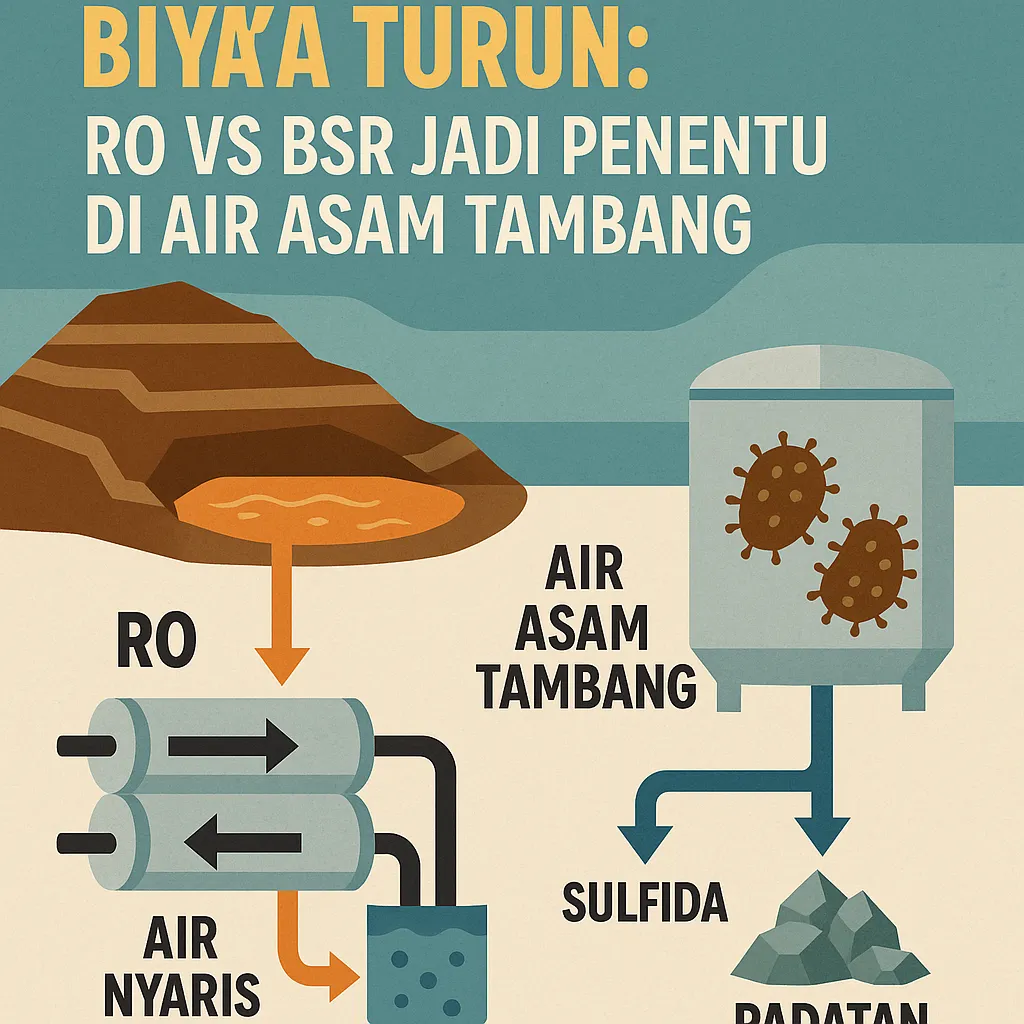
The sulfate showdown in mine water: membranes vs microbes
Industry: Coal_Mining | Process: Acid_Mine_Drainage_(AMD)_Prevention_&_Treatment
Two very different methods now dominate sulfate removal from acid mine drainage (AMD, acidic runoff laden with sulfate and metals): high-pressure membranes and low-energy microbes. In controlled trials, nanofiltration (NF) and reverse osmosis (RO) cut sulfate by over 90–99% every time. In a Brazilian gold-mine case the permeate came out below 200 mg/L (scielo.br).
But NF also delivered 7–12× higher permeate flux than RO under similar conditions, with one “NF90” membrane matching RO’s sulfate retention at significantly higher throughput (scielo.br) (scielo.br).
On the other side, biological sulfate reduction (BSR, an anaerobic process where sulfate-reducing bacteria convert SO₄²⁻ to sulfide) has logged ~94% sulfate removal with 95–99% metal removal in optimized bioreactors. In ethanol- or glycerol-fed systems it raised pH from ~2.8 to 7.5 in 14 days (mdpi.com). Operating costs for BSR have landed as low as R4.5–11/m³ (USD $0.3–0.7) in a South African analysis (scielo.org.za).
Membrane nanofiltration and reverse osmosis
Membrane filtration splits contaminants physically. NF (nanofiltration) rejects multivalent ions such as SO₄²⁻, Ca²⁺, and Mg²⁺. RO (reverse osmosis) rejects essentially all salts. In practice, both can reduce sulfate by over 90–99% and deliver permeates with <200 mg/L sulfate in mine effluent (scielo.br). For compact installations, packaged membrane systems are a common platform for industrial water treatment.
Notably, one study found NF offered 7–12× higher permeate flux than RO with comparable sulfate rejection, and the “NF90” membrane achieved similar sulfate retention to RO at much higher throughput (scielo.br) (scielo.br), supporting the case for nanofiltration where multivalent removal is the main target.
Operating pressures and pretreatment needs
NF usually runs at 10–20 bar and RO at 25–50 bar. Therefore NF usually needs less energy. Pretreatment is standard to limit CaSO₄ scaling, biofouling and suspended solids. It means pH control and filtration. Plants usually put pretreatment before RO, and many specify ultrafiltration as a barrier ahead of high-pressure membranes.
Primary solids removal upstream helps protect membranes. It can include a clarifier to drop heavy precipitates, followed by granular media steps such as sand filtration and fine polishing with a cartridge filter. For scaling control, programs usually include membrane antiscalants to extend run time between cleanings.
Economics and brine management
Membranes “virtually guarantee low‑sulfate permeate,” but concentrate disposition is the catch. Treating 1 m³ of feed usually yields only 0.5–0.8 m³ permeate and 0.2–0.5 m³ brine. The brine then needs evaporation ponds, deep well injection, or processing. One analysis put the energy (ozone + brine evaporation) to handle RO brine at ~R33/m³ (≈US$2.2/m³) (scielo.org.za).
Costs vary by site. In a Brazilian gold-mine example, NF delivered sulfate removal at an estimated US$0.83/m³ including capital amortization (scielo.br). A South African estimate put RO (plus brine handling) at ~R33/m³ (≈US$2.2) (scielo.org.za)—for perspective, R4.5–11/m³ is US$0.3–0.7 (scielo.org.za). For brackish AMD streams, brackish-water RO platforms are commonly engineered to the feed’s total dissolved solids (TDS).
Membrane CAPEX is high (membrane modules and high-pressure pumps), and OPEX is dominated by power plus maintenance. Fouling shortens membrane life, so clean-in-place cycles and compatible membrane cleaners are a recurring line item. The upside: membranes remove most anions (sulfate, chloride, nitrate) and many metals, and usually yield near‑pure water for reuse or discharge.
Biological sulfate reduction reactors
BSR harnesses sulfate‑reducing bacteria (SRB) in anaerobic conditions to convert SO₄²⁻ to sulfide (H₂S/HS⁻) using an electron donor such as ethanol, glycerol, waste organics, or hydrogen. The sulfide then precipitates metals (for example FeS, ZnS), removing acidity and metals alongside sulfate. Reviews report ~94% sulfate removal with 95–99% metal removal in optimized systems (mdpi.com), and one anaerobic bioreactor lifted pH from ~2.8 to 7.5 within 14 days under ethanol/glycerol feed (mdpi.com). Engineered biological digestion systems are the typical backbone for active BSR.
Throughput depends on the design and the carbon source. However, high‑rate reactors can usually treat tens of kg‑SO₄ per day per cubic meter of biomass. Configurations range from fixed‑bed bioreactors to proprietary hydrogen‑based systems (for example, THIOPAQ®) that need tight substrate dosing and sulfide management. Fixed media designs match the fixed‑bed bioreactors used in industrial wastewater.
Passive wetlands versus active systems
Passive constructed wetlands use natural organics and plants at low cost. However, they usually remove sulfate more slowly (weeks to months) and the removal varies, usually 20–50%. They rarely bring >1000 mg/L down to <50 mg/L (researchgate.net). Active reactors remove more sulfate and remove it faster. However, they need reliable energy and chemical logistics, including precise carbon addition through a dosing pump.
One variant uses hydrogen and a membrane bioreactor. It has shown near-complete sulfate removal with sulfur recovery. However, the complexity still holds it back (frontiersin.org).
Effectiveness and cost comparison
Removal efficiency: membranes can deliver >95% sulfate removal down to hundreds of mg/L in a single pass (scielo.br). High‑rate BSR clocks ~90–94% reductions (mdpi.com), while passive wetlands tend toward tens of percent. BSR simultaneously removes most dissolved metals via sulfide precipitation (mdpi.com), whereas membranes leave metals in the concentrate stream.
Cost: published values point to higher cost for membranes relative to BSR. NF/RO have been estimated around US$0.8–2.5 per m³ (site‑dependent) (scielo.org.za) (scielo.br), while BSR has been estimated at R4.5–11/m³ (USD $0.3–0.7) (scielo.org.za), with ethanol or hydrogen accounting for roughly half of that (scielo.org.za).
Byproducts and waste: membranes produce brine rich in sulfate, chloride, and metals. The eMalahleni plant in South Africa has shown how brine evaporation energy can add ~R33/m³ (scielo.org.za). BSR produces a metal-sulfide sludge and hydrogen sulfide gas. The sludge is usually smaller by weight, but H₂S and odor must be controlled.
Water reuse: membrane permeate is very clean and can meet stringent reuse or potable targets. BSR effluent will still carry monovalent ions (Na, Cl, NO₃) and may contain residual organics or sulfide. Aeration or oxidation is a common polishing step.
When advanced sulfate treatment is needed
Regulatory and reuse drivers set the bar. More treatment becomes necessary when discharge must stay below tight sulfate limits or the water is meant for reuse. Regulators demand <500 mg/L sulfate, a widely referenced threshold (sciencedirect.com). Below that limit, membranes or BSR are candidates. Simple neutralization may meet pH and metal limits but leave sulfate near ±1000 mg/L. Gypsum (CaSO₄) precipitation alone bottoms out around ~1500 mg/L in theory (sciencedirect.com).
Feedwater chemistry and flow constraints
Feed characteristics shape the choice. Very high sulfate (>2000 mg/L), hardness, or TDS can favor multi‑stage membranes if scaling is managed. For monovalent leakage tolerance and lower energy, NF is usually attractive. When salt rejection must be near‑total, RO/NF platforms dominate.
However, if sulfate is moderate (<1000 mg/L) and metals and acidity remain, BSR is compelling. It neutralizes acid and precipitates metals while it reduces sulfate. For very saline water (>10,000 mg/L TDS), membranes may need staged recovery or dilution. Microbial salt tolerance limits BSR around ~50–100 g/L TDS. At scale, high‑flow plants lean toward membranes. “Many MLD” can be treated in compact footprints (tens of m² membrane area for ~1 MLD).
Power, operations, and byproduct recovery
Power and skills matter. Membrane plants need reliable electricity and trained operators. Remote mines sometimes rely on passive BSR if land is available. In some underground operations with suitable gases, SRB systems can integrate for sulfur recovery and cleanup.
Byproducts differ. Membranes yield clean water and a concentrate stream that can be sent to evaporation/crystallization (even salt crystals). BSR can produce elemental sulfur or metal sulfides with on‑site water reuse potential (mdpi.com). For hybrid trains, lime neutralization and clarification usually come first, usually via a clarifier, then polishing by membranes or BSR.
Hybrid treatment trains
Many flowsheets start with AMD neutralization to drop iron and form gypsum. Then they move to the tighter sulfate removal step. NF can polish the water after precipitation to reach very low limits. BSR can be used on water after the clarifier, where land is available and low-energy operation is preferred. Auxiliary equipment, for example supporting water‑treatment ancillaries, covers dosing, monitoring and control.
Indonesia context and planning
Indonesia does not yet set numeric sulfate limits for mining effluent. However, permits tie discharge to “point of compliance” receiving-water classes and quality. In practice, Class I–II water quality and the WHO drinking-water reference of 250 mg/L sulfate can be used for reuse decisions (sciencedirect.com). Work in Kalimantan coalfields has shown that sulfate is a challenge in AMD (mdpi.com). Standards are getting tighter, as happened recently for TSS and Bitcoin. Therefore mines are planning for more AMD treatment and looking at membranes or BSR.
Pilot testing and water‑balance modeling are essential because AMD chemistry varies widely. Key metrics include sulfate before/after, water recovery, residual H₂S (for BSR), sludge/brine volume, and lifecycle cost (USD per tonne SO₄ removed or per m³ treated). The data points summarized here—costs of ~$0.3–2/m³ and >90% removal achievable—frame a practical decision for coal‑mine AMD in Indonesia (scielo.org.za) (sciencedirect.com) (mdpi.com).
Sources and references
Sources: Authoritative reviews and case studies were used, including engineering journals and industry reports (scielo.org.za) (scielo.br) (scielo.br) (scielo.br) (sciencedirect.com) (mdpi.com) (metadata below).
References: Rafaella Vieira et al., 2017, Braz. J. Chem. Eng., vol. 34(1), “Nanofiltration and Reverse Osmosis Applied to Gold Mining Effluent…”, DOI:10.1590/0104-6632.20170341s20150082 (scielo.br) (scielo.br); M. van Rooyen et al. (Mintek), 2021, J. S. Afr. Inst. Min. Metall., vol. 121(10), “Sulphate removal technologies for treatment of mine-impacted water” (scielo.org.za); D. Mafane et al., 2025, Sustainability, “Anaerobic Bioremediation of AMD using Sulphate-Reducing Bacteria” (mdpi.com); M. Zaror et al. (eds.), 2018, Environmental Research, vol. 167, “How to tackle the stringent sulfate removal requirements…” (sciencedirect.com). Additional data from peer‑reviewed mine‑water and water‑treatment sources (scielo.org.za) (mdpi.com).