

Article
The lab-grade playbook behind 99.8% nickel: Inside SX‑EW’s quality control
Industry: Nickel_Mining | Process: Solvent_Extraction_&_Electrowinning_(SX
Nickel SX‑EW (solvent extraction and electrowinning) runs more like a laboratory than a mine. Plants aim for primary nickel cathodes of ≥99.80% Ni (ASTM B39 grade) with only trace impurities (Fe, Co, Cu ≤0.02–0.15%). This standard is now enforced by commodity exchanges and buyers (standards.iteh.ai). To meet it, the process targets very high nickel recovery. Integrated laterite flowsheets report about 96% Ni recovery (www.tieiextraction.com).
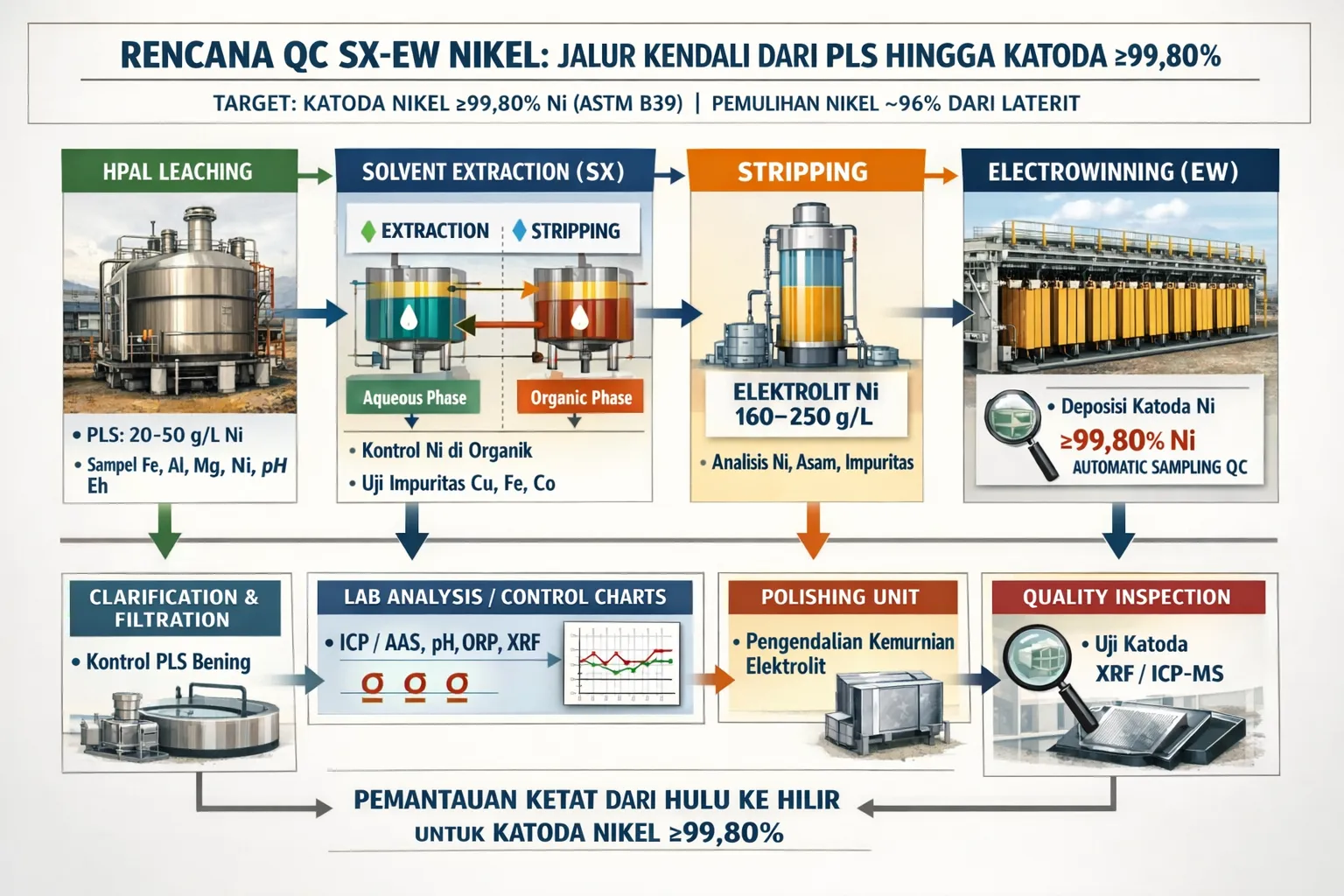
This quality control plan follows the stream from HPAL (high‑pressure acid leach) through SX and stripping to EW. It details the chemical and physical parameters to monitor. It also covers the sampling and analysis needed to keep nickel on spec.
Leach solution composition and clarity
After HPAL, the pregnant leach solution (PLS) carries dissolved Ni and Co alongside by‑products. HPAL gives about 20–50 g/L Ni (and a few g/L Co) in the PLS, with a lot of impurities: iron, aluminium, manganese, and very high magnesium (from the magnesium silicate matrix) (nickelinstitute.org). After neutralization and CCD washing, “the solution contains primarily nickel and cobalt with minor Zn, Cu, alongside more significant amounts of iron, aluminium, and manganese, with a substantial concentration of magnesium” (nickelinstitute.org). Fe is usually above 1–5 g/L in the PLS. This needs tight control because iron contaminates SX.
Key setpoints: track Ni and Co concentrations (targeting full recovery), total Fe and Al (minimized via Fe/Al hydroxides/jarosites precipitation in leach tailings), pH, and Eh. Leach pH is usually very low (pH<0, high acid) but rises to about 1 after neutralization. If the pH is too high (>2), Ni can precipitate and the yield drops. Redox potential (Eh) is kept high (oxidative) to prevent sulfide formation. Online ORP probes are standard. Suspended solids (TSS) in the filtered PLS should be <50 mg/L to prevent organic phase fouling. A clarifier supports this target (it removes suspended solids with 0.5–4 hour detention time). Typical PLS Ni grades for large HPAL plants are in the tens of g/L (for example, 25–30 g/L Ni has been reported in commercial operations), with final leaching yields around 90–96% Ni (www.tieiextraction.com).
Sampling is frequent: composite or grab PLS samples (after filtration) hourly. Analyze Ni, Fe²⁺/³⁺, Mg, Al, Ca, Zn, Cu by ICP‑AES or AAS after acidifying. pH and ORP are logged continuously. Lab titrations quantify free acidity (g/L H₂SO₄). Suspended solids are measured gravimetrically. For inline protection in acid service you can use steel filter housings (high pressure steel housings up to 150 PSI for industrial applications). For pH control, an accurate dosing pump helps with acid/base addition.
Solvent extraction ratios and organic health
The SX plant uses an organophosphorus extractant (for example LIX or Cyanex) or a chelating extractant in a kerosene/diluent to purify and concentrate Ni. The aqueous:organic (A:O) flow ratios and the contact stages are held so that more than 95% of the Ni transfers to the organic. In continuous mixers this is usually about 1:1–2 (v:v). A buffer column or scrub stage strips co‑extracted impurities (for example Cu or Fe) with dilute acid. Level meters and PLC interlocks protect against flooding or short‑circuiting.
Feed control matters. The aqueous pH around 1–2 (adjusted by dilution and acid/addition) stabilizes extraction. Co‑elements (Cu, Zn, and others) should be <100 mg/L (ideally <10 mg/L Cu) because even trace Cu can accumulate on the organic and contaminate Ni plating. Online Cu monitors (for example Instrumenal methods or test strip kits) flag breakthrough.
Loaded organic is sampled for Ni loading (g/L in organic). Circuits aim for ~150–300 g/L Ni (extractant/design dependent). In practice, commercial plants usually run ~50% volume extractant and end-of-stage Ni loading ~10–20% (w/w) Ni. Periodic titrations determine extractant concentration (for example by denitration) and Ni loading. Drying an aqueous sample checks free diluent content. Phase separation time (T80 <1 min) confirms coalescence. Efficient Ni extraction depends on maintaining ~30–50 °C and stable organic potency. We recommend on-line pH meters in raffinate and strip circuits and density meters (to detect entrainment). Josh: Adjust flows if Ni distribution ratio drifts. Regular scrub liquor tests target scrub liquor Ni <1 g/L.
We sample every shift across the extraction and strip stages and analyse Ni, Co, Mg and Fe by ICP or spectrophotometry. This keeps the circuit on trend. Small “packet” organic samples can be centrifuged and analysed for organic vs aqueous yields. Phase purity is checked by loss-on-ignition. Control charts track Ni in the loaded organic and in the stripped electrolyte.
Stripping chemistry and electrolyte prep
Stripping with strong acid produces the high‑grade electrolyte that feeds EW. Nickel concentration should be as high as possible. For workshop, low‑power plating baths, stripped electrolyte targets are usually 40–60 g/L. However, industrial EW baths run much higher, 160–250 g/L Ni as sulfate, for efficiency. Watts plating baths use 240–300 g/L NiSO₄ (www.substech.com). Ni is monitored by ICP and titration (dimethylglyoxime) at least daily. Recycle streams may be used to hold the range.
Acid concentration has two jobs. After stripping, sulfuric acid is often recycled to leach or burned. In the final plating electrolyte, acid content and pH matter (usually pH 3–4 in Watts baths, www.substech.com). For Ni EW, acid must be high enough (often >150 g/L H₂SO₄) to maintain conductivity. However, the pH must not be so low that hydrogen evolution waste increases. Regular titration determines H₂SO₄ (mg/L) and free acid. Sulfate and chloride build‑up (for example from NiCl₂) are monitored.
Temperature and additives are set tightly. The stripped electrolyte is stored and heated (usually ~50–65°C) to improve plating. Boric acid (30–45 g/L as in Watts baths, www.substech.com) is added consistently as a buffer. Thermostatic heaters hold temperature with alarms if >±2°C deviation, since deposit morphology is sensitive to temperature (blog.emew.com). Electrolyte conductivity, usually a few hundred mS/cm, can be measured online as a proxy for composition.
Impurity control is decisive. Copper, cobalt, iron or chloride in the plating bath is dangerous. Copper (E° +0.34 V) will plate preferentially, contaminate Ni cathodes and spoil current efficiency (blog.emew.com). ICP/MS runs weekly, or as needed, and aims for Cu <1 ppm, Fe <10 ppm, Co and Mn <10 ppm, and Cl⁻ usually <100 ppm. If impurities rise, operators turn to cementation (Zn dust to remove Cu/Ni), ion‑exchange polishing, or bleed‑sidestream SX. Polishing can be delivered by ion exchange systems and tuned with the right ion‑exchange resin.
Electrowinning metrics and cathode audits
In the tankhouse, current efficiency (CE) and cell voltage anchor performance. CE is calculated daily from deposit mass against theoretical Faraday yield and should be >90%. Copper EW targets 92–95% CE (scielo.org.za), and Ni EW seeks similar values. Low CE signals parasitic hydrogen evolution or short‑circuits. Cell voltage is monitored in real time and should stay near design, for example 2.4–2.7 V per cell. Creeping voltage hints at resistant films or failing cells.
Current density is kept within design. For example, 20–50 A/ft² in plating terms (≈40–150 A/m²), balancing rate and deposit quality (www.substech.com). Controls adjust amperage as electrolyte volume changes. Supply voltage and current fluctuations are logged and charted. Spikes or dips may reflect switchgear or pump issues that need maintenance.
Cathode quality control is routine. Visual checks look for nodules, pits or discoloration. Thickness is checked with gauges or by weight per area. Chemical analysis (XRF or wet-chemical) of cathode shavings confirms Ni purity (target ≥99.8%) and measures impurities (ASTM B39 limits). Grain structure and stress may be checked with lab bend tests. If impurities (for example Cu, Co) exceed LME Nickel specs (Fe+Co ≤0.15%, Cu ≤0.04%, standards.iteh.ai), the focus moves to upstream contamination.
Electrolyte balance closes the loop. A daily mass balance tracks nickel lost and gained. On each shift, operators measure the Ni concentration left in the electrolyte. Ideally Ni only leaves the electrolyte onto the cathodes. If it drops too low, make-up Ni sulfate is added. Volume tracking controls the concentration. Current, voltage and bath chemistry data are logged in a SCADA/data historian.
Sampling frequency and analytical QA/QC
A formal sampling plan underpins representativity and accuracy. Aqueous streams (PLS, raffinate, strip liquor, bleed) are sampled through automated or manual ports. They are filtered in-line (0.45 μm) to remove solids, then split. One part is acidified (for example with HNO₃) for metals by ICP. Another part is neutralized for anion analysis (sulfate, chloride). Organic samples (≈50 mL) are withdrawn, stripped with yellow reagent and titrated, or digested and run by ICP to determine Ni loading. Karl Fischer or drying checks organic purity (no entrained water). A fine cartridge filter (removes 1–100 micron particles) protects the instruments and helps keep lines clean before lab prep.
Short-cycle parameters (pH, ORP, density) are measured continuously or hourly. Full assays (Ni, Fe, Co, major cations) follow typical intervals. PLS is tested every 1–4 hrs. SX streams are tested every shift. EW electrolyte is tested once per shift. Cathode samples are taken on production batches. In one study, 6,516 cathode electrolyte samples (250 mL each) were collected over 6 months (≈2-hour intervals) to enable statistical control (scielo.org.za). This shows the level of rigor that is feasible.
Laboratory controls need QC standards and replicates. Methods include ICP‑OES for metals, ion chromatography for Cl⁻ and SO₄²⁻, titrations for Ni by DMG and for H₂SO₄ by hydroxide, and XRF/AA for metal analyses. A certified reference nickel standard for the final cathode checks the accuracy of the product purity result.
Process control charts track key metrics with Shewhart methods: Ni electrolyte ppm, pH, cell voltage and FG Ni purity. Ion balances or current efficiency trends show drift. In a copper EW plant, statistical control of cell‑voltage “hotspots” improved current efficiency by 5.4% (saving ~74 t of cathode in 1.5 months) (scielo.org.za). A deviation beyond ±3σ triggers root‑cause analysis and corrective actions, for example adjusting flow rates, cleaning electrodes or recalibrating reagents.
Documentation closes the loop. Every sample is logged with time, location and conditions for ISO9001‑type traceability. The results feed daily operational reports. Regular internal or third‑party audits check adherence.
Standards compliance and environmental limits
Final nickel cathode must meet international and national standards. ASTM B39 specifies ≥99.80% Ni with strict impurity caps (standards.iteh.ai). Indonesia’s regulatory framework emphasizes local value‑addition and strict environmental controls (www.researchgate.net). Ministerial Regulation (Permen LH No.9/2006) limits Ni discharges in effluent to 0.5 mg/L (nikel.co.id), indirectly demanding >99% Ni recovery into product—another reason QC vigilance never lets up.
Figure: A simplified SX‑EW flowsheet (leach → SX → strip → EW) illustrating key streams for sampling and analysis. (nikel.co.id) (standards.iteh.ai) Nickel product and environmental standards: Indonesian law (Permen LH 09/2006) caps Ni in effluent at 0.5 mg/L, while LME/ASTM specs require ≥99.80% Ni with Fe/Co ≤0.15% in cathode.
Each element of this plan is data‑driven. Lab trends inform process setpoints and alarms. Production decisions, such as when to adjust the SX O:A ratio or change cathodes, are made on quantified outcomes, such as current efficiency and yields. By measuring chemical and physical parameters and analysing trends, the SX‑EW plant can operate in control and consistently produce specification‑compliant nickel.
Sources: hydrometallurgy reviews and company reports (nickelinstitute.org) (www.tieiextraction.com) for leach/SX chemistry; plating data (www.substech.com); electrowinning guidelines and case studies (blog.emew.com) (scielo.org.za); and regulatory references (nikel.co.id) (standards.iteh.ai).