

Article
The 0.1 pH That Makes or Breaks Your Boil
Industry: Brewery | Process: Boiling
During wort boiling, proteins and tannins form insoluble complexes called hot break (hot trub). Those clumps have to come out for beer clarity and stability. The size and quantity of that break change with small shifts in wort chemistry and boil conditions. Wort pH around 5.2 (room-temperature measure) comes out again and again as the sweet spot. At that pH the coagulation is strong and hop utilization is not badly impaired (crispmalt.com) (forum.homebrewersassociation.org).
Brewing scientists point to why: as pH moves toward a protein’s isoelectric point (the pH where net charge is near zero; ~4.9 for most malt proteins), solubility drops and coagulation accelerates (braukaiser.com). Calcium (Ca²⁺) helps by reacting with malt phosphates and polyphenols, releasing H⁺ and acidifying the wort while cross‑linking proteins—both effects that stiffen the break (goodbeer.solutions) (crispmalt.com) (byo.com).
Then there is physics. A rolling boil means high heat input, strong convection and strong turbulence. These drive denatured proteins and tannins together, so they collide and agglomerate. One data source puts it this way: “Trub formation is helped by the vigour of the boil, the rate of energy added, [and] the duration of the process, essentially the evaporation rate!” (crispmalt.com)
Hot‑break chemistry and targets
Proteins lose charge as pH falls toward their isoelectric point (~4.9), which enhances coagulation (braukaiser.com). Brewers therefore often target boil pH near 5.2 (room‑temperature measure) because it maximizes break formation without severely impairing hop utilization (crispmalt.com) (forum.homebrewersassociation.org). In practice, wort pH drops about 0.1–0.2 units over 60–90 minutes—e.g., from ~5.8–5.9 down to ~5.6–5.7—driven by calcium–phosphate precipitation and related reactions (crispmalt.com) (braukaiser.com).
Lowering boil pH further (via acids or Ca²⁺ salts) grows flocs but can reduce hop bitterness (byo.com). One brewing expert frames it bluntly: the “best possible hot break” shows up when kettle pH reaches ~5.1–5.2 before finings (forum.homebrewersassociation.org), matching industry guidance that trub‑formation pH is ≈5.2 (crispmalt.com). At pH ~5.4, flocs are smaller and wort haze rises.
Wort pH: small shifts, big gains
Data‑backed practice converges on a cast‑out wort pH ≈5.2 (±0.1), monitored in the 5.1–5.3 range through the boil (crispmalt.com) (forum.homebrewersassociation.org). Brewers usually acidify slightly or use calcium to reach this. Increasing brew pH to 5.4–5.6, common if water is untreated, tends to give smaller flocs and hazier wort.
Quantitatively, sources summarized at byo.com and braukaiser.com note that boil pH ~5.3 yields moderate coagulation, while dropping to ~5.1 can produce larger flocs; raising kettle pH (e.g., with baking soda) substantially reduces trub formation. The typical pH drop of ~0.1–0.2 units (for instance, 5.8→5.6) is itself helpful for coagulation (crispmalt.com).
Calcium concentration: cross‑linking and acidification
Divalent cations, especially Ca²⁺, clearly help break formation. They react with wort phosphates to form insoluble calcium phosphate. This frees H⁺ and lowers the pH (goodbeer.solutions) (crispmalt.com). High-calcium water (for example 100+ mg/L Ca) gives a noticeably darker wort (more Maillard browning) and a faster pH drop.
Brewers usually aim for about 50–150 mg/L Ca²⁺ in the mash and wort. At these levels, Ca–phosphate precipitates help protein coagulation. Murphy & Sons describe calcium as having an almost “chicken and egg” effect on protein precipitation in both mash and boil (goodbeer.solutions). Brew‑Your‑Own agrees that calcium “aids protein aggregation by binding proteins together” (byo.com).
Raising Ca from ~10 to ~100 mg/L can lower mash/wort pH by 0.2–0.5 units (through Ca‑phosphate precipitation). It is also linked to firmer trub formation (goodbeer.solutions). Worts with 10× higher Ca²⁺ (10→100 mg/L) tend to finish the boil around pH 5.3–5.4, against ~5.5–5.6 for very soft water (goodbeer.solutions) (braukaiser.com). Those higher‑Ca worts also leave much clearer hot wort. One practical example: adding 50 mg/L CaCl₂ to maltose solution can lower mash pH by ~0.2, the same way it works in wort.
Practical guidelines in the literature point to supplying at least ~50 mg/L Ca²⁺, with some operations pushing 100–150 mg/L where pH control or yeast nutrition is needed. Above ~200 mg/L there are diminishing returns, and hop doses can need adjustment due to lower pH (goodbeer.solutions) (crispmalt.com). Magnesium above ~50 mg/L can interfere (Mg‑phosphates are more soluble) and is generally kept low (goodbeer.solutions). The summary advice: calibrate water chemistry so calcium neutralizes wort alkalinity and contributes ~0.1–0.2 pH drop by end of boil (goodbeer.solutions) (crispmalt.com).
Boil vigor and duration: turbulence vs shear
A full, rolling boil with strong convection gives more hot break. Crisp Malt ties trub formation to boil vigor, energy input and duration, which in practice is the evaporation rate (crispmalt.com). Stronger turbulence mixes denatured proteins better with polyphenols and hop material. Therefore the flocculation goes faster.
Time matters too. Standard recipes (60–90 minutes) produce ample break, but very extended boils—beyond ~90–120 minutes—introduce shear forces that break large flocs into smaller particles, slowing removal (byo.com). Conversely, a weak, simmering boil can cut hot break formation by about 50% (crispmalt.com). Maintaining a vigorous boil also helps form a tighter whirlpool trub cone, improving downstream clarity (braukaiser.com).
In controlled comparisons, doubling the boil intensity (for example a half‑volume strong boil against a full‑volume simmer) roughly doubled the lees volume observed (crispmalt.com).
Kettle finings (carrageenan) mechanism and options
Kettle finings—Irish moss, Whirlfloc tablets, Protafloc granules—are carrageenan polymers (mainly κ‑carrageenan), long negatively charged polysaccharides extracted from red seaweed. Added late in the boil, they adsorb onto proteins and tannin–protein aggregates and create a net‑like lattice that pulls them out of solution (braukaiser.com) (byo.com) (goodbeer.solutions). Lewis & Bamforth sum it up: “carrageenan (e.g. Irish Moss) in the boil does not increase the protein precipitation but it causes formation of larger flocs that settle more quickly” (braukaiser.com).
Types vary. Traditional Irish moss (raw Chondrus) is inexpensive but less potent and needs >10 minutes to extract. Modern tablets blend κ‑ and λ‑carrageenan and dissolve quickly. Purified κ‑carrageenan (for example, Murphy & Son’s Protafloc) is fully water‑soluble, very active, needs lower doses, and leaves less sediment (goodbeer.solutions).
Quantified finings impact on haze and filtration
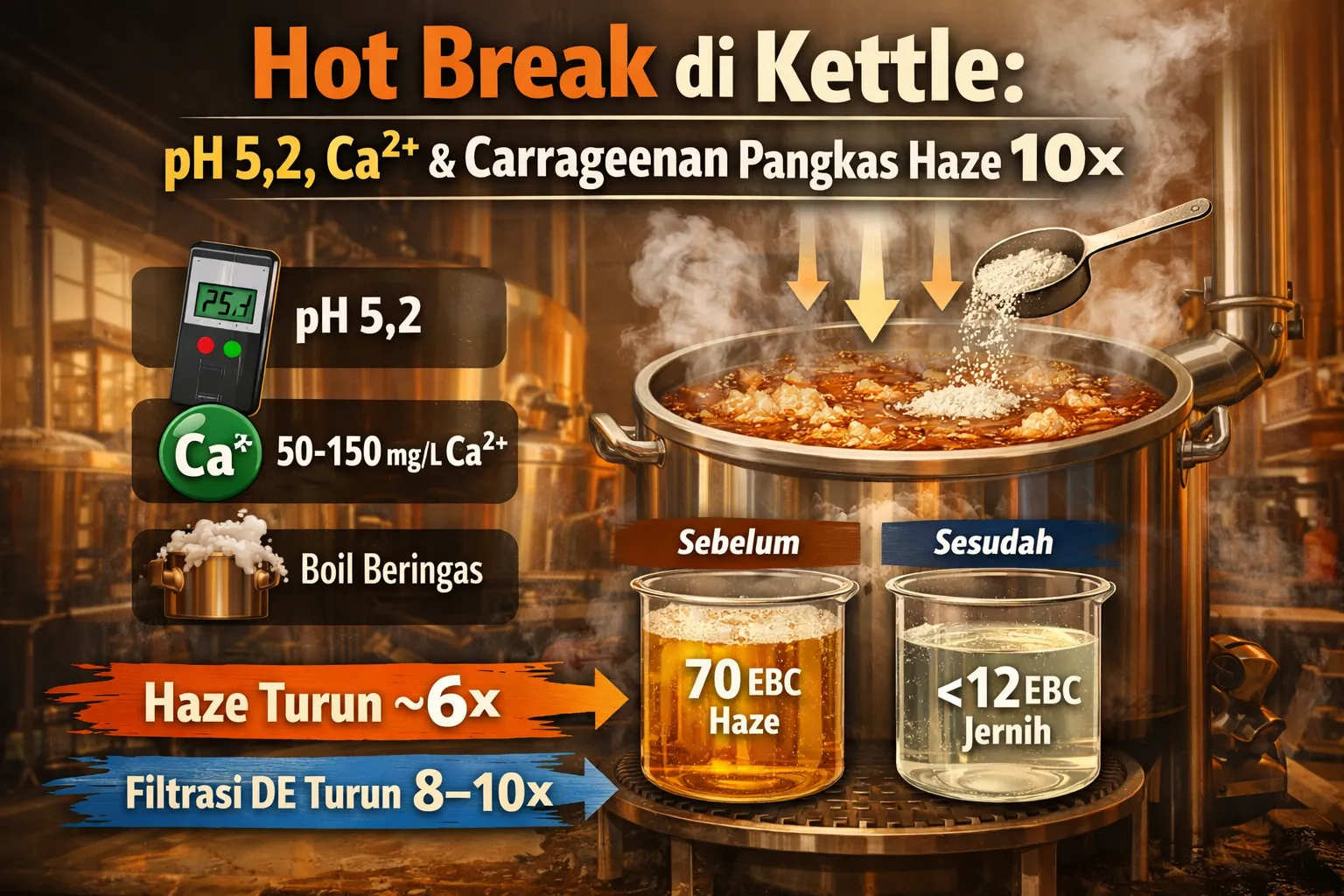
Poreda et al. (2015) dosed 50 mg/L carrageenan at flameout. Pre‑lagering (sweet beer) haze dropped from ~70 to ~12 EBC units (a ~6× reduction) (researchgate.net). After diatomaceous‑earth (DE) filtration, carrageenan‑treated beer filtered with 40 g/hL DE was essentially clear (~1 EBC). The control filtered at the same high DE dosage was ~34 EBC (researchgate.net) (researchgate.net). Only ~5 g/hL DE with carrageenan gave better clarity (<1 EBC) than 40 g/hL DE for untreated wort (researchgate.net).
Industrial notes add that effective kettle clarification can shorten fermentation and storage times by several days thanks to lower yeast/lipid loads (goodbeer.solutions).
Dosing, timing, and mixing parameters
Timing: add kettle finings in the last 10–15 minutes of the boil (usually at 15 minutes remaining). Earlier additions have little effect because finings can degrade. Additions right at flameout risk reduced contact during chilling. Large systems usually recirculate briefly with the fining liquid so the finings make contact with the wort (byo.com).
Dosage: typical rates are 50–150 mg/L (5–15 g/hL) of active carrageenan. Home brewers usually use ~0.75–1.5 tsp (≈3–6 g) per 5 gal (19 L), about 0.1–0.2 g/L (10–20 g/hL) (byo.com). Commercial fermenters usually use 5–15 g/hL. Poreda et al. found 50 mg/L worked best in their malt set (researchgate.net). Starting points from manufacturers such as Murphy & Sons are ~1–2 g/hL. Trials are advisable. Too little underperforms. Too much wastes finings and can rob head.
Dissolution and mixing: pre‑mix the finings in boiled water (about 2–3 L per 100 L wort). Then dose while stirring vigorously for 1–2 minutes before you complete the boil. Rapid circulation disperses the carrageenan “net” so it can capture suspended solids uniformly.
Where operations standardize additions, accurate chemical dosing supports repeatability. Equipment such as a dosing pump can help deliver consistent 50–150 mg/L carrageenan rates, or controlled Ca²⁺/acid additions implied by the pH targets above.
Selection notes and compliance
Selection tips: raw Irish moss is cost‑effective but less potent and may leave particulate. Tablets (κ + λ blends) dissolve quickly but include fillers. Purified κ‑carrageenan (Protafloc/Kappa) is most active, fully soluble, and leaves minimal debris (goodbeer.solutions) (braukaiser.com). Match fining choice to process and style. Lagers and blondes where ultra‑clear wort matters most benefit most. Some dark or unfiltered styles may omit finings to retain more protein.
Regulatory note: always verify approvals in your market. For instance, “Whirlfloc is not permitted by” the Reinheitsgebot in Germany (braukaiser.com).
Expected outcomes and trade‑offs
Proper kettle fining use gives much clearer wort, usually within minutes after whirlpool. Without finings it takes tens of minutes or hours. One study measured about 90% haze reduction after fermentation with carrageenan (researchgate.net). In practice, kettle finings can allow proportional reductions in cold-contact times and DE usage. In lab trials, 50 mg/L carrageenan saved over 80% of DE use and still gave sub-1 EBC haze (researchgate.net).
Brewers can also expect the final cold-break volume (the trub cone) to increase by tens of percent. Fermentations also finish 1-3 days faster because the runnings are cleaner when kettle finings are used. However, too much fining can strip too much protein. High carrageenan levels can make a fluffy sediment that “leaves behind a lot of wort in the trub” and reduce the proteins that give good head formation (byo.com). Full hydration and careful scaling still matter. Track the pH and the clarity to check the benefit. If the kettle pH stays high (>5.4), you may need more calcium or more finings.
Bottom line parameters
Wort pH ≈5.2 (post‑boil), ample Ca²⁺ (target ~50–150 mg/L), and a vigorous 60–90 minute rolling boil together foster strong hot break. A small late‑boil dose of carrageenan finings (Irish moss or refined κ‑carrageenan) consolidates coagulates into large precipitates. Published trials show that 50 mg/L carrageenan can cut post‑boil haze from ~70 to ~12 EBC and enable a roughly 10‑fold lower filter aid dose while achieving sub–1 EBC haze (researchgate.net) (researchgate.net). These effects are consistent with detailed brewing science sources (braukaiser.com) (crispmalt.com) (byo.com) (goodbeer.solutions).