

Article
Chip fabs are bleeding pricey gases. The fix is part recipe, part wrench, and part recycle
Industry: Semiconductor | Process: Specialty_Gas_Delivery
Specialty gases are a major cost and a major source of emissions. These are the high-purity etchants, dopants and chamber-clean molecules that make chips possible. Under normal fab conditions, 10 to 80 percent of fluorinated greenhouse gases pass through process chambers unreacted and are vented (EPA). That is a profit leak and a climate liability.
The industry’s response is pragmatic. Use less gas, use better gas, and capture or kill what is left. Substitution is a headliner. Replacing older C₂F₆ chamber-clean gases with NF₃ can raise in-chamber reaction efficiency from roughly 30% to about 95% (Interface EU). This cuts the unrealized “bleed” by about 70%.
Even NF₃ is under scrutiny because of its global warming potential (GWP, a relative warming impact measure). One leading chipmaker reported swapping some NF₃ cleans for dilute F₂ (fluorine, GWP≈0). NF₃’s GWP is ~17,200×CO₂ (The Elec), while IPCC AR6 lists ~17,400 (MDPI). Gas substitution like this cuts both cost and footprint immediately.
Process gas efficiency upgrades
On‑demand generation is rising for non‑toxic bulk gases. Air‑separation and electrolyzer systems produce N₂, O₂, or H₂ on site more cheaply than buying cylinders or skids. Also, in‑line mass‑flow controllers, monitoring/feedback control, and high‑quality valves let you tune the flow in real time. An industry analysis points to “process control and monitoring systems” that cut etch/clean gas consumption and give “considerable cost savings” (Festo). In high‑purity service, special stainless‑steel valves are standard (Festo). 316L stainless housings are common in ultra‑clean applications such as stainless cartridge housings.
Standards help tools dial back when idle. Fabs use SEMI utility signaling (E167/S23) so equipment throttles purge or plasma gas during waiting states. Cutting wasted purge or pump-down flow usually pays back quickly. Dollars per wafer add up across hundreds of tools.
Recipe and scheduling optimization
Process and recipe optimization cuts consumption at the source. Better yield, for example higher first-pass etch accuracy, lets you meet specs with less over-etch gas. Smart scheduling that batches similar etch steps can keep gas-switch overhead low. Material inventory management avoids excess supply and spoilage (Festo).
The gains are visible at scale. The European semiconductor industry reports a 42% drop in absolute perfluorocarbon (PFC, a subset of fluorinated gases) emissions from 2010–2020, and a 54% fall normalized per wafer (ESIA). Yet demand pressure is real: NF₃ demand is projected +18% in 2024 and a 20% CAGR through 2028 (TECHCET) (TECHCET).
Leak detection and repair programs
Even tiny leaks in gas cabinets, piping or fittings can cost a lot and are dangerous. Leak detection and repair (LDAR) uses calibrated sensors, such as helium sniffers, spectroscopic analyzers and ultrasonic detectors, to find and fix every leak point. The greenhouse math is stark. SF₆ has a 100-year GWP of about 24,300 and NF₃ about 17,400 (MDPI). A few grams lost equals dozens of tonnes of CO₂-equivalent.
The business case is equally blunt. One audit of a large processing plant found leak losses running $5,000–$10,000 per day (Chemical Processing). Even inert gas leaks burn cash: a nitrogen leak “is typically ten times more costly than an air leak” (Chemical Processing).
Safety and compliance is the other reason. A leak of silane, PH₃ or boron hydride can cause an explosion at very low concentrations. Deadly arsine leaks have happened at sites that were not prepared. Leaks of difluoromethane, SF₆ or NF₃ carry a large climate penalty. In many jurisdictions, and in customer audits, leak checks are mandatory or seen as best practice for volatile or semi‑volatile chemicals.
In sum, an LDAR program
- Recovers lost product: avoids $thousands/day in wasted gas (Chemical Processing).
- Reduces emissions: each kg of NF₃ saved spares ~17 tonnes CO₂e (MDPI).
- Avoids incidents: protects purity (leaks can also contaminate processes) and safety.
Recycling and gas recovery feasibility
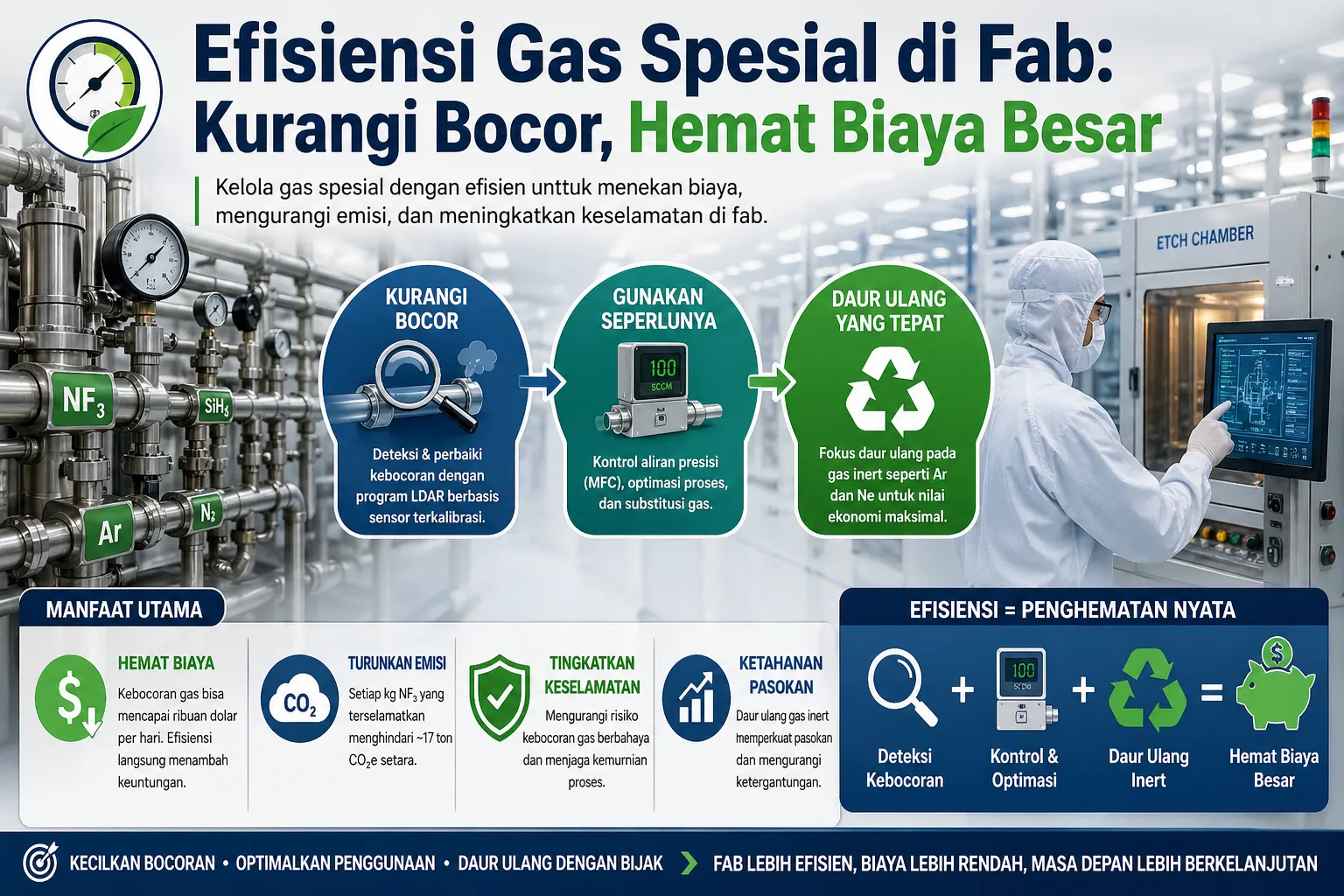
Some gases can be captured and recycled. However, it depends on the chemistry and the purity. Closed‑loop recycling is increasingly viable for abundant inert gases (argon, nitrogen) and for unreactive specialty gases (neon for lasers). TECHCET reports at least one new fab installing hardware to reclaim essentially all exhaust argon. It also notes that SK Hynix and partners are developing systems to recover neon from used KrF/ArF laser assemblages. Samsung plans to begin using recycled gases in production by 2025 (TECHCET).
True recycling is harder for chemically active etch or clean gases. Most fabs destroy exhausted fluorinated gases with abatement (thermal catalysts, wet scrubbers) and do not reuse them. Any recovered gas must be purified to ultra‑high purity (sub‑ppb contaminants) before reuse. A review by Edwards Vacuum (posted in Semiconductor Digest) puts the decision down to value and cost. Recycling a gas with a stable high unit cost or a supply risk can be worth the investment. The benefits are a predictable internal supply, less regulatory permitting and a direct reduction in abatement load. The costs are capital expense, added system complexity and safety considerations (Semiconductor Digest) (Semiconductor Digest).
Niche systems exist. Patents describe adsorber units for NF₃ recovery from exhaust or water scrubbers, to capture HF byproduct for reuse. CF₄ used in some CAB (clean‑room A/C) can be captured from chillers. However, these remain experimental. Current best practice is point‑of‑use abatement. The chamber vent gas is catalytically destroyed (usually converting NF₃ → HF + F₂), so no recoverable output remains. For example, converting 1 kg NF₃ abated yields only innocuous F₂ and N₂. No NF₃ is left to recycle.
The trend still points to more recycling where it is feasible. Gas suppliers and fabs invest together in recovery technology. Besides argon and neon, some suppliers offer reclaimed gases such as recycled helium or specialty mixtures. These cost less in CO₂‑equivalent than virgin gas. In practice, recycling works best for bulk gases, inert gases and byproduct streams. High‑GWP reactive gases need a breakthrough first.
Metrics, markets, and compliance
Progressive fabs track specialty‑gas usage and emissions intensity. For example, some foundries report gas consumption per wafer and normalise GHG intensity in gCO₂eq/MWh or kBOD. Better gas management has already given results across the industry. European fabs cut PFC emissions 42% from 2010–2020 and 54% per wafer (ESIA). Domestic rules may tighten soon. Indonesian law does not explicitly list F‑gases, but any unabated leak counts as a “pollutant discharge” under the environmental statutes. Therefore firms need to control these leaks.
In practice, implementing LDAR and reuse shows measurable outcomes: audits show payback in months, and remaining emissions can be tracked through periodic mass‑balances or sensors. With NF₃ demand projected to rise (+18% in 2024 and 20% CAGR through 2028, per TECHCET), the combination of gas substitution (e.g., NF₃ to F₂, The Elec), advanced flow control (Festo), formal LDAR, and selective recycling (Semiconductor Digest) is becoming table stakes.
Sources and references
Authoritative studies and industry reports underpin the figures above, including EPA guidance (EPA) (EPA); semiconductor industry analyses (Interface EU) (ESIA) (TECHCET) (TECHCET); technical literature (Festo) (Chemical Processing) (Chemical Processing) (Semiconductor Digest) (MDPI). See also: SK Hynix via The Elec.