

Article
Rig water is getting pricey. Drillers are racing to recycle it — or skip it entirely.
Industry: Oil_and_Gas | Process: Drilling
The water budget for hydraulic fracturing has grown a lot. A frac job in the U.S. used about 5,600 barrels of fresh water on average in 2008. By 2014 it used about 128,000 barrels (ogj.com). Even vertical wells need thousands of barrels. Some shale designs use about 100,000 barrels for a single fracture stage drillingfluid.org, and ogj.com reports the same.
The industry also pulls far more water out of the ground than oil. Globally, it produces about 8 barrels of wastewater for each barrel of oil. Regulators are taking notice. In Texas, 2025 wastewater rules could lift disposal costs by about $1 per barrel. In Indonesia, drilling waste and cuttings are classified as hazardous, with strict discharge limits (Permen LH No.10/2010) (onepetro.org).
Closed‑loop recycling on the rig
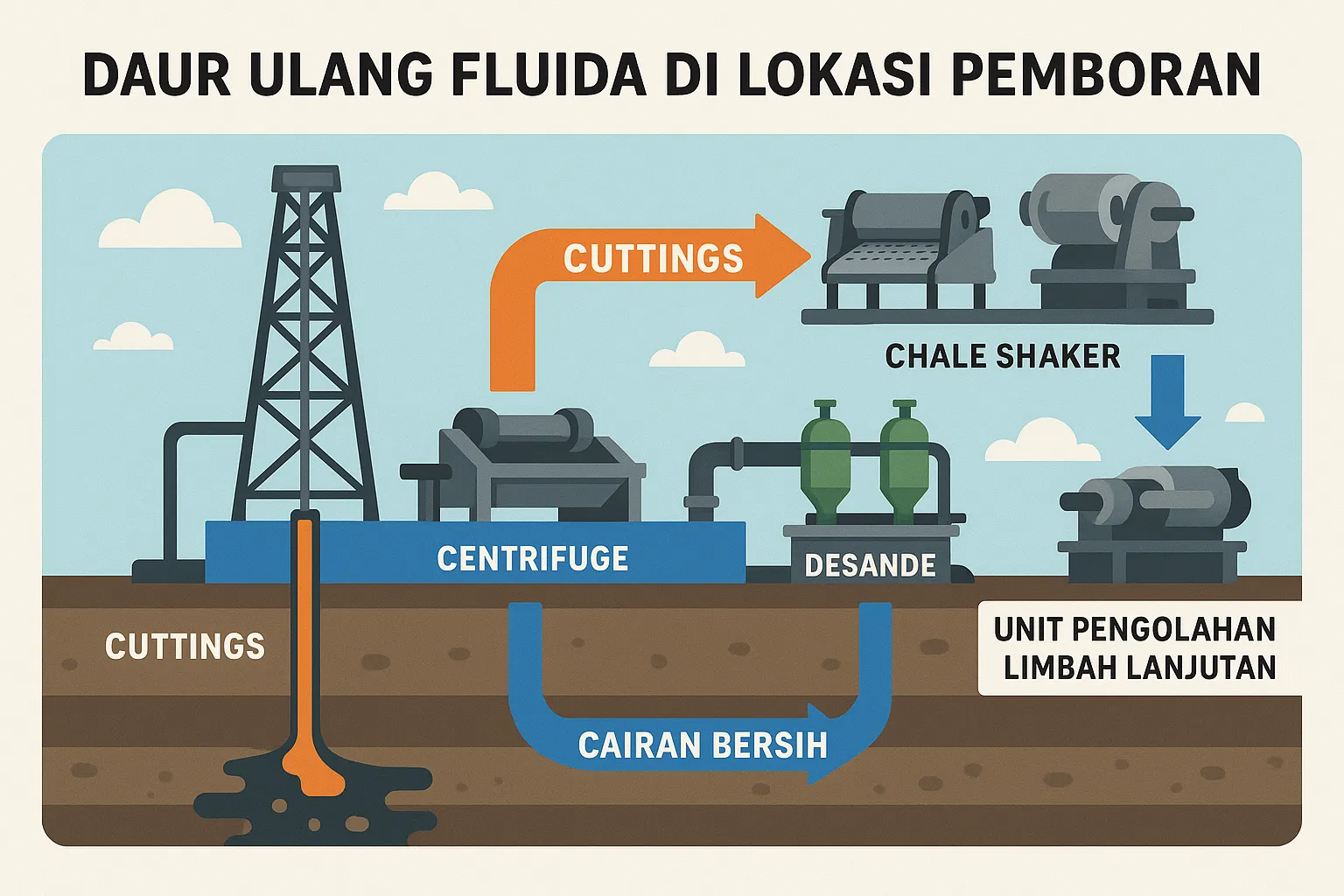
Rigs already circulate and reuse drilling fluids (muds). Solids-control equipment such as shale shakers, decanting centrifuges, and desanders strips cuttings so base fluid can recirculate. Onsite treatment, including belt filter presses and centrifuges, now produces very dry solids (<5% moisture) and recovers clean fluid for reuse (aogr.com). Belt presses originally built for pit cleanup now help reclaim water trapped in cuttings. Therefore rigs can run closed-loop.
Contractors lean on chemistry to speed separation. Flocculants are dosed to aggregate fine solids. Decanting centrifuges then polish the stream, so “clear water” can go back into mud systems or be discharged safely (aogr.com). In practice, that can mean pairing flocculants with accurate chemical feed from a dosing pump. Front-end skids handle screens and primary oil/solids removal via physical separation.
Produced water reuse and mobile RO
In shale completions, reusing recovered flowback/produced water for subsequent frac jobs is increasingly common — and cost‑effective. Analysts report that reusing produced water can cut well costs 30–45%, saving hundreds of thousands of dollars per well (aogr.com; drillingcontractor.org). Yet in 2019, of the ~24 billion barrels of U.S. produced water generated, only ~5% was recycled (drillingcontractor.org).
That gap is where mobile treatment comes in. Operators are putting custom filtration trucks and portable reverse osmosis (RO, a pressure‑driven membrane process) right on the pad. One recent project in Riau, Indonesia, used a containerized high‑pressure RO unit to treat drilling wastewater. It reached about 80% water recovery and effluent under 2,000 ppm TDS (total dissolved solids), which meets discharge standards (suntar.com.sg). A typical pad setup pairs membranes, for example RO, NF, or UF systems, with pretreatment such as ultrafiltration (UF) to protect the RO train.
Indonesia’s Pertamina offers a different twist on reuse. A constructed‑wetland system in the Rokan field cut daily produced‑water discharge by about 36%, from about 11,300 to 7,217 bwpd (barrels water per day).
Water cost arithmetic and disposal risk
Water handling can account for 40–55% of onshore OPEX (operating expenditure), with water also costing 10–30% of drilling CAPEX (capital expenditure) (ogj.com; aogr.com). Typical fresh water is about $0.60/bbl, while trucking and deep‑well injection can run ~$1.50/bbl; recycling at roughly $0.70/bbl is already cheaper than hauling (drillingcontractor.org).
Tighter rules shift the math further. Texas’s 2025 restrictions are expected to raise disposal costs 20–30% and by about $1/bbl in some cases. Therefore onsite reuse becomes even more attractive. Forecasts suggest recycling capacity will expand ~36% per year through 2025. That is far more than the under‑5% annual growth in produced‑water volumes (drillingcontractor.org). One industry analysis put it this way: “the #1 thing” operators can do to cut water costs is reuse more water (drillingcontractor.org). Field deployments usually depend on reliable skids and controls. These are the sort of water‑treatment ancillaries that keep membrane and separation trains online.
Low‑water drilling and fracturing options
Air/gas drilling uses compressed gas (air, nitrogen, or natural gas) instead of slurry mud. In “air drilling,” more than 97% of the circulating fluid is gas, with only small liquid volumes (intechopen.com). The lighter column can speed penetration and almost remove the need for freshwater. It is used in water‑sensitive or collapsed formations. However, it needs specialized equipment and can struggle with hole‑cleaning in deep or sticky clays. New gas recycling systems on rigs aim to capture and reuse circulated gas. Pilot tests are reported to verify >97% gas reuse and cut pollution from venting (intechopen.com).
Foamed and energized fluids (injecting CO₂ or N₂ into the frac fluid) sharply reduce water needs. Baker Hughes’s VaporFrac uses CO₂ foams and reportedly needs only ~10% of the water of a conventional frac (lexology.com). In some cases, energized CO₂/N₂ designs can remove bulk water usage by relying on gas expansion for fracture propagation. Nitrogen foam fracs reduce leak‑off and improve proppant transport. Chen et al. note that adding N₂ or CO₂ reduces or even removes water volumes in frac jobs, which eases field logistics. However, compression and gas costs are higher (aogr.com).
Other “water-free” methods include non-aqueous fracturing. GasFrac’s LPG (liquefied petroleum gas) gel stimulation was proven in the field on about 1,000 wells in Canada and the U.S. It gave a truly waterless frac. However, the company later filed for bankruptcy (lexology.com). Experimental methods include liquid CO₂ slurries or cryogenic fluids. They also include chemical exothermic reactions, such as Chimera Energy’s metal-oxide-based thermal fracking, which cracks rock without water (lexology.com). A related path is wastewater-based fluids. Here you blend or treat saline or low-quality water, including recycled produced water or municipal effluent. This cuts freshwater drawdowns while you manage the chemistry.
Policy signals and field realities
Indonesian upstream operations must meet discharge standards (Permen 10/2010). Permitting also looks closely at water use and spill risks. In the U.S., Texas’s 2025 fracture waste injection rules impose lower pressure and volume limits to protect aquifers. This effectively raises disposal costs by 20–30% and tips the balance toward reuse.
The water challenge is structural in key basins. In the Permian’s Delaware sub-basin, operators face about 6.5 barrels of produced water per barrel of oil (ogj.com). Every barrel of freshwater saved is a direct saving. Treating and reusing water can save tens to hundreds of thousands of dollars per well (aogr.com).
What the next two years look like
A multi‑pronged approach is taking hold. On‑site recycling — mud recirculation, filtration/RO, and closed loops — can reclaim the majority of water and cut fresh‑water make‑up by ~45% or more (ogj.com). Alternative drilling and frac systems — from air drilling to CO₂/N₂ foam — can slash or even eliminate water use in the right formations (intechopen.com; aogr.com; lexology.com). With disposal costs rising and recycling capacity projected to grow ~36% annually through 2025 (drillingcontractor.org), the economics and compliance case for conservation — from Indonesia to the Permian — is increasingly straightforward.
Sources: Peer‑reviewed studies, industry reports, and regulatory documents on drilling fluid management and technology (see citations): ogj.com; aogr.com; drillingcontractor.org; suntar.com.sg; lexology.com; aogr.com.