

Article
Chip Fabs Are Energy Hogs. Smarter Cleanrooms, Efficient Gear, and Heat Recovery Are Cutting Bills by 20–30%
Industry: Semiconductor | Process: Wafer_Fabrication
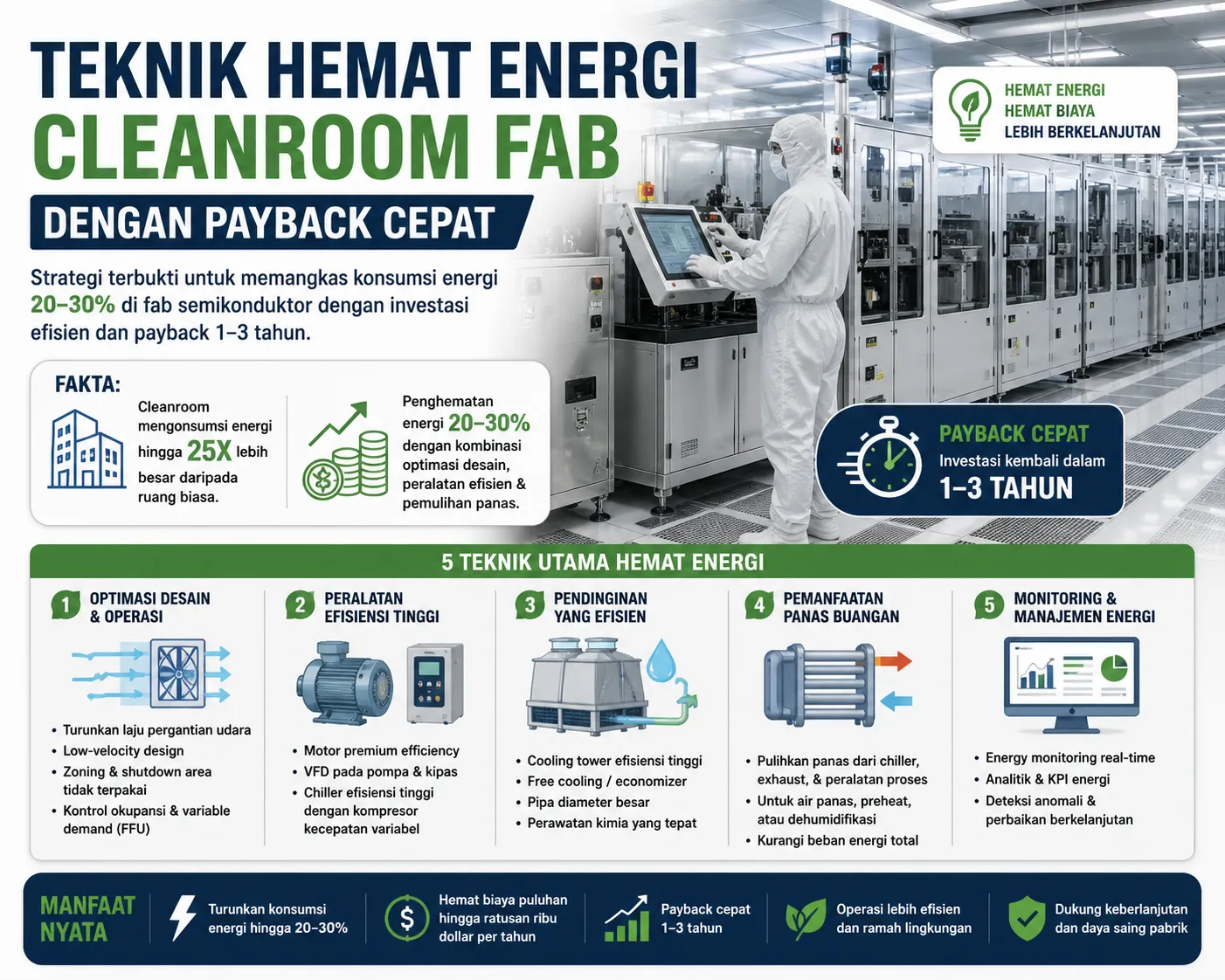
The dirtiest secret in semiconductor manufacturing is not dust. It is energy. Cleanrooms are the controlled spaces that protect yields. They can use about 25× more energy than ordinary building space (Cleanroom Technology). The good news is that fabs are finding big, measurable wins. They redesign air systems, upgrade motors and chillers, and reclaim low‑grade heat. Paybacks are usually counted in months, not decades.
Fan‑wall retrofits save $400,000 per year. Heat pumps make boilers redundant. The playbook is getting sharper. One 300 mm fab in Taiwan modeled a 25.2% facility energy reduction with four targeted measures (ResearchGate). These are not outliers.
Cleanroom airflow and envelope design
Airflow strategy is the lever. If you lower the fan face velocity or reduce the air‑change rates (ACR), fan power drops a lot. A 2004 study found that trimming design ACR by 20% allows a fan size about 50% smaller (Semiconductor Digest). In practice, many fabs now run well below older ISO cleanroom class flow rates and yields are not affected (ISO class: classification of allowable particle counts). Larger filters and coils with slower fans, a low‑velocity design, reduce pressure drops and fan energy.
Cleanroom managers also use re‑circulation. They mix a portion of clean return air with the supply. Recirculating clean return air, for example mixing 50% exhaust with supply, can roughly halve the conditioning load (ResearchGate). Tight construction (high airtightness classes) avoids costly leakage.
Texas Instruments pushed design details further: a two‑story layout, large straight chiller pipes (fewer elbows), and reflective exterior surfaces reduced friction losses and solar heat gain so much that the fab eliminated a major industrial air conditioner (Semiconductor Digest) (Semiconductor Digest).
Variable-demand ventilation and controls
Right-sizing airflow to the task is now standard. Fan filter units (FFUs, ceiling-mounted filtered fans) run at full capacity only during production peaks. They throttle during off-hours. This cuts energy and makes the filter last longer (Semiconductor Digest). Variable-frequency drives (VFDs, speed control for AC motors) and triac controllers (speed control for single-phase motors) have also improved. Therefore even single-phase FFU motors can now vary speed efficiently (Semiconductor Digest).
Fan-wall ventilation helps at part load. One huge fan replaced by an array of smaller fans gives better efficiency across turndown. In one retrofit, two large cleanroom fans were swapped for two nine-fan modules. This saved $400,000/year in electricity, about half the fan energy use (Semiconductor Digest).
Zoning, shutdowns, and setpoints
Zoning cuts idle loads. Keeping clean and dirty zones apart and turning down ventilation in unused areas lowers HVAC demand. At TI, moving some airflow from three‑story bays to two‑story bays cut the cooling load by a large amount (Semiconductor Digest). Automated occupancy controls on exhaust/recirculation dampers and vacuum pumps add savings. One fab saved about NT$317,000/year by duty‑cycling vacuum pumps (ResearchGate).
Higher setpoints help a lot. Raising the chilled-water supply temperature improves chiller COP (coefficient of performance, a ratio of cooling delivered to input power) by more than 1% per °F. A dual-loop chilled-water system can raise overall plant efficiency by about 25%. One loop runs at ~55–65°F for most loads, and a colder loop serves only the hottest tools (Semiconductor Digest). Raising room temperature and humidity within spec also helps. A Korean fab study found that adiabatic humidification (evaporative, not steam) saved 8–23% of HVAC energy against conventional steam humidifiers (MDPI).
Taken together, cleanroom optimization adds up. In a 300 mm fab (Taiwan), four measures cut modeled facility energy use by about 25.2%: regenerative solvent burners, VFD-controlled cooling towers, demand-driven vacuum control, and a heat-recovery coil in the make-up-air unit (MAU) (ResearchGate). Lowering air-change rates and using demand controls usually pay back in 1–2 years. That 20% ACR reduction allows about 50% smaller fans (Semiconductor Digest). Upgraded FFU controls and fan walls give six-figure annual savings, for example $400K/year (Semiconductor Digest).
High‑efficiency equipment and loops
Motors dominate. Continuous-duty electric motors (driving pumps, fans, compressors) can use their entire capital cost in electricity in about a month. Therefore premium-efficiency models, right-sizing and VFDs almost always pay off, even a few percentage points per motor (Semiconductor Digest).
Chillers matter. Let’s say a 1,000‑ton chiller runs at ~70% load. Adding a VFD at $0.05/kWh saves roughly $20–30K per year, and the payback is about one year. VFDs still help below ~95% load (Semiconductor Digest). Use several chilled‑water loops at different temperatures. The “warm” loop runs at ~55–65°F for most loads. The low‑temp loop runs at ~39–43°F for peak HVA/C needs. This raises the overall chiller COP by about 25% (Semiconductor Digest). Free cooling or economizer cooling uses outside air or cooling‑tower water when the weather allows. It can cut chiller energy by an order of magnitude, from roughly 0.5 kW/ton down to ~0.05 kW/ton in cold climates (Semiconductor Digest).
Cooling towers and pumps are good candidates for upgrades. High‑efficiency towers, large‑diameter piping and variable‑speed drives cut consumption and improve the condenser‑water approach. Premium towers with VSDs can improve tower efficiency by about 50–90% compared to older designs, with an approach of only 3–5°F to ambient (Semiconductor Digest). Larger chilled‑water mains, as TI used, allowed much smaller pump horsepower (Semiconductor Digest).
Process cooling is moving to water/glycol loops instead of air. Water carries about 3,300× more heat than air. Therefore process cooling water removes tool heat far more efficiently, and heat recovery becomes easier (Semiconductor Digest).
Lighting is a smaller slice in fabs, but auxiliary systems count. All compressors, chillers, HVAC, ultrapurified water, and chemical‑abatement systems should be selected for efficiency. I/O and metering via smart BMS (building management system) can optimize setpoints and use predictive scheduling to trim wasted runtime. For ultrapurified water (DI/RO), equipment spans reverse osmosis stacks such as integrated RO, NF, and UF systems and deionization technologies like EDI (electrodeionization). Pretreatment steps usually include ultrafiltration ahead of RO and, where membranes are specified, RO membranes designed for high‑purity duty. Some facilities also deploy ultraviolet disinfection in ultra‑pure loops.
The paybacks add up: ~$20–$30K/year per chiller (Semiconductor Digest), ~$400K/year per fan improvement (Semiconductor Digest), and multi‑ten‑thousand‑dollar gains per retrofitted compressor or tower; upgrading motors and drives alone often pays for itself in months (Semiconductor Digest).
Heat recovery and reuse
Fabs throw off enormous low‑grade heat. Intel and peers use “intensive heat recovery”: capturing reject heat from chillers and compressed‑air aftercoolers and routing it into plant heating. In one fab, chlor‑peak cooling (12,000 refrigeration tons) and large compressors generated so much thermal energy that boilers were no longer needed for most HVAC and ultrapurified‑water (DI/RO) heating loads (ASHRAE). Practically, this is done by running chillers as heat pumps or adding plate heat exchangers on condenser loops. ASHRAE reports a retrofit where re‑piping compressors into the warmer chilled‑water return (instead of cold supply) and other heat‑reuse steps cut the site’s gas and water use and carbon footprint by a large margin (ASHRAE) (ASHRAE).
Gas handling is another win. Many processes oxidize exhaust that carries solvent or VOC (volatile organic compound). Direct-fired burners can be replaced by regenerative thermal oxidizers, which recover heat to preheat the incoming air. This can save large fuel costs. In a Taiwanese 12″ fab, a heat-recovery oxidizer for organic exothermic processes saved about NT$9.88M (~$300K) per year (ResearchGate).
On the air side, heat exchangers in the make-up-air unit (MAU) can recapture exhaust heat. Adding a run-around coil in the MAU saved NT$1.74M/year (~5×10^5 kWh or ~$55K) in the Taiwan study (ResearchGate). Even a small fraction of exhaust heat (say 50–60%) recovered back into incoming air can cut the heating load by the same fraction (MAU/ERV, energy recovery ventilation).
Process heat can be reused too. Exothermic tool heat can go to nearby processes or to pre-heating rinse water, and this reduces steam demand. In Europe, one fab reclaims more than 88% of evaporator heat for other purposes. This is an example of the chip industry’s circular economy (ASML) (Financial Times).
When combined, these steps give a large saving. One analysis showed about 25% total energy reduction when heat recovery and efficiency measures were applied together (ResearchGate). Each recovered kWh of heating offset is one less kWh burned. That usually saves tens or hundreds of thousands of dollars per year.
Policy and regulatory context (Indonesia)
Indonesia’s policy environment already points fabs toward this toolkit. The national Green Industry initiative highlights that “green industry gives many benefits, including reducing operating costs via energy and water savings” (Antara News). Government Regulation No.33/2023 (Energy Conservation) mandates efficient technologies and rational energy use across industries (Antara News).
A new ministerial regulation (Permen ESDM No.8/2025) requires structured energy‑management programs (ISO 50001 style) in energy‑intensive facilities (SIP Law Firm). In practice, future fabs would be expected to implement ISO 50001 systems, energy audits, and projects like the “BENEFITS” program to reach 70–80% readiness in energy management (Antara News) (SIP Law Firm).
Bottom‑line outcomes and sources
Across fabs, optimized cleanrooms, high‑efficiency systems, and heat recovery have proven savings potential. Comprehensive retrofits often yield 20–30% cuts in facility energy with 1–3 year paybacks; single actions—like a 1,000‑ton chilled‑water loop upgrade or a fan‑wall retrofit—can save roughly $20K–$400K per year (Semiconductor Digest) (Semiconductor Digest). Facility‑wide, these strategies reduce energy intensity and carbon emissions by similar percentages, strengthening profitability and sustainability (ResearchGate) (Cleanroom Technology).
The data and examples above are drawn from industry studies and case reports: Cleanroom Technology, Semiconductor Digest, ResearchGate, ASHRAE, and Financial Times.