

Article
Fix Fabs Face Wild Wastewater Swings: Big EQ Tanks and Smarter Sensors
Industry: Semiconductor | Process: Fluoride_&_Heavy_Metal_Wastewater_Treatment
At modern chip plants, the volumes are staggering. A 300 mm wafer fab can use on the order of 10 million gallons (~38,000 m³) of ultrapure rinse water per day (hach.com). Not all of that becomes wastewater, but the scale is clear: TSMC alone reported consuming 101 million m³ of water in 2023 (idtechex.com).
The pollutants are just as unforgiving. Fluoride from HF etching usually shows up in the hundreds to thousands of mg/L (link.springer.com). Heavy metals such as Ni, Cu, Cr, Zn, and Pb can reach tens to hundreds of mg/L. One Indonesian plating plant had about 88–122 mg/L Ni in its effluent, far above the discharge limits (pmc.ncbi.nlm.nih.gov). High-strength batches come and go, from end-of-line washes to maintenance dumpings. They cause “extreme fluctuations” in flow, pH, and metal load (nepis.epa.gov).
Without buffering, one concentrated discharge can overwhelm the neutralization or precipitation steps. Therefore the process upsets and the permit is at risk.
Equalization tank as primary buffer
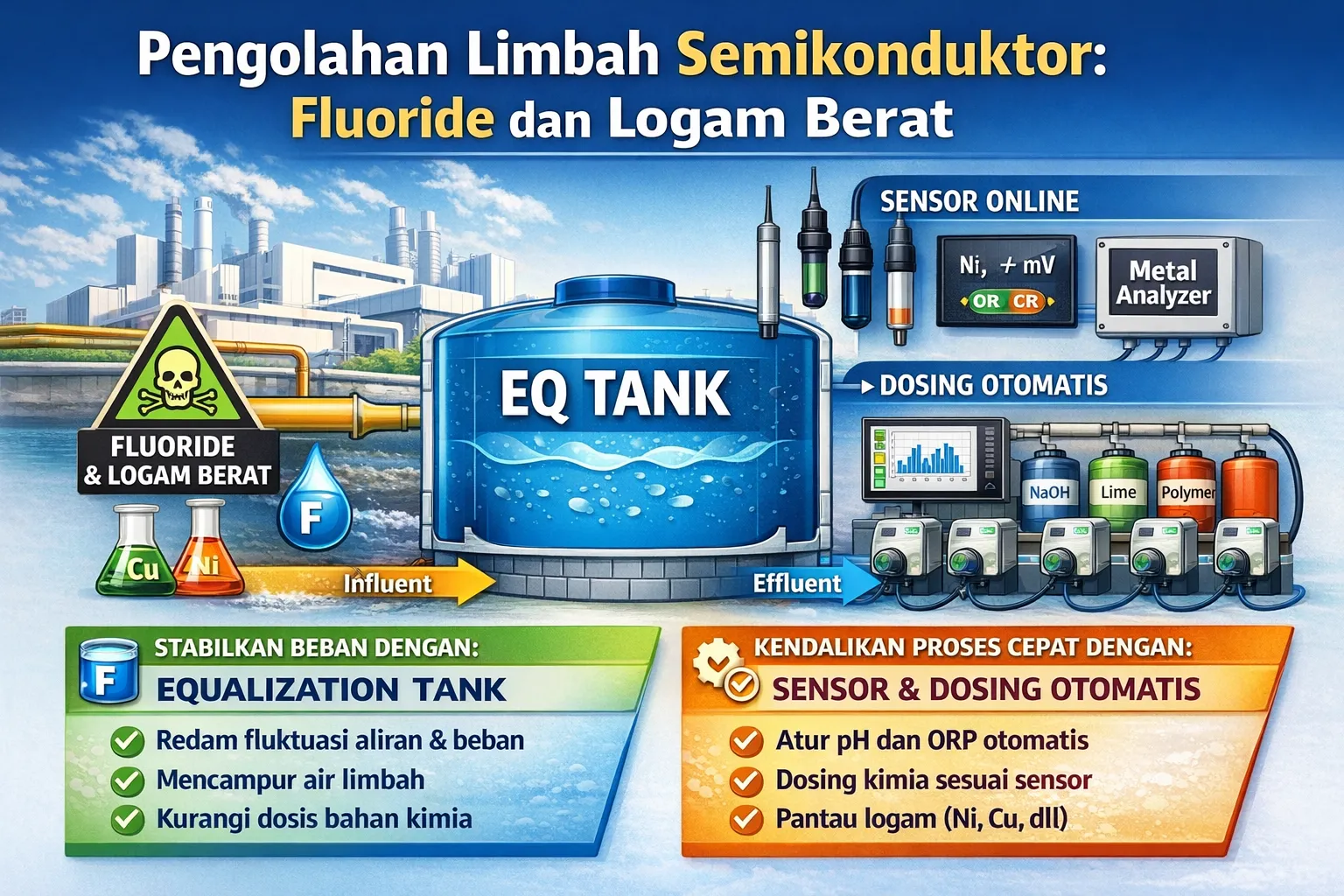
An equalization (EQ) tank is a mixed basin ahead of treatment. It levels both flow and concentration. The U.S. EPA’s metal-finishing field manual defines three tasks: (1) flow equalization to damp hydraulic surges, (2) concentration equalization by mixing high- and low-strength streams, and (3) load control to cap spill-through (nepis.epa.gov; nepis.epa.gov).
In practice, fabs size EQ for the largest surge they expect. Let’s say a cleaning step dumps 1000 m³ at 1000 mg/L F⁻ over 8 hours. A basin with ~24 hours of hydraulic retention time (HRT, the average time water remains in a tank) then releases diluted, steady flow over a day. Proper mixing prevents dead zones and short-circuiting. Turbulent motion keeps solids in suspension (nepis.epa.gov; nepis.epa.gov). Design guides usually cite mixers at ~0.02–0.04 HP per 1000 gal to keep the tank homogeneous (nepis.epa.gov). These mixers usually come packaged with ancillary equipment such as seals, drives, and mounting skids. Plants source these as part of wastewater ancillaries.
EQ tanks also save chemicals. By smoothing extremes before neutralization, operators avoid dosing to worst-case slugs; EPA notes an upstream “smoothing vessel” with enough residence time can “save reagent” in neutralization tanks (nepis.epa.gov).
Online sensors and PLC/SCADA control
Real-time instrumentation turns EQ into a responsive system. Continuous pH probes (acidity/alkalinity) and ORP electrodes (oxidation-reduction potential) feed PLC/SCADA control loops (programmable logic controllers with supervisory control and data acquisition). These loops adjust chemical addition via PID (proportional–integral–derivative) logic. In chromium removal, holding ORP at a setpoint (for example, +350–400 mV at pH 9.5–10) gives near-complete reduction in short residence times (nepis.epa.gov). For cyanide, an ORP of about +600 mV at pH >11 is cited as the best value (nepis.epa.gov).
You can now monitor heavy metals online. Continuous colorimetric and spectrophotometric analyzers track Cu, Ni, Fe and others. One example is a Cogent OVA5000 on-line heavy-metal analyzer, used to monitor trace arsenic in drinking water (environmental-expert.com). Industry reporting points to a “significant shift toward real-time monitoring of industrial wastewater,” made possible by sensors and automation (azom.com). You can track fluoride with ion-selective probes or on-line ion chromatography. This lets you control lime and alum to precipitate CaF₂ (calcium fluoride). Automated loops meter reagents through an accurate dosing pump. The feed is scaled within minutes to match incoming spikes.
Automated dosing and removal efficiency
Automation has removed the delays of manual, off-line testing. One technical review concluded that modern dosing “effectively addressed” the historical lags and now allows a rapid response (azom.com). In practice, if influent Ni or Cu spikes, the control loops increase precipitant (for example hydroxide or sulfide) and polymer feed to hold the targets. pH-controlled coagulant dosing helps avoid overfeed and downstream pH swings. It works together with process chemicals such as coagulants and, where appropriate, flocculants.
The outcomes can be measured. Bench and plant studies have reported >99% removal when pH and ORP are held precisely. A combined coagulation and ultrafiltration (UF, a pressure-driven membrane process) approach on CMP wastewater reached 92.9–99.7% fluoride removal (link.springer.com). This configuration fits directly with industrial membrane pretreatment through ultrafiltration. Another study reported 99.75% Ni removal under optimized conditions (pmc.ncbi.nlm.nih.gov).
Compliance, monitoring frequency, and costs
Regulation pushes toward continuous vigilance. Indonesia’s Permen LH 03/2010 (for industrial estates) needs industrial IPALs to “monitor parameters (including pH and COD) daily” and correct any noncompliance (harumtirtajaya.com). Globally, fabs face strict discharge standards. These are usually microgram-per-liter levels for heavy metals and single-digit mg/L for fluoride. Therefore continuous control is needed to stay within limits.
EQ plus real-time control smooths operation, reduces upsets and cuts cost. Equalization reduces the peak treatment capacity you need. It can also “save reagent” by avoiding worst-case chemical dosing (nepis.epa.gov). Online monitoring cuts labor-heavy off-line tests and catches excursions earlier. Industry trend reporting links real-time analyzers with better efficiency and fewer noncompliance penalties over time (azom.com).
Integrated strategy and expected performance
The playbook is consistent: pair sufficient equalization storage with continuous monitoring and automated dosing. The EQ tank — sized for the largest anticipated surge — levels flow and concentrations (nepis.epa.gov). In parallel, a sensor suite (pH, ORP, conductivity, and specific metals) feeds feedback control for immediate adjustments to influent swings (azom.com; environmental-expert.com). This integrated approach has been shown to achieve >99% removal of fluoride and metals (link.springer.com; pmc.ncbi.nlm.nih.gov), keep effluent within limits, and optimize chemical usage — aligning performance with bottom-line savings.
Reference URLs and sources embedded above include: EPA equalization and control guidance (nepis.epa.gov; nepis.epa.gov; nepis.epa.gov; nepis.epa.gov; nepis.epa.gov; nepis.epa.gov), industry trend analyses (azom.com), real-time metals monitoring (environmental-expert.com), semiconductor water use context (hach.com; idtechex.com), fluoride and CMP treatment performance (link.springer.com; link.springer.com), nickel loading and removal (pmc.ncbi.nlm.nih.gov; pmc.ncbi.nlm.nih.gov), and Indonesian regulatory overviews (harumtirtajaya.com).
Other products for implementation are referenced above. These include accurate chemical dosing, ultrafiltration for membrane-based polishing consistent with the cited study, and supporting equipment via wastewater ancillaries. Process chemicals such as coagulants and flocculants are also available.
Sources: Peer‑reviewed journals and industrial reports — Applied Water Science review (link.springer.com; link.springer.com), Heliyon case study (pmc.ncbi.nlm.nih.gov; pmc.ncbi.nlm.nih.gov), EPA guidance (nepis.epa.gov; nepis.epa.gov), industry analyses (hach.com; idtechex.com; azom.com), and Indonesian regulatory context (harumtirtajaya.com).