

Article
Chip fabs are drowning in fluoride. The fix is calcium, a tight pH window — and a plan for all that sludge
Industry: Semiconductor | Process: Fluoride_&_Heavy_Metal_Wastewater_Treatment
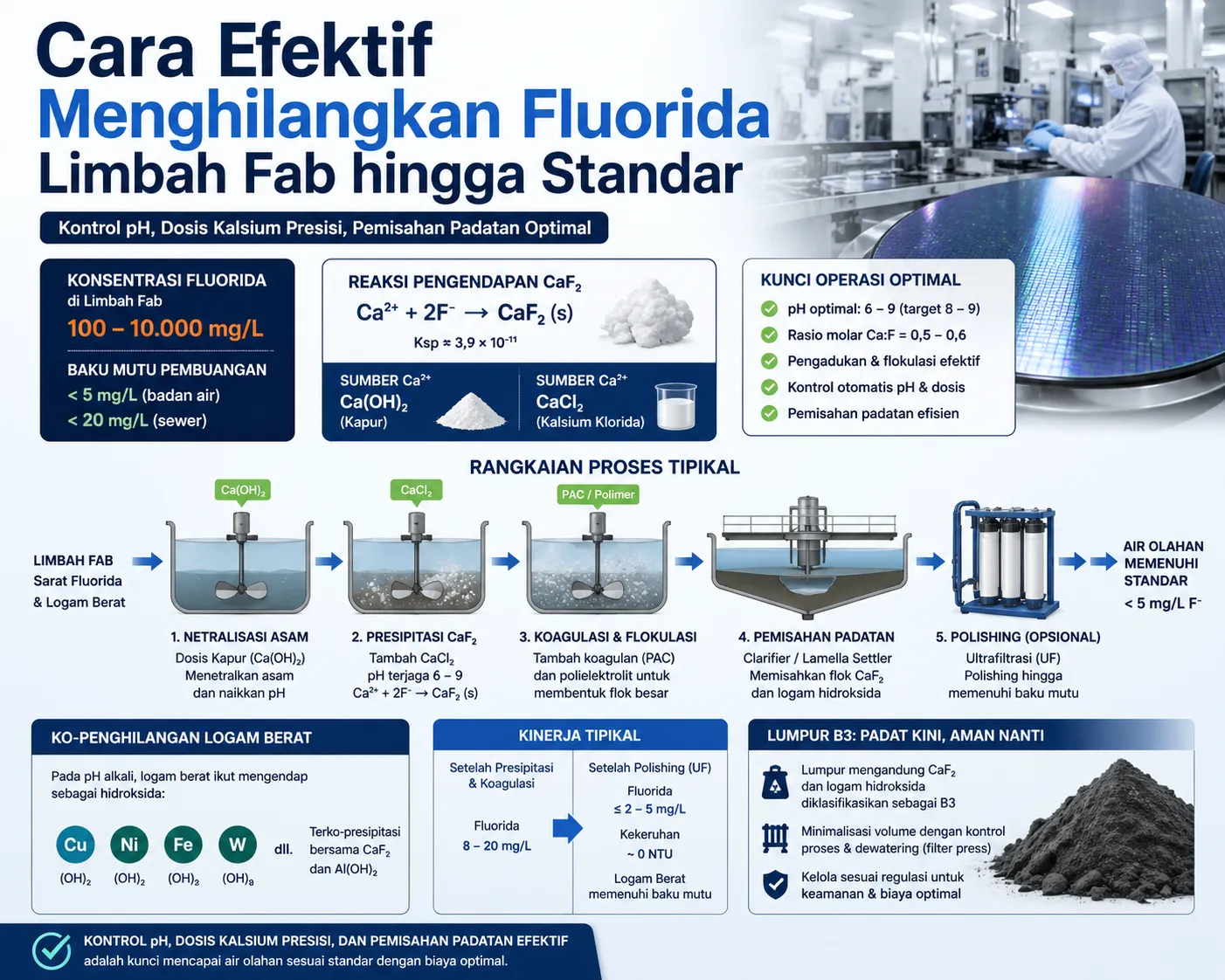
In the microelectronics industry, rinse water from hydrofluoric acid (HF) etches carries fluoride. It usually measures in the hundreds to thousands of mg/L (milligrams per liter). Industry guidance puts the typical range at about 100–10,000 mg/L (www.saltworkstech.com).
Regulators demand far less. Sewer limits are usually below 20 mg/L and aquatic discharge limits are below 5 mg/L. In some jurisdictions they are even below 2 mg/L (www.saltworkstech.com) (www.sciencedirect.com). Heavy metals including tungsten (W), copper (Cu), nickel (Ni), and silver (Ag) are frequent co-contaminants. Treated semiconductor effluents have been observed with dissolved tungsten up to ~0.4 mg/L, far above natural background, alongside elevated Cu, Ga, Ag, etc. (www.sciencedirect.com). Indonesia’s Permen/PP standards also restrict heavy metals to µg-levels (micrograms per liter) and fluoride to low mg/L. Therefore the treatment has to remove both.
The standard response on the fab floor is to precipitate fluoride as calcium fluoride (CaF₂) with lime or calcium chloride, dial in pH, then separate the fine solids. Also prepare for a lot of sludge.
Calcium fluoride precipitation chemistry
The primary industrial approach is CaF₂ precipitation using calcium salts. Calcium ions (Ca²⁺) react with fluoride (F⁻) to form poorly soluble CaF₂ according to Ca²⁺ + 2 F⁻ → CaF₂(↓). The solubility product is Ksp≈3.9×10⁻¹¹ (Ksp is the equilibrium solubility product constant) (pubs.acs.org).
Lime (Ca(OH)₂) neutralizes acid and supplies Ca²⁺. CaCl₂ supplies Ca²⁺ without strongly shifting pH. High-fluoride loads usually use both: lime to neutralize pH, plus CaCl₂ to make sure soluble Ca²⁺ is available. In practice, a molar Ca:F ratio around 0.5 (stoichiometric for CaF₂) to ~0.6 works best. One industrial case treated 1,800 mg/L F⁻ with CaCl₂ at Ca:F = 0.5 and pH ≈8.5. It reached 99.5% removal and ~10 mg/L F⁻ effluent (pubs.acs.org). Lab work shows the same: the best Ca/F is around 0.6. Sinharoy et al. (2024) reported ~85% removal at Ca/F ≈0.6, with little improvement beyond that (www.mdpi.com).
pH control is important. If the pH is too low (below about 3–4), much of the fluoride is undissociated HF (pKa≈3.2, where pKa is the acid dissociation constant) and precipitation is suppressed. At very high pH, hydroxide competes and Ca²⁺ tends to form Ca(OH)₂ or CaCO₃ instead of CaF₂ (www.mdpi.com). A moderately alkaline pH (usually pH 6–9) is best. One study showed removal rose with pH up to about 6 and then fell (81.8% at pH 6, lower at pH >8 because Ca(OH)₂ forms) (www.mdpi.com). Industrial systems usually target pH about 8–9 to get the most F⁻/Ca²⁺ precipitation and floc growth (pubs.acs.org) (www.mdpi.com).
Mixing, coagulation, and solids separation
CaF₂ crystals are very fine and settle slowly (www.saltworkstech.com). Settling alone usually leaves tens of mg/L F⁻. Chang & Liu (2007) found that Ca:F=0.5 at pH 6.5–8.5 could reduce F to ~15 mg/L. However, more flocculants were needed to settle the CaF₂ fully: poly‑aluminum chloride (PAC) or organic polyelectrolytes (www.researchgate.net).
Industry guidance points to a two-step approach. First, lime/CaCl₂ dosing precipitates most of the fluoride (effluent ~8–20 mg/L). Then an aluminum-based coagulant polishes it below 5 mg/L (www.saltworkstech.com). Plants usually dose an aluminum coagulant such as PAC with a controlled dosing pump, then add polymers from flocculants to improve capture.
Because the fine CaF₂ and Al(OH)₃ flocs settle slowly, sedimentation can demand long detention times and large tanks (www.saltworkstech.com). High-rate clarification with a clarifier or a compact lamella settler can shrink footprint. Modern designs also apply membrane filtration; in one report, combined precipitation–UF (ultrafiltration) achieved final F ~2 mg/L with turbidity ~0 NTU (www.sciencedirect.com), aligning with cross-flow options like ultrafiltration. Over‑dosing lime or coagulant, however, inflates wet sludge volumes (www.saltworkstech.com).
Control strategy: pH and calcium dose
Small deviations in calcium dose can swing removal yields. In one trial, raising Ca/F from 0.5 to 0.6 increased removal from ~82% to ~85% (www.mdpi.com). In one industrial case, Ca:F=0.5 and pH 8.5 gave 99.49% F removal (pubs.acs.org).
Automated pH control and titration-dosing of calcium sources are recommended to hit this narrow optimum and avoid excess reagent use (www.saltworkstech.com) (www.mdpi.com). Plants deploy instruments and metering through dosing pumps, and vendors note that integrated controls can avoid overdosing and large footprints (www.saltworkstech.com) (www.saltworkstech.com).
Chemically, rough dosing ranges are 2–5 g of lime or 3–7 g CaCl₂ per liter of high‑fluoride water (scaling with [F⁻]). For example, reducing 1,800 mg/L F⁻ to ~10 mg/L at Ca/F=0.5 might use ≈5–6 g/L CaCl₂ (pubs.acs.org). With proper controls, >90–99% fluoride removal is routinely reported (pubs.acs.org) (www.mdpi.com).
Heavy‑metal co‑removal and pH profile
Alkaline pH also precipitates many metals as hydroxides, for example Cu(OH)₂, Ni(OH)₂ and Fe(OH)₃. Therefore the CaF₂ scheme “removes other contaminants such as … cadmium, copper, chromium, lead, mercury, and zinc” (www.saltworkstech.com). Wastewaters from CMP and plating in fabs can carry metals at µg–mg/L levels. Dissolved tungsten around 300–400 µg/L has been reported (www.sciencedirect.com).
In practice, we first hold the pH at 7–8 and dose calcium. This traps the fluoride. We then raise the pH to 9–10 with excess lime, which may co-precipitate the residual metals. Over-liming gives less and less back. It increases the sludge and the cost (www.saltworkstech.com).
System train and performance outcomes
A typical train runs acid neutralization (lime dosing) → CaCl₂ addition (with pH maintained) → mixing/flocculation → solids separation → optional polishing. In large plants, automated feedback dosing (e.g., online F sensors) helps avoid “overdosing and large footprint” drawbacks of open‑loop systems (www.saltworkstech.com) (www.saltworkstech.com). Semiconductor operations need fluorides and therefore face these treatment steps — precipitation, coagulation, and solids separation — as documented in a BNRC 2022 review (bnrc.springeropen.com) (bnrc.springeropen.com).
Conventional Ca precipitation usually drives fluoride only to ~5–20 mg/L (www.saltworkstech.com). Therefore polishing is common. Aluminum coagulants like PAC can push below 5 mg/L. Where needed, plants add membrane polishing with RO systems. Vendors also offer integrated RO, NF, and UF systems for industrial reuse and discharge quality.
Sludge management and disposal
The precipitated CaF₂ sludge is voluminous and water-rich. Treating wastewater with 500–1000 mg/L F⁻ stoichiometrically yields roughly 1–3 g of CaF₂ solid per liter removed. This fine sludge usually holds >90% moisture. It also contains residual hydroxides and adsorbed metals.
Where heavy metals are present, CaF₂ sludge is classified as hazardous (B3) under Indonesian rules (similar worldwide) and shows heavy‑metal leaching risk. Therefore it needs stabilization (www.researchgate.net). Without treatment, disposal risks groundwater contamination (for example Zn, Ni) and incurs high costs. Dewatering via filter press is needed but difficult. The sludge is gelatinous and poorly dewaters, and conventional thickening is inefficient (www.saltworkstech.com).
Cross-flow UF and ballasted sedimentation can reduce the volume (www.saltworkstech.com). These options fit with membrane choices like ultrafiltration and with dewatering aids under sludge treatment programs. Some plants have looked at reuse. CaF₂‑bearing sludge can go into ceramics or cements, and the high temperature fixes the fluoride and the heavy metals. One example is cement solidification with <10% sludge, which immobilizes the metals and gives structural products (www.researchgate.net) (www.researchgate.net). In practice, most plants send the sludge to licensed hazardous landfills. Some challenges remain. The final stack solids need to meet the leachability standards. The sludge volume needs to stay low. The cost of the desfluoridation byproduct needs to be managed.
Process summary and limits
Lime and/or CaCl₂ precipitation is the main way to remove fluoride from semiconductor wastewater. With pH kept at about 6–9 and a Ca:F ratio of about 0.5–0.6, fluoride removal of >90–99% is routinely reported (pubs.acs.org) (www.mdpi.com). Conventional calcium precipitation usually brings fluoride down to about 5–20 mg/L (www.saltworkstech.com). To meet low limits (for example <5 mg/L), the plant needs careful control or a second polishing step, with aluminum coagulants and, where needed, RO polishing. Heavy metals co-precipitate with the CaF₂ flocs. This helps compliance, but it makes the sludge hazardous. Fine CaF₂ slurry that carries metals is the main lifecycle cost. It has to be dewatered and stabilized (thermal, cement, or engineered landfill). These steps match the precipitation, coagulation and solids separation flowsheets reviewed for semiconductor wastewater (bnrc.springeropen.com) (bnrc.springeropen.com).
Modern systems emphasize tight chemical control and enhanced solids separation — high‑rate clarifiers, lamella separators, or membrane filtration — to minimize sludge volume (www.saltworkstech.com) (www.saltworkstech.com). With those controls, treatment trains can reliably meet stringent limits, including <5 mg/L fluoride (pubs.acs.org) (www.saltworkstech.com).
References
Semiconductor wastewater often contains 100–10,000 mg/L F (www.saltworkstech.com); precipitation at Ca:F≈0.5 stoichiometry (pH≈8–9) yields ≈99% removal (pubs.acs.org) (www.mdpi.com); standard process yields ~8–20 mg/L F before polishing (www.saltworkstech.com). The calcium fluoride precipitation and coagulation steps produce large sludge volumes and require enhanced separation (www.saltworkstech.com) (bnrc.springeropen.com). Fluoride sludge is hazardous with heavy‑metal leaching risk and must be stabilized (www.researchgate.net). Additional citations: Zhou et al. 2023 (ACS EST Water) (pubs.acs.org); Sinharoy et al. 2024 (IJMS) (www.mdpi.com); Saltworks white paper (2019) (www.saltworkstech.com) (www.saltworkstech.com); Chang & Liu 2007 (J. Environ. Eng.) (www.researchgate.net); BNRC 2022 review (bnrc.springeropen.com) (bnrc.springeropen.com); Wei et al. 2011 (J. Hazard. Mater.) (www.sciencedirect.com).