

Article
Power plants are rewriting the rulebook on ultra‑pure water. Here’s the RO‑plus‑UF playbook engineers are deploying now.
Industry: Power_Generation_(HRSG) | Process: Demineralization_Plant_(RO
Combined‑cycle gas turbine (CCGT) sites with heat recovery steam generators (HRSGs) now live or die by water purity. High‑pressure boilers often require “more than 99% of dissolved ions” removed from feedwater (power-eng.com), a standard rooted in the fact that impurities—cations, anions, silica, organics, and dissolved gases—must be nearly completely stripped away (watertechnologies.com; power-eng.com).
In practice, that means resistivity on the order of 1 MΩ·cm (i.e., conductivity <1 µS/cm) or better, with cation conductivity <0.2 µS/cm for ultra‑high purity—essentially “no TDS” water (erunwas.com; power-eng.com). The stakes are real: suspended solids foul reverse osmosis, calcium/magnesium with bicarbonate or sulfate form scale, and high chloride can pit stainless steels (power-eng.com). Even trace iron is especially harmful—boiler feedwater must have essentially zero residual iron to prevent corrosion (sdewes.org).
Raw water changes. Surface supplies, groundwater or treated effluent can swing with the seasons and with storms. Therefore the design has to handle worst-case turbidity spikes and chemistry swings.
Pretreatment sequence and targets
Pretreatment protects RO and ion exchange (IX) from turbidity, particulates and organics. A standard sequence is coagulation/flocculation → sedimentation/clarification → multimedia filtration → cartridge or membrane filtration. Surface water coagulated with about 30 mg/L polyaluminum chloride (PAC) plus an anionic polymer flocculant at optimized pH has shown more than 99% solids removal, with turbidity below 1 NTU (sdewes.org).
Plants usually install a clarifier after dosing. A dosing pump usually feeds the coagulant, so the feed rate stays stable when the raw water changes.
When PAC and polymer are used, operators may standardize on a coagulant such as polyaluminum chloride (PAC). Polymer is usually added as flocculants to tighten the floc and improve settling.
Clarifier effluent moves to media filtration. Well‑designed rapid sand or multimedia filters (anthracite over sand) routinely polish to ~0.5–1.0 NTU (power-eng.com; sdewes.org), and an optimized clarification/filtration train can deliver ≤0.5 NTU with cartridge changeouts extending to ~3 weeks (power-eng.com). Media selection often includes sand media and, for multilayer beds, durable anthracite.
Membrane prefilters are replacing or adding to media beds more and more. Ultrafiltration (UF) or microfiltration (MF) modules have pores of 0.1–0.2 µm. They usually bring turbidity down to 0.02–0.1 NTU and SDI to about 2, even when the feed changes (power-eng.com). In one documented swap, sand was replaced with MF. Turbidity dropped from ~0.5 NTU to ~0.03 NTU, and 5–10 µm cartridge life went from 3 weeks to 3 months (power-eng.com). Therefore many CCGT auxiliaries now specify ultrafiltration upstream of RO.
The RO feed guidelines are clear: turbidity <1 NTU, SDI(15)<3, TSS<1 mg/L, iron <0.05 mg/L, TOC<5 mg/L (power-eng.com). Any residual oxidant must be neutralized before the membranes. Dechlorination is usually done with a dechlorination agent.
Immediately ahead of the primary demin step, plants insert cartridge filters (5–25 µm nominal). Standard 5–10 µm polyester cartridges are often rated for 100–1,000 gpm each, with monthly changeouts depending on upstream performance (power-eng.com; power-eng.com). Where sanitary or corrosion‑resistant hardware is required, plants pair these elements with stainless cartridge housings.
Ion exchange demineralization
Traditional two-bed IX runs a sodium-form cation resin, then a hydroxide-form anion resin. H⁺ released from the cation bed and OH⁻ from the anion bed combine to form water (watertechnologies.com). For very high purity, a final mixed-bed is added. It pushes removal of residual ions to ≥99.99% and reaches low-µS/cm or sub-µS levels [26†L49‑L57]. Plants that specify packaged systems usually reference a complete ion exchange system for this duty.
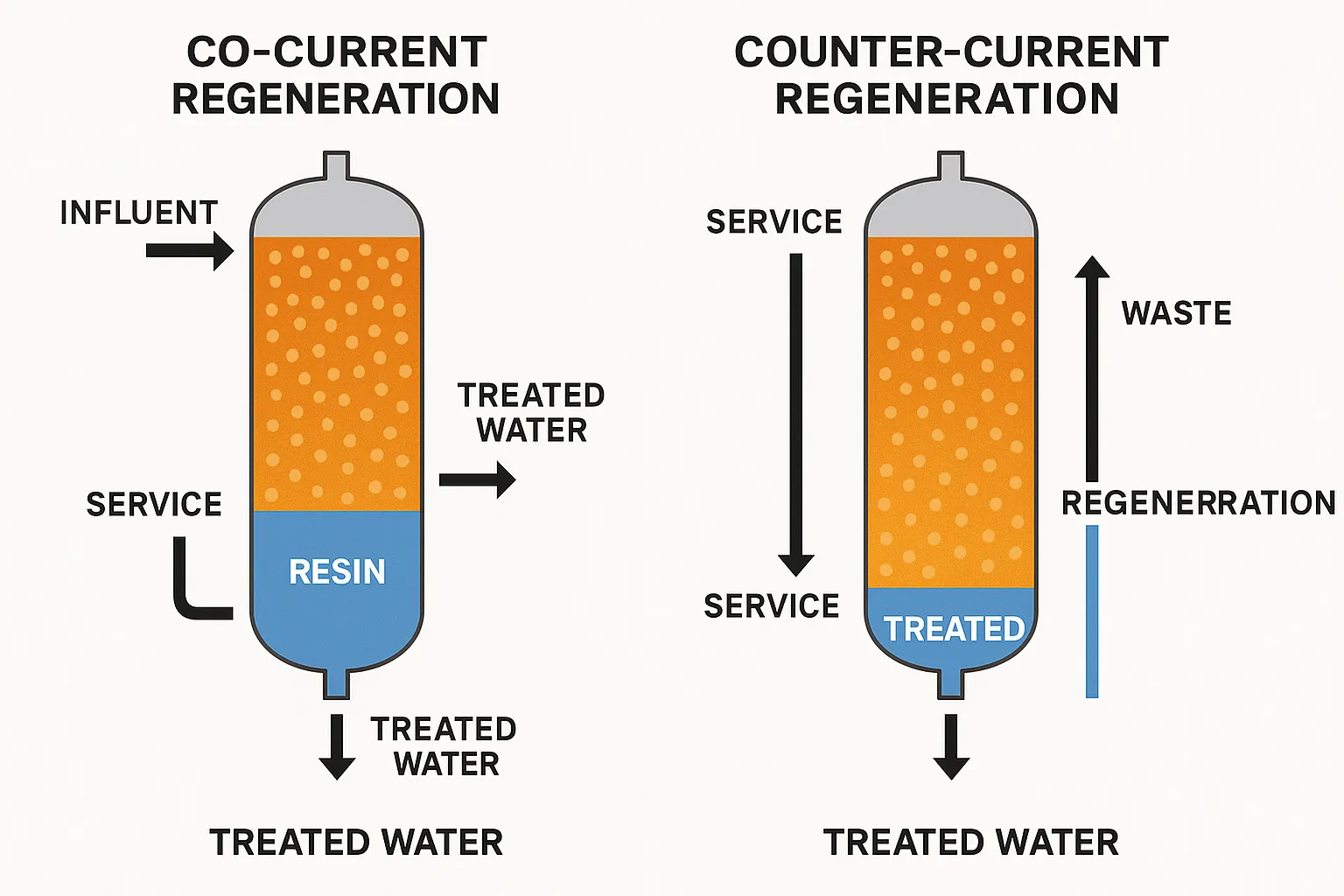
Regeneration uses a lot of chemicals. Cation resins use strong acid (usually H₂SO₄) and anion resins use strong base (NaOH). On moderately high TDS waters, two-bed trains may regenerate weekly or less. Adding RO upstream can extend runtime roughly tenfold and “greatly reduce the loading on the IX resins, lowering regeneration frequency and improving reliability” (power-eng.com). Resin selections are usually drawn from strong/weak cation/anion resins depending on feed chemistry.
Quality isn’t the bottleneck. With a two‑bed followed by mixed‑bed polish, plants routinely produce 10–20 MΩ·cm (≈0.05–0.1 µS/cm) water (erunwas.com; power-eng.com), meeting the HRSG expectation that “nearly complete removal of all ions, including carbon dioxide and silica, is required” (watertechnologies.com). For packaged deployments, a demineralizer with both strong and weak resins is standard.
The trade-offs are waste and handling. Spent regenerants (acidic and caustic brines) must be managed. However, IX capital is modest and the footprint is small. Therefore it remains common at low flows. For hard groundwater pretreatment, some plants use a separate softener ahead of IX to control hardness loading.
Reverse osmosis as primary demin
Over the last two decades, many CCGT sites have shifted to RO as the primary demineralizer with a small mixed‑bed polish. “In the last 20 years, roughly 70% of new power plant water treatment systems use RO+MB” instead of all‑IX (power-eng.com).
The case rests on removal, OPEX, and safety. Single‑pass RO typically removes ~95–99% of dissolved solids in the permeate (power-eng.com)—“product has approximately 99% of dissolved ions removed” (power-eng.com)—while eliminating onsite acid/caustic regenerants. Plants report chemical savings on the order of $200,000/year after switching to UF+RO ahead of mixed‑beds (power-eng.com).
Designs usually specify a brackish train at 15–30 bar feed pressure with 75–85% recovery. The concentrate is 20–25% of feed (power-eng.com). At 80% recovery, a 100 m³/h feed gives about 80 m³/h permeate. Plants specify brackish-water RO for inland feeds and scale up to sea-water RO where intake salinity demands it.
Silica and boron push many projects to two‑pass RO or to add electrodeionization (EDI). Where a second stage is preferred without chemical regenerants, continuous EDI is used to hit ultra‑pure specifications.
RO’s success hinges on pretreatment. UF/MF prefilters delivering ~0.2 NTU and SDI≈2 support consistently high recoveries (power-eng.com). Feed guidelines—turbidity <1 NTU, SDI(15)<3, TSS<1 mg/L, Fe<0.05 mg/L, TOC<5 mg/L—are widely observed (power-eng.com). Scaling control is addressed with membrane antiscalants, and routine clean‑in‑place programs rely on membrane cleaners where fouling trends dictate.
Mixed‑bed polishing and condensate treatment
Whether primary demineralization is IX or RO, a mixed‑bed IX polish almost always closes the line. Mixed‑beds intimately blend cation and anion resins to push final conductivity to the lowest practical level. With RO permeate as feed, resin consumption is low and regeneration intervals stretch. Plants deploy packaged mixed-bed polishers to deliver ~18 MΩ·cm (≈0.055 µS/cm) product (erunwas.com).
Operations usually standardize on mobile “polish bottles”. Exhausted vessels are swapped and regenerated offsite, so onsite chemical inventories stay small (power-eng.com). Some sites keep polishing separate for condensate return. Industry trends point to dedicated condensate polishers upstream of boiler feed pumps.
Design outcomes and measured metrics
Pre‑RO turbidity of ≤0.5 NTU with SDI(15)<3 is a realistic target for media‑based trains; UF/MF pretreatment typically delivers ~0.05–0.1 NTU and SDI≈2 (power-eng.com; power-eng.com), extending RO life by 4–10× versus conventional pretreatment.
RO recovery runs 75–85% with ~99% salt rejection in permeate (power-eng.com). As a reference point, treating 1,000 mg/L TDS feed at high recovery yields a concentrate near ~20,000 mg/L.
Final polish targets ≥10 MΩ·cm with boiler‑feed cation conductivity <0.2 µS/cm (power-eng.com; erunwas.com).
Chemical demand shifts materially: replacing full‑scale IX with RO can cut regenerant usage by ~90%, with case studies reporting ~$200,000/year savings (power-eng.com). Space can shrink too—compact UF/RO skids occupy roughly one‑third the area of conventional plants (power-eng.com).
Recommended scheme and operating practices
For Indonesian CCGT plants (and similar global projects), the recommended makeup water scheme is straightforward and data‑led. First, conduct comprehensive raw‑water testing across seasons to capture worst‑case TDS, turbidity, and organics; “do not assume water is water” (power-eng.com).
Second, specify robust pretreatment: coagulation/clarifiers for surface water or effluent; softening (lime or zeolite) for hard groundwater; followed by multimedia filtration and cartridge protection. Where hardness control is best addressed at the front, plants deploy a softener to reduce scaling risk before RO/IX. Aim for turbidity <0.5 NTU and SDI<3 (sdewes.org; power-eng.com). Support dosing systems with appropriate ancillaries.
Third, use RO-based demineralization as the baseline. Size a brackish RO or, where it applies, a SWRO at 75–85% recovery, with antiscalant dosing and staging as needed. Make sure the RO feed reaches <0.3–1 NTU, SDI<3 and Fe<0.05 mg/L (power-eng.com). If you use a biocide in the pretreatment, neutralize it before the membranes with a dechlorination agent.
Fourth, add a mixed-bed polish at the end. For RO permeate, mobile mixed-bed vessels reduce regenerant handling on site (power-eng.com). Packaged mixed-bed units are standard for stationary service. If you select a full IX train, put the mixed-bed after the two-bed system.
Fifth, instrument for continuous monitoring of conductivity, TOC, silica, and silica species. Target feed conductivity <1 µS/cm and cation conductivity <0.2 µS/cm; track SDI before RO and clean or adjust pretreatment if SDI creeps above 3 (power-eng.com).
Sixth, follow the discharge rules. RO brine or IX regenerant waste must meet the Indonesian Baku Mutu requirements. As a reference, power plant effluent standards are ~< 1,000 mg/L (varies by regulation) for TDS/chloride in non-potable discharges. Keep discharge low with high recovery, or find internal reuse routes.
Across all configurations, engineers increasingly standardize on integrated membrane systems for pretreatment and primary demin. Therefore the makeup water is reliable ultra‑pure makeup. HRSG tubes are protected from scale and corrosion, and the lifecycle cost is much lower.
Sources informing these specifications include power-eng.com, sdewes.org, power-eng.com, watertechnologies.com, and erunwas.com. Case data on UF/MF, RO recovery/rejection, and mixed‑bed results are detailed in the cited articles throughout.