

Article
Landfill leachate keeps clogging pipes, The chemistry behind it — and the dosing play that stops it
Industry: Landfill | Process: Leachate_Pre
In landfill leachate systems, the villain is usually hiding in plain sight: carbonate hardness. As leachate ages, its pH tends to climb to ≈8–8.5. Biodegradation and carbonate buffering drive this (younger leachate can be acidic) (frontiersin.org). At the same time, alkalinity usually sits in the hundreds to thousands of mg/L as CaCO₃ (bowser-morner.com).
That chemistry sets up carbonate precipitation anywhere the water loses CO₂, concentrates, or warms. This happens from storage to heat exchangers to membrane RO. Operators who run integrated membrane systems see this quickest on high-shear surfaces.
Leachate chemistry and carbonate supersaturation
Measured field data underscore the risk. Construction/demolition leachate has shown calcium in the hundreds of mg/L, magnesium in the low hundreds, and total alkalinity often 260–3600 mg/L (average ≈2100 mg/L as CaCO₃) (bowser-morner.com) (bowser-morner.com). In Lebanon, aged leachate (pH 8.26) contained ~59 mg/L Ca and ~32 mg/L Mg (mdpi.com). These ions often derive from dissolution of carbonate minerals like concrete and gypsum, and from organic breakdown that produces bicarbonate (HCO₃⁻) (bowser-morner.com).
The result: leachate is frequently supersaturated with respect to calcite. On indices like LSI (Langelier Saturation Index, a common supersaturation indicator), values >0 are routine, and any rise in pH or temperature triggers carbonate fouling (ascelibrary.org) (bowser-morner.com). An ASCE study puts a finer point on it: the primary cause of clogging in landfill leachate collection pipes is CaCO₃ precipitation (ascelibrary.org), with deposits that can quickly choke pipes, pumps, and heat exchangers — even causing “catastrophic failures” (ascelibrary.org).
Other scales do appear. Calcium sulfate appears where gypsum‑derived sulfate is high. Iron hydroxides appear as pH rises. Struvite (MgNH₄PO₄·6H₂O, a magnesium ammonium phosphate mineral) appears when ammonium and phosphate align. However, CaCO₃ dominates in many landfills (ascelibrary.org).
Scale inhibitor classes and mechanisms
Chemical scale inhibitors work by “threshold” effects (disrupting crystal nucleation/growth) or by complexing hardness ions into soluble forms. The major classes are phosphonates (e.g., HEDP, ATMP, PBTC), polycarboxylate polymers (e.g., polyacrylates, polymaleates, polyaspartates), and polyphosphates (researchgate.net) (researchgate.net).
Potency varies by chemistry. Phosphonates are extremely effective — 0.02–10 mg/L can reduce CaCO₃ fouling by >90% (researchgate.net) and 10–20 mg/L has delivered ~94–96% reduction (researchgate.net). Even inorganic phosphate at 2 mg/L shows notable inhibition in tests (researchgate.net).
Polyacrylates typically require a few mg/L: 5–10 mg/L often yields ~60–90% reductions in calcite fouling, with effects plateauing or varying around 25 mg/L depending on water chemistry (researchgate.net) (researchgate.net). Polycarboxylic acids such as polyaspartate‑type polymers have posted ~80% fouling reduction at ~1 mg/L in specific tests (researchgate.net).
Trade‑offs matter. Phosphonates tolerate hot, high‑ionic waters. However, they add phosphorus and resist biodegradation. Polyacrylates are phosphorus‑free and usually cheaper. However, they are less potent and vulnerable to oxidative breakdown (for example by chlorine) (researchgate.net). Blends are common in high‑calcium leachates. A phosphonate plus a dispersant polymer combines threshold inhibition with dispersion.
Environmental profiles are in focus. Reviews note that widely used chemistries (aminophosphonates, polyphosphates, polyacrylates) show low biodegradability and can contribute to eutrophication (researchgate.net). Therefore R&D is moving to “green” inhibitors: polyaspartates, polyglutamates, or phosphonate copolymers with biodegradable fragments. Industry reviews also highlight environmentally friendly, biodegradable polymers as a focus area (researchgate.net). Many suppliers promote “biodegradable scale inhibitor” blends based on polyacrylate‑succinate copolymers.
It’s a big market: scale inhibitors totaled about $4.7 billion in 2019, with North America, Europe, and Southeast Asia leading consumption (researchgate.net) (researchgate.net).
Selecting chemistry for landfill leachate
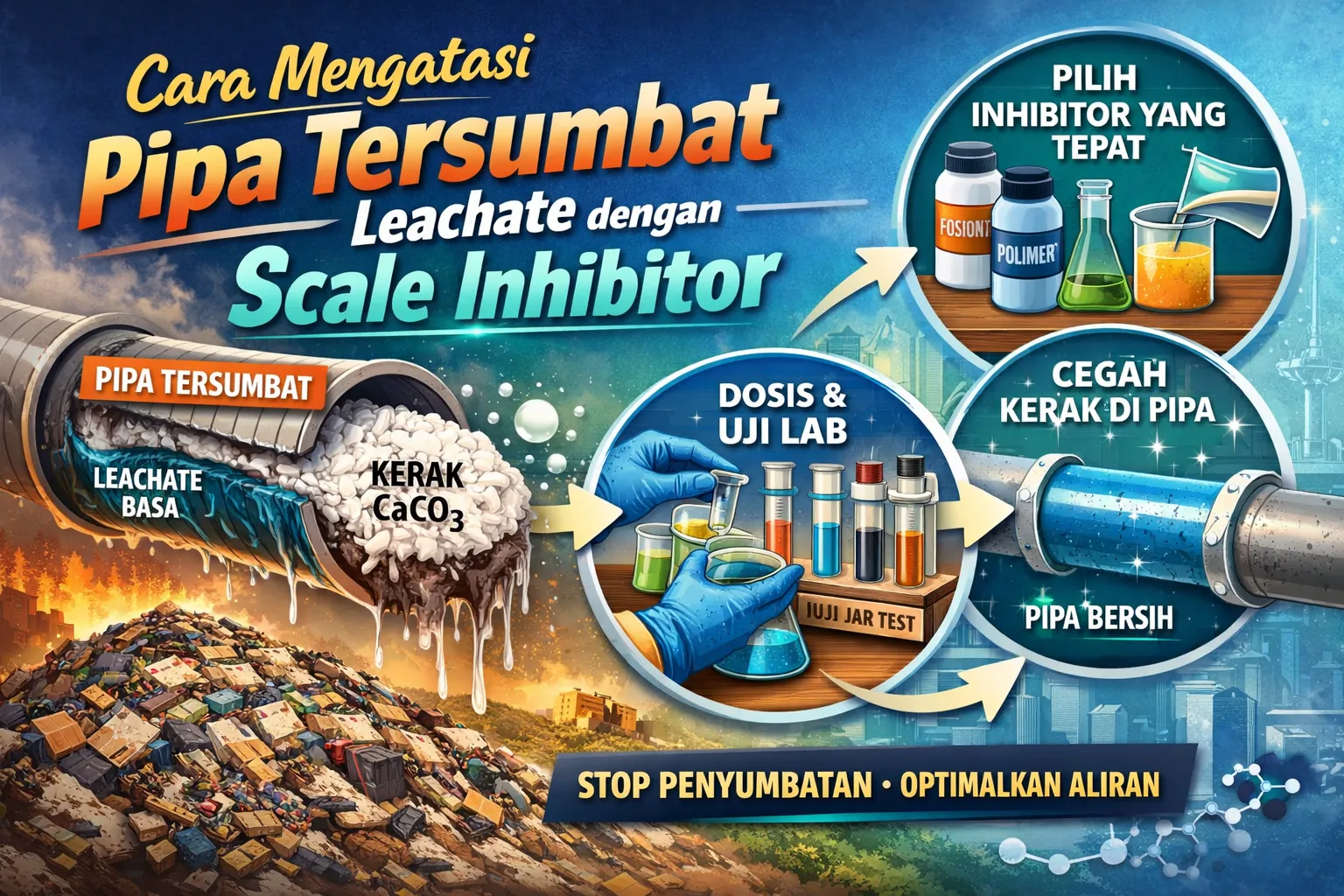
Start with characterization: pH, alkalinity, Ca/Mg hardness, sulfate, silica, temperature, turbidity/solids, and flow regime. If pH is near neutral but carbonate alkalinity is high, CaCO₃ scalability is high. Temperature or concentration steps increase the risk further, for example membrane RO or evaporation (ascelibrary.org). For facilities using reverse osmosis, placing the inhibitor feed upstream of units such as a brackish-water RO can reduce downstream fouling pressure without changing the core process assumptions.
Compute scaling indices such as LSI from lab analyses. As a rule‑of‑thumb example, pH ~8.3 with Ca ~60 mg/L is borderline. Ca ~300–500 mg/L at pH 8–9 is strongly supersaturated, as seen in some C&D leachates (bowser-morner.com).
For CaCO₃, the leading options are polyacrylates or phosphonates. If gypsum (calcium sulfate) is a risk, phosphonates can also help. Where chlorination or biological systems are present, the stability of phosphonates is an advantage. If phosphorus discharge is limited (for example, under Indonesian effluent programs that usually need treated leachate at pH ~6–9), phosphorus‑free polymers or lower‑P variants (for example, ATMP vs. HEDP) are used (check local permit specifics) (scribd.com). We should also weigh compatibility with biological pretreatment and biodegradability.
Bench validation is practical. Split raw leachate into parallel vessels. Simulate destabilization with heat or CO₂ stripping. Dose candidate inhibitors across ranges. Measure residual Ca²⁺ or the mass of precipitate. If needed, analyze inhibitor residuals. Thermodynamic or cooling-tower style models can guide predictions. However, they must be validated against the site’s water (researchgate.net).
Dosing and monitoring in the field
For moderate scaling, a starting point is ~5–10 mg/L of a polymeric inhibitor; for severe cases, ~1–5 mg/L of a strong phosphonate. In lab studies, polyacrylates at 5–10 mg/L cut CaCO₃ fouling by ~60–90%, with performance varying at 25 mg/L depending on chemistry (researchgate.net) (researchgate.net). Phosphonates have demonstrated near‑complete inhibition at ~0.02 mg/L in specific tests, and ~94–96% reduction at ~10–20 mg/L (researchgate.net) (researchgate.net).
Field optimization usually chases the minimum effective dose. Adjust the feed in small steps until conductivity, turbidity or the probe fouling rate settles at clean-system baselines. Then trim down until small scaling appears again, and step back up (frenchcreeksoftware.com). Parallel treated and untreated loops can verify performance. Accurate chemical feed equipment, such as a dedicated dosing pump, helps keep tight control at the low mg/L regime.
After dosing, monitor scale on heat exchangers, pumps and membranes. Re-optimize if upstream conditions change, for example a pH adjustment. Environmental considerations remain. Any discharge has to meet permits on nutrients or toxicity. Low-P or biodegradable chemistries reduce this risk. In practice, one case found that about 10 mg/L of a polymeric inhibitor cut carbonate deposits by about 90%. Also, combining a low-dose phosphonate (for example 1–5 mg/L) with a dispersant polymer can practically eliminate formation in severe cases (researchgate.net) (researchgate.net).
In practice, operators buy blended chemistries as a packaged scale inhibitor for raw leachate lines or upstream of RO trains. This includes cases where the RO is part of a membrane system for high-TDS waters.
Practical recommendations
- Analyze leachate for pH, alkalinity, Ca, Mg and solids. Compute scaling indices (LSI, RSI) to confirm carbonate tendency.
- Identify scaling scenarios. Look for pH or temperature changes in storage ponds, heaters and RO/NF systems (these are injection points) (ascelibrary.org).
- Pilot test inhibitors. Run bench jar tests with polyacrylate, phosphonate and similar products at incremental doses. Target ≥90% fouling reduction with the lowest dose, using the literature as benchmarks (researchgate.net) (researchgate.net).
- Optimize dose in‑situ. Start around 2–5 mg/L polyacrylate or 0.5–2 mg/L phosphonate, then adjust based on monitored performance. Use minimum‑effective‑dose tactics (frenchcreeksoftware.com).
- Consider environment and regulation. Do not violate effluent limits. If phosphorus is constrained, select phosphorus‑free or biodegradable formulas. Indonesian programs usually need pH ~6–9 for treated leachate (scribd.com).
- Review trending practices. The industry is moving toward “green” inhibitors (polyaspartate/maleate blends and similar products) because they ultimately biodegrade (researchgate.net).
Source notes and citations
Leachate composition surveys show pH 7–9 with Ca/Mg in the tens–hundreds mg/L (frontiersin.org) (mdpi.com) (bowser-morner.com) (bowser-morner.com). Field studies confirm CaCO₃ as the main clog in leachate pipes and highlight the risk of “catastrophic failures” (ascelibrary.org).
Scale‑inhibitor performance and market/trend data are drawn from industry reviews: e.g., 5–10 mg/L polyacrylate delivers ~60–90% CaCO₃ inhibition; 0.02 mg/L of specific phosphonate chemistries can fully inhibit under lab conditions; 10–20 mg/L phosphonate achieves ~94–96%; 2 mg/L inorganic phosphate shows inhibition; 1 mg/L polycarboxylic acid can give ~80% reduction; global spend ~US$4.7 billion in 2019, with North America, Europe, and Southeast Asia leading consumption; R&D is focused on biodegradable polymers (researchgate.net) (researchgate.net) (researchgate.net) (researchgate.net) (researchgate.net) (researchgate.net) (researchgate.net) (researchgate.net).
The dose‑modeling and optimization methods referenced here match oilfield and cooling‑water practice. They stress validation and the minimum effective dose (frenchcreeksoftware.com).
In short, match the inhibitor chemistry to the supersaturation profile of the leachate. Feed it precisely through the raw leachate line or ahead of the RO. Then scale can be suppressed even in high‑pH, high‑alkalinity streams. Where membrane trains are central to the flowsheet, pair upstream chemical control with the design basis of a brackish-water RO. This helps protect recovery without a redesign.