

Article
The landfill leachate problem is getting worse, Engineers now have a proven playbook
Industry: Landfill | Process: Wastewater_Treatment
Landfill leachate is not just dirty water. It changes over time. Fresh “young” leachate carries very high biodegradable organics. “Mature” leachate loses BOD (biochemical oxygen demand) but holds ammonia and refractory organics that do not break down. Studies from Indonesian landfills measure raw leachate at about 4,000 mg/L COD (chemical oxygen demand) and about 6,000 mg/L BOD. These are orders of magnitude above typical limits (researchgate.net) (researchgate.net).
Metals (Pb, Cd, Zn, and others), sulfates, chlorides, and trace organics (including PFAS and phenols) come with it. Waste volumes are rising. For example, Indonesia may generate tens of millions of tons per year by 2045. Therefore flows and strengths will only go up. Rainfall infiltration adds to the volume. Normalized leachate generation is about 1–2 m³/ha·day and rising. Therefore equalization is non-negotiable (pmc.ncbi.nlm.nih.gov).
There is no single fix. The answer is a resilient treatment train that adapts as leachate changes. It smooths hydraulic shocks, strips bulk organics and ammonia, then polishes to near-pristine.
Regulatory discharge limits (Indonesia)
Indonesia’s Ministerial Regulation P.59/MENLHK/2016 sets pH at 6–9, BOD ≤150 mg/L, COD ≤300 mg/L, TSS ≤100 mg/L, and total nitrogen ≤60 mg/L (legalcentric.com) (legalcentric.com). For comparison, many countries permit much lower suspended solids or nitrogen. Therefore deep polishing is standard to clear these thresholds comfortably.
Equalization and pre‑treatment architecture
Equalization tanks hold 1–3 days of flow. They blunt storm surges and daily swings, so the biology downstream sees a steady diet. EPA analyses note that raw leachate equalization “is a valuable aid in dampening peak” pollutant loads (nepis.epa.gov).
Front-end gear is straightforward: coarse screening or grit removal, pH adjustment, and chemical precipitation. Many sites use an automated headworks such as an automatic screen to remove debris >1 mm before the chemistry step.
A lime (NaOH/Ca(OH)₂) coagulation step removes heavy metals and a portion of the organic load. It usually doses to pH ~9–10. EPA reports that lime precipitation followed by sedimentation “has been successful in removing the heavy metals and a portion of the organic” fraction (nepis.epa.gov). A dosing pump usually handles pH correction for tight control.
Settling is compact and predictable with a lamella settler or a conventional clarifier. This readies the clarified leachate for high‑rate biology. Where headworks standardization is needed, packaged physical separation systems help lock in performance.
Anaerobic digestion performance (UASB/EGSB)
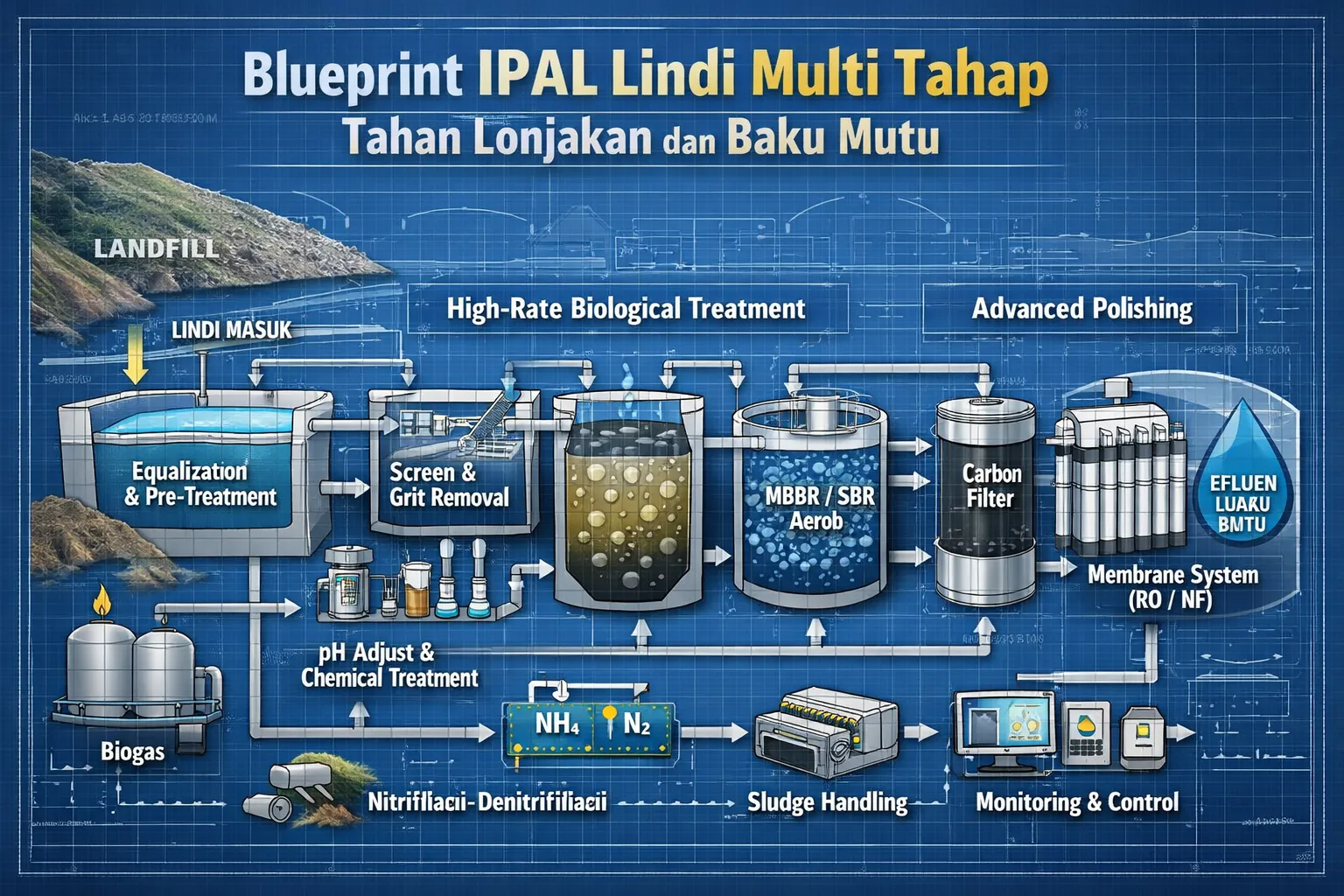
Anaerobic digestion tolerates punishing organics and generates biogas. A Hong Kong landfill study ran a mesophilic (30–35°C) UASB (upflow anaerobic sludge blanket) for 5–6 days HRT (hydraulic retention time). It removed 66–90% of COD, cutting ~12,900 mg/L down to 1,440–1,910 mg/L at 1–2.4 gCOD/L·d OLR (organic loading rate) (pubmed.ncbi.nlm.nih.gov). About ~92.5% of the removed COD became methane, with a net biomass yield near 0.053 gVSS/gCOD (pubmed.ncbi.nlm.nih.gov). Post‑UASB, effluent still held ~1,500 mg/L COD and high NH₄ (ammonium). Therefore polishing was still important.
Pros: low energy and biogas recovery. Trade‑offs: longer HRT and ammonia inhibition risk at very high NH₄ (free NH₃ >2,000 mg/L can slow methanogens). Many operators consider modular anaerobic digestion systems to capture these benefits while phasing capacity.
High‑rate aerobic systems (MBBR/SBR)
Biofilm-based aerobic systems remove organics fast. With enough oxygen they also nitrify ammonia. A two-stage anaerobic (or anoxic) plus aerobic MBBR (moving bed biofilm reactor) treating 4–16 kgCOD/m³·d achieved about 92–94% total COD removal. At 4–8 kg/m³·d, the anaerobic MBBR alone removed about 88–93% COD. At 10–16 kg/m³·d the combined system still reached about 92.6% (pubmed.ncbi.nlm.nih.gov).
Ammonia behavior followed hydraulic residence: with ≥1.25 days in the aerobic reactor, NH₄‑N removal exceeded 97%; at 0.75 days, nitrification slumped to ~20% (pubmed.ncbi.nlm.nih.gov). Sequencing batch reactors mirrored those results: one SBR (sequencing batch reactor) reported ~97.3% BOD and 95.4% NH₃‑N removal (link.springer.com). Robustness matters: the cited MBBR tolerated a 4× COD spike with only ~7% efficiency drop, rebounding in ~3 days (pubmed.ncbi.nlm.nih.gov). For biofilm flexibility, engineered MBBR systems are a common choice.
Low-complexity options exist too. Trickling filters and aerated lagoons are simpler and cheaper. A solar-powered stabilization pond in Indonesia achieved >90% BOD and >80% COD removal because of long retention and simple aeration (sib3pop.menlhk.go.id). Lagoons need large footprints and struggle to nitrify without additional carbon. Where batch flexibility is preferred, packaged SBR units are deployed for 90%+ BOD removal.
Nitrogen removal sequencing
Ammonia is usually in the hundreds to thousands mg/L. Once bulk COD is down, nitrification and denitrification become important. In many cases, conventional aerobic nitrification followed by anoxic denitrification does the job. Denitrification can run on residual carbon or endogenous decay. In very mature leachate (high N, low residual COD), partial nitritation and Anammox is considered. However, it is still an emerging option in practice.
Tertiary polishing to the strictest limits
Adsorptive polishing pulls out color, odor and refractory organics. Both GAC (granular activated carbon) and PAC (powdered activated carbon) are standard. Sufficiently dosed GAC can strip 70–90% of remaining COD. Studies show PAC reduced residual COD by up to about 89%, while GAC reached about 75% under test conditions (pmc.ncbi.nlm.nih.gov). Carbon beds are widely used as a final polish. Engineered media such as activated carbon are common in these stages.
Membranes can finish to near‑zero dissolved solids. UF (ultrafiltration) or MF removes suspended fines. NF (nanofiltration) or RO (reverse osmosis) rejects >95% dissolved organics and salts. In one lab setup, a submerged MBR (membrane bioreactor) with PAC followed by NF reached ~99% total COD removal (pubmed.ncbi.nlm.nih.gov). Plants usually pair pretreatment UF like an ultrafiltration module with downstream NF/RO. They select from integrated RO, NF, and UF systems designed for industrial and municipal duty.
For high-rejection stages, engineers turn to nanofiltration for lower‑pressure hardness and color control. They turn to brackish‑water RO when dissolved solids are elevated. Where biology and membranes are merged, packaged MBR systems produce reuse‑grade effluent.
AOP (advanced oxidation) enters when refractory organics resist. Ozone and Fenton chemistry pushed the Hong Kong UASB effluent to 99.3% total COD removal, ending at ~85 mg/L COD (pubmed.ncbi.nlm.nih.gov). UV/H₂O₂ is another AOP pathway. In multi‑barrier designs, ultraviolet units such as UV reactors can be incorporated upstream of membranes. The cost–benefit tradeoff is site‑specific. Biological plus carbon and/or membranes is usually sufficient. AOP is the contingency for very recalcitrant cases.
Documented performance and sizing rules
Stacked stages deliver outsized gains. In the Hong Kong case, anaerobic biology plus oxidation brought raw COD (~12,900 mg/L) down to ~85 mg/L (pubmed.ncbi.nlm.nih.gov). Two‑stage anaerobic–aerobic biofilm trains routinely cross >90% COD removal and >97% ammonium removal under appropriate HRTs (pubmed.ncbi.nlm.nih.gov) (pubmed.ncbi.nlm.nih.gov), and simpler pond‑based designs with polishing have logged >90% BOD and >80% COD reductions (sib3pop.menlhk.go.id).
As a rule of thumb, expect about 80–90% removal in each primary biological stage (anaerobic or aerobic). Then expect about 90% of the remainder to go in polishing (adsorption/membrane). This gives a final COD below 100–300 mg/L and BOD below 20–50 mg/L under typical loads. Designs must be sized for worst-case leachate so the effluent always stays within BOD ≤150 mg/L, COD ≤300 mg/L, TSS ≤100 mg/L, and total nitrogen ≤60 mg/L (legalcentric.com) (legalcentric.com).
Operations, energy, and residuals
Shock loads happen. Equalization softens the blow, and high-rate biofilm reactors have documented resilience. In one MBBR study a 4× sudden COD spike cost only ~7% removal efficiency and recovered in ~3 days (pubmed.ncbi.nlm.nih.gov). DO, NH₄, and pH controls fine-tune aeration and recirculation. Plants usually bundle instrumentation within supporting ancillaries.
Sludge and concentrates need plans. Anaerobic systems produce little sludge and biogas (~0.35 m³ CH₄ per kg COD treated). Aerobic steps yield more waste biomass. Polishing creates spent carbon and membrane brine. Where spare parts matter, operators lean on water treatment consumables to keep uptime high. If denitrification carbon is limited after deep COD removal, external carbon is sometimes added. Regulators expect regular monitoring. Periodic lab tests and online sensors are common in Indonesia. Remote data logging helps flag upsets early.
Bottom line and sources
A multi‑stage plant—equalization → bulk biological removal → nitrification (if needed) → advanced polishing—repeatedly meets strict discharge limits. Real‑world and pilot data back this: >90% COD/BOD in primary stages (pubmed.ncbi.nlm.nih.gov) (pubmed.ncbi.nlm.nih.gov), ~70–90% of the remainder in polishing (pmc.ncbi.nlm.nih.gov) (pubmed.ncbi.nlm.nih.gov). Design choices—anaerobic vs. aerobic, reactor volumes and HRTs—should be tied to site leachate data over time. All claimed figures and regulatory limits are documented across peer‑reviewed and government sources: (pubmed.ncbi.nlm.nih.gov) (link.springer.com) (pmc.ncbi.nlm.nih.gov) (pubmed.ncbi.nlm.nih.gov) and Indonesian limits (legalcentric.com) (legalcentric.com).