

Article
Inside the Grain Mill: How a 0.1 mm Gap Decides Brewery Yield and Clarity
Industry: Brewery | Process: Milling_&_Mashing
The first important variable in a brewery is not the mash temperature. It is the space between two steel rollers. Milling sets up everything that follows. The gap changes in fractions of a millimeter determine if husks stay intact, starches convert, and lauters run on time. Industry guidance is explicit: adjust roller gaps by ~0.05–0.1 mm at a time (crispmalt.com).
Across mill types, more rollers means more control over each grist fraction. Suppliers put it as “more rollers = finer control” (crispmalt.com). That control comes with higher capital and maintenance costs (crispmalt.com).
Roller configurations and fraction control
A 2‑roller mill (single “nip,” the point where rollers draw in and crush grain) is a low‑cost option suited to well‑modified malts and simple infusion systems (crispmalt.com) (crispmalt.com). A 4‑roller adds a second nip. The first pair makes the primary crush. The second pair (usually less fluted) breaks coarse kernels, the “hard ends,” and can protect intact husks (crispmalt.com).
6-roller mills have three nips. They add another break and screening stage, so each fraction can be controlled very finely (crispmalt.com). These designs are cited as best for all malt types, including under-modified malts (less enzymatic and structural modification during malting), and for modern lautering setups such as deep lauter-tuns or mash filters (a plate-and-frame separation system) (crispmalt.com) (www.scribd.com). Brewmax adds that hobby breweries traditionally use 2-roller mills, but 4- and 6-roller machines are becoming affordable. Multi-nip (“multi-roller”) mills also help keep husks intact. Therefore less unwanted astringency (polyphenols) ends up in the wort (brewmax.net).
Crush profile and lautering outcomes
The aim is straightforward. Expose as much starch as possible for extraction, but keep the husk (the grain’s outer shell) intact so it can form a filter bed in the lauter-tun (the wort separation vessel). As Crisp puts it, “the smaller the particle the more extract you recover, but the run-off will be slower” (crispmalt.com).
If the crush is too coarse, large endosperm (starchy core) lumps may not hydrate fully, hurting starch conversion and “spirit yield” (crispmalt.com) (www.mdpi.com). If it’s too fine, excessive flour and broken husk slurry can leak below lauter grates (slotted plates), causing slow runoff and lost extract (crispmalt.com) (www.mdpi.com).
In practice, brewers aim for roughly 50–80% of the grist mass in large particles (retained on ~1.4 mm sieves) to hold a solid filter bed, with only a small flour fraction (<10% below 0.25 mm) (brewingforward.com) (www.mdpi.com). One pilot study found an industrial mill delivered ≈60–68% of the crushed malt mass above 1,000 µm and only ≈8–9% below 250 µm (www.mdpi.com). Industry guidelines (Briess, Brew‑Like‑A‑Pro, etc.) typically suggest ~50–85% on #14 (1.4 mm sieve) and <5–10% on #60 (0.25 mm) (brewingforward.com).
Each fraction has a role: husks act as the lauter filter bed (crispmalt.com); coarse and fine grits carry most of the starch — the bulk of extract (crispmalt.com); flour (<0.25 mm) contains residual starch and enzymes but contributes little to filter support. A cited 70:20:10 ratio — 70% grits, 20% husk, 10% flour — is common for distilling washes (crispmalt.com). Critically, most beer polyphenols (natural phenolic compounds that can drive astringency) come from the husk: MDPI researchers report that 70–80% of beer’s polyphenols originate in malt husks, and that keeping husks more intact (e.g., via wet or gentle milling) eases wort clarification (www.mdpi.com).
Gap settings and mill maintenance
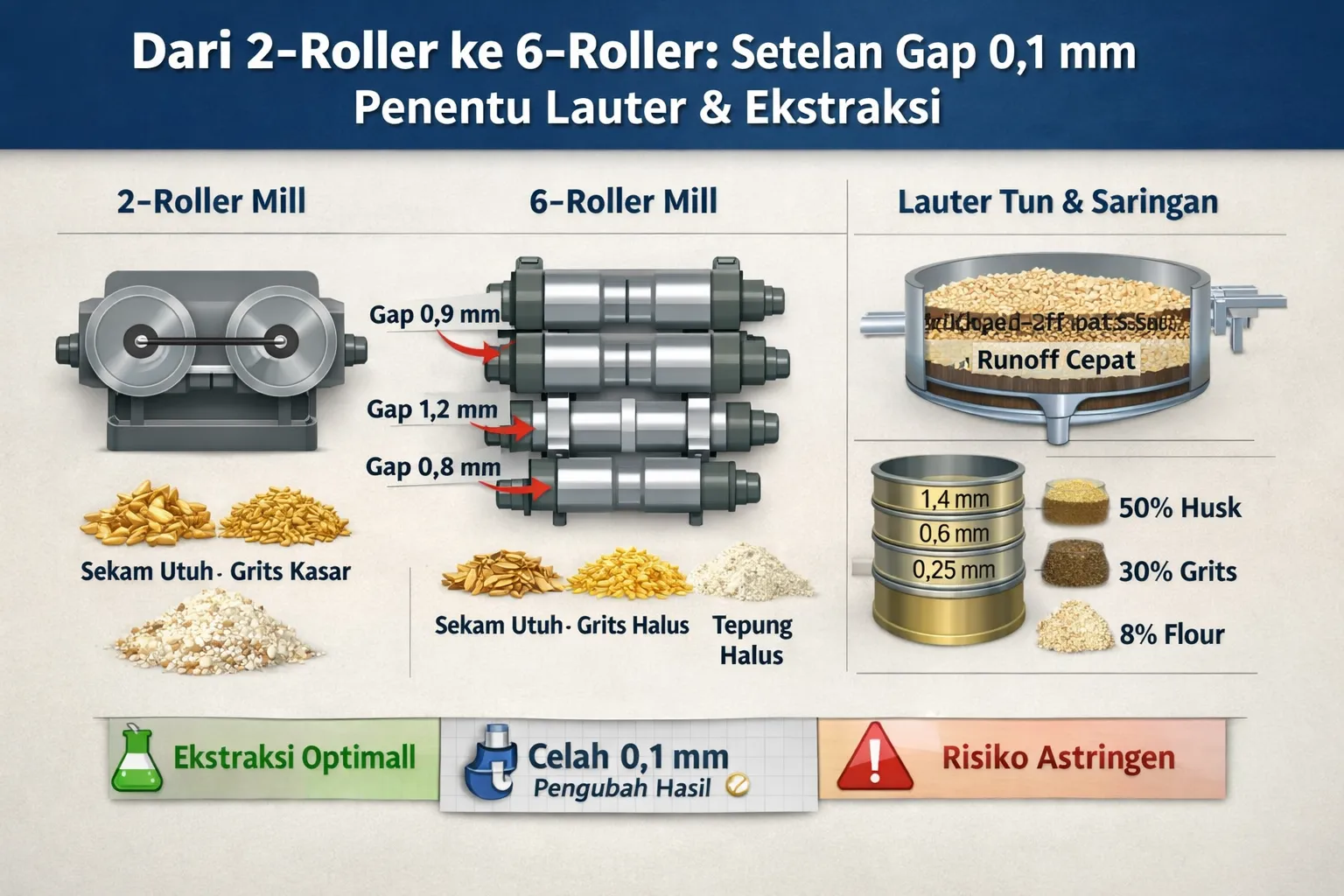
Operators “use fractions of a millimeter” when they set roller gaps. Changes are usually about 0.05–0.1 mm (crispmalt.com). On a 4-roller mill, a common starting point is about 1.5 mm (top) / 1.2 mm (bottom), a 0.3 mm differential. From there the gap is fine-tuned (crispmalt.com). Smaller gaps give a finer grist. Larger gaps give a coarser one.
After any change, check the gap across the entire roller length with feeler gauges. Wear or misalignment can make the gap uneven (crispmalt.com). In day-to-day practice, closing the gap 0.1 mm can raise the husk percentage, and opening it can reduce flour. Record the settings carefully (crispmalt.com).
Rollers must stay parallel and undamaged. Uncrushed kernels, or “tailings”, mean the gap is too wide or the rollers are misaligned. Once the rollers wear, with irregular grooves or flats, no adjustment will fully restore performance (crispmalt.com). Older mills (for example Porteus) usually used fixed “gauge” settings. These no longer show the actual gap when the rollers are worn (crispmalt.com).
Routine maintenance matters. Checking bearings, cleaning the mill and using magnets to trap metal debris are cited as standard practice (crispmalt.com). Set the gap in fine increments, keep the rollers parallel and check it usually. Even a few hundredths of a millimeter can quite shift the crush profile.
Laboratory sieve analysis and targets
To check the crush, breweries use lab sieve analysis (ASBC, the American Society of Brewing Chemists, “manual sieve test”). The standard method stacks sieves, for example 1.4 mm, 0.6 mm and 0.25 mm, to separate husk, coarse grits and fine grits/flour by weight (brewingforward.com). A typical test takes about 100–130 g of freshly milled sample. You shake it in the sieve stack for a set time, then weigh each fraction (brewingforward.com).
Manual tests can show about 10–16% typical variability. Therefore good technique is important (brewingforward.com). The results give a quantitative crush profile, for example “50% above 1.4 mm, 30% in 0.6–1.4 mm, 8% <0.25 mm”. One case study found an industrial mill yielded roughly 68.5% on a 1 mm sieve, 13.5% on 0.5 mm, 7.4% on 0.25 mm, and 8.0% fines (www.mdpi.com).
Benchmarks help interpret results. Malting suppliers usually suggest ranges. For example, Briess suggests about 70–85% husk, 10–20% between 0.25–1.4 mm, and <5% fines for reliable lautering (brewingforward.com)). Others accept about 50–60% husk for economy, with up to about 10% fines (brewingforward.com)). Breweries compare each run to such guidelines. If the fractions drift, they adjust the mill gap or service the rollers.
Suppliers recommend doing grist analysis regularly and whenever malts change; for example, sampling on a schedule or when mixer changes occur, and noting each session’s husk/grit/flour proportions (crispmalt.com) (crispmalt.com).
Data feedback and process choices
Mill selection and precise tuning directly shape the crush profile. Sieve data give objective feedback. One brewery found that tightening the gap by 0.1 mm raised the large‑grit percentage by several points. This justified the change in brewing yield. Each parameter (mill design, gap, roller health) becomes a controllable variable informed by data.
The industry’s through‑line is consistent: pick the mill that matches the system (from 2‑roller “traditional single infusion Mash Tuns” to multi‑nip mills for deeper tuns or filters), and then keep feeding it data to balance extraction and filtration (crispmalt.com) (crispmalt.com) (brewingforward.com).