

Article
The baghouse is the cement mill’s secret workhorse — and the data shows it decides your kWh/t
Run the dust collector right and you get higher throughput, lower power and assured compliance. Let it drift and you pay in lost fines, fan energy and mg/Nm³ breaches.
Industry: Cement | Process: Cement_Grinding
In closed-circuit cement grinding, the baghouse is a fabric filter that separates dust from gas. It is part of the process performance and the emission control. Modern systems capture more than 99% of fine product. Well-maintained units usually remove more than 99.9% of submicron cement dust (Power Mag). It captures almost all fines and returns them to the mill. It keeps the airflow that the classifiers need and prevents carry-over.
The other side is stark. Any bypass or leak means lost throughput and a compliance risk. One case reported dust at 127.5 mg/Nm³ (milligrams per normal cubic meter, a concentration at standard conditions) simply when a single bag was missing (ms.dustcontrolling.com).
Airflow and classifier stability
The baghouse airflow sets the tone for the whole circuit. Effective dust collection keeps the mill recirculation loop clear and collects the returned fines. Therefore it keeps specific surface (total particle area per mass) and particle size distribution on target. It also stops “grounded” dust from choking the process (Clipon). Industry experience is blunt. Without efficient filtration, production rates drop and specific energy rises (Clipon).
Baghouse differential pressure and fan power
Keeping differential pressure (ΔP, the pressure difference between the dirty and clean sides of the filter) low is important for energy-efficient operation. A clean baghouse usually runs at ΔP ≈ 2–6 inH₂O (0.5–1.5 kPa) (Torch‑Air). As the filters load and ΔP rises, airflow falls, and therefore mill throughput falls, unless fan power is increased.
By fan laws, fan shaft power is proportional to (airflow × ΔP) (Donaldson). One estimate: an extra 0.9 inH₂O (≈225 Pa) of loss cost ~$1,960/year at 17,000 cfm (cubic feet per minute), 24/7, and $0.09/kWh (Donaldson). In grinding, the rule of thumb stands: “the higher the ΔP, the more power is consumed; the lower the ΔP, the higher the throughput” (India Cement Review; Donaldson).
The saving is real. One Chinese cement mill optimized its baghouse and cut fan power from 23.5 kW to 15 kW. That saves ~¥19,600/year (6000 h operation at ¥0.55/kWh) (ms.dustcontrolling.com).
Cleaning method and pressure‑drop management
How the dust accumulates matters. If it loads deep in the filter matrix instead of on the surface, ΔP spikes and emissions increase (Power Mag). Worn or saturated bags cause unstable airflows and stoppages. Also, uncontrolled dust abrades machinery and blocks conveyors.
Proactive maintenance — eliminating leaks, replacing rough or corroded cages, and using on‑demand cleaning loops — keeps ΔP low (India Cement Review; Power Mag). Shifting from reverse‑air cleaning to pulse‑jet can maintain ΔP in the 6–8 inH₂O range instead of 10–12 inH₂O (Torch‑Air; Power Mag), cutting fan energy.
Production throughput and energy intensity
When the dust collector is in good order, grinding output increases because the recirculation loop stays clear and fines get recovered. Without it, every ton can need more kWh of power. Lower filtration efficiency pushes up specific energy and drags down production rates (Clipon).
For example, an Indonesian mill replaced an electrostatic precipitator (ESP, a dust control device that charges and collects particles) with a pulse‑jet baghouse and cut cement mill power draw by a large amount. The retrofit allowed a higher gas inlet temperature and reduced the cooling load. It also cut dust emission from ~30 mg/Nm³ to ~6 mg/Nm³ and saved about 0.24 ton CO₂/year through lower electricity use (ResearchGate). Most newly constructed plants now use bag filters, even though the bags need periodic replacement, because the net gain in efficiency and reliability is worth the extra maintenance (ResearchGate).
Filter bag life and replacement strategy
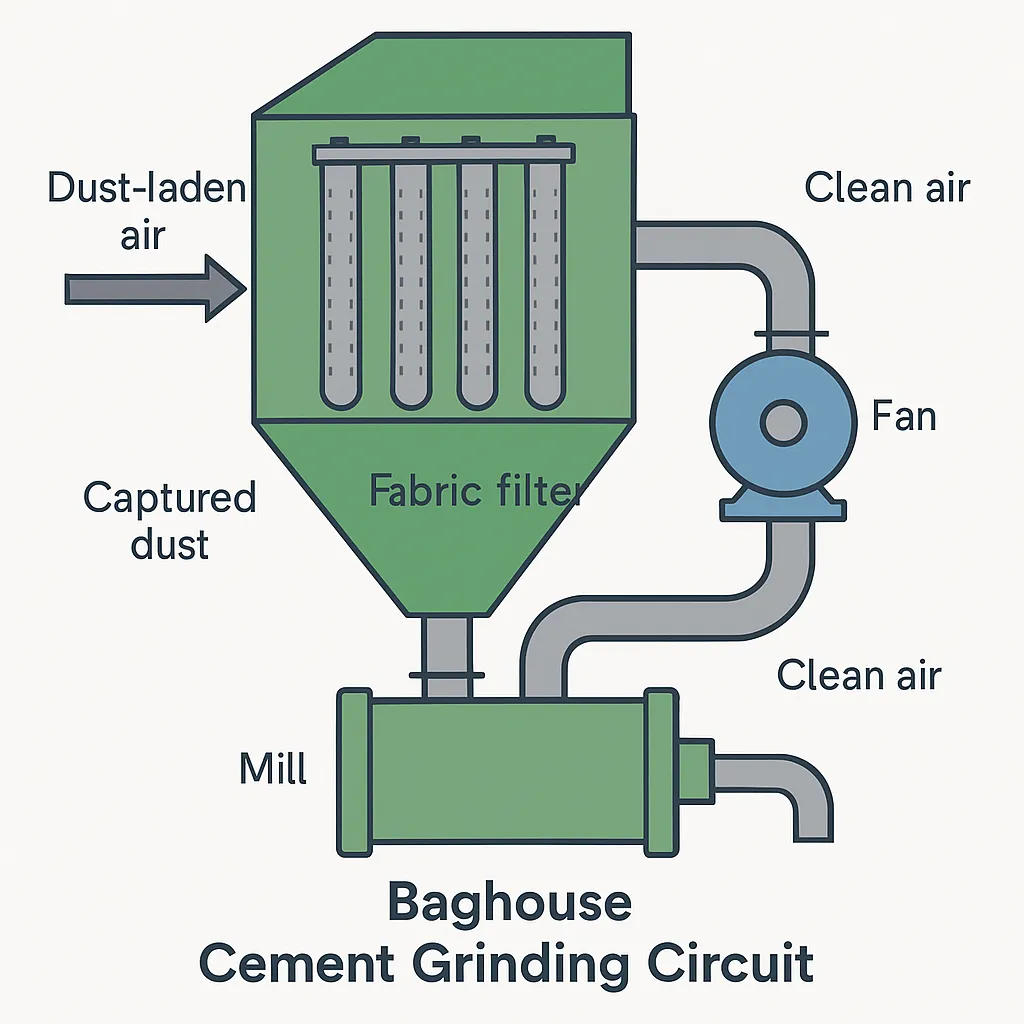
Filter bags are the heart of the baghouse, and their lifespan is finite — ranging from months to a few years depending on dust load, moisture, and media. In extreme cement service (humid, high‑temperature dust), conventional polyester bags lasted ~3 months, while advanced PTFE‑coated or Dura‑Life bags reached 6–9 months, with lower ΔP and better dust release (Donaldson; Donaldson).
Best practice is to replace whole modules — or at least half of the bags at scheduled intervals — rather than mixing new and old, since mismatched permeability drives uneven loading and early failure (India Cement Review). If full replacement is impractical, one report advises changing 50% of bags at once; scheduling based on normalized ΔP or cleaning pulses yields major payback (India Cement Review).
Proactive programs have shown measurable gains. These programs use inspections every 6–12 months and ΔP trend monitoring. One plant consolidated multiple small dust collectors into fewer large pulse‑jet filters. This halved installed fan power (23.5 kW → 15 kW) and saved ~¥19,600/year (ms.dustcontrolling.com). Donaldson also documented a triple‑life case. Bags went from 3 to 9 months by switching from plain polyester to Dura‑Life. The ΔP was lower and change‑outs were less frequent (Donaldson).
Compliance thresholds and business risk
Global baselines are unforgiving. EU guidance of 0.15 kg/ton‑clinker is ≈150 mg/Nm³ (ResearchGate), while modern Indonesian limits are 60–75 mg/Nm³ (studylibid.com). In practice, modern pulse‑jet baghouses easily achieve sub‑10 mg/Nm³ outlet dust when maintained well (ResearchGate; ms.dustcontrolling.com).
But failure is costly: in the “bucket belt” example, removing filters drove emissions to ~127 mg/Nm³, risking violations and exposing workers (ms.dustcontrolling.com). Investing in proactive filter maintenance extends equipment life and avoids unplanned outages, delivering ROI in avoided fines, energy bills, and lost tons (Clipon). The bottom line is consistent across sources: rigorous baghouse operation and timely bag changes yield higher throughput, lower kWh/t, and assured compliance (ResearchGate; Clipon).