

Article
Breweries Are Sitting on a Mountain of Wet Grain. The Smart Money Decides: Give It Away Today or Dry It for Tomorrow
Industry: Brewery | Process: Lautering
This is the beer industry’s biggest open secret. Lautering throws off large amounts of brewer’s spent grain (BSG), and it has to go somewhere quickly. About 20–31% of the original malt ends up as BSG. That works out to about 20 kg of spent grain per 100 L of beer produced (ScienceDirect). Breweries around the world make about 40 million tonnes of BSG every year (Tetra Pak).
The challenge is water. BSG typically carries 70–80% moisture (often 80–85%), so the bulk product spoils rapidly—usually within 7–10 days at ambient temperatures—unless it’s preserved (ResearchGate) (MDPI). On a dry‑matter (DM) basis (i.e., excluding water), BSG carries ~20–30% protein and ~60–70% fiber (ScienceDirect) (ResearchGate). Unused, wet BSG would be an organic waste subject to disposal costs—on the order of ~$16 per metric ton per 8 km transported (ResearchGate)—and environmental regulation.
Wet feed route and logistics
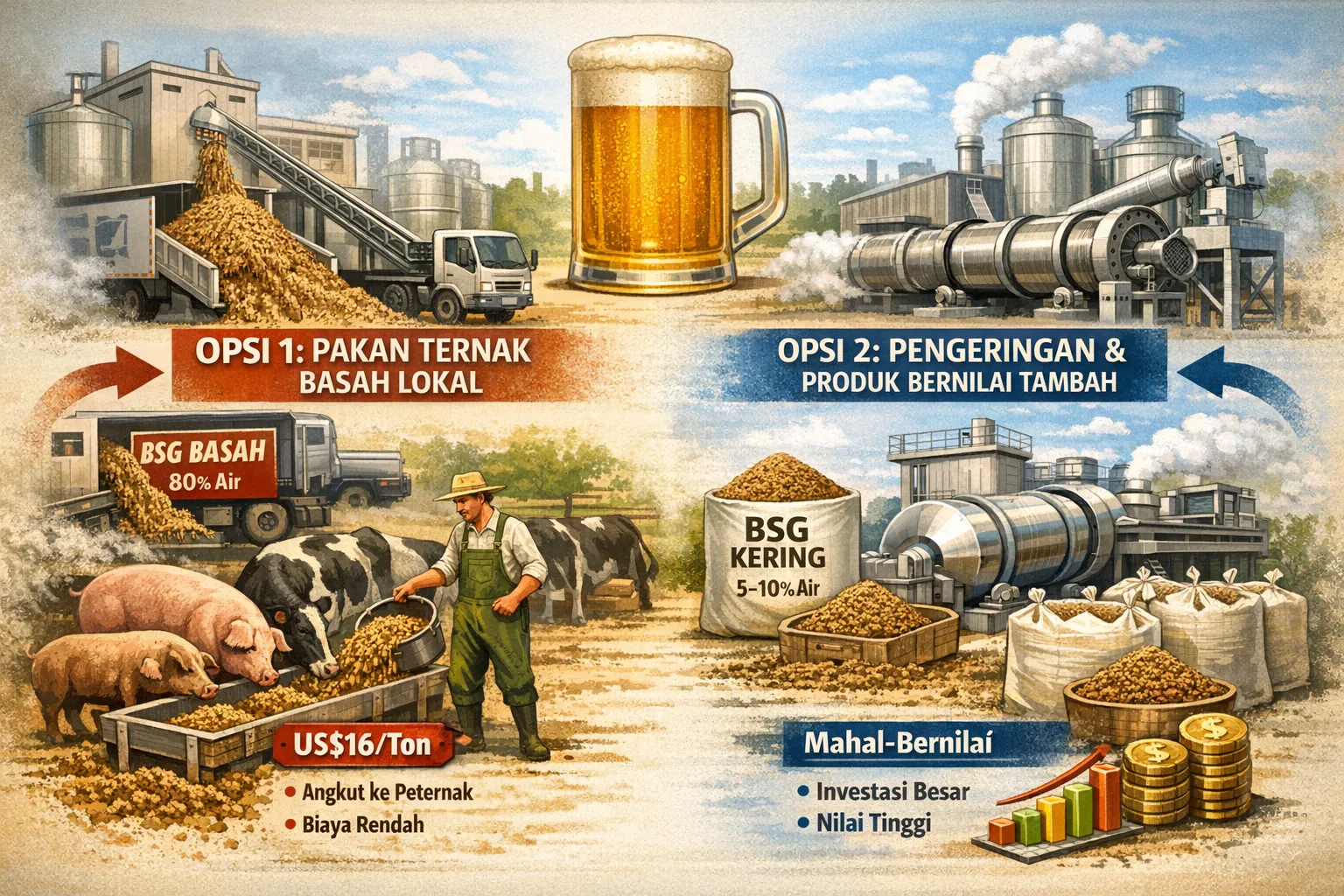
The usual route is local. Breweries give or sell wet BSG, which is usually 80–85% water, directly to nearby livestock farmers. No drying and no major capital: farmers usually pick up daily and feed it to cattle or pigs. The nutrient profile, about 20–30% crude protein (DM) and about 60–70% fiber, fits ruminant diets. Research shows inclusion at 25–30% of a dairy ration (DM basis) can improve intake and milk yield (ScienceDirect) (ResearchGate).
It is usually a goodwill economy. Breweries avoid disposal costs and farmers replace pricier concentrates. However, there is almost no revenue. Most breweries charge nothing or a nominal fee for the grain (ResearchGate). The catch is distance and time. The material is heavy and bulky, so farms within a few tens of kilometers are usually the only viable partners. Pickup must be daily or every few days. In warm conditions, aerobic spoilage is fast. At 30 °C, wet brewer’s grain can lose about 10% dry matter in one day. Some reports give dry-matter losses of about 1–2% per day (ResearchGate).
Market context favors the practice. Reusing BSG as feed is widespread and growing; dried BSG is described as “a staple of the animal feed industry” (Future Market Insights), and brewers often treat BSG as a “core by‑product, not a waste” (ResearchGate). A 2014 U.S. FDA proposal would have required treatment or drying of BSG before farm use (Time), though it faced strong pushback. In Indonesia, there is no known ban and national initiatives broadly encourage agro‑waste use in feeds to reduce import reliance (Kontan press release).
Drying route and market access
Drying changes the math. It brings moisture down to ~5–10% and stabilizes the material for months. It concentrates nutrients by removing water. It also opens new markets (pellets, meal, flour) across cattle, poultry, swine, pet food, organic fertilizer, and emerging “upcycled” human‑food ingredients. The dried BSG market is projected to grow at ~4.7% CAGR to 2035 (Future Market Insights). Major brewers are investing in extraction of protein and fiber for human food applications (Financial Times). Drying also “decreases transportation and storage costs” (ResearchGate).
The trade‑off is capital and energy. Rotary drum, belt, or fluidized‑bed dryers can run to tens or hundreds of thousands of USD. Drying 1 kg of 80%‑moisture BSG down to ~10% moisture takes energy on the order of vaporizing ~0.7 kg of water, about 2–3 MJ. Therefore “energy costs associated with drying” are high (ResearchGate). “Most craft breweries do not have drying facilities” (ResearchGate).
Still, there are cases where it pencils out. One analysis assumed dried BSG flour selling at $2.70–3.60/kg and ~6.6 t/month dried output with ~$3–4k monthly expenses. The capital outlay was ~$90,000. The authors found a positive net present value, a five‑year internal rate of return of ~12.7%, and a payback at about four years (MDPI) (MDPI) (MDPI). The caveat: those returns depend on sufficient scale, affordable energy, and reliable buyers.
Unit economics and energy
Here is the rough calculation. 1 metric ton of wet BSG at ~80% moisture contains ~200 kg of dry solids. If the brewery sells it wet for free, it avoids an estimated ~$16 disposal cost per 8 km of transport (ResearchGate). If it dries that ton, it gets ~200 kg dry. At $3/kg, the revenue is $600.
Drying 800 kg of water from that ton would need about 2–3 MJ per kg of water removed. The analysis puts this at ~50 m³ of natural gas (about $25–$50) plus electricity, so easily >$50 of fuel. An MDPI study estimated monthly operating costs of ~$3,500 to dry ~6,600 kg/month. That implies ~$0.53/kg of dried product cost even before capital (MDPI). Bottom line: selling wet is virtually free but low‑return. Drying is costly but can create $/kg revenue. Many analyses and brewer anecdotes agree it is economical at larger volumes or higher price points, for example 3–5 years payback (MDPI).
Regulatory and sustainability notes
Policy winds matter. The EU promotes “upcycling” BSG into food ingredients, and Indonesia’s sustainability policies broadly favor waste valorization (e.g., government support for local feedstocks) (Kontan press release). Meanwhile, a 2014 U.S. FDA proposal to require treatment/drying of BSG before farm use drew strong pushback (Time).
Not valorizing has its own cost. Transporting wet BSG uses a lot of fuel. Landfilling organic waste is increasingly discouraged. Research suggests that on-farm use of wet spent grain “reduces the environmental impact” compared with disposal (ResearchGate).
Conveying design and cleanout
Whether the grain is headed to a farm or a dryer, the first operational task is the same: get wet BSG out of the brewhouse cleanly and quickly. High‑moisture solids behave like a viscous cake. Therefore the system must handle that cake and still be easy to clean.
Under-tun screw or auger conveyors are common. A screw conveyor or sloped trough sits directly under the lauter tun’s false bottom. It pushes spent grain into a receiving hopper as the mash is emptied. This cuts manual shoveling and removes more of the grain. IndPro’s “iExpel” mounts a variable-pitch screw under the tun and adds a sieve to pre-drain liquid. The unit can connect to a pressurized pneumatic line downstream (IndPro).
For longer runs, pneumatic plug conveying combines a feed screw with compressed-air injection. It pushes plugs of grain through a pipeline to a remote receiver or silo. Commercial systems move material up to ~200 m and up grades. They have “no-back” safety valves to prevent overpressure (making.com). IndPro cites a 22 kW motor and capacities around ~20 tonnes/hour for its units (IndPro).
Short-distance options include belt conveyors or flexible-screw conveyors. A flexible screw is a single auger inside a plastic tube. It needs little maintenance and is easy to clean. It moves grain gently up moderate inclines (Spiroflow). Many layouts add a buffer hopper under the tun to hold a batch and feed downstream equipment steadily. The grain then goes to a silo, truck or bins (IndPro).
Sanitary details matter. The internals should be smooth so grain does not hang up. The materials should resist corrosion (stainless steel or food-grade coatings). The conveying should be sealed to keep out dust and pests. The system should have clean-in-place (CIP) or washdown capability so it does not smell or spoil. Some modern systems add sensors or visual ports to detect bridging early (DataCalculus). Where CIP and washdown tie into plant utilities, supporting water treatment equipment can be part of the package, such as supporting equipment for water treatment or upstream debris control via an automatic screen.
Decision point for brewers
The data shows the status quo still makes sense. Give wet grain to nearby farmers and avoid disposal fees (around US$16 per tonne per 8 km) with minimal capex (ResearchGate). Drying becomes attractive when throughput is high, markets are secure (for example feed flours, pet foods, upcycled ingredients), and energy is affordable. Under these conditions, analyses show positive NPV, ~12.7% five‑year IRR, and roughly four‑year payback on a ~$90k system at ~$2.70–3.60/kg selling prices for dried flour with ~6.6 t/month output and ~$3–4k monthly expenses (MDPI) (MDPI).
Either way, engineering the exit matters. The combination of an under‑tun auger and downstream transfer—pneumatic or mechanical—scaled to peak brew rates (suppliers advertise up to ~20 t/h) clears the lauter tun between batches without labor‑intensive shoveling (IndPro). In practice, that choice usually decides whether BSG is a logistical headache or a steady by‑product stream ready for the next buyer.