

Article
Breweries Make Mountains of Wet Grain. The Economics Still Favor Giving It Away
Industry: Brewery | Process: Lautering_&_Wort_Boiling
Brewing generates very large wet wastes: roughly 20 kg of wet brewers’ spent grain (BSG) per 100 L of beer (www.redalyc.org) (pmc.ncbi.nlm.nih.gov). BSG — the fibrous barley/malt residue after mashing — is about 75–80% water (only 20–25% dry matter) (www.researchgate.net) (www.mdpi.com), with one study finding typical wet BSG at ~77–80% moisture (www.mdpi.com).
Scale makes the problem clear. Global beer output was ~1.89 billion hL in 2021 (hL: hectoliter, 100 L). That implies about 38 million tonnes of BSG per year worldwide (pmc.ncbi.nlm.nih.gov). If waste is carted off, one analysis estimates disposal costs up to €13.64 per hL of beer. That assumes ~20 kg BSG + 3 kg yeast per hL (www.researchgate.net).
In practice, most breweries avoid disposal fees by giving (or selling) wet BSG to farmers or feed producers. In Europe about 70% is reused as animal feed, about 20% is landfilled, and about 10% is used for biogas (pmc.ncbi.nlm.nih.gov). Market prices are low. Wet BSG is valued at only about €35–50 per tonne (wet) (pmc.ncbi.nlm.nih.gov). At 20 kg BSG per hL (0.02 t), that is just €0.70–€1.00 per hL. Small breweries say spent grains are usually free to take. One Montana microbrewery reportedly gives away 2 tonnes/week, and the rancher’s only cost was diesel to haul it (agupdate.com). Therefore selling wet BSG gives the brewery essentially zero margin. It is used chiefly to avoid waste.
Spent-grain drying economics
Drying and pelleting BSG reduces volume and extends shelf life. However, it costs a lot. Industrial dryers (for example rotary drum systems with dewatering presses) usually cost tens to hundreds of thousands USD. Pilot systems cost around $10–30k and larger plants cost >$100k. They handle several tonnes per hour (www.feeddryer.com). Operating energy is also substantial. One manufacturer’s data for an 85%→15% moisture line shows ~34–90 kW of installed power processing 0.4–1.7 t/h (www.feeddryer.com).
Thermodynamics set a hard limit on the bill. To dry 1 tonne of wet BSG (~0.2 t dry), roughly 0.8 t of water must be evaporated. That needs ~7.5 GJ of heat (~2,100 kWh; GJ: gigajoule; kWh: kilowatt-hour) at best. Therefore the heating-equivalent cost is roughly $150–$250 per tonne of wet BSG, or ~$750–$1,000 per tonne of dry product (assuming $0.10–0.20/kWh). Removing water raises energy density from ~2 MJ/kg wet to ~16 MJ/kg dry (www.mdpi.com) (www.mdpi.com). That makes BSG a better biofuel or concentrated feed. However, few small breweries recoup the dryer costs.
The potential upside is a higher-value product. Dried spent-grain pellets or “brewer’s grain flour” can sell at higher prices. The dried-spent-grain market is projected to grow at 4.7% CAGR (compound annual growth rate) in 2025–2035, driven by demand for green feeds, compost, and fertilizers (www.futuremarketinsights.com). In practice, drying 1 t wet (yield ~0.2–0.25 t dry) might need about $200 in fuel and energy but only produce a few tens of dollars of feed value. Dried BSG pellets might sell for about $80–150/tonne if the quality is high. A brewery needs cheap waste heat or a guaranteed market, for example an integrated livestock or pet-food operation. Without that, analyses usually find the ROI poor for standalone dryers. A Brazilian case study notes that small craft brewers usually find BSG valorization, for example as flour, economically unviable without subsidy (www.mdpi.com) (www.mdpi.com). Therefore most of them route BSG as-is to farmers or to disposal.
Wort–trub separation technologies
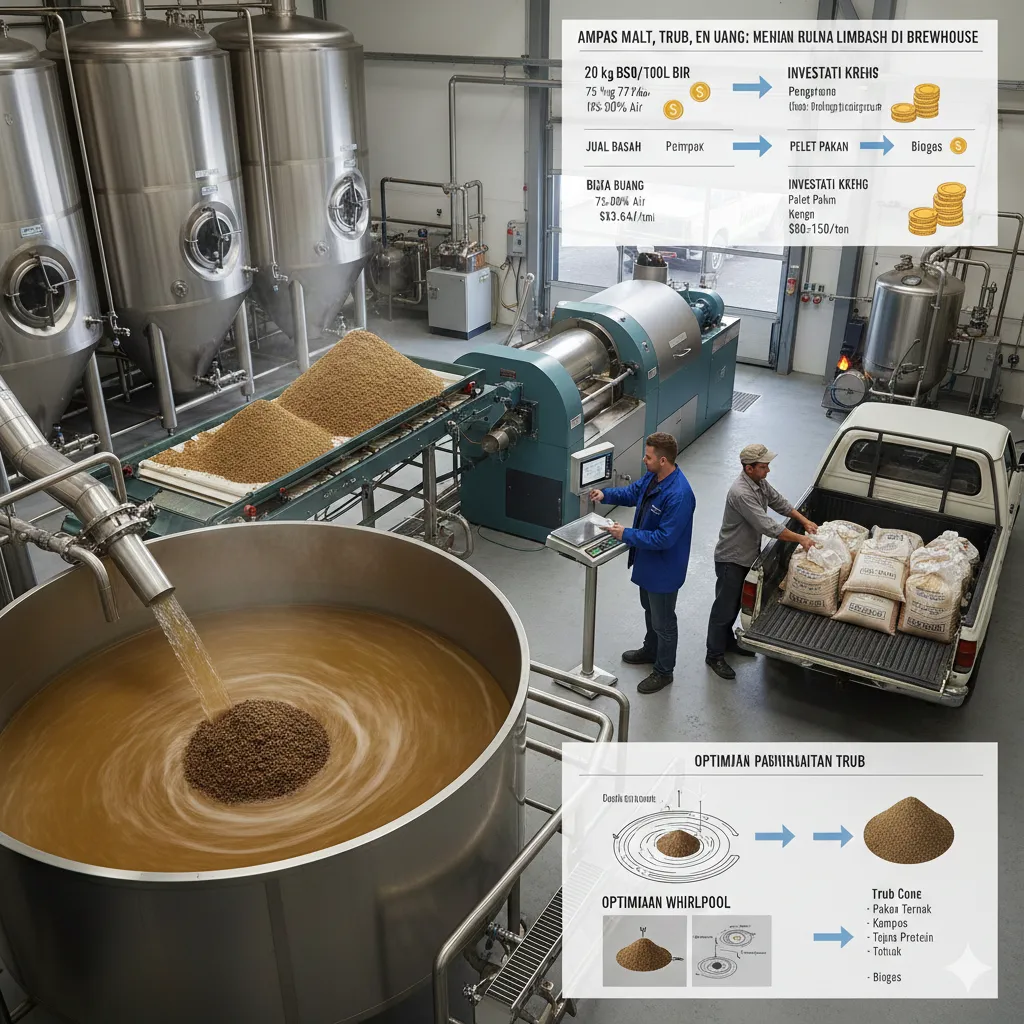
After boiling, breweries must strip trub from the wort. Trub is hot break proteins and hop solids. The wort is the sugar-rich liquid that will ferment. Traditionally this is done by whirlpooling. The boiled wort is pumped tangentially into a conical tank and allowed to circulate. This creates a centrifugal effect that forces insolubles into a loose cone at the center bottom. Clarified wort stays around the sides (frca.paulmueller.com) (www.gea.com).
After an appropriate dwell time — often ~20–30 minutes — a valve is opened at the bottom to “knock out” the accumulated trub, and clear wort is drawn off from above it (frca.paulmueller.com). Key design factors include inlet velocity, tank geometry, and flow rate — all tuned to form a compact trub cone (www.gea.com). This passive whirlpool method is generally the most economical for hot-trub removal; analysts note it’s cheaper than using a centrifuge or filter (www.gea.com).
Some modern breweries add special separators to get more yield. The BrauKon HopSep, for example, connects directly to the whirlpool outlet. It draws hot wort continuously and spins it in a centrifugal clarifier. Then it pumps most of the wort back into the whirlpool, now stripped of solids. The coarse trub is collected separately in a bin (braukon.de) (braukon.de). Other variations include dedicated hop separators or filters placed before the whirlpool to remove large hop particles. This setup is more common in large or heavily hopped craft systems. In small craft setups, foam reduction and whirlpool porting (slow inlet flow) are usually enough. Where filters are used, brewers may choose food-grade elements such as cartridge filters to catch coarse particles.
Collected trub reuse and impacts
The collected trub has nutrients but it is bitter and holds a lot of water. Like spent grain, it is about 70–90% water and spoils quickly, so it is not usually fed raw. Trub can be dried or ensiled with other feedstocks (ensiled: preserved without air). Then it can be used as animal feed or as a soil amendment. In trials, dried trub was fed to broiler chickens at up to 6% of the diet. The chickens gained more weight and converted feed better than the controls (www.researchgate.net). Feed guides also note that spent hops/trub, usually thrown away in small breweries, can be added to dried brewer’s grain up to ~5% of the mix. At that level it does not harm palatability or nutrition (www.feedipedia.org).
Fresh trub can be composted or co-composted. It supplies organic nitrogen. If you spread very wet trub directly on a field, it risks odor and runoff. Over time, composted trub enriches the soil. Spent grain (similar to trub) also makes excellent silage without additives (www.vitalgrainmax.com). Trub breaks down in anaerobic digesters and produces biogas. Wet BSG plus trub can be used in biogas plants. One survey found that about 10% of European BSG goes to biogas (pmc.ncbi.nlm.nih.gov). For integrated projects, packaged anaerobic digestion systems support co-digestion with manure. However, hop oils have an antimicrobial effect. Therefore the inoculum or co-substrates may need adjustment.
Other experimental routes include extracting valuable compounds from hop residues (for example beta-acids as biopesticides or antioxidants). Worldwide trub quantities are about 250,000 t/yr (www.researchgate.net). Therefore valorization is potentially interesting, but most of it is still too low-value. Improper disposal has clear downsides. BSG or trub disposed anaerobically yields about 513 kg CO₂-equivalent per tonne (pmc.ncbi.nlm.nih.gov). Nutrient runoff can also pollute water. Therefore even limited reuse (feed supplement, fertilizer or biogas feedstock) helps turn a liability into some value and fits circular-economy goals.
Bottom line on wet grain and trub
Selling wet BSG is simpler and almost cost-free. It is a way to avoid disposal fees rather than make money. Drying needs a lot of capital and energy. It only pays back with cheap heat or guaranteed buyers. On the hot side, whirlpools are still the most economical way to separate wort from trub. Inline centrifugal options give a small extra yield in higher-throughput beers or beers with a lot of hops.
References: Peer-reviewed studies, industry reports, and technical datasheets were used. BSG generation rates and disposal costs (www.researchgate.net) (www.redalyc.org), moisture and calorific values (www.mdpi.com) (www.mdpi.com) (www.mdpi.com), and market trends (www.futuremarketinsights.com) (pmc.ncbi.nlm.nih.gov) support the spent‑grain analysis. Whirlpool design and separation methods are described in brewing equipment literature (frca.paulmueller.com) (www.gea.com), and trub reuse potentials are documented in animal‑nutrition studies (www.researchgate.net) (www.feedipedia.org) and industry sources . All figures and statements are drawn from these sources.