

Article
Coal prep blowdown is dirty, acidic, and regulated. Here’s the treatment train that brings it to code.
Industry: Coal_Mining | Process: Preparation
Blowdown water from a coal prep circuit usually comes out as a dense slurry of coal fines and clays, plus dissolved metals from the ore and process. Suspended solids can hit 1,000–10,000 mg/L, according to Yokogawa. Raw pH can be low. One case study recorded pH ~3.5, especially when acidifiers or certain flocculants are used (ISCA).
Regulators are watching. Indonesian discharge standards under Government Regulation No. 22/2021 (PP 22/2021) usually need Fe and Mn below 0.5–1 mg/L, TSS under 50–100 mg/L, and pH between 6–9 for receiving waters. A referenced prep plant hit Fe ~0.11 mg/L, Mn <0.01 mg/L, Al <0.01 mg/L, and TSS 10 mg/L post‑treatment (with raw TSS at 1,000 mg/L), all well below mining effluent limits (ISCA).
Blowdown characteristics and regulations
Beyond the fines, raw blowdown usually carries heavy metals: iron (Fe), manganese (Mn) and aluminum (Al) from both ore and process inputs, plus trace toxic metals such as lead (Pb) and arsenic (As) adsorbed onto solids. The 1,000–10,000 mg/L suspended solids band is a typical starting point for coal washer effluent (Yokogawa). Indonesian PP 22/2021 sets the compliance frame: Fe and Mn usually under 0.5–1 mg/L, TSS 50–100 mg/L, and pH 6–9.
One Indonesian case shows what the plant can reach. Treated effluent had Fe ~0.11 mg/L, Mn <0.01 mg/L, Al <0.01 mg/L and TSS 10 mg/L (ISCA). Raw TSS was near 1,000 mg/L (ISCA).
Chemically assisted treatment train
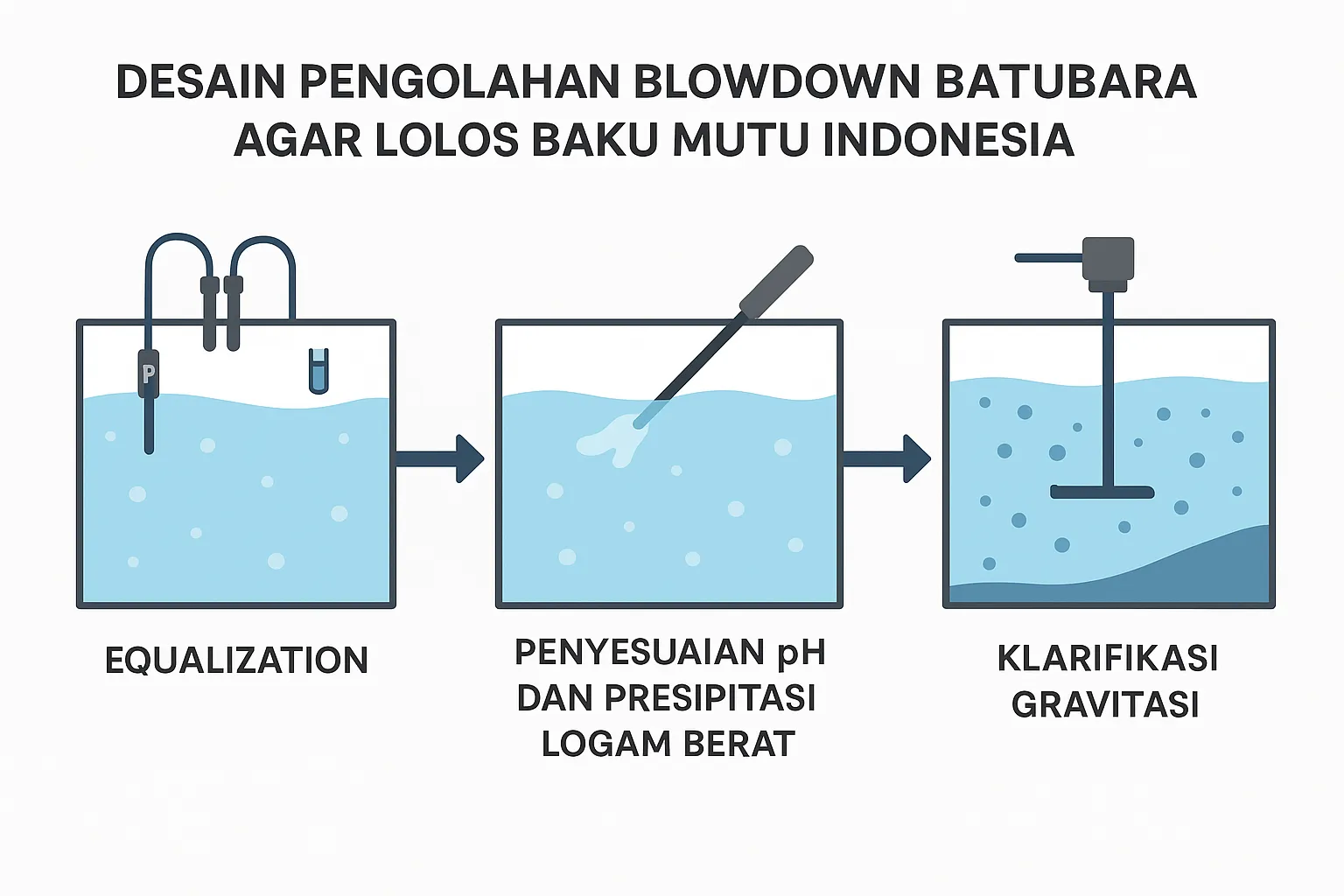
The recommended system follows a conventional sequence: equalization/mixing, pH adjustment and heavy‑metal precipitation, coagulation/flocculation, and final clarification. In practice, the equalization basin buffers flow and load swings and blends the chemical feeds. Automatic pH control gives a stable baseline. One Indonesian design used a 960 m³ equalization pond upstream of dosing (ISCA).
For accurate chemical feed, plants usually use flow‑proportional or pH‑triggered dosing pumps with instrumentation from water‑treatment ancillaries. The conditioned flow then goes to the precipitation step.
pH adjustment and heavy‑metal precipitation
Precipitation is the principal method for heavy‑metal removal in industrial wastewater, forming insoluble metal hydroxides at elevated pH (ChemTreat; IntechOpen). Hydrated lime (Ca(OH)₂) or caustic (NaOH) typically raises pH into the 9–10 range where Fe, Al, and Mn precipitate effectively as Fe(OH)₃, Al(OH)₃, and Mn(OH)₂ (ChemTreat; ITRC; IntechOpen). Lime is favored in mining because it can achieve higher pH than limestone (ITRC).
Depending on the influent, soda ash or magnesium hydroxide (Mg(OH)₂) can substitute where less extreme pH is needed (ChemTreat). Operators hold the pH setpoint steady, for example 9.0–10.0, before moving to coagulation.
Coagulation and flocculation
To aggregate the fine metal hydroxides and colloids, plants dose coagulants such as ferric chloride or alum. They then add polymeric flocculants for gentle‑mix floc growth (Veolia Water Technologies Handbook). In one case, a cationic polymer identified as “N8100” at 5 mg/L with pH adjusted to 6–8 gave excellent TSS removal (ISCA).
Jar tests are bench-scale beaker trials to tune the doses. They set the baseline. When optimized, heavy metal removal is usually above 95% and TSS removal above 90%. If raw pH is very low, an initial neutralization or simultaneous lime-floc dosing stabilizes performance, as reported in the cited design (ISCA). Plants usually source coagulants and flocculants to match jar-test outcomes.
Final clarification and polishing
Gravity settling in a clarifier completes the separation. A clarifier is a tank designed for solid/liquid separation. Typical designs run about 1–3 hours of retention, with surface overflow rates around 0.5–1.0 m³/m²·h. One referenced plant used three identical sedimentation ponds of 675 m³ each, running in parallel. They held the solids for roughly three months between cleanouts (ISCA). In well-tuned operation the effluent TSS falls below 20 mg/L. The case reached about 10 mg/L, with Fe down to about 0.11 mg/L and Mn/Al below 0.01 mg/L (ISCA).
Facilities usually specify a standard clarifier. Where footprint is tight, a lamella settler acts as the compact alternative. If a final polish is needed, dissolved air flotation (DAF) or filtration may be added. Operators sometimes use a DAF unit or a sand filter such as sand/silica filtration to trim remaining fines. For trace metals or organics, ion exchange and adsorption are relevant. Plants match media such as ion‑exchange resin or activated carbon to the specific discharge profile.
Sludge handling and disposal
Metal hydroxide sludge plus captured coal fines adds up. Sludge volume can be high, usually 300–500 kg wet sludge per m³ of precipitated metal (ChemTreat). In the sedimentation‑pond example, desilting every ~3 months yielded about 105 m³ of settled solids per pond (ISCA).
Dewatering with a centrifuge or filter press reduces the volume. Dry solids production usually runs 0.2–0.5 kg per kg of metal precipitated (ChemTreat). Disposal follows local hazardous‑waste (B3) requirements. Plants add sludge treatment steps as needed to improve dewatering.
Operator control and compliance guide
- pH control: Continuous pH monitoring in equalization or precipitation tanks keeps performance steady. Target pH 9.0–10.0 for precipitation. Enough alkalinity stops the metals from dissolving again during any pH dips. Logging pH and residual alkalinity helps tune the dose (ChemTreat).
- Chemical dosing: Flow‑proportional or pH‑triggered pumps set the baseline. Jar tests give the starting doses. Then feed‑forward (flow/turbidity) and feedback (effluent) adjustments refine the setpoints. Reported practice includes ~10–50 mg/L polymer plus comparable mg/L lime, calibrated to site conditions. One cost comparison showed polymer at ~US$10/day versus FeCl₃ at ~US$119/day (ISCA). Plants usually use dosing pumps for coagulant and flocculant feeds.
- Clarifier operation: A stable sludge blanket and gentle inflow protect the settle zone. An online turbidity meter helps track performance. Sludge depth probes that show >0.5 m thickness can point to a ~3‑month cleanout interval in ponded systems (ISCA).
- Monitoring and compliance: Routine sampling for pH, TSS, and key metals (Fe, Mn, Al, plus others of concern) is the base of compliance. Weekly lab checks, or as the permit needs, keep the plant within limits. Typical internal targets: TSS < 20 mg/L, Fe < 0.5 mg/L, Mn < 0.1 mg/L. The cited plant’s Fe at ~0.11 mg/L shows the headroom when chemistry and clarification are in line (ISCA).
- Waste and sludge management: Dewatering (centrifuge or filter press) cuts the volume. Expected dry solids of 0.2–0.5 kg per kg of metal precipitated is a planning guide (ChemTreat). Disposal follows local B3 rules.
Performance benchmarks and outcomes
When precipitation and clarification are set up well, removal efficiency usually lands in the 90–99%+ range. Fe and Al removals of 99%+ at pH 9–10 are common (ChemTreat). In the Indonesian reference case, blowdown TSS dropped from ~1,000 mg/L to 10 mg/L. Turbidity was cut from 150 NTU to 3 NTU. Dissolved metals fell from tens or hundreds of mg/L in the raw to below detection in the effluent (Fe ~0.11 mg/L, Mn/Al <0.01 mg/L) (ISCA).
Key operational metrics include final effluent TSS and metal concentrations, chemical feed rates and sludge yield. A standard clarifier with the right coagulation/flocculation chemistry, supported by properly selected coagulants and flocculants, keeps this consistent.
Economic and regulatory trends
The coal sector is moving toward zero‑liquid‑discharge (ZLD) and internal reuse to reduce environmental impacts. PP 22/2021 tightens heavy‑metal and solids limits. Water‑scarce sites sometimes close the loop with treatment such as evaporation and reverse osmosis (RO). However, the cost rises as purity requirements rise (ChemTreat). Where reuse is viable, plants may consider RO packages like brackish‑water RO under a broader membrane systems strategy. However, many sites meet compliance and cost goals with precipitation/clarification alone.
Summary
A sequential system of equalization, pH adjustment (lime dosing), chemical coagulation/flocculation, and final clarification reduces coal prep blowdown TSS and heavy metals below regulatory discharge limits. With good chemistry and settling, the effluent usually meets TSS < 20 mg/L and key metals < 0.1–0.5 mg/L, per the cited case (ISCA, ChemTreat). Routine monitoring, sludge management, and fit‑for‑purpose polishing support consistent compliance. The polishing step can use options such as DAF, sand filtration, ion exchange, or activated carbon.
Sources
Design guidance and data were compiled from industry and technical references including Indonesian case studies and treatment manuals: ISCA; ChemTreat; Veolia Water Technologies Handbook; Yokogawa; ChemTreat. Additional precipitation specifics are discussed by ITRC and IntechOpen.