

Article
Refiners Are Losing Millions to Preheat‑Train Fouling. Here’s the Chemistry Fix That’s Working
Industry: Oil_and_Gas | Process: Downstream_
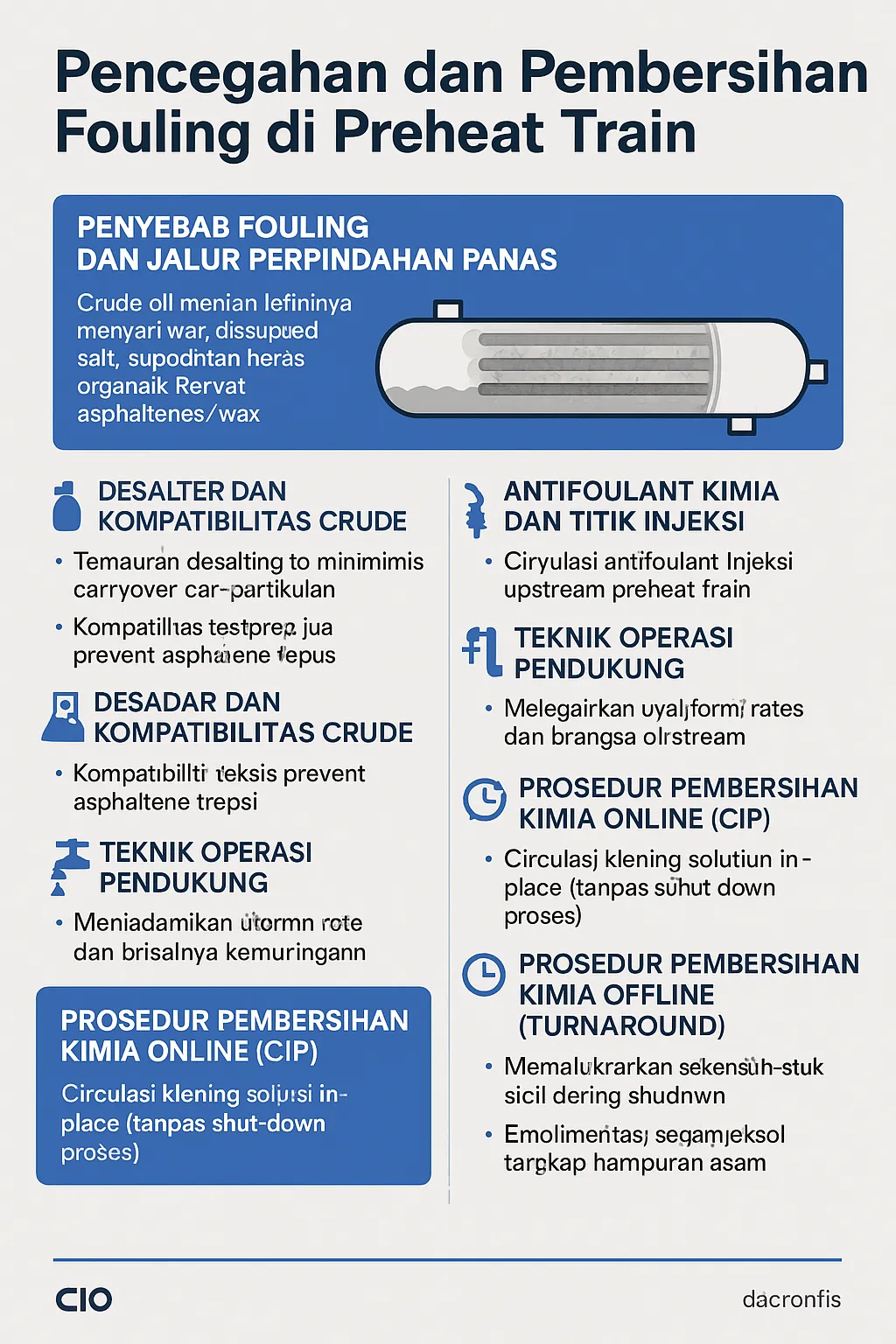
Crude oil doesn’t arrive clean. It brings water, dissolved salts, suspended solids, and heavy organics such as asphaltenes and waxes, all of which are primed to deposit when heated in a preheat train (digitalrefining.com) (fqechemicals.com). The result is a stubborn, dual‑layer mess — often ~50% inorganic scales (iron/silica) and ~50% organic mass (asphaltenes/waxes) by weight — that drags down performance (digitalrefining.com) (fqechemicals.com).
As deposits accumulate, the exchanger’s overall heat‑transfer conductance (UA, a measure of how effectively a unit transfers heat) falls, approach temperatures tighten, and pressure drop rises; required furnace duty climbs to compensate (cheresources.com) (fqechemicals.com). In one assessment, fouling drove roughly $5.4 million per year in extra fuel, before counting throughput losses (researchgate.net). Even a few °C of added duty can trim distillation throughput by a few percent, with significant profitability impact (digitalrefining.com) (researchgate.net).
Preheat‑train contaminants and penalties
Upstream, desalting and solids control are the first line of defense. Electric‑pulse water wash desalting reduces chloride and particulate carryover into hot exchangers. Therefore it curbs both inorganic scale and organic deposition (digitalrefining.com) (cheresources.com). On blending, “stability” matters. Incompatible mixes of heavy and light crudes can precipitate asphaltenes. Simple compatibility tests (for example solvent deposition trials or solubility blending number) help avoid combinations that flocculate when heated.
Refiners have also used high‑aromatic diluents to stabilize heavy feeds. Patents describe adding small fractions of high‑solvency aromatic crude to keep asphaltenes dissolved (SBN, or solubility blending number, >80) and to flush deposits. One soak with a high‑SBN blend lifted feed preheat by ~15 kbtu/bbl (≈100 kJ/L) on average (patents.google.com) (patents.google.com). In short, design blends so SBN to insolubility number (Iₙ) exceeds ~1.0. Or co‑inject aromatic diluents to maintain solubility (patents.google.com).
Antifoulant injection and field performance
We dose antifoulant continuously upstream of the preheat train. This disperses potential foulants before they stick. Most additives are surface-active surfactants or polymers that solvate or encapsulate asphaltene and wax particles (for example alkylphenol ethoxylates, olefin sulfonates, polyamide amines, polyisobutylene succinimides, naphthenic acid derivatives. Formulations are usually proprietary) (researchgate.net). In pilot work, a magnesium-sulfonate surfactant with nanocarbon additives cut deposit mass by ~90% (about 1 g vs ~23 g without additive) and halved pressure drop (1.1 vs 2.5 psi). Fuels were saved and crude conversion went up by ~2–3 wt% after installation (researchgate.net) (researchgate.net).
Results vary. An experienced engineer cautions that off‑the‑shelf antifoulants sometimes only reduce fouling 10–15% unless the chemistry matches the crude and conditions (cheresources.com). That’s why field trials at process conditions (continuous‑loop tests) are favored over lab coupons, which can overpredict benefits (researchgate.net) (digitalrefining.com).
In practice, additives are injected continuously at low dosage, usually tens to hundreds of ppm, at a point that gives good mixing and entry to the hottest exchangers. Accurate metering with a dosing pump keeps the rate under tight control. Vendor guidance and crude assays usually set the initial dose. Operators then watch UA or pressure‑drop trends to fine‑tune it. Overdosing can cause emulsion issues or too much carryover. Residuals must be compatible with downstream catalysts and wastewater limits (researchgate.net).
Operational controls and deposit disruption
Beyond chemistry, temperature discipline matters. Keep tube-wall superheats in check. Manage throughput so the hottest exchanger sits below the onset temperature for asphaltene precipitation. This helps avoid thermal polymerization and deposition. Some units also run on-stream rinses as a quick intervention. They divert desalting water or steam through exchangers to melt waxes and wash away salt scales (cheresources.com).
Others have added ultrasonic transducers to exchanger shells. Low-power ultrasound has been reported to “poke” fouling loose and improve uptime. One vendor claims 24/7 disruption of deposits and up to ~100% cleanability without shutdown (digitalrefining.com).
Chemical cleaning in place (CIP) loops
When fouling crosses limits, online cleaning can keep barrels moving. If the train has isolation valves and a cleaning loop, operators can circulate cleaning fluids through the exchangers without a full shutdown. This “CIP” (clean-in-place) design “allows cleaning without shutting down” (epcmholdings.com).
Cleaning chemistry is staged by foulant type. A mild solvent or alkaline detergent targets organic layers first. Then a separate acid or chelant phase tackles inorganics. One approach circulates a hot hydrocarbon or glycol solvent to dissolve asphaltenes. A dilute inhibited acid follows, for example phosphoric or nitric acid, to chelate iron salts. The crude is by‑passed during the cycle (epcmholdings.com). In one case history, an in‑line solvent soak using a high‑solvency light crude restored furnace feed temperature by 15 kbtu/bbl (patents.google.com). A final flush with clear hydrocarbon or water removes spent chemicals before normal service resumes.
Offline turnaround cleaning sequence
Severe fouling or bundle access needs trigger an offline job. Standard practice uses a fill-and-soak sequence, warmed and circulated, with steps for both organics and inorganics:
Step 1. Pre‑flush (solvent): Fill with hot hydrocarbon, for example recycled kerosene or diesel, or a surfactant emulsion. This dissolves the hard “black pancake” of asphaltenes and wax. Circulate for hours to soften organics. Solvent steps that target waxes can be supported by products designed to dissolve paraffin wax deposits, such as a wax dissolver.
Step 2. Alkaline soak: Drain and circulate an alkaline detergent at 50–80 °C. Use for example sodium hydroxide with a surfactant, or an amine detergent. This saponifies and washes away oils, greases, and fragmented organics (xylemheattransfer.com).
Step 3. Acid/chelating soak: After a flush, fill with inhibited acid (usually phosphoric/nitric mixtures) or an organic chelant (for example, a citric/acetate blend referenced in WO2015044709) to dissolve iron oxides, calcium carbonate, and metallic salts (xylemheattransfer.com) (fqechemicals.com). Soak until the reaction slows. Then sample the effluent for hardness.
Step 4. Final rinse: Flush thoroughly with fresh water (if the system is demulsified) or solvent. Neutralization steps (for example, with bicarbonate) may be needed between stages to avoid violent reactions. Step 5. Reassemble and test: Dry/purge, restart, and monitor performance.
These deposits are “not coke, but very tenacious carbonates and resins.” Solvating the organic binder is usually the rate‑limiting step. Once the binder is broken, inorganics flush or dissolve more easily (fqechemicals.com) (fqechemicals.com). Hydroblasting or steam cleaning can complement chemicals, with care to avoid tube damage. In one report, flushing with light hydrocarbons (kerosene/diesel) recovered 80–85% of lost capacity during outage cleanup (digitalrefining.com).
Waste handling and regulatory notes
Spent acids/caustics and oily sludges need compliant disposal. For example, Indonesia’s environmental rules classify these as hazardous waste (B3). Therefore post‑cleaning neutralization and permitted discharge or contractor removal are needed according to local permits.
Monitoring and ROI: best‑practice checklist
- Monitor fouling metrics: Use heat‑transfer models or alarms on ΔT (approach temperature) or pressure drop. Then you can act before the performance loss becomes prohibitive.
- Optimize desalting: Keep crude water and salt content as low as possible. Make sure the wash‑water quality is good, for example <5 mg/L solids, to reduce carry‑through.
- Blend for stability: Avoid high‑ΔT mixing of incompatible crudes. Consider aromatic diluents or high‑SBN streams for heavy feeds (patents.google.com).
- Maintain small continuous doses of antifoulant: A well‑chosen dispersant injected at pump suction can extend run length. Check the vendors’ claims with field trials (researchgate.net) (researchgate.net).
- Water‑wash tactic: Periodic on‑line desalting‑water or steam flushing can dislodge salt scales in exchangers (cheresources.com).
- Enable CIP design: Where feasible, equip preheat loops with circulation circuits and isolation valves. Then the loop can be cleaned on‑stream with detergents or acids (epcmholdings.com).
- Plan turnarounds: Execute the fill/soak sequence rigorously. Solvents or detergents for organics first, then acids for inorganics (fqechemicals.com) (xylemheattransfer.com).
- Quantify gains: Document recovered UA and ΔP, and track ROI. Eliminating fouling may recover several tens of kJ/kg of crude heating value (patents.google.com) and boost throughput by ~2–3% (researchgate.net). This usually outweighs the chemical costs.
Refiners can cut the productivity and energy losses from preheat-train fouling by using strong fouling-inhibition chemistry, keeping operations disciplined and cleaning chemically from time to time (researchgate.net) (patents.google.com). The choice of antifoulant and cleaning regimen depends on the crude and the configuration. Pilot tests and monitoring are the best way to confirm the gains.
Sources: Peer‑reviewed studies and industry data on crude‑train fouling and chemical cleaning (digitalrefining.com) (fqechemicals.com) (researchgate.net) (researchgate.net); case studies and patents on solvent‑soak interventions (patents.google.com) (researchgate.net); industry experience and best‑practice reports (digitalrefining.com) (cheresources.com) (epcmholdings.com). All figures and claims are from these cited sources.