

Article
The new oil crisis inside car plants: how to break automotive emulsions and hit 17 mg/L
Automotive wastewater carries oils, surfactants and metals that do not want to separate. A multi-stage design gets oil-and-grease down to permit levels, even when the emulsion is chemically stabilized. The stages are API gravity separation, DAF and chemistry driven by data.
Industry: Automotive | Process: Industrial_Wastewater_Treatment_(Oily_&_Metals)
Car factories and service plants discharge wastewater with a lot of mineral oils and lubricants, surfactants, and metals such as Zn, Cu and Ni. The oil content varies a lot. Manual car-wash effluent usually runs at 10–50 mg/L oil-and-grease, with local spikes above 500 mg/L (mdpi.com). Detergents and stabilizers break the oil droplets below 10 µm. Therefore the oil-in-water emulsion is hard to break.
Regulators set tight limits. The U.S. EPA has proposed an O&G effluent standard of 17 mg/L monthly average for metal‑products/machinery industries (researchgate.net). Indonesian rules (Permen LH 5/2014 et seq.) also need low oil/grease and heavy‑metal discharges. In practice, treatment must remove about 90–99% of oil, usually down to below 20–30 mg/L, and precipitate dissolved metals to ppb–ppm levels.
Baca juga:
Kondensat LFG TPA: Desain Trap, Material Tahan Korosi, dan Drainase
Influent profile and permit targets
This is the problem for the environmental engineer. The oil droplets are below 10 µm and held by surfactant. Zn, Cu and Ni come from machining or plating. In some sectors the permit target is 17 mg/L O&G monthly average (researchgate.net). The job is to design a train that removes 90–99% of the oil every time and brings the metals down to the low mg/L or below.
Pre‑treatment screening and grit removal
Start with the first defense: coarse screening or grit tanks with 3–6 mm bar screens to catch debris. This step protects the units after it and removes almost no oil, but it stops clogging. Plants usually use modular systems such as primary wastewater physical separation and choose a manual screen or an automatic screen depending on labor and how much the load varies.
API gravity separation design criteria
The first formal oil removal stage is an API separator (American Petroleum Institute gravity separator). The design targets are a length:width ratio of at least 5:1 and a horizontal velocity of no more than 3 ft/min (~0.015 m/s), with a depth:width of 0.3–0.5 (parsianfarab.com) (parsianfarab.com). The unit separates the water into three layers: sludge at the bottom, oil at the top and clarified water in the middle. Then the oil is skimmed off for reprocessing and the settled sludge is removed mechanically (parsianfarab.com).
A typical API separator removes most of the free (unenclosed) oil. Industry sources cite 60–80% removal in this step (parsianfarab.com). Many plants add engineered skimming systems to the gravity traps, similar to oil removal equipment, so the floating hydrocarbons are captured reliably.
High‑area plate packs (CPI/lamella)
Where space is limited, a corrugated-plate interceptor (CPI) or lamella pack can replace or add to API tanks. CPI devices add plates with a large area. This makes gravity separation stronger and catches smaller droplets. Design assumptions usually use 150 µm, against 60 µm for standard API sizing (parsianfarab.com). Compact modules such as a lamella settler can increase the effective settling area within the same plan view.
DAF with coagulation and flocculation
The API/CPI effluent still has a lot of emulsified and fine‑dispersed oil, so it goes to dissolved‑air flotation (DAF). DAF saturates a recycle stream at high pressure, then releases microbubbles (~100–1000 µm). The bubbles attach to flocs and droplets and float them into a skimmable layer (a typical pesticide‑flotation process description). With the right chemistry, DAF removes 70–90% of the remaining oil (scielo.org.za). The detention time is usually 10–20 minutes.
In jar-test optimization, a cationic polyacrylamide, Zetag FS/A50 at 50 mg/L, achieved 83% oil/soluble oil-and-grease (SOG) removal and 82% COD removal after DAF processing (scielo.org.za). Plants usually specify packaged DAF units. They then translate jar-test doses to full scale by metered injection with a dosing pump for day-to-day control.
Emulsion breakers and polymer chemistry
Breaking chemically stabilized emulsions depends on demulsifiers and the right polymers. Demulsifiers are usually cationic, oil-soluble polymers or surfactant-like agents that adsorb at the oil-water interface. They replace natural surfactants, reduce interfacial tension, neutralize zeta potential, and weaken the interfacial film so droplets coalesce (mdpi.com). Oil-soluble demulsifiers usually work better for oil-in-water emulsions because they migrate into the oil droplet and displace asphaltenes/resins (mdpi.com). Typical practice is a low dose, tens to hundreds of ppm, added before any flocculant. Vendors package these as demulsifiers for industrial wastewater applications.
Once the emulsion film is weakened, high‑MW cationic polyacrylamides bridge droplets and solids into large flocs. In jar tests, a cationic PAA at 50 mg/L (Zetag FS/A50) gave 80–90% removal of COD and SOG and 70–85% TSS removal after DAF (scielo.org.za). In the cited tests, more polymer gave much more removal. The polymer dose was the main factor, and the flocculants worked over a wide pH range (scielo.org.za) (scielo.org.za). Plants usually use inorganic coagulants together with organic polymers. The metal salts help break the emulsions and carry down metals, and the polymers form strong flocs. Commercial lines include coagulants and flocculants.
Jar‑testing protocol for chemical programs
Jar testing decides the chemistry. A typical approach (adapted from industry guides) starts with a representative sample (3–4 L), split into 500 mL beakers and stirred at ~120 rpm to keep the oil in suspension (dober.com).
Step 1: add a small dose of candidate demulsifier or coagulant to each jar. For example, add 0.1 mL of a stock chemical to a 500 mL sample. Mix at high speed for 1–2 minutes and watch for “microflocs” (opalescence or tiny floc). These show the emulsion film is breaking (dober.com). Increase the dose step by step if needed, but avoid impractical additions. A rule of thumb is to stay below ~1000 mg/L inorganic coagulant to limit sludge (dober.com). Record the dose at first microflocculation.
Step 2: drop the stir speed to ~30–40 rpm and add flocculant. Let’s say 1 mL of 0.5% polymer, mixed gently for ~1 minute. Add the chemical in increments until macroflocs form and the water clears quickly. The solids then settle, or they are ready to float in DAF (dober.com). Let the jars settle 5–10 minutes. Then measure turbidity and oil/grease (for example the IR OG method) or total petroleum hydrocarbons. The best dose is the lowest chemical addition that meets the target clarity, such as <20 mg/L oil. If you plot residual oil against dose, you usually see a sharp improvement past a threshold (dober.com).
Step 3: if the emulsions resist breaking, repeat at pH ~4–5. If the flocs are weak, try pH ~8–10. A first‑stage coagulant like FeCl₃ or HCl at low pH can shock the emulsion and form microflocs. Raising the pH before polymer addition can improve bridging (dober.com). Iterate across several demulsifiers and flocculant grades. In one study, model‑predicted removal reached ~96% for COD and 96% for oil/gres at the best doses, close to the experimental ~82–83% (scielo.org.za).
Heavy‑metal precipitation and chelant effects
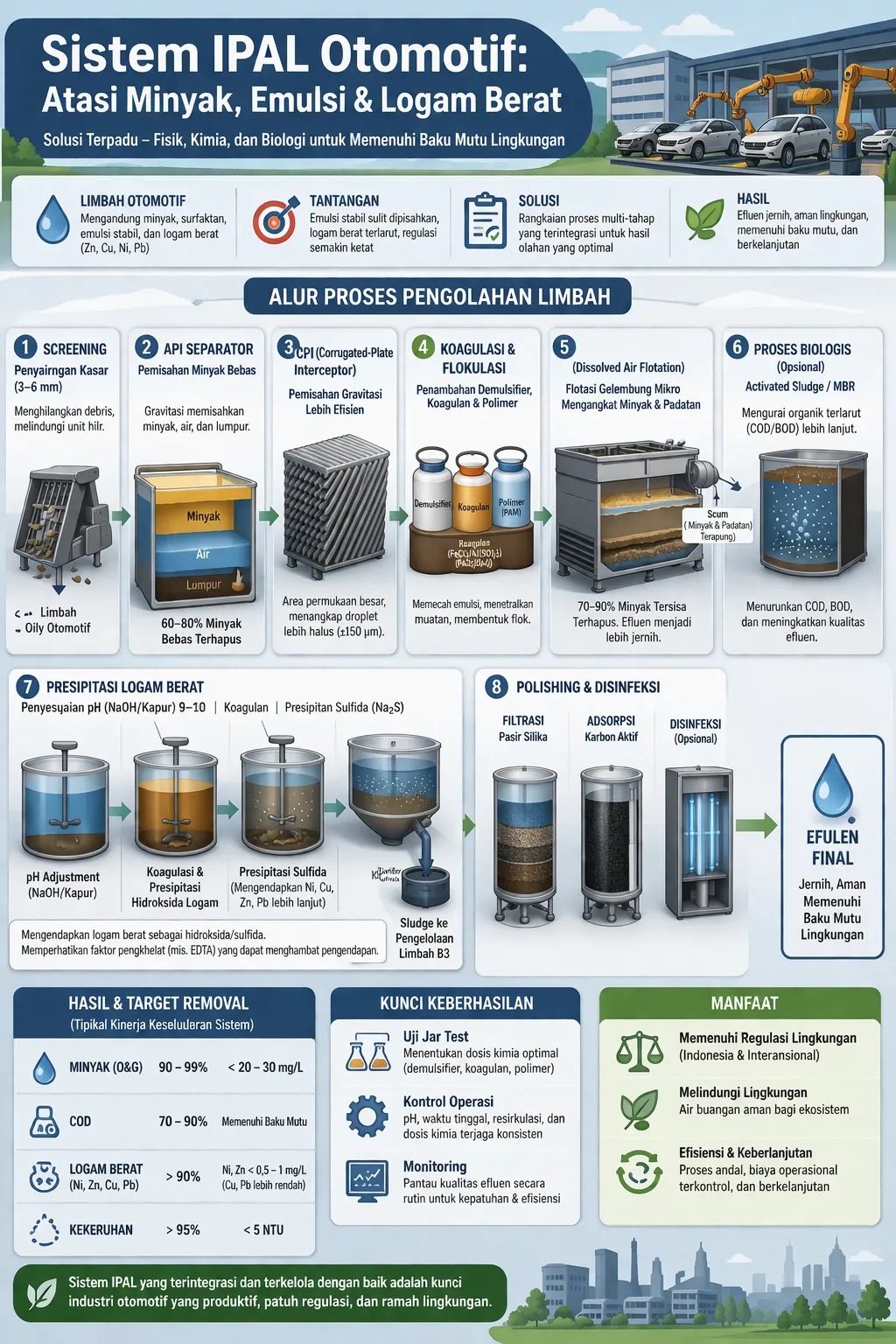
After oil removal, dissolved metals are precipitated chemically. Raising the pH to ~9–10 with lime or NaOH forms metal hydroxides (chrome, Al, Fe). Coagulants such as FeCl₃ or Al₂(SO₄)₃ help this. For Ni, Cu, Zn, and Pb, sulfide addition (for example Na₂S) can drive solubility lower. Studies show sulfide precipitation can reach lower residuals than hydroxide alone (ascelibrary.org).
There is a catch. Chelating agents like EDTA (a common cleaner additive) can stop Ni, Zn and Pb from precipitating, even at concentrations below 1 mg/L (ascelibrary.org). In practice, hydroxide/sulfide usually removes Cu well. However, Ni and Zn may need aggressive dosing. One study found more than 90% Cu removal while Ni/Zn stayed above limits in samples that contained EDTA (ascelibrary.org). The precipitates go to solid–liquid separation in a clarifier. The final effluent is checked against the targets, for example Ni and Zn below 0.5–1 mg/L. The cost is modest. Even aggressive treatments were estimated at less than $5 per 1000 gallons of wastewater (ascelibrary.org). Plants buy reagents from broad lines of water and wastewater chemicals so they can adapt to the chelants.
Baca juga:
Flare Tertutup di TPA: Suhu 1.000°C Penentu Izin Emisi
Tertiary polishing and biological options
If the clarified effluent still carries COD/BOD (chemical/biochemical oxygen demand), activated sludge or an MBR (membrane bioreactor) can oxidize the dissolved organics. Packaged activated‑sludge systems or MBR units are common choices. Filtration or adsorption, such as sand filtration and activated carbon, can polish the residual oil and organics.
There is also membrane polishing. Ultrafiltration (UF) has treated car‑wash effluent and reached about 100% oil removal and permeate turbidity below 0.5 NTU. The performance held across repeated washing (mdpi.com). These units need high capex and they foul easily without good pretreatment. Therefore they are usually placed after DAF. OEM lines include ultrafiltration systems as pretreatment and polishing modules.
Performance metrics across the train
What success looks like: oil & grease removal of 70–90% in the DAF stage when the dose is right (scielo.org.za). In a cited trial, 50 mg/L polymer gave 82–83% oil removal. It dropped an influent of 100 mg/L to roughly 18 mg/L (scielo.org.za). With secondary polishing, UF or activated carbon, O&G can be pushed below 10 mg/L.
COD removal of 80–90% in chemical–DAF reduces load on biology (scielo.org.za). TSS (total suspended solids) removal typically hits 80–90% across API + DAF + sedimentation, with 70–85% TSS removal reported in the polymer jar tests and effluent TSS often ending below 30–50 mg/L (scielo.org.za).
For metals, correct chemistry gives >95% Cu removal and major chromium/hydroxides removal. Very high Cu removal is routine. However, Zn/Ni stay above 90% removed only if chelators are absent (ascelibrary.org). Facilities usually target Ni <0.5 mg/L by adjusting the sulfide dose and checking whether EDTA is present.
Sludge handling and solids management
Expect sludge from each stage: oily sludge from API/air‑scoop (~10–30% dry substance), float sludge from DAF, and hydroxide sludge from metal precipitation. These are usually dewatered (for example with a belt press or filter press) and disposed of according to local classification. For design, assume dry solids of roughly 0.5–1% of flow. Upstream choices like adding a tube settler or specifying wastewater ancillaries can make thickening and removal simpler.
Data‑driven sizing and operating setpoints
Retention times matter. API separators usually hold 30–60 minutes to let the oil rise (parsianfarab.com). DAF units run 10–20 minutes. This matches jar‑test observations that flotation happens within minutes once the chemistry is right (dober.com).
Jar tests set the chemical dose. In the cited work, 50 mg/L of polymer came close to the highest removal, and higher doses gave smaller gains (scielo.org.za). The effluent goal sets the train. If the target is <20 mg/L O&G and the raw wastewater is 200 mg/L, the chain (API + DAF + chem) must remove >90%. You check compliance by simulating or testing representative samples, as the referenced studies show (scielo.org.za) (scielo.org.za). Automated control with a calibrated dosing pump helps keep the dose at the jar-tested optimum.
Baca juga:
Desain Sumur Gas TPA, Kolektor, dan Vakum untuk Tangkap Metana
Source notes and technical references
Design criteria, performance data, and mechanisms referenced in this report draw from API‑style separator guidance and descriptions (parsianfarab.com) (parsianfarab.com) (parsianfarab.com); polymer/demulsifier mechanisms and jar‑test outcomes (mdpi.com) (scielo.org.za) (scielo.org.za); jar‑testing procedures (dober.com) (dober.com) (dober.com) (dober.com) (dober.com); metals precipitation and chelant effects (ascelibrary.org) (ascelibrary.org) (ascelibrary.org); car‑wash influent and UF polishing performance (mdpi.com) (mdpi.com); and O&G permit context (researchgate.net).