

Article
THE CARBON FILTER IN YOUR BREWHOUSE CAN HARBOR BACTERIA. HERE’S THE MAINTENANCE SCHEDULE THAT KEEPS IT CLEAN
Industry: Brewery | Process: Water_Treatment_(De
Brewers use granular activated carbon (GAC) to polish their most important ingredient. GAC removes disinfectants and organic contaminants. This stabilizes flavor and protects downstream equipment such as reverse osmosis (RO) membranes (water.co.id). It strips free chlorine/chloramine and adsorbs off‑flavor volatiles (including aldehydes and phenols) (water.co.id) (activatedcarbon.net). In brewhouse practice, the carbon media itself does the heavy lifting on taste. This is the same class of media found at </products/activated-carbon>. It also shields membrane trains such as those in </products/membrane-systems>.
There is a catch. Once chlorine is removed, microbes can colonize the bed. In an EPA study of drinking‑water GAC filters, over 40% of effluent samples contained carbon fines heavily colonized with heterotrophic bacteria, and 17% harbored coliforms (nepis.epa.gov). GAC‑bound bacteria survived 20 mg/L chlorine for 1 hour (nepis.epa.gov). Microbial releases peaked seasonally (spring/fall) when turbidity or flow increased (nepis.epa.gov). The bottom line is that without maintenance, GAC beds become biofilm reservoirs, including chlorine‑resistant organisms.
Backwash parameters and triggers
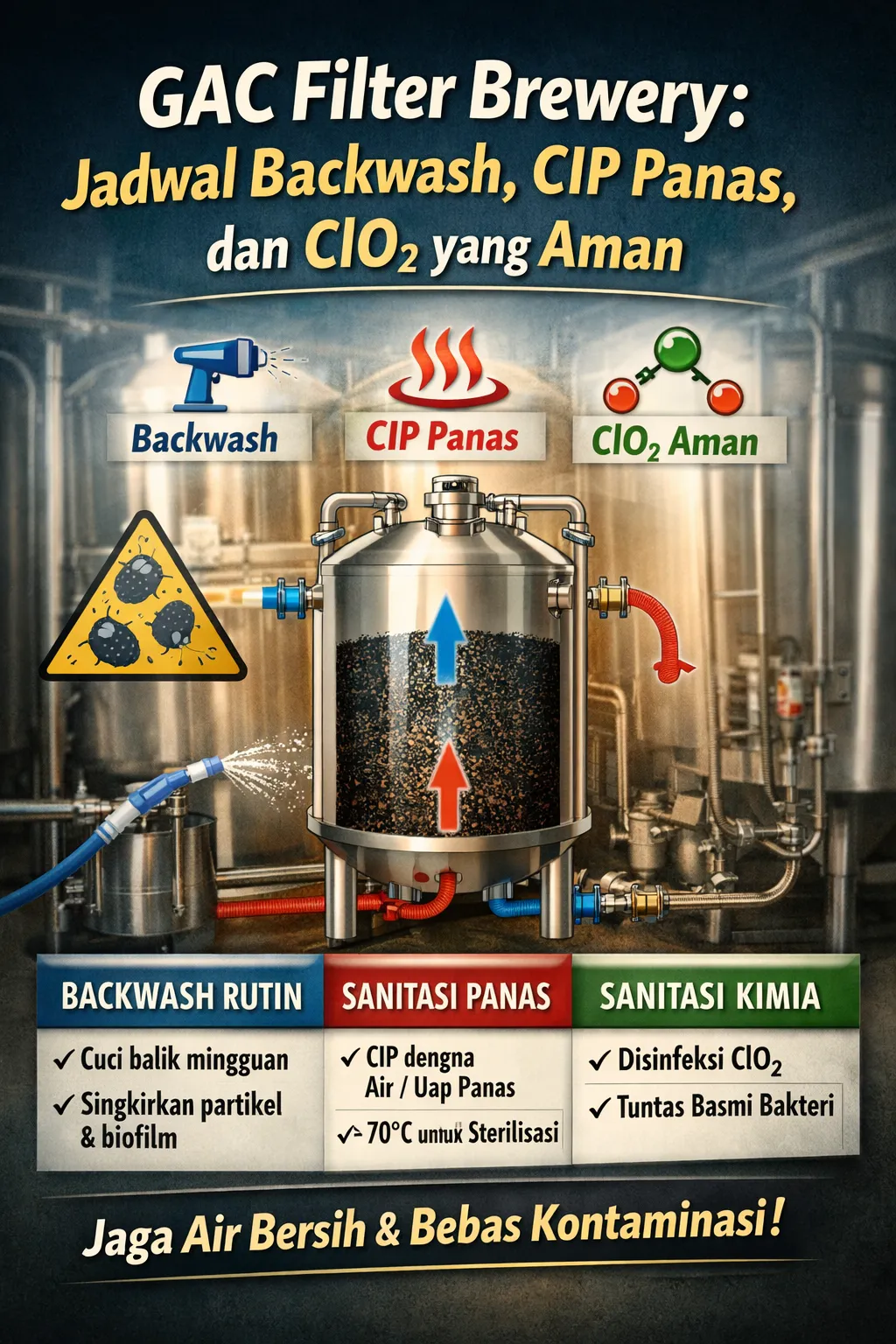
Objective: remove trapped solids and biomass and prevent compaction. A good backwash expands the carbon bed by about 30–40% by volume. During expansion the granules rub together and dislodge particulates and microbes. The bed also re‑stratifies, so denser and larger granules settle below the finer ones. This preserves the mass‑transfer zone (MTZ, the part of the bed where adsorption is active) and delays breakthrough (carbotecnia.info) (carbotecnia.info).
In practice, reverse the flow through the vessel (usually up‑flow) with service water. If the equipment allows, a short air‑and‑water scour helps remove fines. Calibrate the backwash rate so the bed expands fully without carbon loss (screened outlet). One guideline is to ramp the flow gradually until you reach about 30–40% expansion. Check this by watching the backwash effluent run clear (carbotecnia.info) or, on top‑registored units, by looking at the fluidized bed (carbotecnia.info).
Frequency is either condition‑based or scheduled. In pressurized down‑flow filters, a typical trigger is ~0.5–0.7 kg/cm² (≈7–10 psi) differential pressure; in gravity (open‑tank) units, a rise of ~1–1.5 m in weir height signals the same headloss (carbotecnia.info). Where clogging is slow, use a fixed interval — at minimum weekly — to prevent “cementation” by biomass or scale (carbotecnia.info). Each cycle starts with expansion and ends with a rinse to allow carbon to settle and re‑stratify; continue until discharge runs clear. Proper backwashing has been shown to remove nearly all accumulated biomass and fines (carbotecnia.info) (carbotecnia.info).
Thermal and chemical sanitization cycles
Mechanical backwashing does not kill attached bacteria. Periodic sanitization is needed. There are two approaches. Thermal methods: breweries specify “steam‑sanitizable” stainless steel vessels that allow steam or hot water clean‑in‑place (CIP). Industrial GAC filters exist that routinely steam at 70–90 °C to inactivate biofilms (pureaqua.com) (pureaqua.com). After a backwash and drain, the vessel is charged with hot water (or steam) for a 30–60 minute soak. Outcome claims include >5‑log reductions of bacteria on carbon surfaces (industry claims). Caution: make sure the carbon and seals are rated for temperature and pressure. Stainless filters designed for industrial service are pertinent to this discussion.
Chemical methods: general oxidants (free chlorine, ozone, hydrogen peroxide) do not work deep in GAC. Carbon destroys them before they reach the full bed. Chlorine dioxide (ClO₂) is preferred. The recommended procedure is to fully backwash and drain, then flood the bed with ClO₂ at ~30 mg/L (enough to fill the void volume and overflow). Hold for ≥1 hour, then backwash and rinse to purge the sanitant (carbotecnia.info) (carbotecnia.info). Testing of the GAC effluent, heterotrophic plate count (HPC) and coliform, should guide the frequency. At minimum, include the GAC outlet in monthly potability lab protocols. Any exceedance triggers a sanitation cycle (carbotecnia.info). In practice, breweries sanitize with chlorine dioxide or hot water quarterly or semi-annually. They also sanitize immediately if testing shows >0 CFU. Carbotecnia notes that non-silver-impregnated GAC in industrial use must be disinfected when the output fails bacterial standards (carbotecnia.info).
Media life, change‑out, and cost
Adsorption sites exhaust over time. Chlorine breakthrough is not a reliable indicator of organic capacity. Carbon can still remove residual chlorine long after organic removal has faded (carbotecnia.info). In one example, a bed with a 5-minute empty-bed contact time (EBCT) ran 6 days per week and removed dissolved organics (chemical oxygen demand, COD, ~20 mg/L) effectively for ~12 months. Residual chlorine was retained for 2–3 years (carbotecnia.info).
In practice, brewers generally replace GAC annually. An industry calculation showed that yearly carbon replacement (at ~35 MXN/kg) adds only ~0.0006 MXN (≈0.6 cent Rupiah) per cubic meter of treated water — a negligible cost of quality (carbotecnia.info). Some large beverage suppliers explicitly cycle carbon beds annually as routine maintenance (carbotecnia.info). Replacement timing can also be adjusted by monitoring usage or water quality (for example, if feed‑water organics spike or treated‑water total organic carbon, TOC, or UV absorbance trends upward). Smaller brewers sometimes extend carbon life by reactivating — e.g., drying at 100 °C — and reusing 4–5 times (cheekypeakbrewery.com.au) (cheekypeakbrewery.com.au), though this is labor‑intensive and less common in continuous plants. Overall, plan media renewal every 1–2 years, sooner if off‑flavors or breakthrough are detected (carbotecnia.info) (carbotecnia.info). Practicalities of parts and media procurement sit within </products/water-treatment-part-and-consumables>.
Quality outcomes and operational risk
If you follow this schedule, the effluent plate count stays very low. Biofilms do not reach the beer tanks or the RO systems downstream, so you avoid fouling and spoilage. After a proper chlorine dioxide sterilization, microbial assays usually drop from thousands of CFU/mL (colony‑forming units per milliliter) to zero in the filtrate. If you neglect it, the opposite can happen. Coliforms have been found from time to time in GAC effluent at some facilities (nepis.epa.gov) (nepis.epa.gov). Clear water with no chlorine also protects the beer sensory quality. Chlorine residuals cause phenolic off‑notes, and organic surges drive staleness.
There is a business upside too. Routine backwashing reduces headloss buildup. Without it, pump energy goes up or the flow stops. Scheduled change‑outs avoid capacity failures at the last minute. The annualized carbon cost is low (see cost example, carbotecnia.info), so the program is cost‑effective. It also supports food‑safety compliance and brand protection.
Sources and technical anchors
Authoritative studies and industry sources underpin this guide: EPA research on GAC bacteriology (nepis.epa.gov) (nepis.epa.gov); technical guidelines on backwashing and sanitization (carbotecnia.info) (carbotecnia.info); and industry publications on GAC replacement (carbotecnia.info) (carbotecnia.info). Indonesian F&B water‑treatment references were also considered (water.co.id).