

Article
Nickel mines plug in containerized water plants to hit Ni ≤0.5 mg/L
A three‑stage, modular treatment train lets miners dewater fast and meet tight discharge limits, usually from skid‑mounted containers. The train is settling with floc, pH‑driven metal precipitation, and final clarification.
Industry: Nickel_Mining | Process: Mine_Dewatering
When tailings pits fill and pit walls weep, the clock starts ticking. One mining team dewatered 200,000–300,000 m³ in three months using a 10,000 m³/day mobile Actiflo system that dosed ferric sulfate and polymer before microsand clarification—meeting permit standards and accelerating blasting schedules (www.veoliawatertech.com).
The blueprint behind that speed is straightforward. Drop out solids first, precipitate metals next, and clarify again to polish. The units are deployed as containerized “plug-and-play” units. Capacities scale from 1 m³/h up to 500 m³/h per module. Higher flows are achieved by adding further units (www.veoliawatertechnologies.com).
The result is regulatory alignment, including the Indonesian PermenLH 09/2006 limits—TSS (total suspended solids) <100 mg/L at the first stage and nickel (Ni) ≤0.5 mg/L at discharge (pdfcoffee.com).
Primary solids removal (detention 2–6 hours)
Mine dewatering water usually carries sediment, clays, and slimes. These must be removed before any chemistry. A settling pond or a clarifier drops out coarse and fine solids with multi‑hour detention, usually 2–6 hours, so heavier particles gravitate out.
For high flows or tight footprints, lamella (inclined plate) or microsand clarifiers give much more settling area. Compact lamella designs can reduce footprint by about 80% versus conventional clarifiers. High-rate systems like Actiflo multiply the effective area and cut footprint by ~5–10× versus open ponds (www.veoliawatertech.com). Let’s say the flow is 100 m³/h and needs 4 hours of detention (≈1,440 m³ volume). An open basin might then need ~360 m² at 4 m depth. High-rate units can cut that by ~90%.
Flocculant addition is standard. This means polyacrylamide or ferric sulfate plus polymer. Even low doses (≤10 mg/L) agglomerate colloids and lift TSS removal above 90% (www.veoliawatertech.com). Jar tests (bench trials to optimize dose) should set the recipe. In practice, 1–10 mg/L of coagulant/polymer usually delivers 80–95% turbidity/TSS drops. Pairing optimized chemistry with a lamella settler or microsand unit is how Veolia’s 10,000 m³/day mobile system consistently met discharge standards with ferric sulfate + polymer dosing (www.veoliawatertech.com). Typical stage‑one targets are TSS <100 mg/L (Indonesian mine limit) (pdfcoffee.com). Many plants reach single‑digit mg/L TSS when flocculation is tuned.
On equipment, accurate chemical feed matters. Miners usually specify a dedicated dosing pump for polymer and ferric feeds, alongside bulk storage and inline mixers. Chemistry staples are standard consumables in this stage. These are flocculants and coagulants (flocculants, coagulants).
pH adjustment and metal precipitation (target pH 9–11)
After solids, the job is dissolved metals. Raising pH with lime (calcium hydroxide), NaOH (sodium hydroxide), or similar converts many metals into insoluble hydroxides for removal. EPSE summarizes it this way: “A common way to precipitate metals is to raise the pH with bases like calcium or sodium hydroxide… At high pH, many metals form poorly soluble hydroxides” (www.epse.fi).
For nickel, practice shows that removal above 90% needs pH ≈9–10. A good sequence has two steps. First raise the pH to ~8 to drop Fe/Al. Then raise it to ~9–10 to precipitate Ni/Co as Ni(OH)₂/Co(OH)₂. The core reaction is Ca(OH)₂ + Ni²⁺ → Ni(OH)₂↓ + Ca²⁺. Discharge goals usually aim for Ni <0.5 mg/L (Indonesia’s PermenLH 09/2006 sets Ni ≤0.5 mg/L, and the WHO drinking standard is 0.07 mg/L) (pdfcoffee.com). That usually means more than 90–95% Ni removal from the raw level (for example, from 5 mg/L down by more than 10×). Monitoring pH and metal assays is a must.
Reagent choices: lime slurry is preferred for higher pH setpoints (pH ≥9), with a rough guide of ~1–3 kg Ca(OH)₂ per kg of metal removed, depending on water hardness. An MDPI study found crystalline Ni(OH)₂ forming at pH ≈6.5 with Ca(OH)₂, but environmental waters usually need higher pH for complete removal. Sodium hydroxide or soda ash can be easier in modular plants. Ferric salts (for example, FeCl₃) or MgO are sometimes added to target specific contaminants. Ferric also works as a coagulant (coagulant). All chemicals are dosed in stirred reaction tanks.
Final clarification and polishing (sludge capture)
Precipitated metal hydroxides become sludge that must be settled and removed. A second clarifier or lamella thickener captures >95–99% of these fines. In design, flow through the clarifier is deliberately low, for example <0.5 m³/m²‑min, to favor settling. High‑rate options (a second Actiflo or lamella module) can maintain throughput. Where ultra‑low TSS is needed, polishing filters such as sand filters can drop residual turbidity to <5 NTU.
Performance is well documented: effective trains deliver TSS often <10–50 mg/L, and Actiflo systems can achieve <10 NTU even at high loads (www.veoliawatertech.com). Coupled with full metal precipitation, plants meet Ni <0.5 mg/L and Fe <5 mg/L (per Indonesian limits) (pdfcoffee.com). Turbidity and metal assays should validate discharge.
Sludge handling is part of the plan. Thickened sludge (usually 1–5% solids) is removed from time to time and dewatered with a filter press or geotextile tubes. Geotextile dewatering has precedent in Indonesia. Solmax reported dewatering 250,000 m³ of tailings slurry in Kalimantan using long geotubes. This is beyond the water‑treatment skid. However, modular projects must include sludge management logistics.
Mobile and containerized delivery (plug‑and‑play)
For remote or temporary dewatering, mobile/containerized packages are increasingly standard. Units ship by truck or ship and are “plug‑and‑play” on site, minimizing civil works and allowing ease of installation (www.veoliawatertechnologies.com). Typical modules cover 1 m³/h to 500 m³/h per unit, and scalability is achieved by adding identical skids in parallel (www.veoliawatertechnologies.com).
Mobility also derisks projects: mobile teams can run “trial” campaigns to prove performance while permanent plants are engineered (www.veoliawatertechnologies.com). As discharge limits tighten (lower TSS, Ni, As), miners can slot in added filtration or ion‑exchange containers to stay compliant with Indonesian PermenLH (Ni ≤0.5 mg/L) and international standards (pdfcoffee.com). For temporary capacity, some operators turn to containerized rental units designed for emergency or short‑term water treatment needs.
The commercial momentum is clear. The global mobile water treatment market is estimated at about $5.84 billion in 2025. It is projected to reach $9.33 billion by 2030 (CAGR ~9.8%). Mining is among the drivers (www.researchandmarkets.com).
Schematic train and controls (three modular stages)
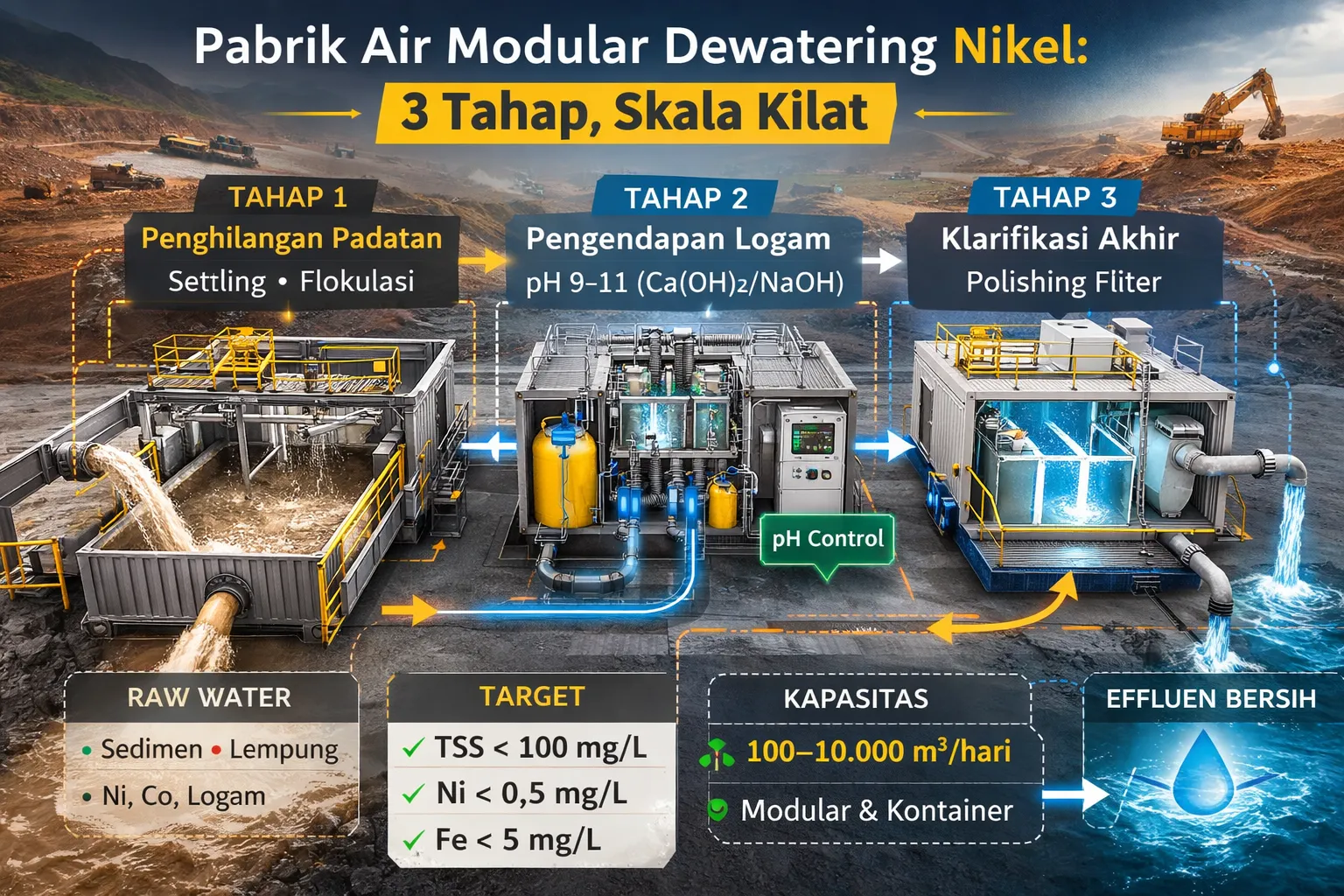
A typical skid‑mounted dewatering kit chains three stages. (a) A grit/sediment basin or lamella tank with a polymer feed (supported by a chemical dosing pump). (b) A mixing/precipitation stage where lime/caustic is dosed into a rapid‑mix tank. (c) A clarifier tank (usually lamella or microsand). Modules come with all piping and pumps. Crews make only the onsite connections. Built correctly, this configuration meets Indonesian effluent limits (for example, TSS <100 mg/L and Ni <0.5 mg/L) (pdfcoffee.com).
Implementation, automation, and outcomes
We size the plant from field sampling and piloting. The expected dewatering rate sets the number of modules. A mass balance, for example the moles of Ni to precipitate, tells us the lime and caustic demand. To make the plant bigger, add parallel skids. Modern packages have control panels on board and telemetry. The dosing controls hold the pH and turbidity targets. In-line sensors (pH/ORP/TSS analyzers) check compliance. This matters at remote sites (supporting equipment).
One Western Australia example ran a modular Actiflo package at 10,000 m³/day (~420 m³/h), mixing ferric sulphate and polymer prior to clarification to meet strict discharge permits (www.veoliawatertech.com). Veolia notes mobile services can cover any treatment step—coagulation, filtration, demineralization, metals removal—as part of the regulatory process (www.veoliawatertechnologies.com).
A well‑designed train gives consistent outcomes. It reduces Ni from raw water (usually >5 mg/L in tailings effluent) to ≤0.5 mg/L. It removes >95% of Fe/Mn/Co. It drops TSS from hundreds of mg/L to <50 mg/L. This meets Indonesian mining water standards.
Financing and deployment economics
Mobile or containerized plants can be leased or rented. This turns CAPEX into OPEX. That helps during development phases when cash is tight. Operators pay monthly for capacity and can put off permanent builds. Faster permit compliance can save time on the schedule. Mobile units prove the performance while the fixed plants are built (www.veoliawatertechnologies.com).
A modular plant for nickel mine dewatering can be scaled and built in containers. It runs in three steps: high-rate settling in a pond or clarifier with floc, then a pH-lime reaction to remove metals, then final clarification to capture the hydroxide sludge. Each stage can be containerized. This approach is proven at hundreds of m³/h for pit dewatering and usually meets strict TSS and metal limits (www.veoliawatertech.com. www.veoliawatertechnologies.com). It gives the business what it needs (OPEX flexibility, fast deployment) and still meets the environmental obligations.
Sources: Indonesian PermenLH 09/2006 (Ni ≤0.5 mg/L; TSS ≤100–200 mg/L for nickel mines) (pdfcoffee.com); Veolia case studies and technology notes (www.veoliawatertech.com; www.veoliawatertech.com); EPSE metal precipitation primer (www.epse.fi); market analysis (www.researchandmarkets.com).