

Article
Nickel mills are bleeding steel Smarter media, tuned mills, and a dash of chemistry can slow the bleed
Industry: Nickel_Mining | Process: Ore_Crushing_&_Grinding
In nickel, every tonne pays a toll to comminution. Grinding and crushing take 30–50% of mining operating costs (journals.sagepub.com). Inside industrial ball mills, the split is stark. About 37% of the cost is grinding media, 13% is liners and 50% is energy (www.mdpi.com). A small gain in efficiency moves real money.
Nowhere is that more consequential than in laterite-heavy nickel hubs — Indonesia alone sits on about 20% of world nickel reserves (eur-lex.europa.eu). Here’s what the data and field practice say about cutting media and liner wear while meeting throughput: pick the right media, tune the mill, and let chemistry do some lifting.
Grinding-media selection and sizing
Match the media to the ore hardness and chemistry. The best media balance hardness, toughness and corrosion resistance (www.mdpi.com). For abrasive nickel laterites or aggressive wet grinding, high-chromium white cast iron (HCWCI) balls wear much less than ordinary steel. These are Fe–Cr–C alloys at 12–30% Cr with hard carbides. One study found HCWCI wear rates about 10× lower than forged/cast steel in dry grinding (www.mdpi.com). Heat-treated medium-chrome cast irons also show better microstructure and wear resistance (www.mdpi.com).
Forged high‑carbon steel balls (usually 1–3% C) are tougher but they resist abrasion less. They cost less upfront and they wear faster. There is a trade-off on nickel/copper sulfide circuits. Some studies saw higher flotation recoveries when grinding with forged steel instead of high‑Cr balls (www.mdpi.com). Therefore operators sometimes accept higher media wear to get cleaner metallurgy in Ni–Cu sulfides. An old milling rule of thumb says: grind soft ores with very hard media, but very hard ores with softer, tough media so the ball surfaces can “armor” (www.911metallurgist.com). In modern wet nickel practice, tough high‑chrome alloy balls are common (www.mdpi.com).
Size distribution matters. Large balls break coarse feed. Smaller balls finish the grind. Plants pick the top size with Bond’s approach or the square‑root rule of feed top size, about D_top ≈ √F80 (F80 is a common feed size indicator, where 80% of particles are finer). A graded charge, for example 80, 60, 40 mm, gives the most contact points and the best efficiency (www.metso.com). Too many oversize balls leave product coarse. Too many small balls extend time and abrasion. Trials report 3–5% kWh/t improvement from optimizing size mix, with proportional wear benefits.
Shape plays a role. Experiments found spherical balls cause the highest liner wear compared with cylindrical or block‑shaped media (journals.sagepub.com). Where appropriate (usually in regrind), cylpebs or segments trade some impact for more surface area and slower media wear. Shot or ceramic beads are used in specific cases, for example nano‑ceramic beads in stirred mills (www.mdpi.com). However, round forged or cast balls are still the nickel workhorse.
Mill speed, charge, and slurry density
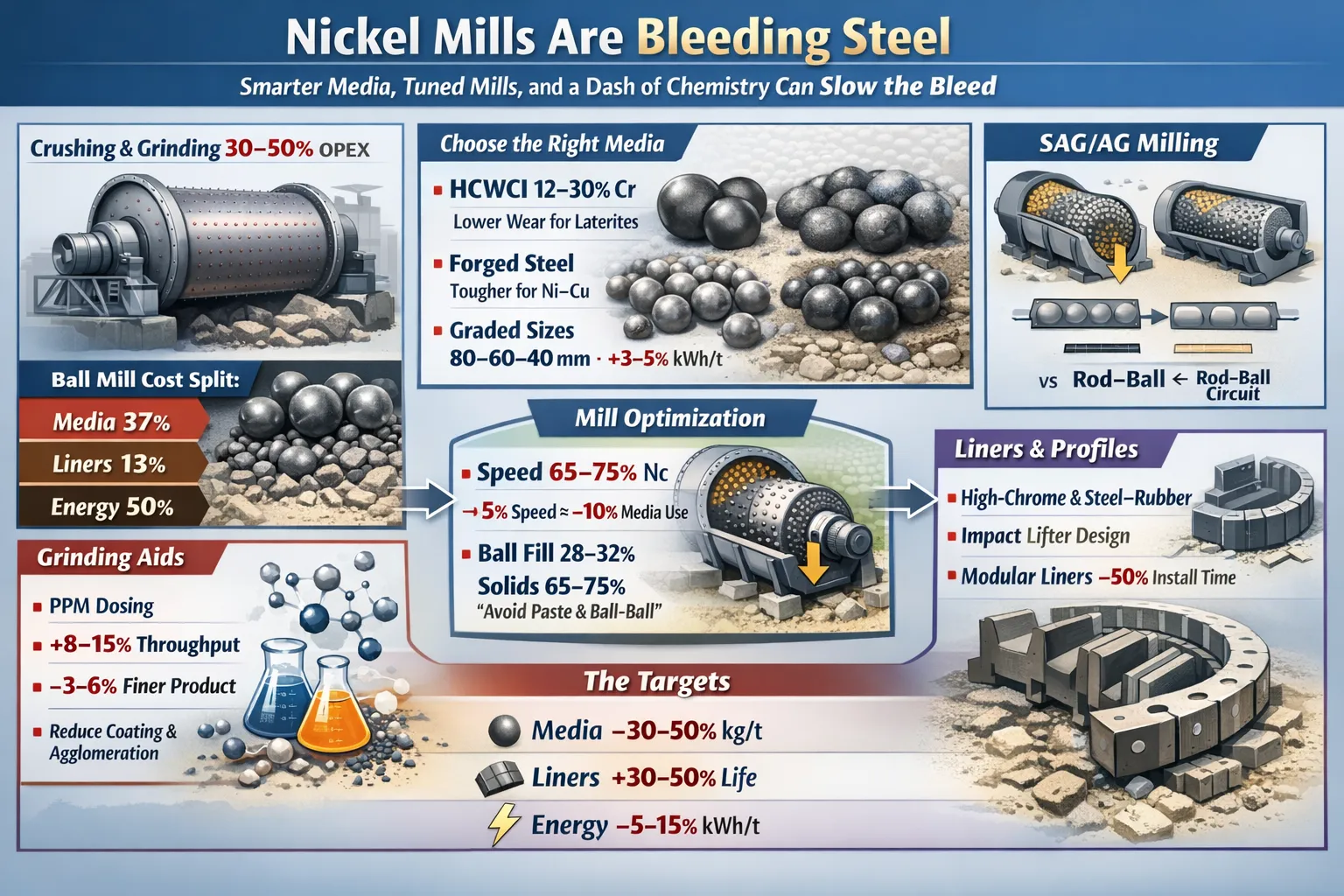
Speed is a lever. Running closer to critical speed Nc (the rotation where media would centrifuge) boosts impact intensity and wear. Empirical data indicate roughly linear dependence in the normal range. Gupta and Yuan reported about 2% higher ball‑media consumption for every 1% increase in mill speed (www.mdpi.com). Many mills target 65–75% of Nc to achieve cataracting (balls arcing and impacting) without centrifuging. Even a 5% speed reduction can trim media consumption by ~10% using that relationship.
Ball filling and pulp matter. Higher ball volume raises total media surface area and, with it, wear; overloaded toes cause balls to rub each other rather than the ore (www.mdpi.com). Typical ball filling sits around ~28–32% of mill volume. Slurry solids are tuned to cushion impacts without creating paste‑like flow: many circuits target 65–75% by weight (www.mdpi.com). Extremely high solids (>80%) slow grinding and throughput (as Tucker noted, efficiency drops with paste‑like flow, www.mdpi.com), while too dilute (<60%) raises ball–ball collisions. Historic observations suggest an intermediate “armoring” condition minimizes wear (www.911metallurgist.com; www.911metallurgist.com).
Discharge style shifts the wear mode. Overflow mills, with a slurry pool above the discharge, skew toward abrasion and corrosion. Grate-discharge mills, with drained slurry, see more impact and liner wear (www.mdpi.com). Grate mills usually need sturdier liner sets. Sometimes they tolerate a slightly coarser grind to limit extreme impacts.
AG/SAG changes the steel balance. Semi-autogenous grinding (SAG, where the ore itself is primary media augmented by a smaller ball charge) and autogenous grinding (AG, ore-only media) can cut total steel consumption. In one like-for-like comparison, a conventional crushed/rod-ball circuit consumed 0.8635 kg balls/t and 0.0953 kg liners/t. A SAG+ball circuit on the same ore used 0.7540 kg balls/t (15% reduction) and 0.0898 kg liners/t (6% reduction). That is a 13% drop in total steel (www.911metallurgist.com). For high-throughput nickel plants, that arithmetic matters.
Chemical grinding aids and dosing
Chemistry reduces time on steel. Grinding aids, polymers or surfactants, disperse particles and reduce slimes agglomeration. Therefore each collision breaks more rock. In one continuous ball-mill trial, a low-molecular-weight polymer dosed at ~0.6 lb/ton raised throughput by 8–15% at constant product size (www.911metallurgist.com). Alternately, it produced about 3–6% finer output at constant feed rate (www.911metallurgist.com). More tonnes per operating hour means fewer ball impacts per tonne. Therefore the media and the liners last longer.
Mechanisms are surface‑science simple: additives adsorb on mineral surfaces, change inter‑particle forces, prevent fines “ball coating,” and limit agglomeration so impact energy goes into ore instead of heat (www.911metallurgist.com; www.911metallurgist.com; www.911metallurgist.com; www.911metallurgist.com). Industry reports suggest 5–15% energy or time savings in wet grinding when additives are optimized (www.911metallurgist.com), with the added benefit that aids can enable higher solids while keeping workable viscosity (www.911metallurgist.com).
Operationally, plants handle low-dosage additions with accurate chemical feed equipment. The aim is steady ppm-level control, not batch slugs. For dosing control, many operators specify precise metering gear such as a dosing pump. Suppliers of mining reagents provide the additives used in these trials and similar wet-grinding circuits (chemicals for mining applications).
Liner materials and profiles
Liners do not grind, but they set the charge motion that does the grinding. High-wear alloys (Ni-hard irons), hybrid steel-rubber composites and weight-optimized systems have extended service life in abrasive circuits. Industry analysis shows that lighter or composite liners can improve wear life by reducing weight while keeping the same protection. Lower weight also eases bearing loads. Modular concepts like Metso’s “Megaliner” combine several lifters into one piece. In some cases this has cut installation time by about 50% (www.metso.com).
Placement and geometry matter. A common pattern is fewer, heavier segments of high-chrome steel or Ni-alloy near the mill toe (the high-impact zone), with rubber or mild steel in the lower-wear zones (www.metso.com). Steeper lifters raise the cataract height and the impact (faster grind, higher wear). Shallower angles soften the cascade (slower grind, less liner chipping). As liners wear, the charge motion shifts. Surveys point to 10-20% more wear failures with worn geometries. Therefore change-outs at planned outages, before the wear is too far, protect run-time. Good planning and tools for removal and installation matter, because the time saved adds up over years (www.metso.com). One miner extended liner life from 9 to 15 months with profile optimization and modular liners (www.metso.com).
Performance outcomes and metrics
Steel consumption falls when circuits are tuned. In the SAG example above, media dropped from 0.8635 to 0.7540 kg/t (−15%) and liners from 0.0953 to 0.0898 kg/t (−6%). That gives a 13% total steel reduction (www.911metallurgist.com). A site that uses 500 t/day of balls would save about 75 t/day at that cut. At scale that is a multi‑million‑dollar swing.
Throughput gains add to the wear savings. Field tests with grinding aids reported 8–15% higher tonnage at equal fineness (www.911metallurgist.com). A 2,000 t/d mill could reach about 2,200–2,300 t/d. The same media inventory then covers more tonnes, so wear per tonne drops by about 9–13%. Also, cutting mill speed by 5% can cut media consumption by about 10%, following the ~2%‑per‑1% relationship (www.mdpi.com).
Pulp density is another quiet win. Let’s say the mill runs at 70% solids instead of 60%. Throughput usually goes up a little and the balls hit each other less. Many plants report a 5–10% drop in specific energy (kWh/t) when they optimize density (www.mdpi.com). That means lower power and iron wear costs.
Put together, a full program can plausibly double grinding media lifetime. The program covers good media selection, balanced charge and speed, and chemical aids that work. For a baseline wear of 1.0 kg/t, plants have cut consumption to ~0.5–0.7 kg/t. Liner life usually goes up 30–50% with better material and geometry. Nickel plants run 24/7 at high throughput. Therefore saving even milliseconds per rock break adds up (journals.sagepub.com; www.mdpi.com).
References
See sources above for detailed wear and performance data (journals.sagepub.com) (www.mdpi.com) (www.mdpi.com) (www.mdpi.com) (journals.sagepub.com) (www.mdpi.com) (www.mdpi.com) (www.mdpi.com) (www.911metallurgist.com) (www.911metallurgist.com) (www.metso.com) (www.911metallurgist.com) (eur-lex.europa.eu).