

Article
Inside the screen wars at aquaculture intakes: traveling belts vs wedge‑wire
Industry: Aquaculture | Process: Water_Source_&_Intake_Treatment
For farms that use a lot of water, the wrong intake can kill the very fish they aim to raise. Regulations such as US Clean Water Act §316(b) need “best technology” to minimize impingement (organisms pinned against a screen) and entrainment (organisms drawn through a screen into the intake). The US EPA has said plainly that “a traditional traveling screen [alone] cannot meet the impingement mortality standard” for small fish (nepis.epa.gov).
The stakes are real. Australian studies and irrigation legislation worldwide set strict criteria on approach velocities and mesh sizes. Without screening, diversions can remove millions of fish every year. One estimate puts the loss at tens of millions of native fish each year to unscreened pumps (www.publish.csiro.au).
Regulatory drivers and ecological risk
Compliance rests on a simple premise: keep out the aquatic life stages you target, and safely return any that touch the screen. That premise sets the hardware, either traveling water screens or wedge‑wire panels, and the design parameters that govern performance, including mesh (or slot) size and approach velocity (the flow speed perpendicular to the screen face).
In practice, these choices also shape the pretreatment train that feeds aquaculture water systems. Many plants put screen equipment inside broader physical separation packages to remove debris before finer filtration. For example, they use packaged systems for screens in physical separation, or they select continuous debris‑removal units comparable to an automatic screen.
Traveling water screens: mechanics and performance
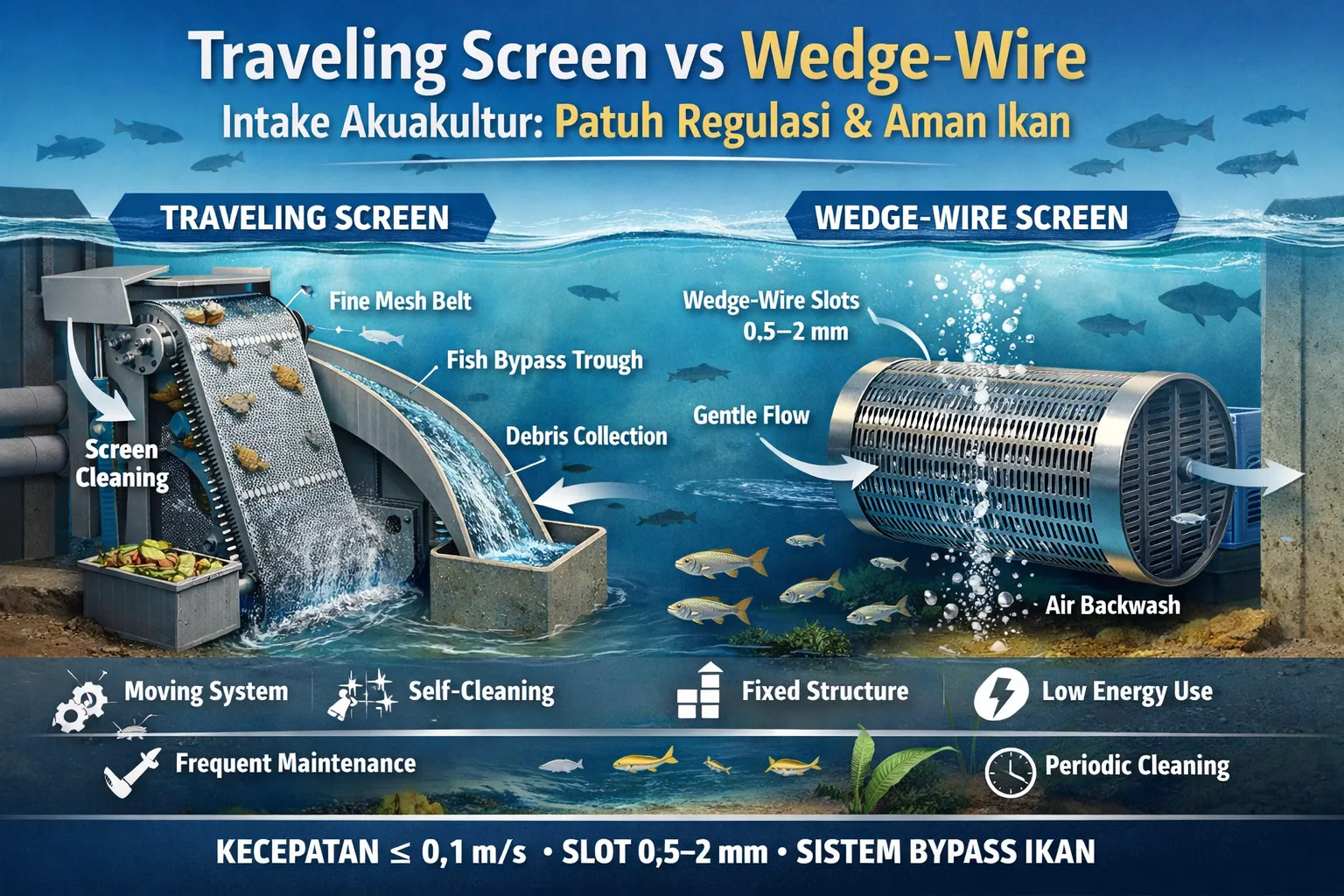
Traveling screens are mechanical “bucket belt” systems. Screen panels on a continuous belt or drum rotate through the intake and catch fish and debris. The belt carries them to the surface, where sprays rinse them into a bypass trough that returns the fish to the source. They are widely used in older industrial intakes and can be installed vertically or on an incline.
Exclusion efficiency depends on mesh. Coarse panels stop large fish but pass most juveniles and larvae. With fine mesh, usually about 0.5–1.0 mm, facilities have achieved high exclusion of fish eggs and larvae (nepis.epa.gov). In controlled tests on juvenile salmon about 26 mm long, a 2.5 mm mesh retained about 100% at approach velocities up to 0.3 m/s (nepis.epa.gov). In operation, even with fine mesh some small fish can be impinged and may slip through under strong currents. With fine mesh, traveling screens can achieve >90% retention for sturdier species. However, capture of the smallest larvae drops unless the mesh is extremely fine.
Reliability is proven, but it is mechanical. These systems clean themselves continuously with brushes and sprays. On large screens, brush cleaning usually runs about every 5 minutes, or it starts when the pressure drop is small (fwafishforum.com). Modern bucket designs have given very high survival of impinged fish. One study reported survival “among the highest for any traveling screen system” after the bucket improvements (nepis.epa.gov). The trade-off is moving parts. Motors, sprockets and brushes need power and routine maintenance. If upkeep lapses, failures cause downtime.
Maintenance centers on lubricating chains, replacing worn mesh panels, and servicing the spray and brush parts. Manual debris removal is minimal during operation. However, the bucket conveyor and wash system need regular inspection. Fine mesh can foul with algae if it is not flushed. Clean-water sprays help. Spray nozzles and bearings need periodic replacement. Overall, traveling screens need more maintenance for mechanical care, even though self-cleaning reduces manual labor.
Wedge‑wire screens: passive, fine‑slot exclusion
Wedge‑wire screens are rigid stainless panels, flat or cylindrical, built from wedge‑profile wires welded onto supports. The wedge geometry gives a high open area, usually 30–40%, and a continuous slot. Installations can sit perpendicular or angled into the flow, with deflectors or weirs to distribute the flow and reduce approach velocity.
They are widely recognized as highly effective for protecting small fish and larvae: with sufficiently small slots, they physically exclude larval‑sized organisms. Laboratory and field studies report that ~0.5–2.0 mm slots block 98–100% of small fishes and eggs (nepis.epa.gov; www.publish.csiro.au). Stocks et al. (2024) found a 2 mm wedge‑wire screen cut Murray cod larval entrainment by ≤84%, and with a 2 mm slot and ≤0.1 m/s design velocity, essentially none got through (www.publish.csiro.au; www.publish.csiro.au).
There are trade‑offs. Narrower slots raise headloss and clog risk from fine debris (www.mdpi.com), although large installations designed “specifically to prevent entrainment of [organisms]” have not caused unusual maintenance problems (nepis.epa.gov). In practice, many industrial wedge‑wire screens use ~4–10 mm slots and accept bypass of larvae; when used as small mesh panels (SMP) or paired with finer attachments, they can meet the strictest exclusion goals. With low design velocities and appropriately small slots, wedge‑wire systems can achieve near‑total exclusion of a target size class (nepis.epa.gov; www.publish.csiro.au).
Reliability favours the passive approach. No motors or chains means high mechanical uptime and low energy use. The flow must be enough to carry debris away, but maintenance is usually occasional cleaning rather than constant operation. Modern systems trigger air-pulse or rotating-brush cleaning on a sensed pressure drop (www.mdpi.com), so the operating costs stay low (www.mdpi.com). Power-plant intakes with 6–10 mm slots have been “biologically effective in preventing impingement of larger fish”, with no unusual maintenance problems (nepis.epa.gov). Clogging is still a concern if the slots are too fine and there is no debris control upstream. Where manual cleaning is an option, some facilities look at manual screen units in low-load locations.
Maintenance is straightforward. Remove environmental fouling (barnacles, algae) and monitor the pressure or flow drop to cue self‑cleaning. Seasonal use of fine screens usually involves backflushing or air‑scouring. When clean, wedge‑wire faces do not impede flow and help keep approach velocities low. The trade is some headloss sensitivity for large reductions in routine mechanical maintenance and power consumption (www.mdpi.com; www.mdpi.com).
Hydraulic criteria that drive survival
Approach velocity is the main variable. Tests show that a steady approach velocity of ≤0.1–0.12 m/s (≈0.3–0.4 ft/s) lets fish escape. Small fish were “very much more susceptible” to entrainment at 0.5 m/s than at 0.1 m/s. Therefore Boys et al. (2013) recommend ≤0.1 m/s (pmc.ncbi.nlm.nih.gov). Stocks et al. (2024) also recommend ≤0.1 m/s for juvenile cod with a 2 mm screen (www.publish.csiro.au).
The velocity cap sets the size. As a rule of thumb, 1 cfs at 0.33 ft/s needs about 3 ft² of open screen area (fwafishforum.com). A high open-area face (30–40% or more) lowers the slot velocity. If the structure limits the open area, designers add screen panels. One study showed that deflectors cut the peak inlet velocity from more than 2.0 m/s to about 0.06–0.08 m/s by equalizing the flow distribution (www.mdpi.com). A good sweeping current is also important. Guidance recommends a cross-current at least 2× the approach speed, so fish pass by instead of holding against the face (fwafishforum.com).
Slot size, mesh, and what gets through
Screen opening (slot) size must be smaller than the smallest protected organism. Guidelines suggest ~0.5–1 mm for salmonid fry, and up to ~2–3 mm for larger juveniles (nepis.epa.gov; www.publish.csiro.au). Collected data show 0.5 mm openings retained ≈98–100% of larval fish in tests (nepis.epa.gov). However, even 1.8–2.5 mm openings allowed escapes. In practice, many aquaculture intakes use medium slots (~3–5 mm) plus active fish‑return systems for larger fish.
Upstream debris management aligns with these choices. Where debris loads are variable, some operators consider continuous debris‑removal screen equipment similar to an automatic screen to stabilize differential head. Low‑flow canals may rely on simpler equipment akin to a manual screen in maintenance windows. These selections sit within broader physical pretreatment blocks, such as screens and primary separation.
Fish return, cleaning triggers, and uptime
Providing escape routes or returns is non-negotiable. Traveling screens depend on improved bucket shapes (Envirex design) and well-monitored bypass troughs. Reported survival of adult and juvenile fish has reached 90–100% in evaluations of these improvements (nepis.epa.gov). On wedge-wire panels, airflow or water jets coupled with post-screen return flows free impinged fish.
Operations keep velocities in check by cleaning on small head differentials. A common trigger is 0.03 m water column (about 0.1 ft), which makes sure approach speeds never exceed criteria (fwafishforum.com). Automated cleaning systems that respond to pressure drop are standard on passive designs (www.mdpi.com).
Materials, edges, and verification
Construction must avoid injurious surfaces. Specifications call for smooth stainless steel, and sharp edges are not allowed (fwafishforum.com). Rigid frames should sit flush with adjacent walls so no eddies form. Corrosion‑resistant materials and anti‑fouling coatings reduce buildup. Without them, the plant would need higher velocities. After construction, biological monitoring checks that impingement is negligible.
Bottom line: hardware plus hydraulics
Good fish protection needs the right screen and steady hydraulics. Traveling screens with fine mesh and fish return have been used for a long time and are easy to retrofit. However, they need more power and more maintenance. Wedge-wire screens usually keep out more fish, especially larvae, and cost less to run. However, they clog if the slots are too fine and there is no upstream control. For both types, the important requirement is to keep approach velocities low, about 0.1 m/s, and to provide return or bypass pathways (pmc.ncbi.nlm.nih.gov; nepis.epa.gov).
If you follow these criteria, and check them against local regulations, an aquaculture intake can draw the water it needs, harm fewer fish and meet its sustainability goals. Where a facility wants a packaged or modular option, vendors offer screen-based physical separation systems, plus continuous and manual screen formats, that match the designs described here (physical separation; automatic screen; manual screen).
Sources used to quantify performance, velocities, and survival include peer‑reviewed research, agency proceedings, and guidelines: www.mdpi.com; nepis.epa.gov (multiple sections including improved screening, cylindrical wedge wire, and impingement mortality); pmc.ncbi.nlm.nih.gov; and www.publish.csiro.au (with velocity guidance). Design calculations and criteria are also reflected in fisheries screening guidance (screen area; cleaning frequency; sweeping current; head differential triggers; materials).