

Article
The quiet battle at the seawater intake: fine‑mesh vs wedge‑wire
Industry: Desalination | Process: Seawater_Intake_&_Screening
Designers have two proven ways to reduce fish losses at open‑ocean intakes: finer openings and slower water. Fine‑mesh traveling screens are active moving belts, drums or baskets fitted with 0.5–1.0 mm mesh. They have repeatedly caught the smallest life stages. Passive wedge‑wire screens are stainless slotted cylinders or panels. They use hydrodynamics to sweep fish away instead of pinning them. The difference shows up immediately in field numbers and survival rates.
In power‑plant tests, 0.5 mm fine‑mesh screens captured more than 95% of fish eggs and about 86% of larval fish. 60–65% of the fish returned through fish‑return systems survived (nepis.epa.gov). Seasonal 0.5 mm installations at Big Bend (FL) and Brunswick (NC) cut entrainment by roughly 80–84% compared to conventional coarse screens. Entrainment means organisms drawn through the screen (nepis.epa.gov) (nepis.epa.gov).
Active fine‑mesh traveling screens
Fine‑mesh traveling screens (fine woven wire of 0.5–1.0 mm) are active, moving systems. They physically intercept eggs, larvae, and small juveniles, then carry them to a fish‑return system, usually in water‑filled buckets (studylib.net). They work like an automatic screen: automatic and continuous. Their performance is data‑backed. Power‑plant intake studies with 0.5 mm mesh captured >95% of eggs and ≈86% of larvae, with 60–65% survival among returned individuals (nepis.epa.gov).
In practice, seasonal 0.5 mm retrofits at Big Bend (FL) and Brunswick (NC) reduced entrainment by roughly 80–84% versus conventional coarse screens (nepis.epa.gov) (nepis.epa.gov). Those tests documented up to 95% removal of planktonic eggs (primarily Atlantic croaker and bay anchovy) and ~86% of larvae, dramatically cutting entrainment relative to unscreened intakes (nepis.epa.gov).
The trade‑offs are maintenance and fish handling. Small openings clog quickly with silt, algae, and debris. Therefore frequent cleaning (usually pressure sprays) and power for conveyors are part of the package. Without gentle fish‑return sluicing, impinged juveniles can suffer high stress or mortality. These are the fish held against the screen surface. EPA studies warn that return systems must be carefully designed to avoid this (nepis.epa.gov). In short, fine‑mesh traveling screens give the highest entrainment reductions for eggs and larvae. Reductions of 80–95% have been documented (nepis.epa.gov). However, the equipment is more complex and the upkeep is intensive.
Passive wedge‑wire surface screening
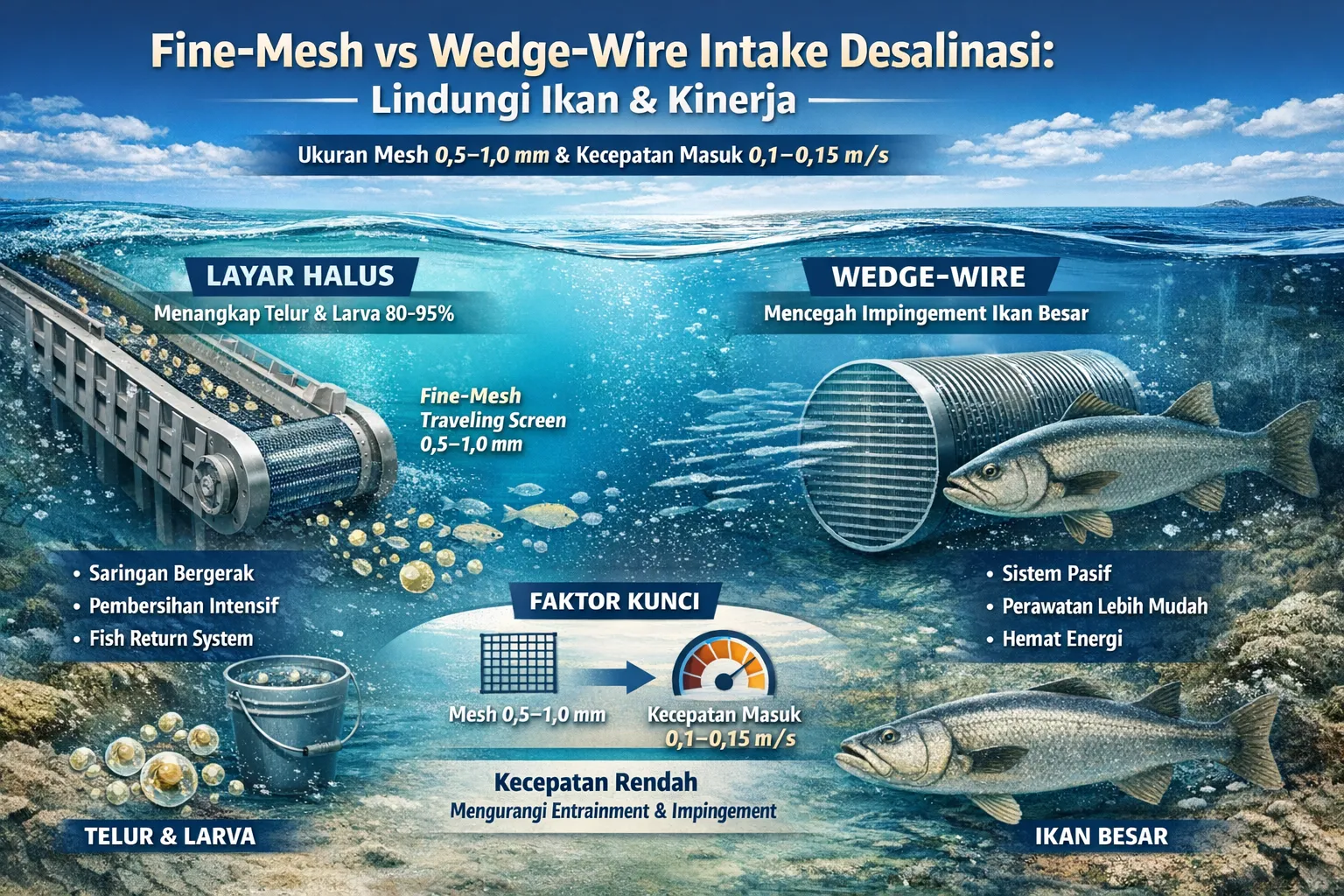
Passive wedge‑wire screens use narrow, stainless slotted elements (slot widths usually 0.5–3 mm) in cylindrical “V‑screens” or panels oriented parallel to the ambient flow. Their hydrodynamic principle is simple: maintain high cross‑flow at the screen face to sweep organisms off the surface while drawing water through the angled slots (nepis.epa.gov) (www.researchgate.net).
Field results are striking for larger fish. In Santa Cruz, a submerged cylindrical wedge-wire screen with 2.0 mm slots was evaluated for 13 months at ~0.33 fps (0.10 m/s). It reported zero fish impinged (www.researchgate.net). At the Eddystone Generating Station, retrofitting 9.5 mm wedge-wire screens dropped fish impingement from millions per year to essentially zero (nepis.epa.gov).
Lab work helps set the size thresholds. With 1 mm slots, wedge‑wire kept out more than 80% of ichthyoplankton (fish eggs and larvae) longer than 5 mm and virtually 100% above 10 mm. Fish under 5 mm passed through virtually unimpeded (www.tandfonline.com). Passive systems do not physically remove plankton or eggs below the slot size. They also foul more slowly than fine mesh, but they still need periodic air‑burst back‑flushes (studylib.net). Compared with fine‑mesh traveling screens, and with conventional coarse configurations that are usually manual, such as a manual screen, passive wedge‑wire usually has a lower operating cost. However, it needs careful siting and orientation. The equipment is usually submerged. EPA 316(b) guidance cites wedge‑wire as the most effective passive open‑intake screen form (studylib.net).
Mesh/slot size and approach velocity
Screen effectiveness depends on two things: the opening size and the approach velocity (the through-slot speed at the screen surface). Smaller openings block smaller organisms. However, they increase head loss and the risk of fouling. Coarser openings allow a higher velocity for a given area. However, they let more organisms through. Industry guidance aims for very low approach velocities, on the order of 0.1–0.15 m/s, with mesh or slots selected for the target biota (studylib.net) (studylib.net). Both fine-mesh traveling screens and narrow-slot wedge-wire systems are usually designed with ~0.5–1.0 mm openings and a through-slot velocity around 0.5 fps (~0.15 m/s). This matches the U.S. EPA’s 0.5 fps (feet per second) recommended limit and default compliance criterion for fish protection (studylib.net) (studylib.net).
Field studies suggest that even lower velocities protect small fish better. Boys et al. (2013) found that mesh size had little effect on entrainment rates. However, approach velocity was decisive. Doubling the velocity (0.1→0.2 m/s, or somewhat higher in their tests) sharply increased entrainment of small (<150 mm) fish. They recommended ≤0.1 m/s to minimize impacts across an entire fish assemblage (journals.plos.org). A Polish study showed that adding flow deflectors to equalize flow could reduce the maximum inlet velocity to ~0.05–0.08 m/s. This gives an extra margin of safety for ichthyoplankton (www.mdpi.com).
Design practice and field thresholds
Below about 0.15 m/s, impingement drops sharply. One intake running at 0.33 fps (0.10 m/s) recorded zero fish impinged (www.researchgate.net). Above those velocities, entrainment goes up a lot. EPA studies note that intake head flows of only a few tens of cm/s can kill juveniles. In practical designs, very fine mesh (for example 0.5 mm to catch larvae) usually means a larger total screen area or more frequent cleaning, so the approach velocity stays within about 0.1–0.15 m/s.
Accordingly, high‑value installations layer safeguards: multiple parallel screens enlarge area, air‑burst systems purge fouling, and fish‑return sluices recover impinged organisms. The data bear this out: fine‑mesh traveling screens can achieve ~80–95% entrainment reduction (nepis.epa.gov), while wedge‑wire screens in proper orientation have repeatedly eliminated impingement of large fish (www.researchgate.net) (nepis.epa.gov). Maintaining an approach velocity on the order of 0.1–0.15 m/s is the key to achieving those results (journals.plos.org) (studylib.net).
Sources and reference notes
EPA intake‑screening studies report 84–95% entrainment reduction with 0.5 mm traveling‑screen mesh (nepis.epa.gov) (nepis.epa.gov). A North American Journal of Fisheries Management study found that 1 mm wedge‑wire slots excluded virtually all fish >10 mm (www.tandfonline.com). The Water Research Foundation (2011) and EPA (2014) note 0.5–1.0 mm mesh and ≤0.15 m/s design velocity as industry standards (studylib.net) (studylib.net). Intake tests (e.g., Santa Cruz, Eddystone) have confirmed nearly 100% impingement elimination at these parameters (www.researchgate.net) (nepis.epa.gov). Collectively, the data are clear that mesh size and approach velocity must be chosen together.
References: Bauer et al. (2011); Boys et al. (2013); EPA 316(b) TDD (2002, 2014); Kaczmarski et al. (2023); Mackey et al. (2011); Weisberg et al. (1987); Voutchkov (2011) (nepis.epa.gov) (nepis.epa.gov) (www.tandfonline.com) (journals.plos.org) (nepis.epa.gov) (studylib.net) (studylib.net) (www.researchgate.net).