

Article
Brewers’ Two-Track Playbook for Taming Alkalinity: Acid Dosing vs Split‑Stream Dealkalization
Industry: Brewery | Process: Water_Treatment_(De
Brewing water is typically 85–95% of beer, so its chemistry—especially alkalinity—has a major impact on mash pH, enzymatic conversion, and beer flavor (www.horiba.com) (www.brunwater.com). Alkalinity—mostly bicarbonate/carbonate in water—is defined as the amount of strong acid needed to lower water to pH ≈4.3–4.5 (www.brunwater.com).
In brewing, excess alkalinity “buffers” wort and pushes mash pH above the optimal ~5.2–5.4 range (www.horiba.com) (byo.com). Horiba recommends keeping water bicarbonate under 50 ppm (as CaCO₃) to avoid unacceptably high mash pH (www.horiba.com), while broader industry advice targets total alkalinity under ≈100 ppm (blog.hannaservice.eu) (www.horiba.com).
If untreated water has 150–200 ppm CaCO₃ (common in hard areas), mash pH can exceed 5.6–5.8 unless corrected—risking reduced enzyme efficiency and off‑flavors (www.horiba.com) (byo.com). Brewers typically measure alkalinity by titrating a water sample; results are often reported in mg/L as CaCO₃ (www.brunwater.com).
Pretreatment and oxygen control
Standard pretreatment usually includes activated carbon filtration to remove chlorine/chloramines and deaeration to strip oxygen and excess CO₂ before mashing. Deaeration, by vacuum or spray, can remove dissolved O₂ to <0.02 ppm for shelf‑life (bbt.corosys.com). It also helps vent CO₂ produced by acid dosing. For chlorine and organics removal, breweries usually use activated carbon. A media system such as activated carbon is a typical front end. UV disinfection can also come before alkalinity adjustment, because it kills 99.99% of pathogens without chemicals and at low operating cost (ultraviolet).
Acidic neutralization (acid dosing)
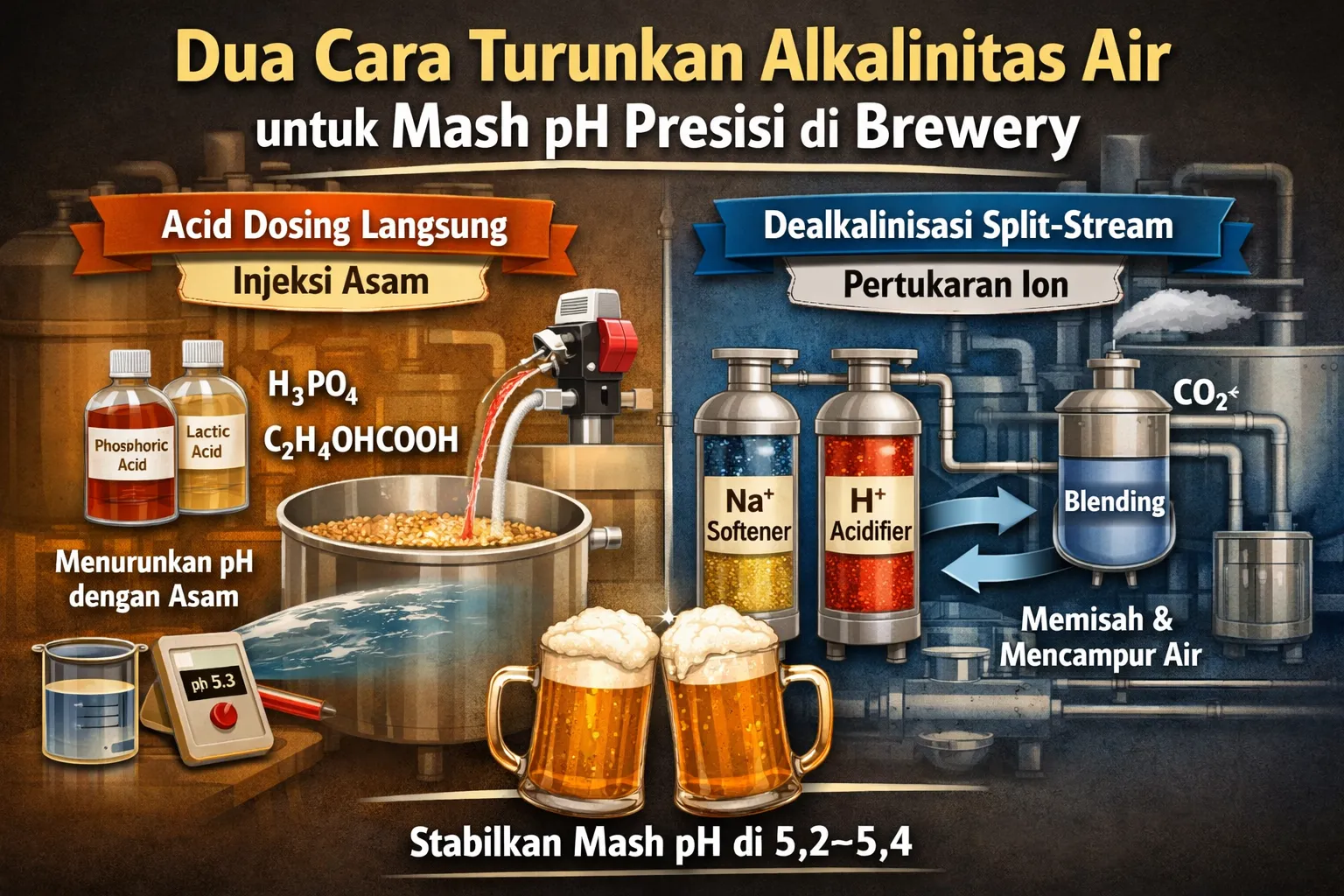
The most straightforward way to lower alkalinity is dosing food‑grade acid directly into the mash or liquor water. The usual choices are 85–88% phosphoric acid or 80–88% lactic acid. They neutralize bicarbonate via HCO₃⁻ + H⁺ → H₂O + CO₂. Phosphoric (H₃PO₄) is a strong, polyprotic acid that effectively neutralizes alkalinity. Bru’n Water notes it has little flavor impact and can be used up to ≈0.1% (v/v) without excessive Ca precipitation (www.brunwater.com). Lactic acid is weaker (monoprotic) and contributes lactate, but it is very palatable. It is usually used at ~1–3 mL per gallon in homebrewing.
Dosage guidance: 1 mL of 88% lactic acid per US gallon (~0.37 mL/L) neutralizes roughly 40 ppm HCO₃⁻ (ca. 38 ppm as CaCO₃) (www.brunwater.com). This implies ~2.5–3 mL/L can remove ~100–150 ppm CaCO₃ (approaching the lactic flavor threshold). In practice, brewers add acid in steps and measure mash pH or total alkalinity. Bru’n Water reports that lactic acid can neutralize 50–300 ppm of water alkalinity before taste is affected (www.brunwater.com). Above ~300 ppm removal, a stronger acid or split‑treatment is advised. By contrast, phosphoric acid (with 2 dissociations) neutralizes more alkalinity per volume. Usually ~0.5–1 mL of 85–90% H₃PO₄ per liter is enough to cut alkalinity by tens of ppm.
Practical steps usually include diluting concentrated acid, for example making a 10–20% working strength, and adding it slowly to the mash or liquor while stirring, with pH monitored. A reference approach is outlined at www.morebeer.com. After dosing, some CO₂ will evolve, so venting or a deaeration step is used. Mash pH targets are usually ~5.2–5.4 at mash temperature (~65–68 °C), which is ~5.0–5.2 at room temperature. For example, tap water with 150 ppm CaCO₃ might need ~3–4 mL/L of 85% H₃PO₄ (≈0.3–0.4%) or ~3–4 mL/L of 88% lactic (2–3%) to get near the 50–75 ppm target range (ballpark estimates). When uncertain, a trial test can titrate 1 L of water with 1 N HCl to pH 4.5 to measure alkalinity and calculate the acid needed.
Acid dosing removes alkalinity and lowers pH. However, it does not remove hardness (Ca/Mg), so water hardness stays the same. That is usually good for mash enzyme activity. Typical doses are small. For 100 ppm alkalinity, only tens of mg/L acid are needed. Food‑grade acids are quite cheap. For example, 85% H₃PO₄ sells for ฿390 per kg ($12 USD), or about $0.01–$0.02 per liter of brew water (thaibrewshop.co). Therefore acid dosing is a low‑cost treatment. The main costs are the acid and safe handling. The method is easy to control (start small and titrate up) and the equipment needs are minimal. Many facilities specify an accurate chemical dosing pump for repeatable injection.
Flavor and safety notes: phosphoric acid adds phosphate but has little sensory impact. Lactic acid may give yogurt-like notes if you use too much. Horiba notes they are “strong alkaline buffers”. Keeping bicarbonates low means small acid additions are enough (www.horiba.com). Use well below the flavor thresholds (Briggs et al. notes ~400 ppm lactic in final beer (www.brunwater.com)). CO₂ should be vented and fumes avoided. Never add water to concentrated acid.
Split‑stream ion‑exchange dealkalization
Another route removes alkalinity with ion exchange and blending. In split-stream dealkalization, part of the source water feeds two parallel strong-acid cation (SAC) resin beds. One bed is in Na⁺ form (a softener) and one is in H⁺ form (an acidifier) (www.waterworld.com). One portion comes out as “soft” water, and the original alkalinity stays in the Na⁺ stream. The other portion comes out fully acidified, with zero alkalinity and full H⁺ exchange. After the resin, the two streams are blended. The Na-treated stream adds bicarbonate. The H-treated stream adds none, but it is rich in acidity. The blend then passes through a degasser (vacuum column) to strip out the CO₂ formed by neutralization (www.waterworld.com). You adjust the split ratio to bring the final alkalinity to the target. Wayne Bernahl’s review notes that split-stream dealkalization can reach “100% of the influent alkalinity” in one stream and 0% in the other (www.waterworld.com).
The pros are precise control of the final alkalinity and some reduction in total dissolved solids (TDS). SAC resin capacity is high, so the beds can run large volumes between regenerations (www.waterworld.com). No hazardous acid goes into the batch water itself, only into regeneration, and the system can be automated. Complete systems are usually specified as ion exchange plants. The components include media such as ion-exchange resin and a Na⁺ stream made by a softener.
The cons are high complexity and cost. Regenerating the H‑form bed needs strong acid (usually sulfuric). A vacuum or deaerator is used to remove CO₂ (www.waterworld.com). Bernahl also warns about the use of “hazardous acid” and about extra caustic to re‑alkalinize if needed (www.waterworld.com). Capital outlays cover resin vessels, pumps, degasser and control systems. Ongoing expenses include regenerant chemicals and maintenance. Small breweries rarely use this approach because of cost and complexity. However, large breweries sometimes use similar schemes.
Split‑treatment with lime softening
A related technique (usually called “Carlsohn” or “Calcium Cycle”) treats a portion of the water with lime (calcium hydroxide) to pH ~10–11. This precipitates CaCO₃ out (www.brunwater.com). The water is decanted, then blended with untreated water to restore calcium (~40–50 ppm) and reduce pH (www.brunwater.com). The blended water has much lower alkalinity. A final aeration or acid step is needed to dissolve the CO₂ and lower pH to brewery levels (www.brunwater.com). Bru’n Water notes split‑lime can reduce Ca to ~12 ppm and needs blending to reach the desired hardness (www.brunwater.com). Lime treatment avoids introducing sodium. However, it needs handling of caustic chemicals and sludge.
Method outcomes and trade‑offs
Acid dosing lowers alkalinity by neutralization with an immediate pH drop. It does not remove hardness. Capital needs are minimal: manual additions or a small dosing skid. Operational burden is low (acids plus pH monitoring). Flavor impact is minimal (phosphoric) to mild (lactic up to threshold).
Split ion exchange: this can remove about 100% of the alkalinity from one stream. The final alkalinity is then set by blend control (www.waterworld.com). It needs higher capital: two resin vessels, a degasser and regeneration systems. It also needs more operational inputs, such as regenerant acid and caustic, and maintenance (www.waterworld.com). There is no flavor impact, because no acid is added to the product water.
Lime softening (split): this removes carbonate hardness (HCO₃⁻) by precipitation. The final alkalinity is lowered by blending and CO₂ release. The equipment needs are tanks, decanters, mixing and blending. The operational burden is high because of lime handling, pH adjustment and settling time (www.brunwater.com).
Dilution (RO/DI): this removes all ions and needs re‑mineralization. Capital is moderate (an RO unit), and operational needs are medium (membrane maintenance and waste rinse water). This route can be flavor‑neutral, but the water must be profiled afterward. For breweries that use dilution, a compact reverse osmosis skid such as a brackish‑water RO plant is a typical choice.
Data points and operating targets
Mash pH target: most styles aim for ~5.2–5.4 (measured near room temperature), balancing enzyme activity (www.horiba.com) (byo.com). Horiba cites an ideal mash pH range of 5.2–5.5, with <6.0 wort runoff pH to avoid tannins (www.horiba.com).
Alkalinity limits: many guides consider >100 ppm CaCO₃ “high alkalinity” requiring treatment. Hanna suggests keeping alkalinity <100 ppm for most beers (blog.hannaservice.eu), and Horiba explicitly recommends ≤50 ppm bicarbonate for most brewing (www.horiba.com).
Acid amounts: Bru’n Water quantifies lactic acid usage. About 1 mL of 88% lactic per US gallon lowers about 38 ppm CaCO₃ (www.brunwater.com). For phosphoric acid, a lab calculation shows that about 0.03 g (0.017 mL) of 85% H₃PO₄ neutralizes 100 ppm in 1 L. That implies a few mL/L for large adjustments.
Effect on flavor: excess alkalinity causes harsh, astringent beers; maintaining proper mash pH improves flavor and mash efficiency (www.horiba.com) (byo.com). Over‑acidifying can cause tartness; Bru’n Water warns against “over‑acidifying,” as beer can become vinegary or metallic (www.brunwater.com) (byo.com).
Regulatory context: Indonesia’s drinking-water SNI standards need pH ~6.5–8.5 and set hardness limits (for example, for packaged water (insightof.id)). Brewing water must meet basic potable criteria. The chemistry is then adjusted for each recipe. No local regulations cover final beer alkalinity, so brewers use industry guidelines (usually international best practices).
Process integration and planning
Measurement is foundational: operators test source water to determine initial alkalinity (ppm as CaCO₃), hardness, and desired mash pH; calculators such as Bru’n Water guide the dose (www.brunwater.com). For modest corrections, acid injection with phosphoric or lactic is the most cost‑effective route—minimal equipment (e.g., burette or a small skid) and low per‑liter cost (thaibrewshop.co) (blog.hannaservice.eu), with process notes from www.morebeer.com.
Where source water is extremely high in alkalinity (>200 ppm) or volumes justify a plant, partial dealkalization can be considered. A split‑stream ion‑exchange system provides precise control (www.waterworld.com), but requires significant investment and maintenance. Lime softening is another option for large volumes, albeit labor‑intensive (www.brunwater.com) (www.brunwater.com). These methods can “solve” alkalinity without constant acid dosing, at the cost of complexity.
Blending is a constant: in split‑treatment schemes (ion exchange or lime), treated water is blended with raw to restore desired calcium and pH balance (www.brunwater.com) (www.waterworld.com). Sparge runoff pH is kept <6.0 to avoid tannin pickup (www.horiba.com). In practice, breweries often combine methods—e.g., a small acid dose plus dilution with softened or DI water (or partial ion exchange) to hit exact targets (www.morebeer.com). For dilution strategies, compact membrane skids such as RO, NF, and UF systems are commonly referenced in industrial water treatment; breweries typically lean on RO and then remineralize.
We put the carbon filters and UV before the alkalinity adjustment. This makes sure the water is clean and free of chlorine. The acid injection comes after the carbon and before mash-in. If acid dosing releases CO₂, we vent it or remove it (deaerate) before heat. In split-stream dealkalization, the blended water usually passes through deaeration towers. The towers strip dissolved CO₂ and O₂ on the way to the mash/lauter tun.
Cost and capacity notes: to neutralize 100 ppm alkalinity, phosphoric acid might cost only a few cents per batch. It also needs little automation (www.morebeer.com). WaterWorld notes that when both hardness and alkalinity are high, a Weak-Acid Cation (WAC) resin can also remove alkalinity efficiently. However, SAC split-stream gives even higher capacity (www.waterworld.com) (www.waterworld.com). In operations, acid dosing has a minimal per-liter cost (on the order of cents) (thaibrewshop.co). Resin regeneration and equipment amortization can run in the hundreds to thousands per month in a larger plant.
Sources: Authoritative brewing chemistry guides and industry resources were used for data and recommendations (www.brunwater.com) (www.horiba.com) (www.brunwater.com) (www.brunwater.com) (www.waterworld.com) (www.waterworld.com) (www.morebeer.com) (thaibrewshop.co). Each citation links to the source text.