

Article
The HRSG Dechlorination Split: GAC vs. Sodium Bisulfite
Industry: Power_Generation_(HRSG) | Process: Raw_Water_Pre
In heat‑recovery steam generator (HRSG) service, free chlorine is the wrong oxidant in the wrong place. It attacks ion‑exchange resins and stainless steels, so operators target non‑detectable residuals—about 0.0–0.1 mg/L—downstream of pretreatment (dechlorinationforro.blogspot.com) (www.ncbi.nlm.nih.gov). That protects downstream ion‑exchange resin units and, where used, Reverse Osmosis (RO) systems from oxidant damage.
Two approaches do most of the work: chemical dechlorination with sodium bisulfite (SBS, NaHSO₃, usually fed as sodium metabisulfite, SMBS, Na₂S₂O₅) and granular activated carbon filtration (GAC). Other techniques (aeration, UV, chloramination) are rarely used in large power‑plant raw water.
Chemical dechlorination kinetics and dosing
SBS reacts quickly and almost stoichiometrically with chlorine (1 mol Cl₂ + 1 mol bisulfite → products). In theory, 1.34 mg of Na₂S₂O₅ removes 1.00 mg of free Cl₂. In practice, however, engineers feed about 2–3 mg per mg Cl₂ to make sure the quench is complete (www.researchgate.net). Neutralizing 0.5–1.0 mg/L usually takes about 1.5–3 mg/L SBS, mixed in-line. The reaction completes in seconds, so no large contact basin is needed.
Performance is decisive. SBS dosed correctly removes more than 99% of free chlorine, usually to less than 0.01 mg/L. In comparative testing it also works quite faster than other chemicals (www.researchgate.net). The main byproduct is sulfate (Na₂SO₄). It raises total dissolved solids (TDS) but is inert. For example, a 3 mg/L SBS dose generates roughly 3–5 mg/L Na₂SO₄.
Capital needs are minimal. A skid with an accurate dosing pump is enough. Control is straightforward via ORP (oxidation‑reduction potential) or residual monitors. A 2013 RO pretreatment guide even calls SBS the “chlorine reducing agent of choice” for large systems (docslib.org). However, over‑dosing or poor mixing can leave residual reducing agent that fosters microbial fouling downstream. SBS also adds dissolved solids that may marginally increase boiler blowdown needs. The SBS chemical (pH ~5) needs proper storage and handling. The dose is a respiratory irritant hazard and can form SO₂ if misdosed.
For procurement and operations, dechlorination chemicals are usually supplied as a dechlorination agent, fed continuously in proportion to chlorine load.
GAC filtration mechanism and capacity
GAC (granular activated carbon) removes chlorine by catalytic reduction on the carbon surface, not by simple adsorption. It also pulls down organics, total organic carbon (TOC), pesticides, and trihalomethane (THM) precursors, delivering dual benefits (www.ncbi.nlm.nih.gov) (docslib.org). Fresh beds are nearly 100% effective initially.
But chlorine “breakthrough” is a matter of time, dose, and velocity. With 5 mg/L Cl₂ feed running at 4 gpm/ft² (≈9 m/h), one study saw ~10 days to reach 0.5 mg/L at the outlet (www.ncbi.nlm.nih.gov). At longer contact (~15 minutes), ~25 days passed before 0.5 mg/L appeared in the first 10% of the bed (www.ncbi.nlm.nih.gov). Another trial found 50% breakthrough (~0.25 mg/L) in 25 days at a faster 0.3 minute contact (www.ncbi.nlm.nih.gov). In short, under heavy Cl₂ loading, breakthrough occurs on a days‑to‑weeks timescale (www.ncbi.nlm.nih.gov) (www.ncbi.nlm.nih.gov).
Longer term, GAC capacity is finite. Studies suggest about 1–4 grams of Cl₂ can be removed per gram of carbon. With 1–2 mg/L in feed, a bed usually exhausts over about 2–3 years and will be replaced or regenerated (www.ncbi.nlm.nih.gov). In practice, filters are sized for long runs, with weekly backwashes in summer and monthly in winter to manage headloss (ncbi.nlm.nih.gov). At about 1–2 mg/L Cl₂ in raw water, a GAC bed usually lasts >1 year on service (www.ncbi.nlm.nih.gov), and it usually gives 20–50% TOC reduction as an extra benefit.
GAC needs capital: a large pressure vessel or a multi-tank array with thousands of kilograms of media. It is common for small systems (below 100 gpm). Large flows need multiple vessels. Plants usually specify activated carbon media in strong housings. For high-pressure service, steel filter housings are standard.
Maintenance to control biofouling
There is a trade-off. Once chlorine is removed on carbon, the high surface area and the adsorbed organics allow bacteria to grow. A treatment bulletin warns that carbon filters are “notorious for breeding bacteria”. Viable counts double in 24 hours unless the filter is sanitized (docslib.org). In beverage applications, GAC “was much maligned because of its inability to prevent bacterial growths”, even though chlorine removal itself was effective (www.ncbi.nlm.nih.gov).
Operators respond with frequent backwashing and periodic chemical or thermal sanitization, media replacement, or reactivation. Drinking-water plants backwash GAC weekly in summer and monthly in winter (ncbi.nlm.nih.gov). Without this maintenance, bacteria counts in the beds rise quickly and foul downstream systems. Many HRSG facilities schedule downtime months in advance. Others rely more on SBS so they depend less on a single GAC unit.
Comparative performance and trade‑offs
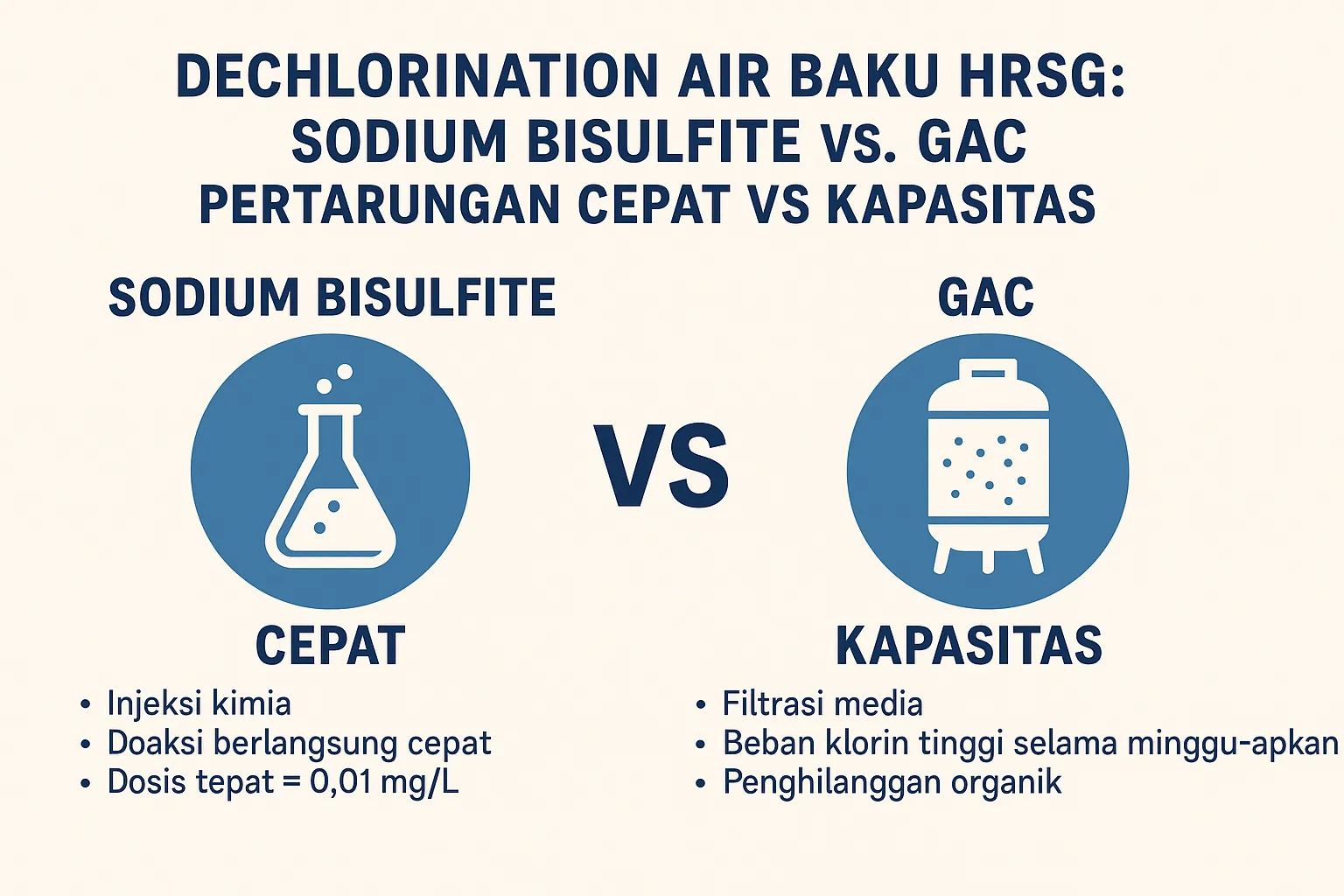
Removal efficiency: both methods can push free chlorine to near zero. SBS can quench >99.9% immediately—often to <0.01 mg/L—when the dose is right (www.researchgate.net). GAC initially removes essentially all chlorine but will break through as its finite capacity is consumed (www.ncbi.nlm.nih.gov) (www.ncbi.nlm.nih.gov).
Speed and control: SBS acts in seconds and allows tight cascade control with ORP or residual meters. A GAC bed needs a designed contact time (seconds to minutes) and careful monitoring for breakthrough. No online sensor “doses a bed”, so operators manage bed life and backwash schedules.
Footprint and cost: chemical dechlorination has the smallest capital footprint, essentially a mixing loop and a pump. GAC needs large vessels and media. Operating cost is the other way round. SBS uses reagent (roughly tens of kilograms per Mgal (≈3.8 m³) at 1 ppm Cl₂). GAC uses little chemical, but it needs media replacement or reactivation, thousands of kilograms per year at scale.
Water quality impacts: GAC improves overall water quality by removing organics and particulates. This usually gives a 20–50% TOC reduction (docslib.org). It also converts chlorine to chloride without changing TDS. SBS adds sulfate. For every mole of Cl₂ removed, a mole of SO₄²⁻ is produced. This raises conductivity and can increase blowdown a little. However, sulfate is usually benign at the low mg/L levels used in HRSG makeup.
Safety and byproducts: SBS brings a handling hazard (respiratory irritant, potential SO₂ formation). Its byproducts are sulfite and sulfate. The “byproducts” of GAC are adsorbed organics on the media, and these are usually biodegraded in situ. Operational reliability differs too. A well‑maintained SBS system rarely fails unless pumping or mixing fails, and these are alarmable events. GAC can channel or break through if it is not maintained. Large plants usually install tandem vessels to keep one online while another is serviced.
Many designs prefer SBS when dechlorination has to be fast and the footprint small. GAC is chosen when removing extra organics is useful, or for redundancy. An RO pretreatment Q&A even argues there is “no need for GAC” if mixing is good (“Forget the GAC”) (thewaternetwork.com). Others run two trains (SBS first, then GAC polishing) for safety.
Quantitative comparison snapshot
Engineers often remember two figures: SBS eliminates ~100% of Cl₂ in <10 seconds using ~3× stoichiometric dose (www.researchgate.net), while a GAC bed under moderate flow may run ~25 days before any Cl₂ appears, after which it must be reactivated or replaced (www.ncbi.nlm.nih.gov) (www.ncbi.nlm.nih.gov).
Where RO membranes are part of the train, dechlorination protects the polyamide layer as much as it shields ion exchange. Plants that integrate brackish‑water RO usually place SBS dosing ahead of membranes and GAC downstream for polishing. This keeps both organics and oxidants in check.
Sources: Authoritative water treatment literature and industry reports. Modeled GAC breakthrough data and the “brewing industry” note come from a U.S. National Research Council review (www.ncbi.nlm.nih.gov) (www.ncbi.nlm.nih.gov). Stoichiometric details of sodium bisulfite dosing are documented in water supply studies (www.researchgate.net). Operational practices for GAC (backwash schedules, biogrowth) are noted in recent treatment reviews (ncbi.nlm.nih.gov) (docslib.org).
The equipment and media depend on the application. However, the two anchors rarely change. You dose the oxidant away with a controlled chemical feed and an SBS‑type dechlorination agent. Or you design and maintain a stable bed of activated carbon in a suitable pressure housing. Then you monitor for breakthrough to protect both resins and membranes.