

Article
Brewers Are Designing Oxygen-Free Water Like It’s a Product Line. Here’s the Playbook.
In beer, dissolved oxygen is the enemy. Breweries are racing to build deaerated water systems that strip O₂ to parts per billion—by vacuum, membranes, or nitrogen—because shelf life and flavor stability depend on it.
Industry: Brewery | Process: Filtration_&_Carbonation
Modern beer is made in a near-oxygen vacuum. That is figurative, and for process water it is literal. Even trace dissolved oxygen (DO) speeds up staling, notably through trans-2-nonenal, and shortens shelf life. This comes from peer‑reviewed research (academic.oup.com) and from instrumentation experts (wiki.anton-paar.com). In practice, breweries push water DO to ≪0.1 mg/L, usually below 0.05 mg/L. They do this to avoid oxidizing beer during blending, filtration, gravity adjustment and transfers (bbt.corosys.com). Pentair puts it plainly: “increased quality requirements are placing higher demands on residual oxygen content.” Water that is not deaerated well enough causes foaming issues, poor carbonation and off-flavors (foodandbeverage.pentair.com).
There is a stark regulatory contrast here. Indonesian packaged drinking-water standards actually need added oxygen. SNI 6241:2015 mandates ≥20 mg/L DO in oxygenated demineralized water (ro.scribd.com). Brewing is the exception. The process needs near‑zero DO, not more.
Deaeration technologies and operating principles
All removal strategies use the same physics. They maximize surface area and contact time and minimize the oxygen partial pressure, so O₂ leaves the water (bbt.corosys.com). Combining measures gives the deepest cuts: vacuum plus heat plus an inert‑gas counterflow. A rotor–stator mixer study using both vacuum and N₂ reported ~97% DO removal (η≈97.3%). That is much better than vacuum or nitrogen alone (www.mdpi.com).
Vacuum deaeration (spray/trickling columns). Water is sprayed or trickled over packing under strong vacuum (often <50 mbar) to boil off gases, frequently with a small CO₂ or N₂ bleed to carry out dissolved O₂ (interupgrade.com). “CO₂ or N₂ can be used as a stripping gas. Nitrogen is more effective…[and] is not absorbed by the water…CO₂ is…of choice for carbonated beverages,” notes Inter‑Upgrade (www.interupgrade.com). Well‑designed systems routinely hit residual DO below 0.02 mg/L (20 μg/L) (www.interupgrade.com; interupgrade.com).
Membrane degassing (hollow‑fiber modules). Water flows on one side of a porous fiber bundle. A vacuum or sweep gas (usually CO₂) pulls O₂ across on the other side. This creates a strong concentration gradient. With enough membrane area, residual DO below 0.02 mg/L is achievable (bbt.corosys.com). These units are compact and use little energy for small and mid flows. However, large capacities need many modules, so capex goes up. The membranes also tolerate only limited CIP (clean‑in‑place) regimes and temperature (<80 °C) (bbt.corosys.com).
Gas‑stripping columns (inert‑gas counterflow). At (near) atmospheric pressure, water cascades down a packed column while nitrogen or CO₂ bubbles up from the bottom. Cold columns at ambient temperature can yield <0.05 ppm O₂; properly sized designs can approach ~0.02 mg/L (www.interupgrade.com; bbt.corosys.com). Nitrogen is not absorbed, leaving water essentially N₂‑saturated; CO₂ would carbonate the water. Typical consumption is ~0.22 kg N₂ per hectoliter (hl; one hectoliter equals 100 liters), with ~5% gas loss (www.interupgrade.com). Pentair’s Water Deaeration System (WDS) uses CO₂ in counterflow packing, offered in “hot” or “cold” versions (foodandbeverage.pentair.com). Hot columns pasteurize the water (adding ~8 °C) and improve hygiene; cold systems rely on downstream UV or CIP (www.interupgrade.com; www.interupgrade.com).
Spray (atmospheric) degassing. Spraying water into open air releases O₂. However, it is not enough for ppb targets unless you combine it with inert gas. Chemical scavengers (for example sodium sulfite) exist. However, food production usually avoids them.
Performance metrics and scale economics
Residual DO targets. State‑of‑the‑art brewery systems aim for <0.02 mg/L (20 μg/L) DO (bbt.corosys.com; www.interupgrade.com). Cold stripping columns deliver <0.05 mg/L reliably, while multi‑stage vacuum units reach ≤0.02 mg/L (bbt.corosys.com; www.interupgrade.com). Untreated water at 10–15 °C contains ~8–10 mg/L O₂, so this is a >99.9% reduction (bbt.corosys.com).
Throughput and scale. Stripping and vacuum columns scale large. Inter‑Upgrade quotes up to 860 hl/h (Type 125) (www.interupgrade.com). At that size, standard configurations give ~0.05 ppm DO. Optional packing brings it to 0.02 ppm. Membrane modules usually handle ≪50 hl/h each. Large breweries need many in parallel (bbt.corosys.com).
Gas and steam consumption. Cold N₂ stripping uses ~0.22 kg N₂/hl (www.interupgrade.com). Hot‑vacuum designs using CO₂ report ~0.10 kg CO₂/hl (www.interupgrade.com). Steam for hot operation is ~1.2–1.3 kg steel‑pipe steam/hl; for example, a Type 50 unit uses ~151 kg/h steam at 120 hl/h (www.interupgrade.com). Cold stripping uses no heat but must still chill water after.
Energy and maintenance. Vacuum systems need pumps and blowers. Hot columns need steam. Membrane degassers usually have the lowest electrical demand (a vacuum pump). However, they have stricter cleaning and temperature limits. Packed columns and vacuum towers can be cleaned by CIP. Hot designs usually self‑sanitize on startup. Cold systems rely on routine CIP or UV (www.interupgrade.com).
Quality outcomes. One brewery reports a cold column “reliably supplies water with significantly <0.05 ppm O₂ and ≈2.0 g/L CO₂” for gravity adjustments and blending (bbt.corosys.com). Nitrogen‑purged water (CO₂‑free) suits still‑beer processes; CO₂‑saturated water fits carbonation stages. Studies affirm ppm‑level DO in beer yields pronounced freshness loss (academic.oup.com; wiki.anton-paar.com).
Market trend. The global food & beverage deaerator market is projected to grow ~6.1%/yr, from ~$360 M in 2024 to ~$614 M by 2033 (www.marketdataforecast.com), as brands chase shelf life and flavor by minimizing oxygen exposure (www.marketdataforecast.com).
DAW system design and pretreatment train
A typical DAW (deaerated water) system starts with clean water at ~10–15 °C. The water is filtered and possibly softened or run through RO before degassing. Removing chlorine, organics and taste and odor upstream with an activated carbon filter is common practice for hygiene and flavor.
Many plants use a softener to control hardness ahead of the membranes. Sources with high TDS go through brackish-water RO. Where surface water is used, an ultrafiltration skid pretreats the RO feed and makes the drinking water clear.
Degasser unit selection. In a vacuum deaerator, water enters a multi‑stage vacuum column (sprayers and packed sections), with vacuum ejectors/pumps drawing out gases; a small CO₂ or N₂ feed is often bled into the inlet and swept out countercurrently (interupgrade.com; www.interupgrade.com). “Hot” operation raises water to ~70–80 °C to lift most O₂ and pasteurize, followed by cooling; “cold” operation runs near ambient, then relies on UV or CIP for sterility (www.interupgrade.com). Three‑column vacuum rigs are used to reach <20 ppb DO when demanded (interupgrade.com; www.interupgrade.com).
Alternatively, a nitrogen stripping column sends water down a packed tower and high‑purity N₂ up from the bottom. A 2–3 m tower can deliver <0.05 mg/L with sufficient gas. Larger or multi‑stage designs achieve ~0.02 mg/L. It is a simple, quiet stainless device, and the stripped N₂ is vented. N₂ is not absorbed, so the water exits essentially N₂‑saturated. The ongoing cost depends on the gas supply. This cost is usually low if N₂ is generated onsite (www.interupgrade.com).
CO₂ buffering (optional). Many breweries add a small CO₂ charge after degassing to buffer the water and suppress re-dissolution. Pentair recommends this (brought up in [5] and [27]). For example, a cold-column output is about 2.0 g/L CO₂, which also primes the water for carbonation (bbt.corosys.com).
Storage and distribution. Deaerated water is collected in a closed buffer tank under a slight CO₂ or N₂ blanket. It is then pumped to points of use: filter precoats and pump flushes, carbonation tanks or inline carbonators, blending and mixing for final gravity or high‑gravity beer, and purging or pushing beer to the filler (bbt.corosys.com). For hygienic filtration steps, breweries favor 316L stainless cartridge housings in food‑grade service. Automated manifolds (for example Pentair/Südmo) route DAW safely under PLC control (foodandbeverage.pentair.com).
Instrumentation and control. Plants monitor UV performance, flow, pressures and vacuum. A central panel sequences water, steam valves (hot mode) and N₂ flow. In [27], a Siemens S7 PLC managed blending and DAW routing. Cold systems usually integrate UV sterilization downstream. CIP ports allow sterilization. Hot columns usually need less frequent cleaning because of pasteurization (www.interupgrade.com). For spare parts and skids, brewers tap supporting equipment for water treatment.
Flow diagram (conceptual): Clean Water → (Preheater/Steam Exch) → Degasser (Vacuum or N₂ column) → CO₂ Infusion (if used) → Buffer Tank → Distribution Pump → Blending Port / Filter / Filler.
Vacuum vs nitrogen stripping trade‑offs
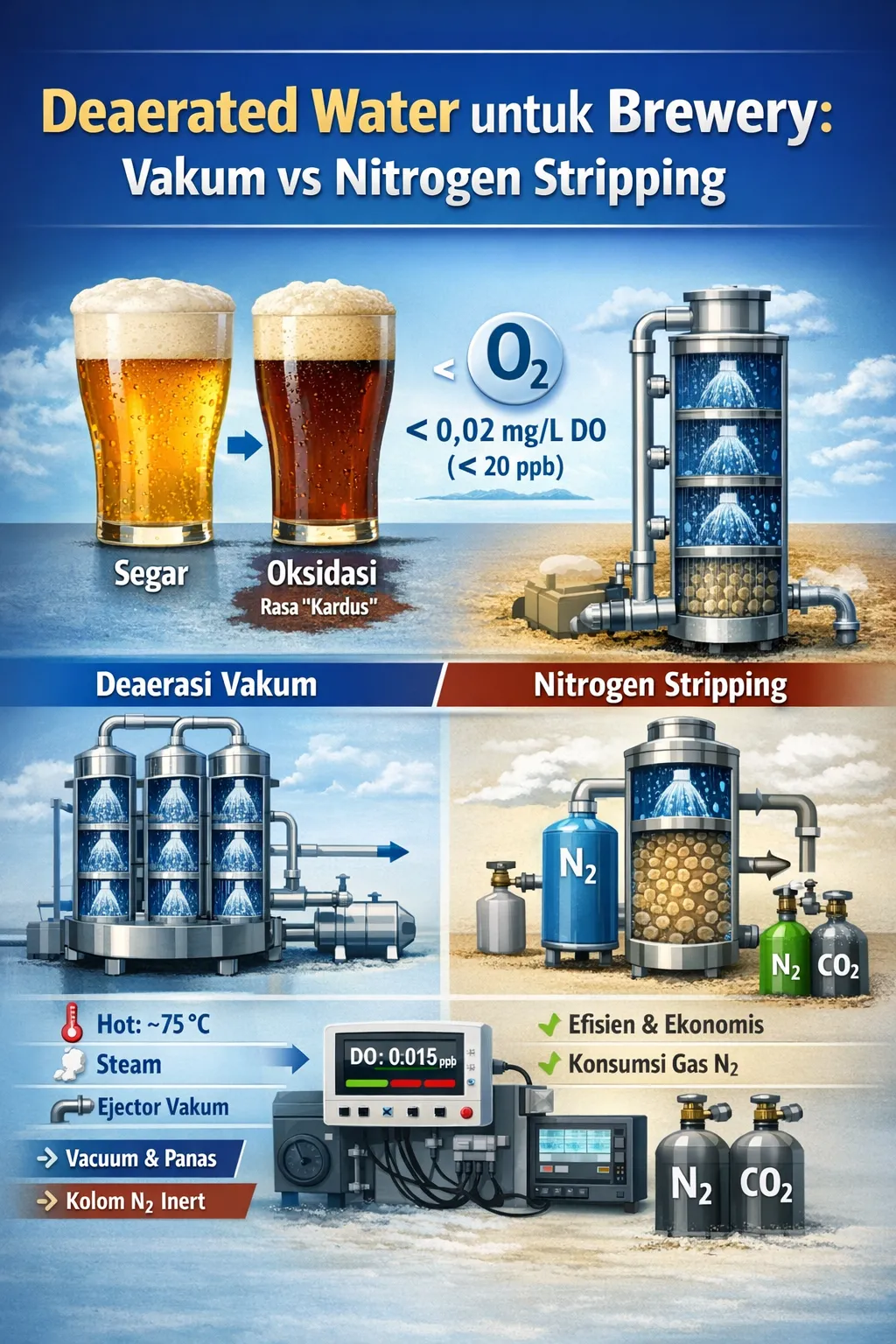
Degree of removal. Both reach low DO. Multi‑stage vacuum designs usually post the absolute lowest (≪0.02 mg/L). N₂ columns can also hit <20 μg/L when sized appropriately. Some membrane degassers apply vacuum on the permeate side, which blends the approaches (www.interupgrade.com).
Footprint and capex. Vacuum systems are taller and more complex (multiple chambers, nozzles, vacuum pumps/ejectors) and can be capital‑intensive. Market analysts cite high upfront cost as a restraint (www.marketdataforecast.com). N₂ columns are simpler stainless towers with lower upfront cost. However, they need a steady gas supply. Retrofitting a stripping column is usually cheaper where space is tight.
Operating cost. Vacuum units draw electrical power and may use a small CO₂ bleed; N₂ columns consume nitrogen. Where N₂ is generated onsite (via membrane or PSA, pressure swing adsorption), cost per kg is low. Inter‑Upgrade lists ~0.22 kg N₂/hl vs ~0.10 kg CO₂/hl for vacuum operation (www.interupgrade.com; www.interupgrade.com). Hot columns consume significant steam (~1.3 kg steam/hl); cold systems skip that (www.interupgrade.com).
Maintenance and hygiene. Packed towers and vacuum columns can usually be cleaned in place (CIP), though vacuum nozzles make rigging harder. Hot columns usually clean themselves on startup (www.interupgrade.com). N₂ columns are simple devices with few moving parts. Membranes need careful cleaning. Breweries that run heavy duty usually prefer vacuum rigs because CIP is easier. Craft startups may choose N₂ columns because they are simple.
In practice, nitrogen stripping is usually preferred for still beverages where cost matters, because N₂ does not dissolve. Vacuum deaeration works better when you need the lowest possible DO at large scale. Engineers weigh the O₂ target (for example <0.05 mg/L), the capacity (for example 50–500 hl/h), and whether pasteurization is needed. A lower residual O₂ needs much more equipment and energy, unless a stripping gas is used (Figs. 1–3 in [3]).
Monitoring and control of DO in DAW
Inline DO sensors. Breweries install dedicated dissolved-oxygen meters on DAW lines or buffer tanks. Optical (luminescent) DO sensors are favored because they are stable and low-drift. They do not consume oxygen and do not need stirring. They read low ppb reliably (0–0.5 mg/L ranges) (wiki.anton-paar.com).
Calibration and QA. We use standard two‑point calibration: zero‑oxygen (100% N₂‑purged water) and air‑saturated water at the current temperature. Atlas Scientific warns brewers to “be sure to calibrate the DO probe to 0 ppm before measuring” (atlas-scientific.com). A QC target might be DO <0.05 mg/L. If the readings drift upward, it flags problems (leaks, pump failure, fouling). Some plants validate from time to time with Winkler titration (ASTM D888‑2019).
Sampling regime. Measure DAW exit continuously or at frequent intervals. Absent a permanent sensor, manual sampling in a closed, N₂‑blanketed bottle with a portable meter each shift can suffice. The beer require e.g. ~0.05 mg/L DO or less (atlas-scientific.com). Monitor upstream raw water (~8 mg/L at 10–15 °C) to quantify improvement (bbt.corosys.com). At packaging, “total package oxygen” practice checks both DO and headspace O₂ to diagnose ingress (wiki.anton-paar.com).
Controls. Tie the DO sensor into the PLC. Then a high‑DO alarm shuts the DAW feed automatically and alerts the operators. Gas flow meters on the N₂ lines give a sanity check (an unexpected low flow suggests a leak). Keep the buffer tank under a CO₂ or N₂ headspace (a few psi) so air does not get in.
Anton Paar sums up the stakes: monitoring DO “provides great insight into water quality” and is as central as pH (wiki.anton-paar.com). Trending DO data supports compliance. For example, Indonesian breweries under BPOM might need to show “zero detectable O₂” in top‑up water for beer.
Business case and implementation outlook
A DAW system can use vacuum or N₂ stripping, sized to the throughput. It feeds a sealed buffer and automated distribution. This reliably delivers ultra‑low DO (≪0.1 mg/L) to protect beer quality. Industry sources show well‑designed systems achieving <0.02 mg/L (www.interupgrade.com; bbt.corosys.com) with modest CO₂/N₂ and energy inputs. The ROI shows up in longer shelf life, more consistent flavor and less waste. The market is growing at ~6.1% CAGR through 2033 (www.marketdataforecast.com).
Small craft plants may accept a 0.05 mg/L spec with a simpler N₂ column. Multinationals invest in vacuum systems to reach 0.02 mg/L for premium lines. Field data guides the final design. This data includes the DO drop in ppm, the slower rise of staling markers, and inline DO trends. With good controls, every decoction or draft meets the oxygen-free standard that top-quality beer needs (bbt.corosys.com; foodandbeverage.pentair.com).
Sources: Industry engineering articles and equipment data (Corosys/Inter‑Upgrade/Brauindustrie) on brewery water deaeration (bbt.corosys.com; www.interupgrade.com; interupgrade.com); beer‑oxidation research (academic.oup.com); process technology journals (www.mdpi.com); instrumentation wikis (Anton Paar) (wiki.anton-paar.com; wiki.anton-paar.com); market reports (www.marketdataforecast.com); and Indonesian standards (SNI 6241) (ro.scribd.com).