

Article
The unseen output of spinning mills: up to 11% fiber becomes “waste.” Here’s how it’s turning into product — and profit
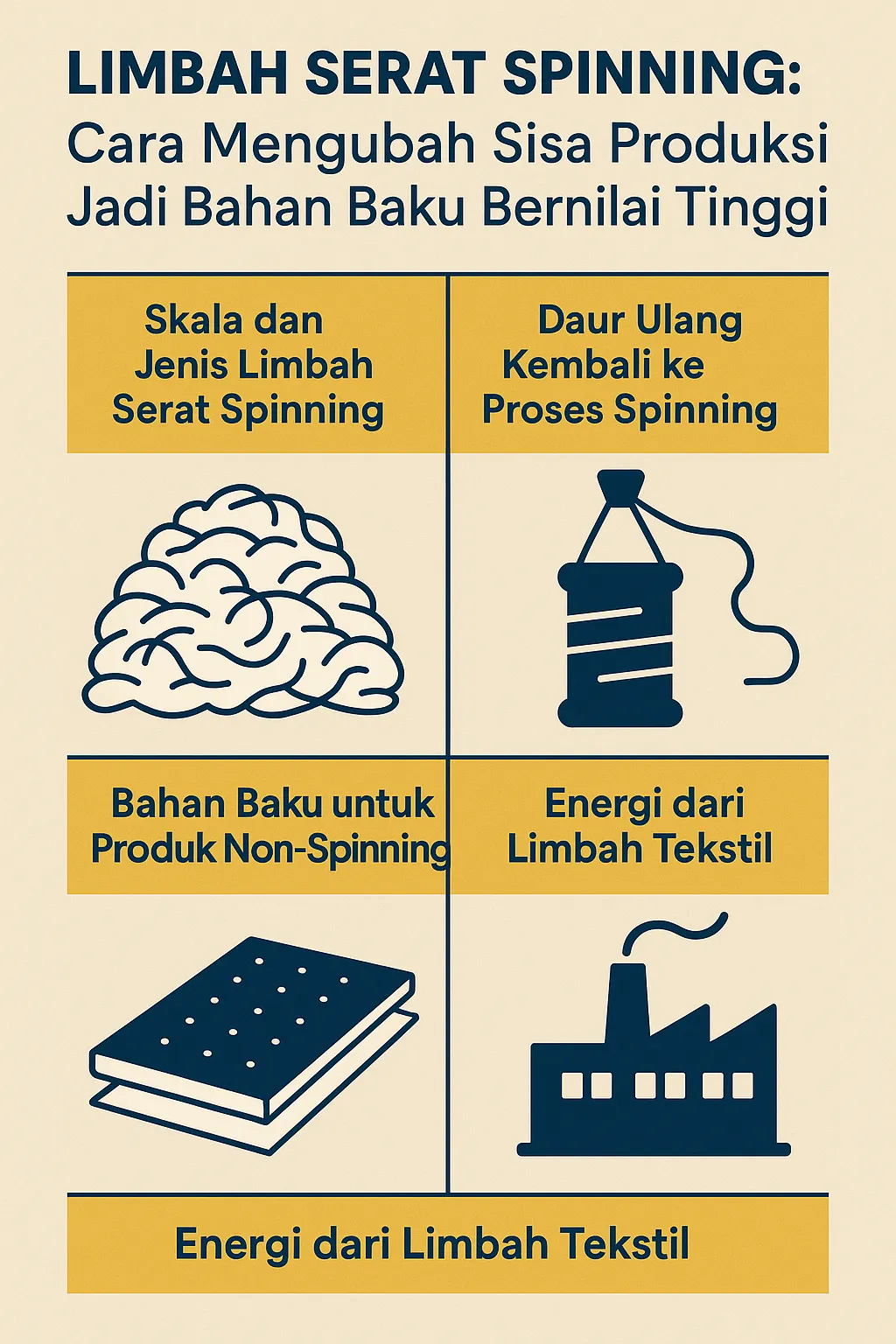
Textile spinning sheds 6–11% of raw fiber as waste, but mills are increasingly recycling it back into yarn, nonwovens, composites, and even fuels — if they can solve the dusty, flyaway handling challenge.
Industry: Textile | Process: Spinning
Worldwide fiber production topped 100 million tonnes by 2017, according to industry research (IntechOpen). Inside spinning mills, the basic arithmetic is stark: 6–11% of that input typically ends up as waste during cleaning, opening, carding and combing (IntechOpen) (IntechOpen). One Brazilian snapshot: 167,850 kg of cotton consumed yielded 19,086 kg of spinning waste — roughly 11% (IntechOpen).
That “waste” is not one material. It covers blown cotton dust, card flats, combing noils (short fibers removed during combing), sliver tail scraps (sliver is the untwisted rope of fibers after carding), roving bits (slightly twisted sliver before spinning) and broken thread or “fly.” Dirty blowroom waste (the opening and cleaning stage) can be only about 35–55% good fiber. Carding and sliver waste usually exceeds 80% fiber (IntechOpen). About 6–8% of inputs become primary mill waste, and that waste contains about 50% fiber (IntechOpen). Downstream blends change the picture. Spinners usually recover about 90% or more of that fiber, with about 6% residual trash, back into product (IntechOpen).
Recycling back into yarn production
One straightforward route is reintroducing cleaned waste into yarn. Modern lines blend “good” waste (for example sliver noils and filtered fly) at modest levels. Fine ring and rotor yarns (ring spinning is the conventional twist insertion, and rotor or open‑end spinning feeds fibers into a high‑speed rotor) usually tolerate about 2.5–5% rebonded waste. Coarse open‑end yarns can include 10–20% recycled fiber (IntechOpen). Mills prefer to return each waste type to its original mix, card waste back into carded yarns and combing noils to rotor yarns, to keep quality stable.
Studies consistently show surprisingly high headroom. Blends with up to about 20% waste usually cause only minor property changes, and those changes are acceptable (IntechOpen). Wulfhorst (1984) reported “up to 20%” reclaimed fiber without noticeable yarn‑quality declines (IntechOpen). Halimi et al. found blend uniformity and irregularity unchanged up to 25% waste in rotor‑spun yarns (IntechOpen).
There are trade-offs. In practice, raising waste from 5 to 40% lowered tenacity and raised imperfections. One study recorded about 22% lower breaking strength in ring-spun yarn and 52% lower in rotor-spun yarn (IntechOpen). Another trial found that rotor yarns with 50% waste blend had about 20–25% lower strength and 21–22% higher hairiness. However, up to 30% waste gave only modest increases in thick and thin faults (IntechOpen). Fabrics made from 100% recycled fiber showed higher hairiness and lower tensile strength than virgin yarns. However, they met the technical requirements in targeted uses (IntechOpen) (IntechOpen). The cost case is strong because recycled fiber is essentially “free” raw material. In practice, mills use a lot of clean waste. Sliver noils and filtered fly can reach 50–100% reuse. They keep dirty waste lower, at 30% or less in open-end and 10% or less in ring, to balance quality (IntechOpen) (IntechOpen).
Nonwovens, insulation, and composites
When the waste is not re-spun, the fibers go to nonwovens and insulation. Spinning byproducts were chemically bonded into nonwoven fabric with tearing strength up to about 23 g, using 25% polyvinyl alcohol as binder (ResearchGate). Recycled-denim fiber mats gave about 0.131 W/m·K thermal resistance at 20–40% fiber content. This is comparable to polystyrene insulation (ResearchGate). One review found that textile waste panels can match or exceed conventional insulators. They perform similarly to XPS (extruded polystyrene) foam or mineral wool (IntechOpen).
Waste fibers also act as fillers in composites. Reviews report cotton, jute, hemp and other textile wastes embedded in polymers, concrete and natural binders to make construction panels and auto parts (MDPI). For example, cotton fiber/polyester blends are pressed into cement blocks or epoxy boards. They improve stiffness and thermal mass.
Industrial and consumer byproduct uses
Lower‑quality laps and noils are blended into industrial yarns for mops and rugs, or into nonwoven fillings. Historically, mills baled wastes into “cotton batting” for mattresses and upholstered furniture (ILO Encyclopaedia). One industry guide notes ring‑spinning waste is often sold to make mop yarns, while carding (“garnetting”) waste is pressed into bedding insulation (ILO Encyclopaedia). In Indonesia, Asia Pacific Fibers (APF) points to a “textile‑to‑textile” program turning second‑hand clothes into new fiber blends (Asia Pacific Fibers).
Pyrolysis and material recovery
Cellulose‑rich wastes can be converted by heat. Pyrolysis (thermal decomposition without oxygen) of pure cotton waste gives roughly 45% liquid oil (mostly heavy naphtha) and a carbon‑rich char (~75% carbon) that can serve as activated carbon (ScienceDirect). Mixed cotton/polyester waste gives mostly combustible gas (H2‑rich) (ScienceDirect). These routes show that waste fibers can become fuels or adsorbents. They can power on‑site boilers (boilers) or supply raw materials for chemical industries (ScienceDirect). Waste cotton could also be processed into cellulosic ethanol or furfural (ScienceDirect). The char pathway links directly to the wide use of activated carbon in industrial applications.
Disposal routes and regional trends
When waste isn’t reused, it’s often incinerated or landfilled — both contentious. Incinerating textile waste emits toxic gases such as furans and dioxins, a risk flagged in a Reuters analysis of Asian textile hubs (Reuters via WSAU). That analysis warns unmet recycling capacity leaves the rest to clog bodies of water, pollute soils or be incinerated (Reuters via WSAU).
In the EU, separately collected textile waste treated in 2022 was ~1.38 million tonnes; of that, ~12% went to landfill and 15% to incineration (EEA). If including mixed municipal waste, about 73% of discarded textiles still end up burned or landfilled (EEA). By contrast, India recovers ~60% of its 4.7 Mt textile waste (Reuters via WSAU).
Energy recovery is a bridge option. Modern boilers can burn clean textile waste (cellulosic content) together with lignite or biomass. However, polyester comes from fossil material, so it lowers the heat value and raises SO₂/NOₓ concerns. Pyrolysis (above) recovers energy and materials with less impact. Regulation discourages landfill more and more, for example the forthcoming EU Waste Textiles rules. In Indonesia, environmental law (Law 32/2009) and Ministry of Environment standards classify textile scraps as non-B3 (non-hazardous). These scraps need licensed handling and proper disposal (Rafika Transindo). Major Indonesian fiber producers refer to the national Circular Economy Roadmap, which “prioritizes the textile industry”. They also pledge textile-to-textile recycling streams (Asia Pacific Fibers) (Asia Pacific Fibers).
Handling and conveying constraints
Waste fibers are bulky, low‑density and flyaway, which complicates transport and conveying. Mixed short fibers (“fiber fly”) are best collected pneumatically: modern mills use central vacuum systems to suck waste from machines into hoppers, cutting labor and dust exposure (ILO Encyclopaedia). Collected waste then needs compaction. Classic “wastehouses” accumulated scrap until it could be baled — around 200+ kg per bale (ILO Encyclopaedia). Today, horizontal bale presses automatically compress vacuum‑collected waste (ILO Encyclopaedia).
Risks remain. Lint carries dust and static. The ducting must be leak-tight and explosion-protected. Waste mix variability adds steps. One mill’s blowroom waste was “very dirty” (≈22% trash such as leaf and seed hull). It needed de-contamination before reuse (ResearchGate). Short fibers clump easily. High “nep” counts (tiny entangled fiber knots) in rotor yarns have been traced to card waste inclusion (IntechOpen). Belt conveyors can jam as fibers entangle. Therefore layouts usually favor vertical suction and baling over long open conveyors. Keeping waste-blend ratios steady is operationally complex. It forces careful inventorying of sorted waste. Net-net, large volumes of light, mixed waste fibers need dedicated infrastructure (vacuum collection, sliver breakers, bale presses) and tight moisture and dust control.
Market signals and cost calculus
Global textile recycling is scaling. One analysis pegs the market at about USD 9.4 billion by 2027 (Reuters via WSAU). Policy pushes (EU’s Ecodesign for Sustainable Products) and corporate programs such as APF’s “Sustainable Stitch” show accelerating adoption (Asia Pacific Fibers).
Technical studies keep finding the same thing. If a mill puts 15–25% spinning waste back into blends, raw material cost and landfill volume drop by a useful amount. Quality drops a little (IntechOpen) (IntechOpen). For decision makers this gives a practical plan. Invest in automated suction and baling. Decide the outlet tiers: back to yarn, nonwovens, composites, or energy and pyrolysis. Then a disposal cost becomes value: cheaper fiber input, insulation or composite feedstock, or energy feedstock. This works if you manage the handling complexity and the quality specs are clear (IntechOpen) (IntechOpen).