

Article
Bleach Plants Are Thirsty Smart Washing and Chlorine Choices Are Finally Cutting the Tap.
Industry: Pulp_and_Paper | Process: Bleaching
Bleach plants use a lot of water. They are among the largest water consumers in a pulp mill because they have several wash stages. Modern mills reduce this load with multi-stage counter-current washing. The cleanest (final) wash water goes to the last stage, and its filtrate is reused in earlier stages (pulpandpapercanada.com). Optimized Kraft mills can bring bleach-plant effluent down to 12–25 m³ per ADt (air-dry tonnes) of pulp (eur-lex.europa.eu).
Policy pressure is rising too. Green-industry standards in Indonesia cap fresh water use at 65 m³/ton (pulp mill) or 45 m³/ton (integrated pulp–paper) with ≥25% recycling (fr.scribd.com). For context, large modern pulp–paper mills use about 28.7 m³/ton of water globally. Some Indian mills use 80–150 m³/ton (researchgate.net). Therefore systematic reuse through counter-current washes and closed loops can roughly halve the raw-water input, or do better.
Counter‑current washing and washer efficiency
Counter‑current washing saves water. It also improves delignification, because cleaner pulp entering each wash means less bleaching later. In practice, mills usually run 3–6 counter‑current stages. The filtrate from each stage washes the cleaner pulp of the next stage. New high‑efficiency washers (multistage vacuum drum or pressure diffusers) help push performance (pulpandpapercanada.com).
One case study found that better brownstock washing “reduces chlorine consumption in bleaching and the emission load of wastewater” (eur-lex.europa.eu). In an experimental kraft bleach (D0‑(E+P)‑D1‑P) with 3 m³/day of wash water, the brightness reached an acceptable ISO level. However, when the bleach-stage washing was left out, the pulp did not reach specification (scielo.br). Very low “wash factors” (about a few m³ of fresh water per ton) are feasible. However, if the washing is removed, brightness and quality drop (scielo.br).
EU best‑available‑technique (BAT) guidance gives bleach‑plant effluent volumes as low as 12–25 m³/ADt. Reports of efficient counter‑washing that reaches <15 m³/ton effluent show what is possible (eur-lex.europa.eu). When mills tune the chemical additions at these lower dilutions, precise metering with equipment such as dosing pumps becomes central to stability.
Reuse loops and pinch optimization outcomes
Mills also recirculate process waters. “White water” (paper-machine shower filtrate) and chlorine-stage filtrates can wash oxygen-delignified pulp. Alkaline-stage filtrates wash earlier pulp. Pilot work used treated bleach effluent in place of fresh water for all bleaching washes. Using treated effluent raised chlorine dioxide (ClO₂) demand from 8.1 to 13.8–16.3 kg ClO₂/ton to hit 90% ISO brightness. Pulp quality was unaffected and effluent treatment loads remained manageable (bioresources.cnr.ncsu.edu). About 70–100% more ClO₂ was needed when reuse organic load was high (bioresources.cnr.ncsu.edu).
Water-pinch optimization has also given large savings. In one simulated Kraft bleach plant (Cl₂, alkali and hypochlorite stages), a pinch analysis cut fresh wash water from 8,628 to 5,086 m³/day, a 41% cut. It also cut bleach effluent from 5,097 to 1,549 m³/day (researchgate.net). The plant did this by reusing stage effluents and by purging only a small makeup flow, for example 12–25 m³/ton. Closing loops usually depends on good process water treatment. Many plants look at integrated membrane systems to make reuse possible while they control contaminants.
Industrial programs show the same gains. One mill cut water use by 11.4% by closing circuits (researchgate.net). Detailed studies reported up to 66% less fresh water use and 54% less effluent with aggressive reuse algorithms (researchgate.net). These methods reuse bleach liquor, evaporator condensate and white water. They are proven ways to minimize raw water demand and still control process contaminants. Where treated effluent is recirculated, pretreatment steps such as ultrafiltration are usually considered to protect downstream unit operations.
ECF and TCF bleaching impacts
Switching bleach sequences lowers toxic load. Elemental‑chlorine‑free (ECF) bleaching replaces Cl₂ with chlorine dioxide (ClO₂). This eliminates by‑product dioxins and most chlorinated organics. Studies show ECF drives chlorophenols and 2,3,7,8‑TCDD (dioxin) to non‑detect levels and cuts AOX (adsorbable organic halides) by ~90% (p2infohouse.org). By the late 1990s ECF had already overtaken TCF globally. In 1997 about 50% of bleached pulp was ECF and about 6% was TCF (p2infohouse.org). ECF mills meet stringent effluent limits (EU “BAT‑AEL” targets ~0.25 kg AOX/ADt). They do this mainly by reducing the use of chlorine chemistry and improving pulp washing.
Totally-chlorine-free (TCF) bleaching (using only oxygen, peroxides, ozone, etc.) removes all organochlorines and AOX. Its effluents consist entirely of oxygenated organics (acids, aldehydes, etc.) which can be treated biologically with no toxic halogens. TCF has real trade-offs. Published studies note TCF pulp usually has about 10% lower dry strength (tensile and tear) than equivalent ECF pulp (p2infohouse.org). Wood usage can also be 6–10% higher for TCF than ECF to make a ton of pulp. A Nordic mill, “Wisaforest,” needed 6% more fiber for its TCF product than for a comparable ECF grade (p2infohouse.org). Incremental bleaching costs for TCF run roughly 60% greater than ECF (p2infohouse.org). Where mills pursue TCF and aim to recover more reuse-quality water, biological treatment units such as membrane bioreactors can work with the effluent’s biological treatability.
Regional standards and industry adoption
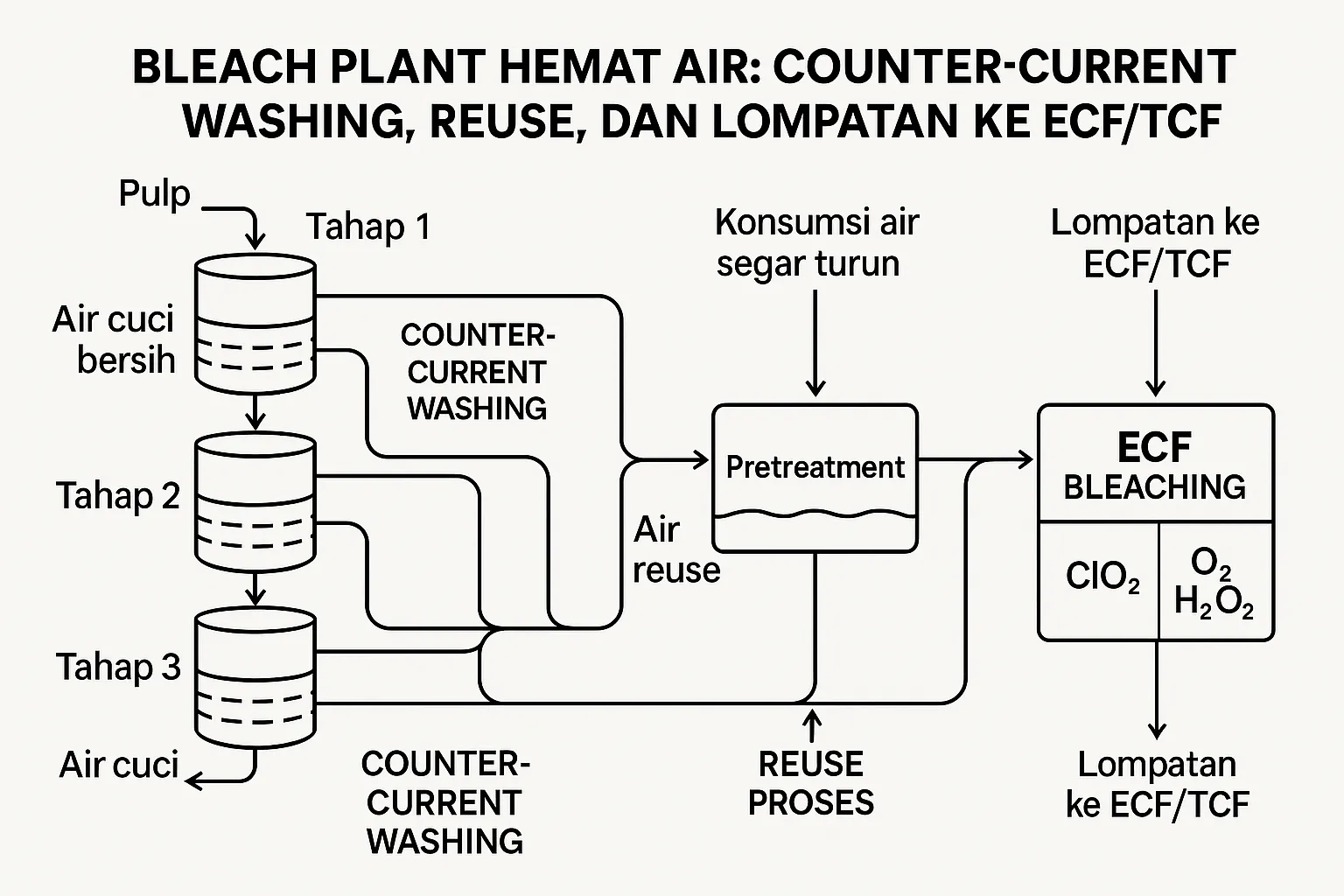
Regulatory direction is clear. In Indonesia, APP and APRIL report O₂-based and ECF chemistries in operations, partly to meet government “green industry” criteria. Water reuse is also strict, with ≥25% recycle mandated (fr.scribd.com). Together these measures reduce the mill’s freshwater footprint and toxic load.
Trade‑offs, targets, and source notes
Counter-current washing and closed water loops can cut fresh-water use in the bleach plant by tens of percent. Typical EU BAT targets of ~12–25 m³/ADt mean 40–60% recycling of process water (eur-lex.europa.eu). Pinch-optimization and wash-efficient equipment can do better (40–70% water savings; researchgate.net, researchgate.net). However, less dilution usually makes the effluent stronger (higher COD, chemical oxygen demand) and can need more bleaching chemicals. Any reduction plan must check the pulp properties and the load on the treatment plant. Where reuse goes toward near-closure, polishing steps such as ultrafiltration can be used as pretreatment for reuse circuits.
All data above come from recent industry studies and regulations. Closed-loop design studies report exact water-use figures (from 8,628→5,086 m³/d fresh water and 5,097→1,549 m³/d effluent, researchgate.net). Indonesian pulp regulations specify 65/45 m³/ton caps with 25% reuse (fr.scribd.com). In bleaching, chemical and water metrics are routinely measured. In trials, increasing reuse raised ClO₂ demand from 8.1 to 16.3 kg/ton (bioresources.cnr.ncsu.edu). Efficient counter-washing achieved <15 m³/ton effluent (eur-lex.europa.eu). This data-driven approach lets plants balance water savings against pulp quality and cost. It guides investment in new washers or ECF conversion. For mills planning reuse upgrades, integrated membrane systems can be evaluated alongside biological steps such as membrane bioreactors to align with targeted closure levels.