

Article
Pulp mills are cutting wash water Counter‑current trains and closed loops show how.
From multistage counter‑current washers to near‑zero‑effluent loops, kraft brown‑stock washing is moving from “hundreds of m³” to ~1–20 m³ of fresh water per tonne. The gains are measurable, modelled, and increasingly regulatory‑driven.
Industry: Pulp_and_Paper | Process: Brown_Stock_Washing_&_Screening
Brown-stock washing is the rinse after the digester in kraft pulping. It has long been one of the biggest water draws in a mill. Recent analyses of best-available technologies put today’s integrated mills at only about 10–20 m³ of fresh water per tonne of product. Mills in the 20th century used hundreds of m³ (www.sciencedirect.com) (www.sciencedirect.com). Regulators are moving to similar targets. EPA/EC guidelines now point to about 20 m³/tonne through Best Available Technologies (www.sciencedirect.com).
The core move is simple. Run the washers counter-current, so the cleanest water hits the cleanest pulp and flows “upstream.” The TAPPI literature puts it plainly: “the cleanest water is added in the last stage and the resulting filtrate is used in the preceding stage.” Fresh additions must be kept “as minimal as possible” to keep high black-liquor solids in the recovery cycle (www.researchgate.net).
Brown‑stock washing baseline and targets
Brown-stock washing removes residual pulping chemicals and dissolved organics from the fiber stream before bleaching. “Black liquor” is the spent cooking liquor. Mills want to recover its solids as energy and chemicals. The modern baseline is 10–20 m³/t fresh water for an integrated mill. Policy aims for about 20 m³/tonne (www.sciencedirect.com) (www.sciencedirect.com).
In practice, counter-current layouts are now standard in the field. They are “integrated into the” multistage washer trains. Filtrate reuse between stages keeps new makeup water to a minimum (www.researchgate.net).
Counter‑current washer configuration
In a counter-current scheme, fresh water goes in at the last washer stage. It flows against the pulp stream through the stages before it. Each washer uses filtrate from the next (cleaner) stage as its shower water. Therefore fresh water demand goes down directly (www.mdpi.com).
TAPPI’s guidance says “the cleanest water is added in the last stage and the resulting filtrate is used in the preceding stage”, and fresh water additions should be “as minimal as possible”. This ties water use closely to recovery performance. Higher black-liquor solids reduce the steam the evaporators use (www.researchgate.net).
Measured savings and recovery effects
A model of a multistage brown-stock line found that an optimized counter-current design cut fresh wash liquor use by about 8 tonnes per hour against a conventional configuration. That is an ~8 t/h reduction in added water on a large kraft line, with pumping savings as well (www.mdpi.com). The same study said counter-current flow helps “recover valuable pulping chemicals while minimizing water consumption and chemical waste” (www.mdpi.com).
Empirical work aligns: counter‑current washers significantly increase wash efficiency—less clean water is needed to reach the same delignification and dilution of black liquor (www.researchgate.net). Reported outcomes include improved chemical recovery, reduced wash losses, and lower effluent COD/BOD, all with reduced water use (www.researchgate.net) (www.mdpi.com).
Mori et al. (2019) reported that counter-current designs “reduces water consumption and enhances chemical recovery efficiency” compared with simpler washing trains. They also reported that optimizing vacuum drum washer parameters (drum speed, feed consistency and dilution flows) keeps pulp cleanliness with minimal fresh bleed (www.mdpi.com). The ~8 t/h liquor saving came solely from adopting counter-current flow (www.mdpi.com). In the cited baseline scenario that is roughly a 10–20% cut in fresh wash water.
In practice, these gains mean higher black‑liquor solids to the evaporator, which saves steam. They also mean lower effluent loads per tonne of pulp, which directly lowers environmental discharge (www.researchgate.net).
Closed‑loop washing and effluent recycling
A more radical path is a closed loop: recycle filtrates instead of discharging them, treat as needed, and route them back to the washing circuit or raw‑water reservoir so essentially no liquid effluent leaves the mill (link.springer.com) (afry.com). The environmental upside is direct: system closure can “drastically reduce or even eliminate liquid discharges and associated water‑quality problems,” and helps mills “preserve energy” and lower effluent treatment costs (link.springer.com).
Mass‑balance and water‑network (“pinch”) analyses show that aggressive recycling can cut freshwater needs by orders of magnitude. One modern mill study reported ~93% less freshwater, dropping from ~13 m³/t to effectively ~1 m³/t. This happened when a full closed loop integrated wash and effluent streams with partial treatment (www.sciencedirect.com).
Even a partial closure makes a difference. At Arauco’s Licancel mill, the pulp line was reconfigured to reuse 50% of treated effluent and send the rest to downstream irrigation. This created a pseudo-closed reservoir and cut the water taken from the river by about half. That matters when the mill is under drought constraints (afry.com).
Treatment blocks and control requirements
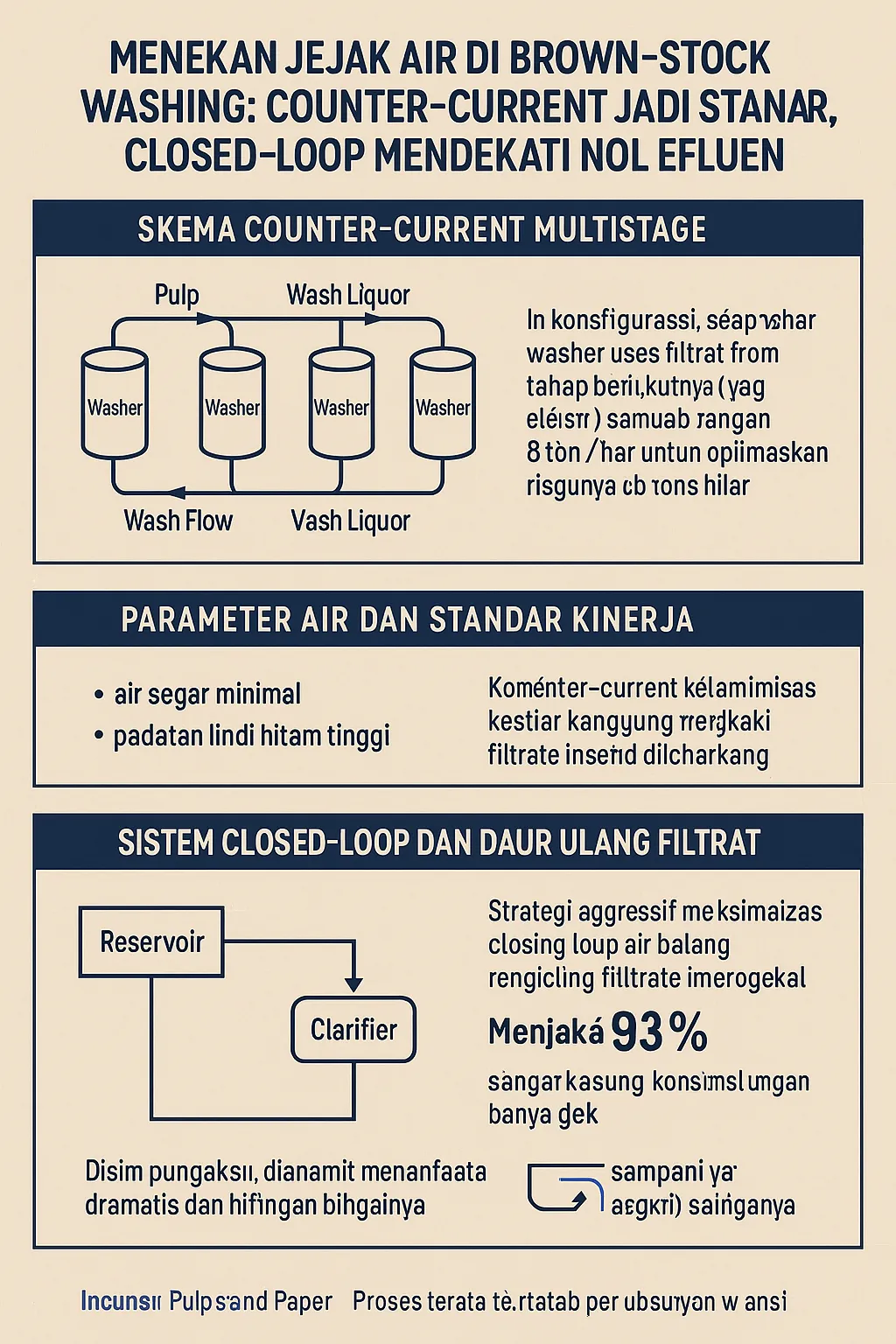
The trade-offs are complexity and capital. High closure usually needs added treatment (membrane filtration, evaporation, etc.) and very tight process control (link.springer.com). Many mills look at membrane trains to support this. Treatment options include membrane systems and pretreatment steps such as ultrafiltration to condition recycled filtrates for reuse.
Sometimes the loop water needs cleaning inside the mill. A clarifier or dissolved-air flotation can prepare the water before it goes back to the washers. Process control also matters, including chemical dosing hardware such as a dosing pump, when you balance the recycled chemistry. Arauco is one industrial example. They adjusted the caustic/sulfate balance so the recycled water would not harm the pulping chemistry. The result was much less water taken from the river (afry.com).
Business impacts and constraints
After closure, makeup water can become negligible and wastewater drops in proportion. In theory, a fully closed system would have zero effluent (www.sciencedirect.com). Reuse also helps when there is a shortage or the permit gets tighter. It saves pumping and heating on fresh intake water and cuts the O&M of effluent treatment (link.springer.com). Regulations are pushing this way. Indonesian mills, for example, face stricter discharge standards and aim for PROPER “Green” status. Raw water also costs money. Therefore the investment can pay off.
Targets and sources
The literature and the case work show the same thing. Multistage counter-current washing and closed-loop recycling give double-digit reductions in fresh water. In the cited models and reviews, counter-current flow alone cut make-up water by 10–20% or more (www.mdpi.com) (www.researchgate.net). With full loop closure, water use can approach the theoretical minimum. In the best cases this is about 1–2 m³/t (www.sciencedirect.com).
Sources: recent industry reviews and studies on pulp washing (Santos & Hart 2014, www.researchgate.net), current modeling research (Kayal et al. 2025, www.mdpi.com; www.mdpi.com), and water‑integration analyses (Tajvar et al. 2023, www.sciencedirect.com; www.sciencedirect.com), which underpin the figures and outcomes cited above.