

Article
Bleach plants are brutal on metal Titanium, duplex steel, and FRP are changing the game.
Industry: Pulp_and_Paper | Process: Pulp_Bleaching
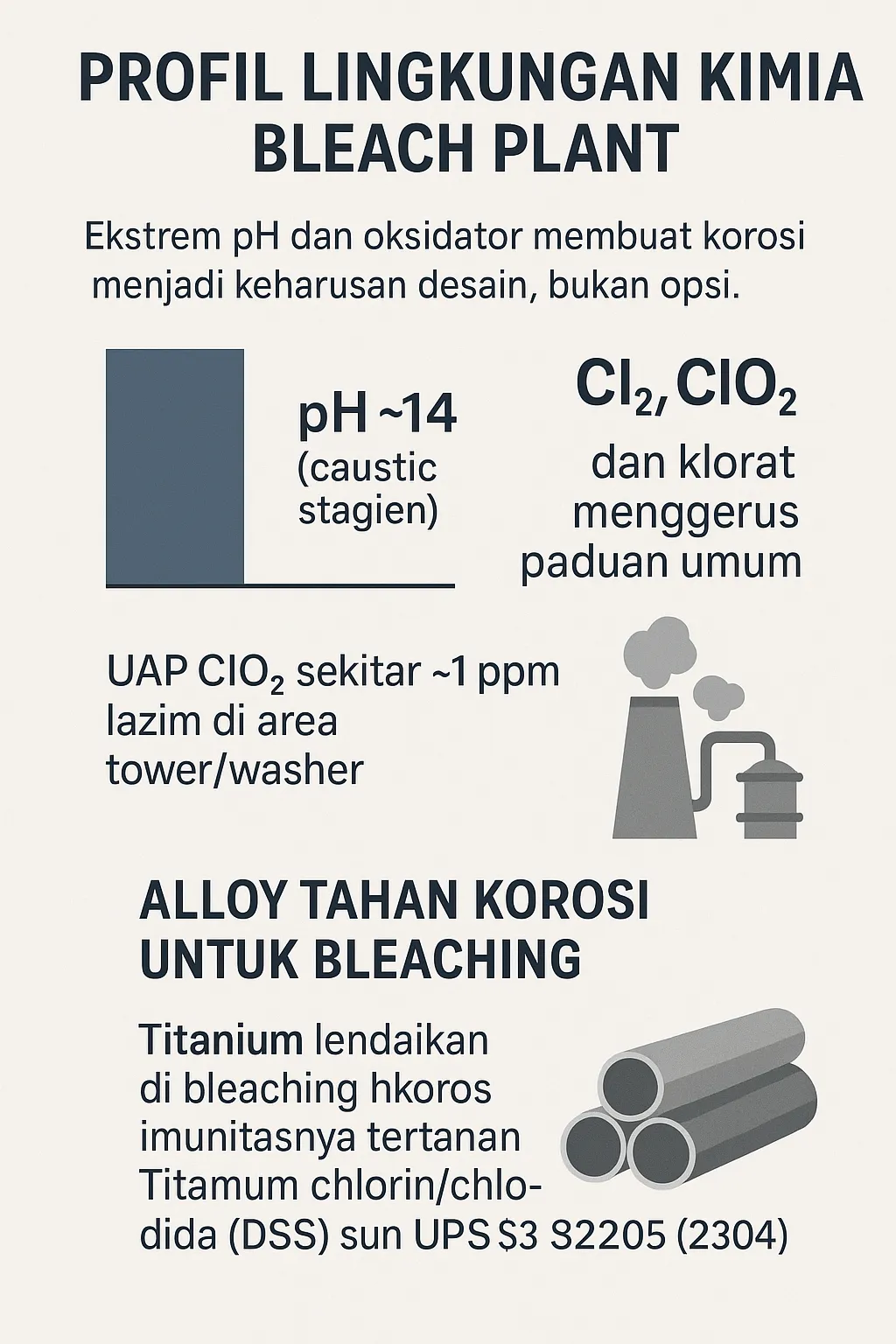
Hot caustic digester liquors can reach pH ~14, and oxidizing bleach stages can drop to pH ~1, according to ASM International. Add agents like Cl₂, ClO₂ and chlorate salts, and most common alloys are under attack. Typical bleach towers and washers see chlorine dioxide levels ~1 ppm (vapor) (Bry-Air). This helps explain why carbon steels and basic 304/316 stainless steel usually fail fast.
Inspections decades ago found severe caustic stress‑cracking in unprotected digesters and corrugated boilers. The cost of corrosion is not theoretical. In the U.S., a ~$165 B industry faces roughly $6 B/year in corrosion-related costs (ASM International). If you plan materials and maintenance accordingly, you avoid spills, downtime and fines. This is also increasingly central to sustainability.
Bleach‑stage chemistry and attack mechanisms
Bleaching chemistry is an aggressive mix. In addition to extreme pH swings (pH ~14 to ~1), oxidizing species such as chlorine dioxide and chlorate target passive films on standard stainless grades (ASM International). At ~1 ppm ClO₂ vapor, even external surfaces can corrode (Bry-Air).
The result is a high incidence of pitting, crevice corrosion and SCC (stress corrosion cracking, cracking driven by tensile stress and corrosive environments) in conventional 304/316 equipment. The industry’s corrosion bill is roughly $6 B/year on a ~$165 B base, which shows the stakes (ASM International).
Titanium applications and economics
Titanium’s “outstanding corrosion resistance… in chloride environments” has been documented for decades. Early work already predicted more Ti use as mills close water cycles (ASME Digital Collection). In practice, many bleach towers (including D0 towers), sock filters, washers and digester vents are built in Titanium grade 2 or grade 7.
While Ti’s purchase price can be 10–20× carbon steel, total life‑cycle cost is often lower because of near‑“permanent” corrosion resistance (Strongwell; ASME Digital Collection). North American mills have replaced aging FRP/metal lines with titanium spools for “better reliability and service longevity” (Apex; Apex). Design guidelines warn that conventional SS (316L/317L) cannot survive rising chlorides in closed‑circuit bleach filtrates, so upgrading to Ti (or Ni alloys) is needed (ASME Digital Collection).
Duplex stainless steels in service
Duplex grades such as UNS S31803 (2205), S32205 (2304) and SUPERDUPLEX S32750 combine about 50% ferrite and about 50% austenite. They give very high strength and corrosion resistance. Compared to 304/316, duplex alloys tolerate more chloride and resist SCC much better in hot, caustic liquor mixings (Pulp & Paper Canada).
Field experience is striking. One corrosion engineer says “new duplex digesters are no more costly than new digesters built using carbon steel,” and in service duplex equipment “just don’t experience appreciable corrosion or cracking” (Pulp & Paper Canada; Pulp & Paper Canada). Meanwhile, modern 316L often sits at only ~2.0% Mo (the low end of spec) versus older material at ~2.8% Mo (Pulp & Paper Canada). A duplex like 22%Cr–5%Ni contains ~3.5% Mo, boosting pitting/crevice resistance. As a result, most new batch or continuous digesters, flash vessels, level tanks, and bleach washer tanks/installations now use 2205/2304, and equipment constructed in duplex “needs far less inspection and maintenance” due to SCC resistance even under wet insulation (Pulp & Paper Canada).
Table 1 from industry sources (MDPI) shows typical duplex SS applications in a Kraft mill. Digesters (high P) use 2205. Washer and flash tanks (mid P) use 2304/2205. Liquor piping (n/a) uses 2205/2101. The O₂‑delignification separator uses 2205. Brownstock washers (low P) use 2101/2205. BL storage usually uses standard 2202 (25Cr), etc. (“P” = pressure, n/a = none.)
Other high‑alloy choices for hot spots
In the rare cases where even duplex fails, such as vent condensers or certain acid mixers, mills turn to Ni alloys (for example Alloy 20, 825, Hastelloy C276) or zirconium. However, titanium and duplex cover most bleach‑plant needs and still balance cost.
Non‑metallic options: FRP and elastomer linings
FRP (fiberglass-reinforced plastic, glass fiber in a corrosion-resistant polymer such as vinyl ester) and rubber linings are workhorses in bleach service. FRP tanks, vessels and piping became common from the 1950s onward. They have excellent corrosion resistance, high strength-to-weight and design flexibility (OnePetro). FRP does not corrode in hot caustic or low-pH bleach chemicals (except in worst cases). Therefore it gives a very long life. One pulp mill’s buried FRP effluent line ran 30 years with virtually no degradation. It was removed only for capacity expansion (OnePetro). Modern FRP service lives of 25–40+ years in bleach duty are reported. FRP is usually cost-competitive with exotic alloys over time (OnePetro).
There are limits. High‑concentration ClO₂ or hot concentrated acids can attack FRP resin. UTComp notes ClO₂ “can attack and degrade FRP” and cause thickness loss (UTComp). Some mills found cracks and thinning in FRP bleach washers after ~15–20 years, driving repairs (UTComp; UTComp). Monitoring mitigates risk: external ultrasonic systems can map FRP wall thickness. In one case, 28‑year‑old FRP seal tanks with ClO₂ filtrate showed no immediate need for relining and an estimated ~29 more years of life (UTComp). Where oxidizers are present, inspection frequency typically increases, and cracked panels may be repaired or replaced (UTComp).
Rubber linings (neoprene, EPDM, Hypalon) and polymer linings on steel or FRP substrates are common in washers, towers and lye tanks. These elastomers give toughness and chemical resistance in mildly oxidative environments. They usually last 5–10 years before relining, depending on chemistry. Technical lining systems also use vinyl ester or ceramic-filled polymer concretes in bleach towers (Blome). Elastomers age, and chlorides can embrittle some formulations. Therefore lined vessels are inspected for gap corrosion or lining failure. Composites usually outlast metals “through multiple life cycles” of their alloy counterparts (Strongwell).
Corrosion control beyond base materials
Supplementary protections are widely applied. Cathodic protection or anodic straps are sometimes used in digesters. They are not usually used in bleed piping because of mixed waters. Any such system needs periodic checks.
Special coatings add insurance. Mills use sprayed novolac epoxy coatings (for example TL‑47 and TL‑91 types) or high‑build urethane membranes to protect carbon steel internals from NaOH and chlorine. Good QA on thickness and holiday checks is important because a coating failure concentrates the attack in one spot (Blome).
Chemical inhibitors are limited in bleaching itself. However, they may be added in water‑scrubbers or heat exchangers to buffer pH or tie up oxidants (phosphates, amines, silicates). Where programs are used, mills turn to tools such as a corrosion inhibitor for general protection or a neutralizing amine for pH control. Precise addition is supported by an accurate chemical dosing pump. Process control helps too. For example, one mill recirculated filtration until acid concentrations dropped, and this preserved the FRP piping (OnePetro). Another step is balancing washer temperatures and flows to minimize erosion‑corrosion. The fix depends on wood type, liquor composition and flows, so each mill’s history matters.
Inspection and maintenance program essentials
Even the best materials demand surveillance. Regular thickness monitoring via UT (ultrasonic testing) on vessels and piping in bleach areas is standard. High‑risk items like bleach towers, digesters and washer drums warrant annual or biennial checks. Industry practice maps internal thickness in known thinning zones of digesters yearly because cracks can grow ~10 mm/year (Pulp & Paper Canada). Measured wall‑thickness data drive capital calls. For example, whether to install a $1M stainless‑steel overlay versus cheaper options (Pulp & Paper Canada).
NDT (non‑destructive testing) goes beyond UT. UTComp’s UltraAnalytix detects FRP delamination or thinning without shutdown (UTComp; UTComp). Mills also use dye‑penetrant, thermal imaging, or guided‑wave ultrasound. Crucially, plans “tailor” to high‑risk areas — welds, nozzle corners, bottom plates — rather than a shotgun approach (Pulp & Paper Canada).
Visual and safety inspections at turnarounds check for pitting, cracking and lining failure. High‑voltage holiday tests on linings check that the lining is sound. Leak detectors (sumps or sensors) give early warning between outages. PMV (positive material verification) at construction matters too. One $30K analyzer flagged a wrong alloy substitution (carbon steel instead of the specified 310). It prevented a major leak (Pulp & Paper Canada).
Maintenance tracking in a CMMS (computerized maintenance management system) helps measure improvement. Define KPIs such as corrosion rate, outages prevented, and repair‑versus‑replacement cost. Corrosion management experts report strong ROI. NACE usually cites 5–15×, but each site needs its own analysis. In practice, data has extended asset lives. An FRP seal tank was due for re‑lining at 25 years. UT data showed it was sound, so it stayed in service and gained about 3 more years (UTComp). Neglect can be catastrophic. Wensley recounts a boiler explosion and $100M loss. A cheap process gas analyzer discouraged future inspection, and then a carbon‑steel tube failed (Pulp & Paper Canada).
Regulatory context and outcomes
Regulators are raising the bar. Indonesia’s environmental program is pushing pulp mills toward “PROPER Hijau” (highest environmental performance). In practice this calls for best-in-class process integrity alongside emissions control (KemenLH). The path is clear in bleach plants. Choose titanium or duplex stainless where it counts (Pulp & Paper Canada; Apex). Use FRP or rubber linings where they work best. Back it all with rigorous, targeted NDT and maintenance. The result is lower downtime, lower lifetime costs and less risk of spills or fines. In the end, equipment life and reliability improve in harsh bleach-plant service.
Sources: ASME Digital Collection; Pulp & Paper Canada; OnePetro; Apex; ASM International; UTComp; MDPI; Strongwell; Bry‑Air; Blome; UTComp.