

Article
Refinery boilers fail on water, not fire: Here’s the playbook to keep steam reliable for decades
Industry: Oil_and_Gas | Process: Downstream_
In refineries, the quiet killers of boiler reliability sit on the water side. Utilities data tie corrosion to roughly half of forced outages and to most tube failures (Electric Power Research Institute cited at power-eng.com). Also, a thin layer of scale (mineral deposits) of about ~1/8″ can cut heat transfer enough to raise fuel consumption and create temperature hot spots (chardonlabs.com).
That is why modern refineries lock down the chemistry. Indonesia’s SNI 7268:2009/ASME Boiler Code needs boiler feedwater pH ~7–9, virtually zero dissolved O₂, and hardness ~1 mg/L as CaCO₃ after treatment (kupdf.net). These limits, together with condensate return controls, are designed to prevent oxygen pitting and calcium silicate scale.
Water chemistry standards and controls
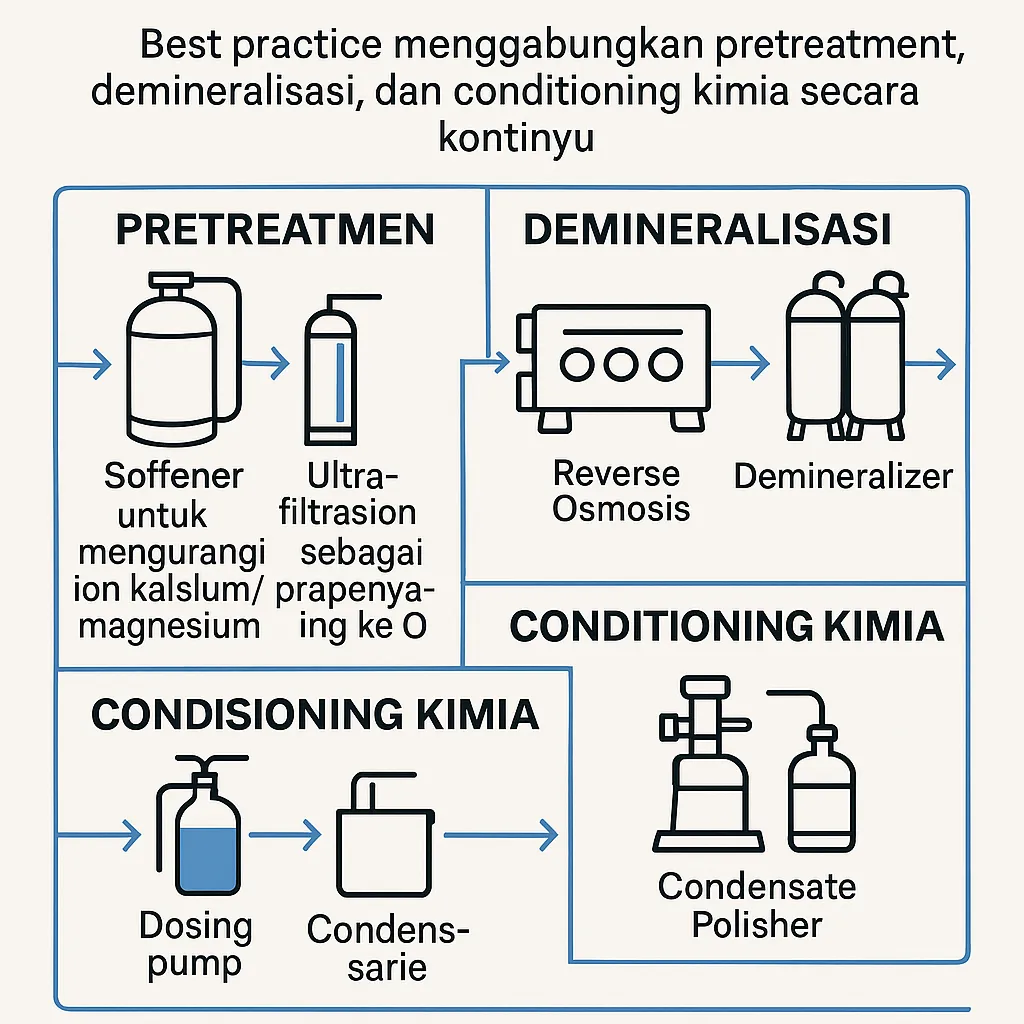
Best practice starts with pretreatment and continues with chemicals and monitoring. Pretreatment usually includes softening to remove calcium/magnesium hardness, and many plants deploy a softener for this. It also includes Demin (demineralization via ion exchange), usually through a packaged demineralizer or an ion‑exchange system.
Chemical conditioning is continuous. Programs include oxygen scavengers (chemicals that react with dissolved oxygen), alkalinity builders or neutralizing amines (volatile amines that raise condensate pH), and scale inhibitors (dispersants to keep precipitates from depositing). Facilities usually standardize these under boiler chemical programs such as oxygen scavengers, a neutralizing amine, and a scale control package.
Blowdown management and monitoring
Blowdown is the controlled removal of boiler water to limit dissolved solids. It must be tight. U.S. DOE/FEMP guidance notes that inadequate blowdown lets solids accumulate and causes carryover. Too much blowdown wastes water and energy (energy.gov). The guidance recommends daily or weekly tests for pH, alkalinity, hardness, conductivity, silica and related parameters (energy.gov). It also covers on-line chemical feeds, usually handled by a metering dosing pump, and the engagement of water-treatment specialists to “prevent system scale and corrosion” and optimize concentration cycles.
When implemented to spec, results are measurable: lower corrosion rates, fewer leaks, and improved thermal efficiency. Field experience shows plants can sustain “as‑new” boiler efficiency for decades if water chemistry stays in control (digitalrefining.com; chardonlabs.com).
Preventive maintenance and RCM program
Downtime economics are blunt. An analysis counted more than >2,000 unplanned outage events in 2019 at U.S./North American refineries. These came from failures outside planned maintenance (blog.geckorobotics.com). In a U.S. refinery survey, about ~92% of maintenance-related shutdowns were unplanned (pumpsandsystems.com). Take an 80,000 bpd FCC unit (fluid catalytic cracking, a conversion unit). The lost-margin hit is roughly $0.34–1.7 million per day when production stops (blog.geckorobotics.com).
A best‑in‑class approach formalizes reliability‑centered maintenance (RCM, a method that aligns tasks to failure modes) across boilers and steam loops. Schedules mix inspections, testing, cleaning, and tune‑ups with condition‑based monitoring. DOE/FEMP recommends periodic combustion tuning, with air/fuel‑ratio tuning at least annually (energy.gov), and inspection and cleaning of both water‑ and fire‑sides during turnarounds to restore heat transfer. “Turndown” (the minimum‑to‑maximum firing range) and load cycling should be minimized when possible to limit thermal stress. Safety devices (safety valves, low‑water cutoffs) and controls need scheduled calibration. Plants usually pair chemical programs with boiler cleaning service during major outages to maintain heat‑transfer surfaces.
Steam traps, predictive methods, and savings
Steam traps and condensate pumps need routine surveys. One refinery case reported that tighter steam-trap maintenance halved trap failure and saved $9.3 million per year in energy and repair costs (spiraxsarco.com).
Predictive maintenance (data-driven condition monitoring such as vibration and ultrasound analysis, real-time chemistry sensors, and AI analytics) cuts risk further. Operators who use predictive, data-driven methods report about 36% less unplanned downtime than reactive programs (blog.geckorobotics.com). Also, an RCM-style study by Patil et al. (2022) found that formalizing preventive schedules on boiler components could raise system reliability by about 28% and cut annual maintenance costs by about 20% (mdpi.com).
Critical spares inventory planning
Maintenance alone cannot outrun supply chains. Long‑lead items need to be stocked: boiler tubes, burner components, feedwater pumps, safety valves, controls, and similar. ASME codes effectively need spares. For example, each boiler must have at least one spare safety valve (usually purchased upfront), with additional spares for pumps or instrumentation that carry long procurement times.
The reliability gain is large. Modeling shows that a needed spare on the shelf can cut an outage from months to days. In one analytical example with a 30‑day mean time between failure, downtime with a spare was ~1 day. Without it, downtime was 30 days (smartcorp.com). In that model, uptime improved from ~50% to ~85%. If spares are always on hand, uptime can “approach 100%” (smartcorp.com).
Best practice is to run a criticality analysis and then stock the parts it shows you need. Boiler rooms usually keep burner nozzles, igniters, probes, gauges, and control boards. They also keep one-way or blowdown valves, feed-pump rotors, and specialty gaskets. Teams sort the parts by how important they are and by lead time. “A-items” have a long lead time and matter for safety, so they are kept on site. “B-items” have a moderate lead time or use, so they are kept at a regional store. Inventory carries cost. However, facilities usually judge a core spare set as necessary to avoid expedited shipping and long outages.
Chemical dosing and system ancillaries
Plants standardize dosing equipment and supplies to support continuous conditioning and stable concentration cycles. Many programs are built around a neutralizing amine for condensate pH control, an alkalinity control package in the boiler, and an oxygen scavenger on the feedwater, all delivered through a calibrated dosing pump. water‑treatment ancillaries complement these and keep monitoring and feeds reliable during long refinery runs.
Source notes and documented practices
Authoritative industry studies, standards, and case reports cited above justify each practice. U.S. DOE guidance emphasizes routine inspections, tuning, blowdown control, and chemical treatment (energy.gov), while EPRI and others document the damage from poor water chemistry (power-eng.com; chardonlabs.com). Reliability analyses and refinery experiences quantify gains from scheduled maintenance and spare availability (pumpsandsystems.com; blog.geckorobotics.com; mdpi.com; smartcorp.com). All of these data‑driven insights underpin the recommendations presented here.