

Article
Bleach plants are the mill’s biggest water hogs. Here’s how pulp makers are cutting the tap by half.
Industry: Pulp_and_Paper | Process: Pulp_Bleaching
The bleach plant is the thirstiest island in a pulp mill — often about 50% of total mill water intake and producing ~80% of the effluent, according to BioResources (bioresources.cnr.ncsu.edu). Industry has already pushed specific water use down from roughly 50 m³ per tonne in the 1980s to ~25 m³/odt (m³ per oven‑dry tonne) today (bioresources.cnr.ncsu.edu), but typical kraft lines still run 10–16 m³/tonne for washing and stage feeds — Santos et al. cite ~16 m³/tonne with ~6 m³/tonne between stages (bioresources.cnr.ncsu.edu).
Every cubic meter saved at the bleach plant cuts fresh‑water withdrawal and effluent by ~50% of that amount at the mill level. In many regions (including Indonesia), water scarcity and tightening discharge limits make further reductions imperative. The playbook is counter‑current washing, internal recirculation (including treated effluent reuse), and conversions to elemental chlorine‑free (ECF) or totally chlorine‑free (TCF) sequences. All of this is backed by peer‑reviewed results and case data.
Bleach-plant water demand baseline
Typical kraft bleaching lines still use on the order of 10–16 m³/tonne for washing and stage feeds, and mills report that bleach plants alone drive roughly half of total water intake and ~80% of effluent (bioresources.cnr.ncsu.edu). Specific water consumption has fallen from roughly 50 m³/tonne in the 1980s to ~25 m³/odt today (bioresources.cnr.ncsu.edu). Within that context, Santos et al. detail ~16 m³/tonne total, with ~6 m³/tonne between bleach stages (bioresources.cnr.ncsu.edu).
Counter‑current washing and wash‑factor control
Running wash water in counterflow to the pulp, with later‑stage filtrates washing earlier stages, slashes fresh demand. In an experimental ECF sequence, counter‑current washing factors of 9, 6, 3, and 0 m³/tonne (fresh water per tonne) showed that using only ~3 m³/tonne still produced 92% ISO brightness, reasonably close to conventional results. However, zero washing failed to reach target brightness (www.scielo.br). In plain terms, multi‑stage counter‑current washes can cut fresh wash water by roughly 60–70% with little loss of pulp quality.
“Jump-stage” washers (filtrates skipping a washer) and closed-circuit thick-stock washers give similar gains. One note calls the counter-current jump-stage method a significant contributor to fresh-water reduction (bioresources.cnr.ncsu.edu). Some mills even consolidate washers. In a D₀/E₁/D₁/E₂/D₂ line, merging D₀ and E₁ (skipping the intermediate wash) cut bleach-plant effluent flow and water use. AOX (adsorbable organic halides) fell from 1.2 to 0.42 kg/t (~65% drop) while the line still met 90% ISO brightness (pubmed.ncbi.nlm.nih.gov). Below ~3 m³/t, the Brazilian study deemed washing “commercially unviable” because of carry-over (www.scielo.br).
ECF stages need accurate chemical dosing, and the stages are finely tuned (chlorine dioxide instead of elemental chlorine). Mills usually rely on equipment such as a dosing pump to keep tight control and avoid overfeed.
Closed‑loop reuse and washer recirculation
Many modern mills operate bleach washers with no fresh water at all, feeding washer tanks with “white water” — condensate from pulp dryer vacuum systems — and evaporator condensates instead of plant water (bioresources.cnr.ncsu.edu). As Sillanpää observed: “many mills do not use fresh water in the pulp bleaching washers, but white water from the pulp dryer and black liquor evaporation condensates” (bioresources.cnr.ncsu.edu).
Recirculated process streams have limits (COD, AOX, TDS). A purge bleed is needed from time to time to control inorganics (Na, Cl). To manage solids ahead of reuse loops, engineers usually evaluate primary clarification steps. A compact clarifier is usually the first treatment step before the water goes to reuse.
Effluent recirculation and water‑network integration
Pinch and water cascade analyses of bleach plants show that fresh water use can fall 40–70% with smart reuse. Shukla et al. reported 41.8% fresh water savings and 70.7% effluent reduction in an Indian kraft line with three washers (hypo, chloro, alkali). They reused and cascaded filtrates within the constraints (link.springer.com). A Water-Source-Diagram follow-up confirmed similar figures. Initial bleach withdrawals of 8,628 m³/d were cut by about 41% to about 5,000 m³/d, and effluent was cut by about 70% (www.researchgate.net).
Santos et al. ran ECF bleaching trials with three wash streams: (a) deionized water, (b) internal white water, and (c) low and high organic treated bleach effluent. They reached 90% ISO brightness with both clean water and effluent. However, ClO₂ consumption rose from 8.1 kg/odt (fresh water) to 13.8–16.3 kg/odt (effluent) (bioresources.cnr.ncsu.edu). Pulp quality did not change statistically, and the recirculated filtrate did not overload the wastewater plant (bioresources.cnr.ncsu.edu).
Integrated reuse schemes — filtrate recirculation, pinch‑based network design, washer reconfiguration — can cut bleach‑plant fresh water by about 40–50% or more in mature mills (www.researchgate.net; link.springer.com). Huber et al. add that such reuse “may allow a reduction of more than 50% of mill consumption” (bioresources.cnr.ncsu.edu).
Where mills look at reuse polishing, they usually review membrane options. Suppliers offer integrated membrane systems for industrial water treatment, with ultrafiltration as pretreatment ahead of high‑recovery loops. Some operators also look at biological hybrids sold for reuse, such as membrane bioreactors, to match the treated‑effluent recirculation cases described above.
ECF and TCF chemistry and AOX reduction
ECF (elemental chlorine-free, using ClO₂ instead of Cl₂) and TCF (totally chlorine-free, using oxygen, peroxide, ozone and other non-chlorine oxidants) cut AOX (adsorbable organic halides) a lot. ECF reduces AOX to “insignificant” levels. TCF gives essentially zero AOX (www.researchgate.net). Kumar et al. report conventional (D₀/C ED sequence) bleaching at ~2.6 kg AOX/ton. Optimized ECF sequences (for example D E P D) kept AOX <1 kg/t, below stringent limits (www.researchgate.net). These ECF sequences also reduced NaOH by ~30% and saved up to 45% of certain chlorine chemicals (in an O–D–E–D sequence) (www.researchgate.net).
Cleaner chemistry usually means less washing. Converting the first stages to oxidation and peroxide (eliminating an intermediate wash) cut AOX. It also “enables reduction of the total flow rate of effluent…and the total consumption of water” (pubmed.ncbi.nlm.nih.gov). With counter‑current washing, an ECF/TCF line can get close to a “nearly closed” bleach mill. It uses <10 m³/tonne fresh water (sometimes close to zero) and makes very low AOX effluent.
Economics and regulatory context
A comparative techno-economic model for a eucalyptus mill found operating costs nearly identical: ~$465/adt for ECF vs ~$468/adt for TCF, with internal rates of return at 16.5% vs 16.4%. TCF reduced chemical costs (no chlorate or methanol) but used more electricity (ozonation). The financial result was parity (www.researchgate.net).
Regulation has driven the shift for decades in the EU and North America. Elemental chlorine has been largely removed from bleaching there. Scanner countries report ≳95% of kraft mills using ECF (pmarketresearch.com). Even without strict AOX limits, mills see ECF/TCF enabling clean‑water objectives and ecolabel criteria. Indonesia’s pulp leaders (APP, APRIL Taiwan Group, etc.) likewise tout ECF bleaching and water reuse in sustainability reports.
Implementation notes and unit operations
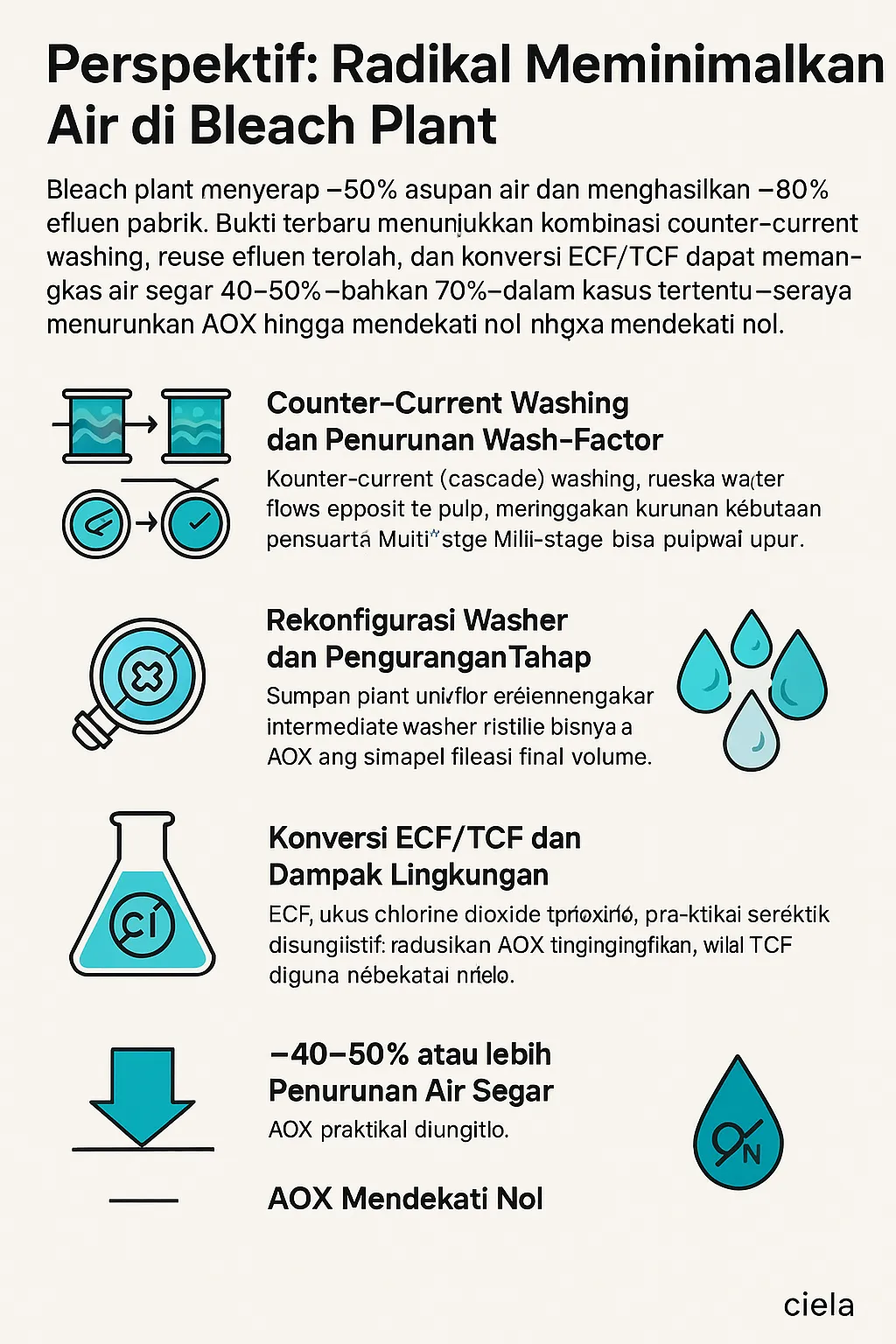
Case data show reuse can be dramatic without heavy capex. A Water‑Source‑Diagram study cut bleach fresh draw ~41% (8,628 to ~5,000 m³/d) and effluent ~70% (www.researchgate.net). Another example trimmed AOX ~65% simply by removing a washer, while maintaining 90% ISO brightness (pubmed.ncbi.nlm.nih.gov). For mills designing reuse loops, pretreatment trains are commonly reviewed alongside the washer network. Options on the market range from primary clarification to pressure membranes. Vendors position ultrafiltration as pretreatment to protect high‑pressure units. They also list integrated RO, NF, and UF systems for industrial water reuse. Some plants evaluate membrane bioreactors where biological polishing is part of the strategy.
Bottom line
Implementing counter‑current washing, reusing whitewater/filtrates and recirculating treated effluent can typically cut bleach‑plant fresh water by 40–50% or more (www.researchgate.net; www.scielo.br). Converting to ECF/TCF effectively eliminates chlorinated organics, with techno‑economic work showing minimal cost delta (~$465/adt for ECF vs ~$468/adt for TCF; IRR 16.5% vs 16.4%) (www.researchgate.net; www.researchgate.net). Together, these measures curb freshwater demand, effluent volume and toxicity — aligning with strict Indonesian and international standards.
Sources span BioResources (Santos et al. 2020; Sillanpää 2005), Clean Technologies & Environmental Policy (Shukla et al. 2012), Environmental Science & Technology (Kirk et al. 2001), TAPPI Journal (De Assis et al. 2017), and market reports, with URLs embedded above for verification (bioresources.cnr.ncsu.edu; pubmed.ncbi.nlm.nih.gov; link.springer.com; www.researchgate.net; www.scielo.br; pmarketresearch.com).