

Mining
TERRAGARD Industrial Degreasers: Types and How to Choose
Updated
A degreaser removes oil and grease from heavy equipment, engines, and workshops. Compare water-based, quick-break, and solvent types and TERRAGARD products.
Discuss the application.
Send the application, operating conditions and the result you expect. Our team will discuss the options with you.
A degreaser is a cleaning chemical that releases oil, grease and oily dirt from engines, heavy equipment, components and workshop floors. Then the surface can be inspected, repaired or painted. There are three main types: water-based, quick-break and solvent-based. PT Beta Pramesti Asia supplies TERRAGARD Degreasers, namely the water-based TERRAGARD GR 642 and the solvent-based TERRAGARD EXSO 504 and EXSO 508, for workshops, wash bays, mining equipment and engines.
Updated: 12 November 2026.
What is a degreaser and how does it work?
Degreasers work in one of two ways. Water-based degreasers use surfactants, wetting agents and alkaline builders to lift oil from the surface into an emulsion. The emulsion is then rinsed away with water. Solvent-based degreasers dissolve oil and grease directly, without water. Then they evaporate or are wiped off. Quick-break is a water-based degreaser whose emulsion is deliberately unstable. Oil is lifted during washing and then released again from the wash water, so an oil-water separator can capture it.
The type you choose decides more than cleaning speed. It also decides rinse-water demand, fire and vapour risk, compatibility with paint, seals and aluminium, and whether the separator and wastewater plant on site can handle the wash water.
Which degreaser type suits which job?
| Type | Typical soils | Surfaces | Rinse and oil-water separator | Where it is used | Product and page |
|---|---|---|---|---|---|
| Water-based (alkaline, heavy duty) | Oil, grease, soot, oily road film, light tar | Steel, concrete floors, equipment bodies; test first on aluminium, paint, and rubber because the product is alkaline | Rinsed with water. Oil leaves as an emulsion, so check the separator and treatment plant can handle it | Wash bays, workshop floors, heavy-equipment exteriors and undercarriages, trucks, tanks and heat exchangers | TERRAGARD GR 642, see heavy duty water-based degreaser |
| Quick-break water-based | Oil and grease in routine washing where wash water goes to a separator | As water-based; test material compatibility | Rinsed with water. The emulsion breaks in the separator so a skimmer can remove the oil | Vehicle and heavy-equipment wash bays with an oil-water separator or sump | Selected after a wash-water trial, see quick-break degreaser |
| Solvent-based | Heavy grease, hardened oil, tar, dirt on engine components and spare parts | Metals and well-bonded paint (per the EXSO data sheets); test on rubber, plastics, and coatings | No water rinse. Spent solvent and rags are collected separately, never sent to the separator | Component workshops, parts soaking, engines, areas that must stay dry | TERRAGARD EXSO 504 and EXSO 508, see solvent base degreaser |
Mixed contamination of oil, coal dust, mud and clay usually needs two stages. Remove solids first by scraping or water spray, then degrease. Surfaces that will be painted, welded or NDT-inspected need a low-residue degreaser that passes the acceptance test of the next process.
When should you choose water-based, quick-break, or solvent?
- Choose water-based for repeated washing of heavy equipment, trucks and workshop floors where rinse water is available and fire risk must be kept low. The product, its technical data and the dilution arithmetic are on the heavy duty water-based degreaser page.
- Choose quick-break when wash water drains to an oil-water separator and stable emulsions have been carrying oil through to the treatment plant or drains.
- Choose solvent for targeted cleaning of engine components and spare parts that must dry fast, cannot be rinsed with water, or need soaking. Control flash point, ventilation and ignition sources.
A step-by-step guide is in how to choose the right degreaser for mining machinery, and what degreasers do on heavy equipment is covered in chemical degreasers for oil and grease on heavy equipment.
How does a degreaser affect the oil-water separator and wastewater plant?
A water-based degreaser that forms a stable emulsion can carry oil straight through a gravity separator. Oil and grease at the outlet rise, the treatment plant takes more load, and separator sludge becomes harder to handle. Quick-break chemistry is designed to reduce this. However, results still depend on retention time, temperature and separator maintenance.
Before you change the product in a wash bay, sample the wash water and test oil and grease, pH, and TSS. Testing is available through the lab.id laboratory. If emulsions still pass, review an oil removal or DAF stage before the water reaches a biological process.
TERRAGARD Degreaser products
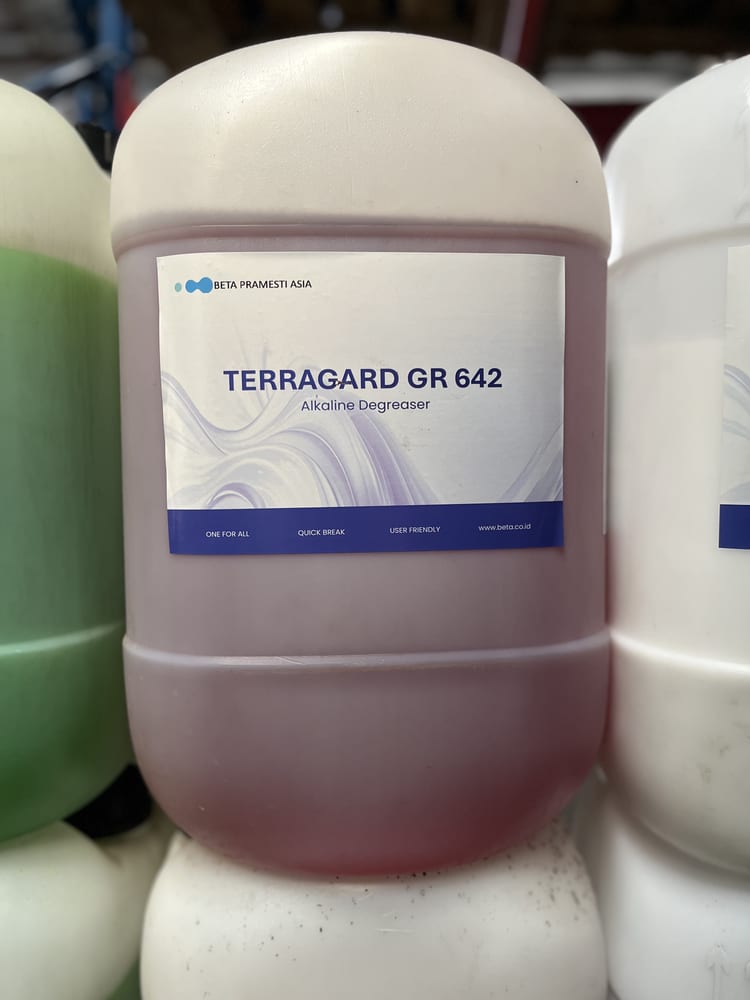
TERRAGARD GR 642: water-based alkaline degreaser
TERRAGARD GR 642 is a water-based alkaline degreaser for cleaning oil, grease, and dirt from many surfaces. You can apply it by spraying, dipping or immersion, or brushing. Its data sheet lists use on condensers, mixing tanks, heat exchangers, machinery, heavy equipment, pipes, oil platforms, oil residue inside holding tanks, fan-coil units, and heavy-duty vehicles and trucks.
| Parameter | Value |
|---|---|
| Appearance | Clear yellow liquid |
| Specific gravity | 1.00-1.10 (20°C) |
| pH | 8.5-9.5 |
| Solubility | Completely soluble in water |
| Dilution | Depends on the degree of soiling; the data sheet gives usual dilutions of 1:10 to 1:40. Prior heating and circulation improve effectiveness; combine with mechanical cleaning for hard soils |
| Handling | Alkaline and may irritate eyes. Wear goggles and gloves. If eyes are contacted, flush with plenty of water for about 15 minutes and seek medical attention |
| Packaging | 30 kg plastic container, 200 kg drum, or 1,000 kg IBC |
TERRAGARD EXSO 504: solvent degreaser
TERRAGARD EXSO 504 is a solvent-based cleaner for removing oil, grease, and dirt from engines and spare parts. It evaporates to speed drying and leaves no residue that attracts carbon dust, metal particles, or other contaminants. It suits general maintenance cleaning of manufacturing, automotive, marine, and transport equipment.
TERRAGARD EXSO 508: solvent degreaser with a higher flash point
TERRAGARD EXSO 508 has the same purpose and application as EXSO 504. The main difference on the data sheets is flash point: above 77°C for EXSO 508, against 40°C for EXSO 504.
| Parameter | EXSO 504 | EXSO 508 |
|---|---|---|
| Appearance | Clear colourless liquid | Clear colourless liquid |
| Odour | Solvent | Solvent |
| Specific gravity | 0.75-0.85 g/cm³ | 0.75-0.85 g/cm³ |
| Flash point | 40°C | >77°C |
| Solubility in water | Insoluble | Insoluble |
| Application | Immersion or brush. For thick, hard oil or grease, soak for 5-10 minutes, then wipe and allow to dry | As EXSO 504 |
| Storage | Do not store above 45°C or near strong oxidising agents | As EXSO 504 |
| Packaging | HDPE 25 L pail, 200 L drum, or 1,000 L IBC | HDPE 25 L pail, 200 L drum, or 1,000 L IBC |
Always use the current SDS to set ventilation, PPE, ignition-source controls, and waste handling before work starts.
How should you test a degreaser before using it site-wide?
- Pick an area or component that represents routine work and photograph its starting condition.
- Make up the working chemical from the data sheet and record concentration, application method and contact time.
- Compare with the current method: cleanliness, residue, labour time, and effect on paint, seals and rubber.
- Measure wash-water volume and the response of the oil-water separator. Send samples to a laboratory where needed.
- Decide product and procedure on actual cost per job, not price per litre.
What should you send us for a quotation?
- Soil type (engine oil, hydraulic oil, grease, soot, coal dust mixed with oil) and photos.
- Equipment or areas cleaned and the number of units or area per week.
- Current method: spray, steam, soak, brush, or parts washer.
- Sensitive materials: aluminium, paint, rubber, electrical parts.
- Wash-water route: wash bay, sump, oil-water separator, wastewater plant.
- Delivery location and preferred packaging.
Send these details through our technical team or WhatsApp on this page.
Frequently asked questions about degreasers
What does a degreaser do?
A degreaser releases oil, grease and oily dirt from metal surfaces, engines and floors. Leaks are then visible during inspection, repairs are safer, surfaces are ready for painting or welding, and the risk of slipping or fire from oil build-up is lower.
What is the difference between water-based and solvent-based degreasers?
A water-based degreaser is diluted with water. It lifts oil as an emulsion and is rinsed off. Fire risk is lower, but the wash water must be treated. A solvent-based degreaser dissolves oil without water and dries quickly. It suits components and spare parts, but it needs vapour, ventilation and ignition control.
What is a quick-break degreaser?
A quick-break degreaser is a water-based degreaser whose emulsion breaks again after washing. The oil then rises in the separator tank and can be removed. It is chosen for wash bays whose wash water drains to an oil-water separator.
Which degreaser suits mining heavy equipment?
For routine washing of bodies and undercarriages in a wash bay, start with a water-based degreaser such as TERRAGARD GR 642. Use a quick-break product if the separator struggles with emulsions. For removed engine components and spare parts, a solvent such as TERRAGARD EXSO 504 or EXSO 508 is more practical. The final choice comes from an on-site trial.
What dilution should be used?
Follow the product data sheet and adjust to the degree of soiling. For TERRAGARD GR 642 the data sheet gives usual dilutions of 1:10 to 1:40. The EXSO solvents are used neat, without water.
Can a degreaser damage paint and seals?
Yes, if the type or concentration does not suit the material, or the contact time is too long. Test a small area first. Look for discolouration, softened paint or swollen seals, then rinse or dry according to the procedure.
See also the TERRAGARD mining chemicals range, including mining dust suppressants.