

Article
textile wastewater: coagulation or radical chemistry?
Industry: Textile | Process: Wastewater_Treatment
In jar tests on real reactive-dye wastewater, one team needed 6000 mg/L of alum (aluminum sulfate) at pH ~2.4 to reach about 90% color removal (www.researchgate.net). In the same study, a pre-hydrolyzed coagulant, polyaluminum chloride (PAC), reached 100% color removal at only 800–2000 mg/L, at pH ~4 (www.researchgate.net).
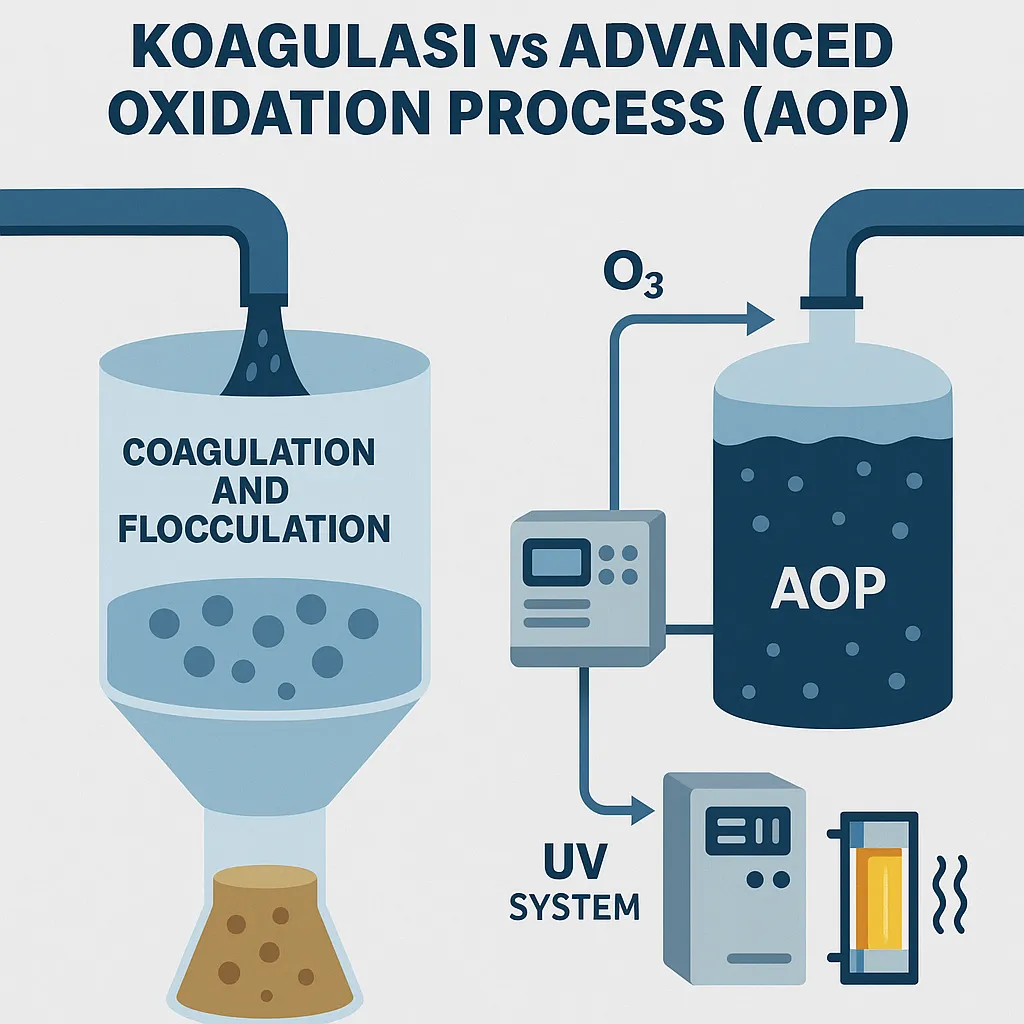
That is the coagulation/flocculation story in miniature. Conventional metal salts are cheap per kilogram. However, they need a high dose and make a lot of sludge. Polymeric coagulants and aids cut the mass and still remove the color. When stubborn chromophores remain, plants pay for oxidation processes (AOPs), Fenton chemistry or ozonation, to break the molecules apart.
Costs vary widely. A typical coagulation stage costs about $0.05–0.10 per m³ in chemicals. AOP steps cost about $1–10 per m³. One Fenton study gives about $10–20/m³, from a figure of $8.6/kg COD removed (link.springer.com).
Conventional metal salt coagulation
Aluminum and iron salts (alum, FeCl₃, ferrous sulfate) hydrolyze and form metal hydroxides. These hydroxides adsorb and destabilize dye colloids. That is coagulation (charge neutralization) and flocculation (aggregation) in the classic sense. These processes usually need moderate to high dosages (hundreds to thousands of mg/L) and pH adjustment. They make large flocs and therefore high sludge volumes (c.coek.info).
In practice these inorganics are very cheap ($0.1–0.3/kg). However, the chemical consumption per cubic meter tends to be large. Ferric/ferrous salts can work better at slightly higher pH (about 7–9). However, they also make bulky sludge. Color removal usually stops below 80–90% for stubborn chromophores, unless very high doses or pH are used (c.coek.info). Plants that standardize their chemistry usually buy base coagulants through coagulant programs.
Pre‑hydrolyzed polymeric coagulants
Pre‑hydrolyzed products (PAC, polyferric sulfate (PFS), polyaluminum‑ferric chloride (PAFCl)) behave like their inorganic counterparts. They tolerate pH better and make denser flocs. PAC (“polyaluminum chloride”) usually works better than alum at a lower dose. The same reactive‑dye effluent reached 100% color removal at only 800–2000 mg/L PAC (pH ~4). Alum needed 6000 mg/L for ~90% (www.researchgate.net). Ferrous sulfate can remove 99% color at ~4000 mg/L, but only at high pH (www.researchgate.net).
These polymeric metal salts cost somewhat more (still on the order of $200–400/ton). However, they need a lower dose and settle faster. Verma et al. note that PAC “shows better colour removal efficiency in a wider pH range (7–10)” and makes flocs that settle quickly (c.coek.info). Buying high‑purity PAC for industrial service is routine through programs like PAC supply.
Polyelectrolyte aids and charge effects
A small amount of a high‑molecular‑weight charged polymer, usually 1–5 mg/L, can improve coagulation a lot. These aids are polyelectrolytes such as polyacrylamide, polyDADMAC, or natural polymers like chitosan. They bridge particles to form “massive flocs” that settle quickly and reduce sludge volume (c.coek.info). Jar tests show that about 1 mg/L of cationic polymer can raise dye removal a lot and speed up decanting (c.coek.info).
Since many dyes in effluents are negatively charged (anionic), cationic polymeric flocculants are usually most effective; “cationic polymer is preferred over anionic and nonionic” types for textile dyes (c.coek.info). One industry report found >90% color removal and ~60% COD (chemical oxygen demand) removal using a few mg/L cationic polyacrylamide on a dye wastewater sample, with minimal sludge formation (www.sinofloc.com). In practice, polymeric/co‑polymeric coagulants allow similar or higher color removal at 10–100× lower mass dose than alum (c.coek.info) (c.coek.info). Plants concerned with precision feed often rely on accurate metering—an application for an industrial dosing pump—to hit those single‑digit mg/L setpoints.
Performance windows and sludge yield
For many reactive and direct (anionic) dyes, coagulation with PAC or with a cationic polymer aid, when optimised, can usually remove ≥85–95% of color (link.springer.com) (www.researchgate.net). Conventional alum usually stalls below ~80–90% under comparable conditions. Cationic (basic) dyes are harder to capture unless you match them with anionic coagulants. Coagulation removes color quickly, in minutes, but it can leave residual chromophores (the color‑bearing chemical groups) if they are not fully adsorbed.
For inorganic coagulants, sludge yield is usually ~2–5% of treated volume (as settled cake). Organic polymers produce much less solids (c.coek.info). The key trade‑offs are chemical cost versus sludge cost. Inorganic salts are cheap per kg. Polymeric aids cost a few dollars per kg, but the very low dosing usually gives a lower total cost where sludge disposal is costly (c.coek.info). Facilities that boost settling area usually add modular internals. A tube settler is a common capacity upgrade in clarification trains.
Fenton’s reagent oxidation (AOP)
Fenton chemistry (Fe²⁺ + H₂O₂) makes hydroxyl radicals (•OH). These are very reactive and they break dye molecules apart. It usually runs at low pH (~3), with a molar H₂O₂:COD ratio of about 1:1. One pilot on real textile wastewater (COD ~1600 mg/L) used a Fenton step (H₂O₂ ≈2000 mg/L plus Fe²⁺). It removed ~70–73% of both COD and color in 1 hour (link.springer.com). pH and radical quenchers (for example excess colorants) can limit the efficiency.
Energy demand is moderate (mixing only). However, chemical use is high, about 2 g H₂O₂ per liter plus iron salts, so the operating cost is high. The same study estimated chemical Fenton (CFenton) at about $8.6 USD per kg COD removed. That is about $10–20 per m³ of raw effluent (link.springer.com). Fenton’s sludge is mostly iron hydroxide flocs (≈<10% of the initial COD as solids). That is much less than the sludge volume from coagulation (bluewaterlab.co). Because of the cost, it is usually used as a polishing step after biological or coagulation stages. Studies report that Fenton can quickly break down persistent reactive dyes (azo, anthraquinone, complex metal‑organic). The effluent biodegradability improves quite a lot (bluewaterlab.co).
Ozonation parameters and costs
Ozone (O₃) bubbled through effluent directly attacks unsaturated chromophores. It is usually run at elevated pH to slow ozone decomposition. Bench tests on reactive dyes achieved 83–96% decolorization within 45–90 minutes. In that study, anthraquinone and copper–complex (copper formazan) dyes were fully decolorized (journals.sagepub.com). COD is partially oxidized, but full mineralization usually needs high doses.
There is no sludge. The residuals are largely O₂ and CO₂ plus low-level organics and aldehydes. The drawbacks are capital intensity and energy. Reported power consumption is on the order of 1–4 kWh/m³ for moderate dye concentrations. The full cost per m³ depends on electricity. However, one study estimated a UV/H₂O₂ step (a comparable AOP) at about $0.3–0.8 per m³ (bluewaterlab.co). Ozone alone usually costs more because of the power. Water treatment AOP texts usually cite tens of dollars per ton of ozone produced. Operators who consider UV-based oxidation usually look at reactor hardware like UV systems as part of that train.
Costs, hybrids, and equipment choices
Coagulation and flocculation, especially with optimized polymeric coagulants, can remove a lot of color (usually >90%) for many dyes at low capital cost and moderate consumable cost. The trade-off is chemical and sludge handling (link.springer.com) (www.researchgate.net). A typical coagulation stage might cost on the order of $0.05–0.10 per m³ in chemicals (alum/PAC). Fenton or ozone treatment can cost on the order of $1–10 per m³ depending on conditions. The cost is about $10–20/m³ when implied by $8.6/kg COD removed (link.springer.com).
Many textile effluent treatment plants therefore use a hybrid approach. They use low‑cost coagulation for bulk color/COD, then a targeted AOP “polish” to meet strict color limits. That choice is usually reinforced by the availability of optimized chemistries such as PAC (for example, industrial‑grade PAC) and customizable pre‑hydrolyzed blends (for example, PAC/ACH families), plus modular clarification hardware like a compact lamella settler.
Dye class sensitivity and regional adoption
Effectiveness varies by dye class. Anionic reactive dyes respond well to cationic coagulants and also to AOP. Cationic (basic) or dispersed dyes may need stronger AOP or different coagulants (c.coek.info). Indonesian and Southeast Asian plants face the same trade-offs. Many report outdated ETPs that cannot remove deep color without upgrades. New investments usually involve polymeric coagulant aids or small ozone/UV units (bluewaterlab.co).
As color targets tighten, the most durable approach has been step by step optimization. Jar-test the coagulation chemistry first. Then trim the dose with a cationic polyelectrolyte from a calibrated flocculant program. Keep radicals, Fenton or ozone, for the residue that is hard to remove.