

Article
Refiners are burning money in their boilers. Three fixes slash fuel, water, and chemicals — fast
Industry: Oil_and_Gas | Process: Downstream_
In oil refineries, the cheapest energy is the energy you don’t waste. Condensate is the hot water formed when steam gives up heat. It is essentially hot, distilled feedwater. Efficient steam systems usually recover 75–80% of it (www.scribd.com). Condensate holds a high fraction of the steam’s sensible heat, usually about 25% of the steam enthalpy. Sensible heat is the temperature-related part of heat content (www.scribd.com). Therefore returning it avoids reheating cold makeup water. Makeup water is replacement water added to the system.
The economics are clear. A Spirax Sarco analysis shows that a boiler evaporating 10,000 kg/h steam (8,400 h/yr) that lost all condensate would waste roughly £91,700 in fuel, £51,200 in makeup water, and £37,800 in wastewater charges per year. That is about 10.7 TJ (terajoules) of fuel and 84,000 m³ of water (www.scribd.com). Each 1% of condensate recovered would then proportionally save ~£1,800 in fuel, £512 in water, and £378 in effluent costs (about 840 m³ water and its treatment) (www.scribd.com. www.spiraxsarco.com). In practice, most refineries target >90% condensate return.
One case study from Indonesia (a fish‑feed plant) reported that implementing 100% condensate recovery via a flash tank raised boiler efficiency by 55.6% and cut both coal and makeup‑water demand by a large margin. A flash tank is a vessel that depressurizes hot liquid to generate flash steam. The plant saved about Rp 25.3 billion/year (≈US$1.7 million/yr) with a one‑month payback.
Condensate return: energy, water, chemicals
Recovered condensate also reduces blowdown and chemical use. Blowdown is the purging of boiler water to control total dissolved solids (TDS). Condensate is pure water. Returning it means the boiler receives pre-treated feed with low TDS. Therefore the boiler can run at higher cycles of concentration. Cycles of concentration is how many times dissolved solids are concentrated before blowdown. This cuts continuous and shot blowdown, so the heat and chemicals that would otherwise be dumped are saved (www.scribd.com. www.scribd.com). Industry guides point to these gains. For example, recovering the discharge from a single steam trap “can pay for itself in a very short period” by avoiding makeup water, fuel and effluent costs (www.scribd.com).
Disposal of hot condensate often incurs effluent treatment costs or regulatory limits on discharge temperature (www.scribd.com; www.scribd.com). By contrast, unused condensate must be replaced by cold feedwater requiring full heating plus water treatment. In short, each kg of condensate reused saves the fuel that would heat that kg from ambient (~20–25 °C) to steam plus the water‑treatment such kg of makeup would need (www.scribd.com; www.scribd.com).
Returned condensate, when polished after heat‑exchange cooling, aligns with the goal of sending low‑TDS feed to the boiler (see </products/condensate-polisher>). Reductions in treatment chemicals also flow through boiler programs (</products/boiler>). Controlling cycles depends on accurate dosing hardware (</products/dosing-pump>).
Blowdown heat recovery systems
Refinery boilers must purge water to control dissolved solids. Hot blowdown water is usually above 150 °C, and dumping it wastes heat. Modern systems recover that heat. Simple flash tanks (atmospheric or intermediate pressure) separate flash steam from blowdown. Other schemes use heat exchangers to preheat feedwater or deaerator water with blowdown condensate. A deaerator is a vessel that strips dissolved gases from feedwater. Heat recovery from blowdown can capture up to ~70–90% of the thermal energy in the blowdown stream (michaelsenergy.com).
Michaels Energy reports that “up to 90% of the energy used to heat the blowdown water can be recovered as useful heat.” Project paybacks are usually under 1 year (michaelsenergy.com). Take a typical case: a 50,000 lb/h boiler at 80% efficiency with 5% blowdown. A flash‑tank + exchanger system could recover ~9.5 therms/hour (a therm is a unit of heat energy), about 0.81 MW. That is ~$100,000/yr savings at $1.20/therm (michaelsenergy.com). The same applies to a 6 t/h oil‑fired boiler (10.5 bar) with 2% blowdown (~120 kg/h). It will flash overall ~338 kg/day steam. When that flash steam is returned, it saves roughly 7.7 tons of furnace‑oil fuel per year (www.forbesmarshall.com).
Blowdown recovery also saves water treatment and reduces effluent. Captured flash steam displaces fresh steam demand. Heat‑recovered condensate reduces the cold makeup needed. It also avoids regulatory problems. Cooling blowdown to sewer can need large cooling water or break discharge‑temperature limits. Surveys note that flash economizers and heat‑exchanger blowdown recoverers usually pay back in under a year (michaelsenergy.com, www.nationwideboiler.com).
Flue‑gas economizers (stack heat recovery)
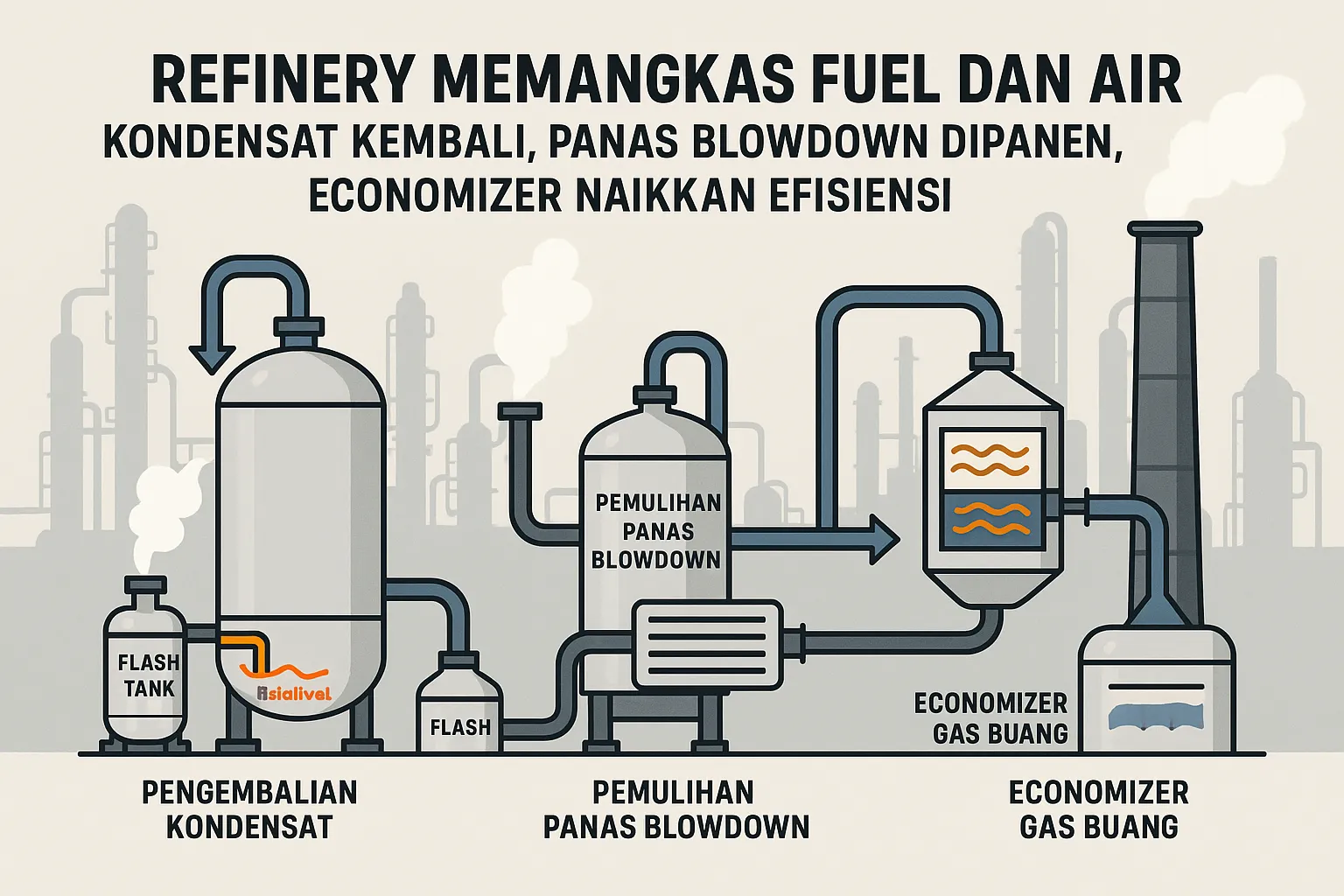
Flue-gas economizers are heat exchangers on the exhaust stack that preheat feedwater. They take heat from the stack gas, either above or below acid dewpoint. Therefore they can raise feedwater temperature by tens of °C and cut fuel needs. Best-practice installations in refineries and power plants usually lower stack exit temperatures by 50–100 °C. Natural Resources Canada notes that a proper economizer can reduce exhaust gas from ~135 °C to ~77 °C. This lifts effective boiler efficiency from under 80% to nearly 90%.
In a controlled test, an economizer cooled the flue gas by ~103 °C. Boiler efficiency went from 77.23% to 84.55%, a gain of 7.3 percentage points (www.researchgate.net). In practice the gain is usually 5–8% efficiency (absolute). Industry sources usually quote up to 8% net fuel reduction from economizers (www.nationwideboiler.com). In one refinery study, heating feedwater from 147.8 °C to 150.7 °C cut fuel use by about 0.3% (www.researchgate.net).
Combined impact and payback metrics
Taken together, these measures — maximizing condensate return, installing economizers, and recovering blowdown heat — can cut a refinery boiler’s fuel and water usage by double‑digit percentages. For decision‑makers, the metrics are straightforward: each percentage point of condensate recovered yields proportional savings on fuel (e.g., ~£917/year per percent in the Spirax example — www.scribd.com) and water, while earlier Spirax figures also show ~£1,800 per percent in fuel, £512 in water, and £378 in effluent costs saved (www.scribd.com; www.spiraxsarco.com). Adding economizers avoids millions of Btu/h in thermal losses natural-resources.canada.ca), and blowdown recovery can save on the order of $100,000/yr for moderate‑sized boilers (michaelsenergy.com). In practice, payback periods for these investments are often just a few years or less (michaelsenergy.com; www.nationwideboiler.com). In dollar terms, a 5–8% improvement in boiler efficiency can save tens or hundreds of thousands of dollars per year in fuel for large units.
Sources: Data from industry case studies and guides (www.scribd.com) (www.scribd.com) (michaelsenergy.com) (michaelsenergy.com) (www.researchgate.net) (www.nationwideboiler.com natural-resources.canada.ca) (Spirax Sarco, Forbes Marshall, Michaels Energy, research literature, etc.). All values are drawn from these references.