

Article
Paper machines are bleeding output to “invisible” deposits. A three‑pronged fix is paying off.
Pitch, stickies, scale and slime are quietly eroding productivity — costing packaging and tissue machines the equivalent of 4% of their daily output. A holistic program blending smarter chemistry, cleaner loops and sharper raw‑material choices is changing that.
Industry: Pulp_and_Paper | Process: Papermaking_&_Pressing
Production losses and runnability impacts
Deposits of pitch (wood resins), stickies (adhesives from recycled paper), scale and biological slime can severely disrupt paper production. Even a small buildup on wires, felts or dryers causes sheet breaks, holes, quality defects and unplanned downtime (link.springer.com) (www.degruyterbrill.com).
One industry report notes that packaging and tissue machines “lose the equivalent of 4% of their output per day due to machine contamination and sheet breaks caused by deposits” (www.cleanroomtechnology.com). Unchecked slime and biofilms spoil raw materials, corrode equipment and emit odorous gases (www.degruyterbrill.com).
Deposits are “one of the most important factors limiting the productivity on a paper machine” (link.springer.com). The risk is rising as recycling grows. Around 38% of global fiber supply comes from recovered paper. This greatly increases stickies and foam problems. Good deposit control is economically important.
Deposit categories and material origins
Organic pitch and stickies (insoluble, tacky particles) originate from wood extractives or recycled paper; their agglomeration and adhesion to equipment are persistent challenges (www.cleanroomtechnology.com). Scale (e.g., calcium carbonate, sulfate salts) precipitates when soft water is evaporated or heated, especially in evaporators and dryers. Microbial slime — biofilms of bacteria, yeast and fungi — proliferates where residual starches and sugars are present, clogging lines and spoiling sheets.
As one review stresses, trees are “living material” rich in extractives, and recycled pulps contain many nonsoluble contaminants that “cause a deposit problem” throughout the papermaking system (link.springer.com). In practice, mills contend with mixed deposits across wires, felts, rolls and tanks, so control programs must address insolubles, tacky fines and microbes simultaneously.
Chemical treatment programs and dosing control
Two application modes dominate. The first is surface cleaning (sprayed cleaning showers or boil-outs) to remove localized buildup on felts, rolls or wires. The second is internal additives that circulate with the wet stock so deposits never agglomerate (www.jstage.jst.go.jp).
Dispersants are usually water-soluble polymers or surfactants. They bind hydrophobic pitch and sticky particles and keep them dispersed. Archroma reports that its new anionic polymer (Cartaspers PLH) “attracts non-polar (hydrophobic) substances like stickies and natural pitch,” passivates them and “prevents agglomeration and deposition,” without reacting with cellulose (www.cleanroomtechnology.com). Inert minerals like talc add ash or scale. Modern dispersants do not. Cartaspers “does not cause scale deposits in evaporators or contribute to ash content” (www.cleanroomtechnology.com). A good dispersant program keeps the machine running and the sheet clean, and it cuts chemical and cleaning costs.
Trials at two pulp mills found that one polymeric dispersant, instead of three older products, gave “better performance in soft water and significant cost savings” (www.cleanroomtechnology.com). Detackifiers are usually cationic or weakly cationic polymers. They neutralize tacky extractives and adhesives and mask the charges, so the contaminants lose their stickiness. For recycled stock, detackifiers (for example modified starches, polyamines or specialized latex dispersions) are dosed to flocculate fine sticky particles. This keeps them suspended instead of letting them stick to the fabrics. Recycled contaminants vary, so optimizing detackifiers is usually mill-specific.
Biocides (slimicides) complete the toolkit for microbial slime. Papermaking systems are warm, wet and rich in nutrients. If microbes are left unchecked, they foul wires and cause odor and corrosion (www.degruyterbrill.com) (www.degruyterbrill.com). Traditional programs use glutaraldehyde, isothiazolinones and DBNPA (a fast-acting biocide) to disinfect whitewater loops and chest tanks. Mills are adopting more targeted combinations (for example isothiazolinones + glutaraldehyde) and enzyme-based alternatives to meet environmental rules. Microbial treatments “may appear as a costly offer.” However, without them, slime-induced losses can lead to a “large economic drain” (www.degruyterbrill.com) (www.degruyterbrill.com). Optimized biocide programs are usually monitored with online microbial sensors to minimize both slime and chemical waste. Some mills even trial enzymes or bacteria-lysing agents as eco-friendly adjuncts to reduce biocide load.
Each specialty chemistry needs careful dosing and monitoring. Automated dosing and sampling systems (flow-paced injection, hygiene sensors) keep the protection consistent. An accurate chemical dosing pump helps hold the targets. Mills use assays (stickies deposition tests, deposit monitors) to measure deposit potential and adjust the chemistry. In practice, deposit control combines dispersant and detackifier programs in the wet end (stock forming section) with dedicated clean-in-place cycles (alkaline or acidic boilouts) during shutdowns.
Raw materials and water chemistry control
Raw material selection matters. Many high-yield pulps contain more resin acids. Therefore blending with bleached kraft pulps can reduce the pitch load. Eucalyptus and acacia pulps usually have lower resin content than some softwoods (link.springer.com). Minimizing bark and knots and using freshly debarked chips cuts extractives. In recycling, stricter segregation of hot-melt labels and waxed cartons, plus cold-water adhesive use in paper products, reduces the stickies that enter the mill.
Water and chemistry control are important. Softening make-up water and controlling hardness limit calcium bridging of pitch (www.researchgate.net), where a softener reduces calcium and magnesium. Keeping the pH right through the system affects resin acid solubility. Mills usually run slightly alkaline (pH ~8–9) to discourage pitch deposition.
Closed-loop water systems need cleaning from time to time, because dissolved and colloidal substances (DCS) build up over reuse cycles. Good filtration in whitewater loops reduces free pitch and fines. A clarifier can remove suspended solids within typical detention times (clarifier). Flotation skimming is widely used to remove dispersed contaminants. Dissolved air flotation gives high solids capture in a compact footprint (DAF). Continuous debris removal keeps the loops stable and reduces foulants on fabrics (automatic screen).
Mechanical and operational practices are still the base. Regular high-pressure showers and vacuum boxes on wires and felts remove deposits before they build up. Scheduled chemical cleans of press felts (caustic or peroxide) keep them open. Recovery boiler cleaning (antiscalant programs, sootblowing) prevents fireside fouling that can send surges of solids into the loops. A targeted scale inhibitor program supports this. Find deposit hot spots with online deposit monitors or manual deposit clamps, then fix them with bolt-on measures (side-stream cleaning, frequent felt washing).
Program governance and ROI tracking
A good chemical program pairs routine monitoring with ROI discipline. Mills use a return-on-investment mindset. Instead of price per kg, they calculate value in production yield, quality, downtime avoided and energy savings (www.pulpandpapercanada.com) (www.pulpandpapercanada.com). Small gains in runnability, or a few percent more production from fewer breaks, usually justify premium deposit-control additives.
Review deposit metrics regularly (cleaning frequency, shower frequency, sheet breaks) and compare them with chemical dosages. Then you can fine-tune from the data. Many mills pilot new chemistries. Archroma reports that after testing, some mills consolidated three older products into one dispersant. This cut chemical usage and reduced total cost (www.cleanroomtechnology.com).
Standards, compliance and regional context
Environmental regulations frame every decision. Indonesia’s pulp & paper mills (6th‑largest paper producer globally; www.universaleco.id) operate under strict standards (ISO 14001, green‑industry certifications, wastewater limits). Milieu rules push mills toward minimal‑waste processes: many have committed to 4R policies and closed‑loop water use (okipulppaper.co.id).
In practice, deposit-control chemicals must be as safe and as biodegradable as possible. Archroma highlights that its dispersant “complies with food contact regulations such as BfR and FDA” (www.cleanroomtechnology.com). Biocides must be handled as B3 (hazardous) waste under local law.
Measured outcomes and industry trends
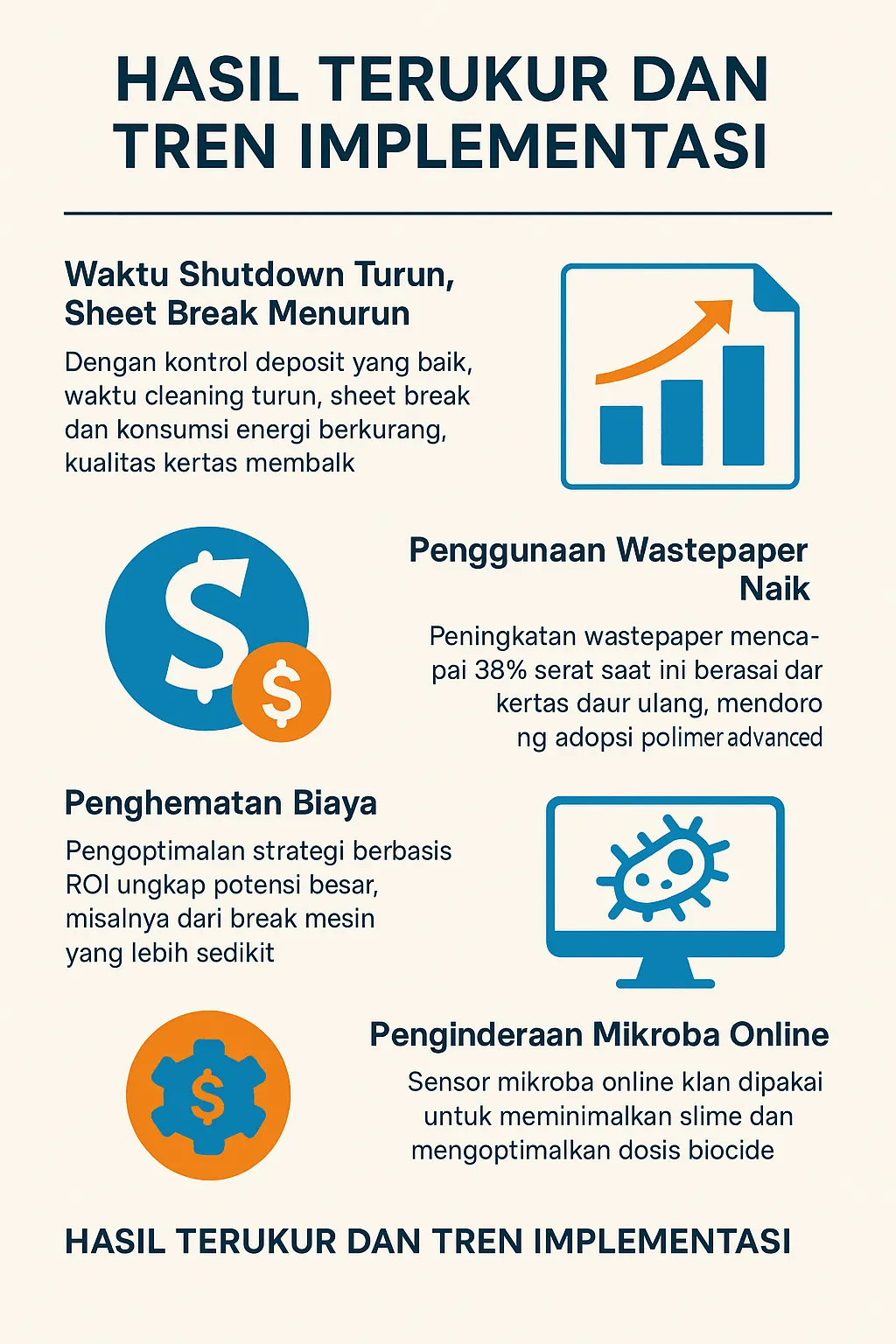
Well-run programs show gains you can measure. Shutdown time falls, with hours of cleaning per week cut by double digits. There are fewer sheet breaks. Paper quality improves, with a lower speck count. One study (PW Consulting) notes that good deposit control, along with scale inhibition, can cut boiler fouling and energy use by 12–15% (pmarketresearch.com). Archroma’s tests found “significant cost savings” from simplifying deposit treatment (www.cleanroomtechnology.com). Industry surveys suggest that an ROI approach to additives usually finds multi-hundred-percent ROI when speed or quality is the bottleneck. That is different from choosing only by chemical cost (www.pulpandpapercanada.com).
Key trends make deposit control more necessary. Wastepaper use is rising. About 38% of fiber is now recovered paper, and projections show it will keep growing. Soft-water markets, for example Asia, where hardness is low, increasingly ask for polymers that work at low hardness instead of traditional talc or bentonite. Environmental scrutiny of biocides is tightening worldwide, for example the EU Biocidal Products Regulation. Therefore mills need to optimize dosing and look at enzyme or biological slimicides as alternatives (www.degruyterbrill.com). In Indonesia, the industry’s “Green Industry Standard” encourages both efficiency and safety. Therefore mills run integrated programs that tie deposit control to waste minimization.
Figure-quality monitoring (for example deposit sensors and sticky counters) and digital process control are on the rise. They allow preemptive adjustments. In sum, effective deposit control combines three things: (a) selecting low-extractives raw materials, (b) optimizing process conditions (pH, water loop cleaning, equipment maintenance), and (c) applying the right mix of dispersants, detackifiers and biocides. Deploying these measures together, with attention to ROIs and regulations, supports cleaner operation, higher uptime and lower total cost in modern papermaking.
Sources: Authoritative industry reviews and reports (Hassler 1995 (link.springer.com); Pathak et al 2021 (www.degruyterbrill.com)), specialty‑chemical case studies (www.cleanroomtechnology.com) (www.cleanroomtechnology.com), market analyses, and Indonesian industry data (www.universaleco.id) (okipulppaper.co.id) were consulted to compile these insights. Each recommendation above is grounded in documented mill experience and technical literature, ensuring practical relevance for engineering and procurement decisions.