

Article
Nickel mines are leaving money in the sump: Smarter dewatering cuts energy by double digits
Industry: Nickel_Mining | Process: Mine_Dewatering
Mine dewatering means pumping inflow water out of underground and open-pit mines all the time. It can take a large part of a site’s energy consumption. Electric motors drive pumps, fans and air compressors, and they use about 50–60% of global industrial electricity (id.hanzelmotor.org). Regulators have acted. About 76% of world electricity supply now runs under motor efficiency standards at IE2/IE3 levels (id.hanzelmotor.org). In markets like the EU and USA, “premium” (IE3) or superpremium (IE4) motors are mandated. For example, EU Ecodesign Reg. 640/2009 needs IE3 motors from 0.75–375 kW.
Nickel mines pump all year. Therefore even small efficiency gains add up. Upgrading pump systems to high‑efficiency designs and controls is a proven way to cut costs and carbon emissions.
High‑efficiency motors and pump hydraulics
New pumps and motors built to IE3–IE4 efficiencies draw several percent less power than older IE1–IE2 units. One analysis looked at a 75 kW centrifugal pump. Replacing an IE2 motor with an IE4 motor saved 192.6 MWh of energy over 20 years. An IE3 motor saved 82.4 MWh. The paybacks were about 2.9 years and 5.2 years (mdpi.com). The IE4 upgrade also avoided about 8.87 tonnes CO₂ per year, against 3.78 for IE3 (mdpi.com). In practice, a mine that electrifies dewatering with IE4 motors can get back the higher motor cost in just a few years (mdpi.com).
Hydraulics matter. Many pumps are too big for the worst-case inflow. They run throttled or idle below best efficiency. Right-size the pump duty instead. You can trim the impeller or install a smaller pump. Then no flow is wasted through bypass valves. Energy-management guides say to remove throttling by impeller trimming, resizing pumps, or installing VSDs (variable-speed drives) (policy.asiapacificenergy.org). New pumps with better volute and impeller shapes, or multi-stage diffusion systems, can raise hydraulic efficiency by 5–15% over worn-out units. This comes from manufacturers’ data.
Typical outcomes support this. In one mine study, high-efficiency motors across the site saved about 65 kW in total. However, better control saved more than this (danfoss.com). Replacing IE2 with IE3/IE4 motors in pump systems usually cuts power draw by a few percent to >10% per motor, depending on the load factor. In heavy-load applications with long operating hours, even a 2–3% motor efficiency gain gives large cumulative savings.
Regional context (Indonesia) is changing too. Indonesia’s Ministry of Energy now mandates energy management and audits under PP 33/2023 (ireem.id). Large mines will therefore need to justify their equipment efficiency. Indonesia does not yet have separate laws for motor MEPS. However, it follows global trends, and across Asia IE2/IE3 is becoming standard. Indonesian operations should plan to match or exceed these levels to stay competitive. This matters because the country is pushing for energy conservation and diesel fuel costs a lot in remote areas.
Variable‑frequency drives for fluctuating inflows
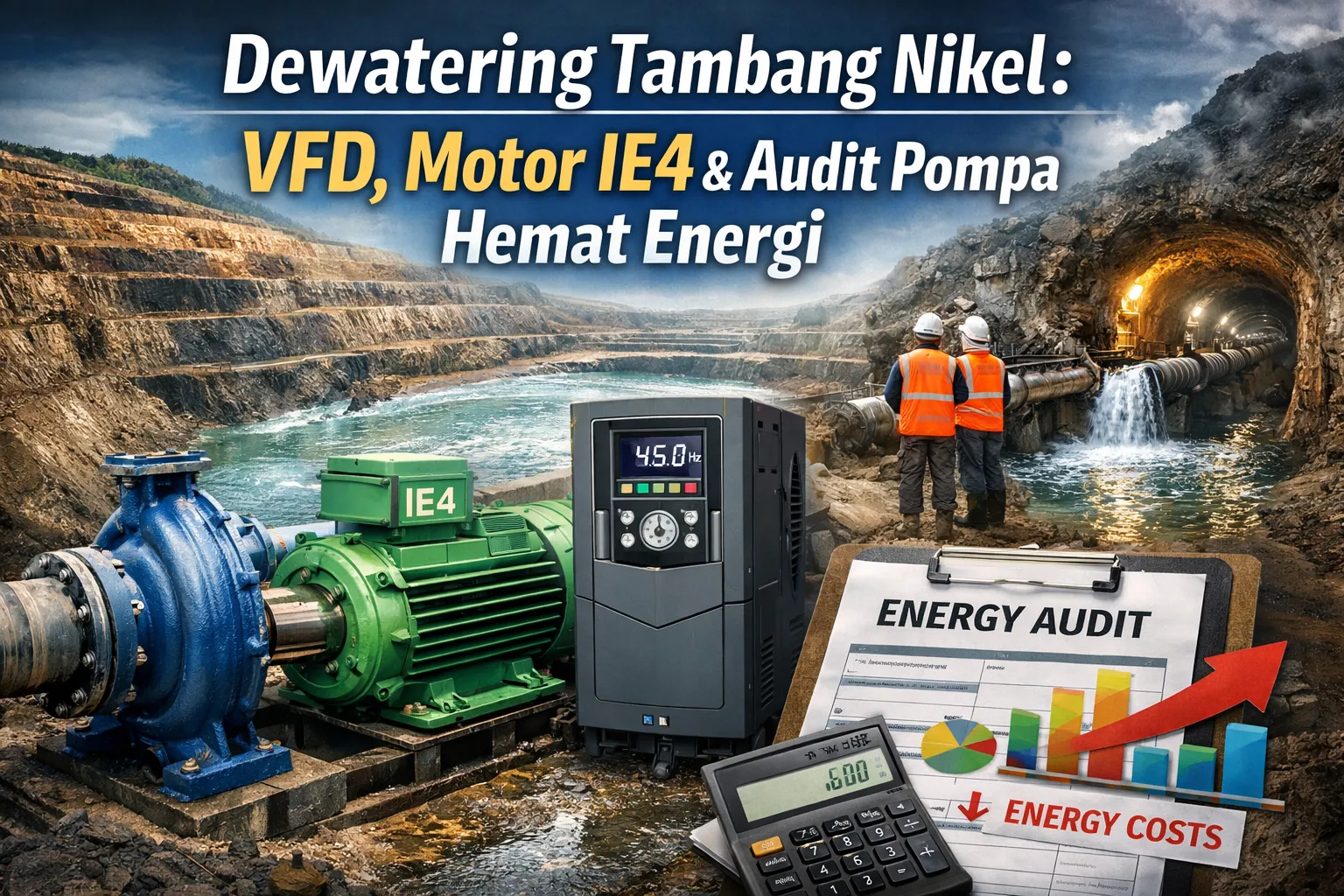
Dewatering demand changes with rainfall, pumping cycles and reservoir buffering. Therefore fixed-speed pumps usually run far from their best efficiency point. A VFD (variable-frequency drive, electronic speed control for AC motors, also called VSD) lets the output match what the plant needs at that moment. Under the Affinity Laws (pump performance scaling rules), power scales roughly with the cube of speed. If you cut speed by 20%, energy use can drop by about 50%. In mine applications, adding VFDs usually cuts pump energy use by 10–20% or more (rmipsl.com).
One analysis of underground roof‑support pumps found that converting from fixed‑speed to full‑VFD operation saved over 20% of annual energy costs; an intermediate case (a single pump on VFD, others fixed) showed ~10% savings (rmipsl.com) (rmipsl.com). Extrapolating, retrofitting four 24/7 pumps in a mine would save roughly ¥1.5 million (US$205k) in one year (over 20 years, >¥22 million) (rmipsl.com). VFDs also eliminate start‑up power spikes and throttling losses, reducing mechanical stress.
Electrification economics versus diesel
Switching from diesel-driven dewatering pumps to electric pumps with VFD control multiplies these gains. Electric pumps have no fuel cost and much lower maintenance, because there are no oil changes and no fuel handling. Therefore operating costs drop a lot. Industry sources note that, all else equal, an electric VFD-equipped pump can be 3–5 times cheaper per kWh-equivalent than a diesel engine (miningmagazine.com). Danfoss notes that an electric-driven pump skid costs more upfront. However, the fuel and maintenance savings “are recovered very quickly, usually within months” (danfoss.com).
A case from Kolomela mine (South Africa) shows that control is a lever. The mine added VFDs with better cooling to the dewatering system. This cut the AC power draw of the substation by 80 kW. All high‑efficiency motors at the site saved only 65 kW (danfoss.com). Vendors say VFD systems usually pay back in under 1–2 years. In the Kolomela case, AC drives with back‑channel cooling saved enough on AC demand at once (8–10% of drive costs) to give “payback from day one” (danfoss.com).
Pump energy audit: inventory to ROI
To get these savings in a systematic way, you need a pump energy audit. A structured approach for dewatering systems includes:
• Inventory and data collection: list all dewatering units (surface and underground). Note the motor power, pump type, age, piping, valves and typical operating conditions (flow, head). Gather historical operation (flow rates, start/stop times, control modes) and energy use from SCADA (supervisory control and data acquisition) or meters. Use field instruments (flow meters, pressure gauges, power loggers) to measure actual performance during normal operation, including partial-load periods and idle times.
• Operation profiling: find the duty cycles at full load, partial load or standby, and the seasonal variation (for example, rains). Note on/off waiting or throttling through bypass valves. For example, RMI analyzed 15‑day SCADA records of on‑load vs off‑load time for each pump (rmipsl.com). Profiling shows pumps that run at 30% flow but 100% speed.
• Performance analysis: compare the measured flow/head against the pump and motor curves. Find the mismatches. If a pump needs throttling (valve control) to hit demand, it is oversized. Check the motor efficiency at loaded conditions (older motors may only reach IE1 or IE2). Tools such as pump‑metering kits or software (for example, DOE’s PSAT) can estimate the losses. Check for these problems: too much throttling, worn impellers, leaks, partial‑cycling, or wrong selection.
• Benchmarking: compare operation to best‑practice benchmarks. For example, a pump drawing 37 kW to deliver 50 l/s at 30 m head might need only 30 kW if it is sized well (researchgate.net). A fixed‑running pump replaced with a VFD at partial load usually pays back in 1–3 years. High‑efficiency motor swaps (IE2→IE3/IE4) usually pay back ~3–5 years for 24/7 service (mdpi.com).
• Identify savings measures: common opportunities include VFDs on constant-flow pumps, impeller trimming or smaller impellers, resizing or adding parallel pumps for varying flow, repairing worn components, and upgrading to IE3/IE4 motors. A pump that throttles 20% of the time can save up to about 3× the throttled power by running about 20% slower on a VFD (Affinity Law). Also, replacing one 150 kW IE2 motor with IE4 gives about 40 MWh/year saving (at $0.1/kWh) and about €5000/year in the MDPI case (mdpi.com).
• Prioritization and planning: rank measures by ROI and feasibility. Do the immediate low‑cost steps first (impeller trimming, VFD parameter tuning). Then do the mid‑term replacements (high‑efficiency motors, pumps) together with maintenance cycles. Then test after upgrades. Put the audit findings into the site’s formal energy management system. Indonesia’s Regulation 33/2023 says recurring audits and certified energy managers are needed (ireem.id).
A disciplined audit usually finds 10–30% energy-savings potential in a dewatering system. Real-world studies back this. One deep-mine analysis found that optimizing pump control and shifting to off-peak pumping cut overall water-system energy use by 2%, but cut peak demand by 65% (researchgate.net). Even if the total savings look modest, the business impact is large because the plant runs all the time and energy rates are high.
Implications for nickel mines
For nickel mines, especially in Indonesia where electricity and diesel costs are high, investing in pump efficiency pays off. You can upgrade to IE3/IE4 motors and precision pumps, add VFDs, and audit pump systems on a regular schedule. This can cut dewatering energy use by double-digit percentages (rmipsl.com) (danfoss.com). Case studies show tens of thousands of dollars saved per year per pump bank, and paybacks usually under 5 years. The audit framework helps mine operators measure the gains, meet regulatory energy-management requirements (ireem.id), and decide on upgrades with confidence.
Sources and references
Industry reports, case studies, and energy‑audit guidelines support these conclusions. RMI Pressure Systems data show VFD retrofits cutting pump power by ~20% (rmipsl.com). Comparative studies document life‑cycle savings and CO₂ reductions from premium motors (mdpi.com) (mdpi.com). Regulatory and technical guides (Indonesia’s Permen‑Energy, IEC/IEA analysis) detail efficiency standards and audit processes (id.hanzelmotor.org) (policy.asiapacificenergy.org) (ireem.id).