

Article
Automakers Are Leaving Money in the Drain: A Leak-Test Water Loop Fixes It
Industry: Automotive | Process: Assembly
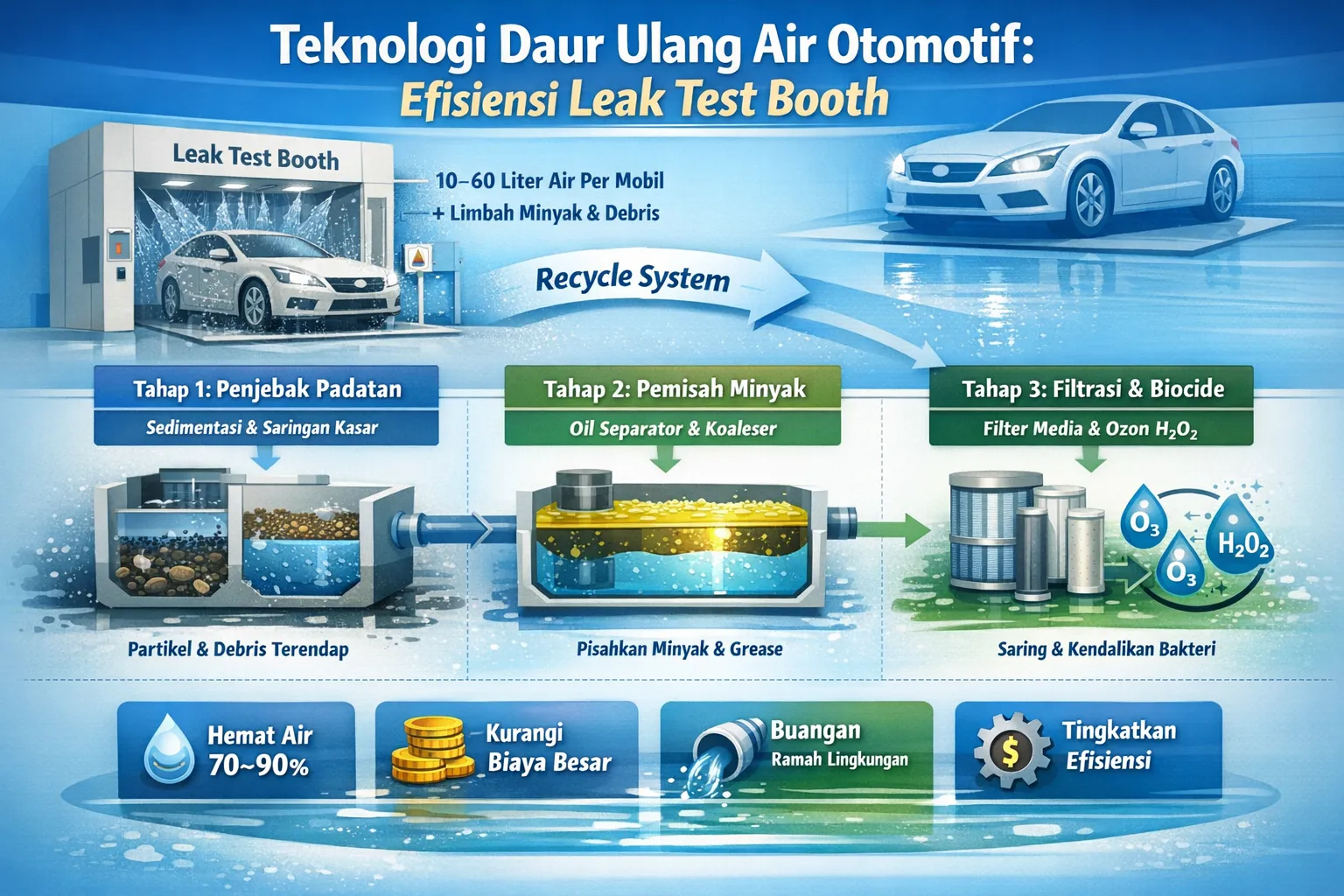
Automotive leak-test booths spray vehicles with water to check seals. This usually takes 10–60 liters per car. The runoff carries oil and debris. Across the whole assembly process, studies report roughly 5.2–6.0 m³ of cold process water used per vehicle (agris.fao.org). Even a few liters saved per car through reuse adds up to large volumes and costs.
The spent rinse water carries suspended dirt, paint chips, and free or emulsified oil from engine bays and grilles. If it is left untreated, this wastewater needs pre-treatment to meet effluent limits (including Indonesian water quality regulations) and it drives disposal fees. Warm, stagnant tanks also grow microbes and odors if they are not dosed. This becomes a quality and worker-comfort issue as soon as a booth goes recirculating.
Closed‑loop booth water design
A robust closed-loop design processes booth effluent through three stages (washbaysolutions.com; washbaysolutions.com).
Stage 1 – Coarse solids trap and settling. Waste first enters a grit/sediment chamber where heavy particulates sink. A coarse screen or grit trap removes large chips and sand, usually by gravity in a sump. In high-throughput booths, a continuous screen such as an automatic screen keeps debris from entering pumps.
Stage 2 – Oil/water separation. Water flows to a separator where free oil rises for skimming. A first compartment can act as a clarifier. Oil is removed and solids are captured in a hopper.
To speed up droplet rise and solids shedding, inclined stainless plates coalesce finer oil. Think of a compact, plate‑pack separator, a role served by stainless plate settlers. A final coalescing module then captures dispersed, non‑emulsified oil. Dedicated oil‑removal systems in this class “remove essentially 100% of all free and dispersed non‑emulsified oils,” producing FOG (fats/oils/grease) as low as ~5 ppm (washbaysolutions.com).
Stage 3 – Filtration and polishing. After oil removal, multistage filters strip suspended solids and residual organics. Multi-media beds, for example silica sand media such as sand and silica filtration, target fine turbidity.
Activated carbon then adsorbs dissolved organics and odor precursors; activated carbon is the standard medium here. For final clarity, polishing filters (down to 10 µm) deliver a crisp spray; cartridge filters typically handle this duty. Some designs add a high‑voltage corona or ozone oxidation step to further break down trace organics and strip odors (washbaysolutions.com).
Non‑corrosive biocide control
To prevent slimy growth and odors in the reservoir, keep a residual biocide. A non‑corrosive oxidizing biocide such as hydrogen peroxide (H₂O₂) is singled out. It is described as “pollution‑free, non‑toxic and minimally corrosive” (ncbi.nlm.nih.gov). It oxidizes sulfides and organics directly. It “controls odors” by reacting with H₂S (hydrogen sulfide) and similar compounds (h2o2.com).
In practice, continuously or periodically dose to maintain roughly 1–5 ppm (parts per million; equivalent to mg/L) H₂O₂. Peroxide decomposes to water and oxygen, leaving no toxic residues and reducing corrosion risk (ncbi.nlm.nih.gov; h2o2.com). A metering skid with an accurate chemical dosing pump keeps the residual steady without overfeeding.
Recovery rates and blowdown
A well‑designed loop recovers most of the fresh water. In one engineering simulation of a multi‑step treatment train (coarse, ultra‑ and reverse‑osmosis), 77% of inlet water was reclaimed for reuse (mdpi.com). In practice, properly operated systems usually achieve 70–90% recycle. Only a small blowdown (bleed‑off) is discarded to purge salts/contaminants, and makeup water replaces it. The recycled water returns clear, oil‑free, and microbiologically stable to the booth.
Performance metrics and reuse outcomes
With the above train, recycled wash water usually achieves sub‑10 ppm oil, single‑digit NTU turbidity (NTU: Nephelometric Turbidity Units), and no odor. A turnkey unit in this class advertises <5 ppm FOG after oil removal and final polishing (washbaysolutions.com). That is enough for vehicle testing sprays, which need clean rinse water rather than drinking quality.
Inverted, boilers and cooling towers usually need similar quality. Therefore reuse here meets many industrial reuse benchmarks. Recirculating about 80–90% of the flow reduces fresh makeup by the same amount. In the earlier simulation, 77% recovery after UF/RO produced a very pure reuse stream (mdpi.com). Even without membranes, industry car‑wash reclaim systems save 85–95% of water.
A U.S. car‑assembly paint line retrofitted with optimized rinse controls saved ~4.99×10^6 gal/year (~18,900 m³), worth $47,000 annually, and achieved payback in under 1 year (en-my.ecolab.com). That single measure cut 25% of the plant’s 2030 water‑reduction target (en-my.ecolab.com). A dedicated leak‑booth recycle loop would yield similar financial benefits in proportion to the water volume diverted.
Cost–benefit for plant managers
Fresh water and wastewater costs. Assume the leak‑test booth uses N m³/year. Fresh industrial water in Asia usually costs on the order of US$1–3 per m³ (supply and tariffs), plus sewer discharge fees of similar magnitude. One plant’s reductions valued water at ~$2.5 per m³ (en-my.ecolab.com) when counting supply plus avoided discharge. Each 1,000 m³ recycled saves about $2–3K annually. For 5,000 m³/year in leak testing, that’s ~$12,500/year.
Capital investment. A skid for an auto bay (50–100 m³/day) usually costs $10–15K), pumps and tanks (~$5K), and filters/controls ($5–10K). UV/ozone/chemical feeders add a few thousand more. Estimate CAPEX at ~$30K–$40K for a moderate system. Larger high‑flow booths can cost more. Smaller single‑bay units can be <$20K. Pumps, tanks and controls are standard water‑treatment ancillaries.$20K–$50K installed. That covers a multi‑stage separator/clarifier ($5–10K), a packed‑media coalescer (
Operating costs. Recirculation and any ozone generator draw about 1–2 kW continuous (~$500–$1,000/year in power). Media and filters cost roughly $1–3K/year. Self‑cleaning backwash designs cost less. A 35% hydrogen peroxide biocide usually costs $2–3 per liter. Dosing might be ~1–5 mg/L. Even at 5 mg/L for 5,000 m³/year, that is ~25 kg or <$100/year. Total O&M is ~$2–5K/year, mostly labor and media.
Savings and payback. Let’s say 4,000 m³/year (80% of 5,000) is recycled at $2.5/m³. Then the plant saves about $10,000 a year. After O&M, net savings are about $8,000/year. Even at $40K CAPEX, simple payback is about 5 years. The Ecolab example reached under 1 year by optimizing a rinse area (en-my.ecolab.com). A fully closed‑loop recycle usually pays back in 2–5 years for industrial users. The exact time depends on the water price.
Regulatory and market context
Recycling reduces the volume of industrial effluent. Therefore sewer surcharges tied to flow or pollutant load go down, and plants meet environmental regulations more easily. In Indonesia, industries must meet national effluent standards, for example Government Regulation No. 22/2021 on water quality. These standards set limits on oil/grease, BOD and more. Recycling and pre‑treating keep discharges within limits. Therefore plants avoid fines and extra pre‑treatment. Corporate water‑stewardship goals, for example the targets of major OEMs, increasingly favour reuse. The global water‑reuse market is growing (about $8.4 B in 2024, about 9% CAGR) because of scarcity and regulation (en-my.ecolab.com). Implementation gives measurable utility savings and supports certifications and public reporting.
Bottom line
A leak‑test booth recycle loop — solids trap, oil/coalescer separation, fine filtration, and a non‑corrosive biocide — can recover 70–90% of rinse water, hit sub‑10 ppm oil with single‑digit NTU, and eliminate odors (washbaysolutions.com; washbaysolutions.com; mdpi.com). The result: multi‑thousand‑dollar annual water/waste savings, lower compliance risk, and strong ROI — often under five years, and faster in high‑water‑cost sites (en-my.ecolab.com).