

Article
Farm runoff is a soil thief A pinch of polymer is stopping the heist
Industry: Agriculture | Process: Runoff_&_Drainage_Management
Soil erosion is getting worse as farms intensify and the weather becomes more extreme. One EU analysis projects global soil loss rising 30–66% by 2070. Erosion already costs about USD 8 billion per year in lost productivity (joint-research-centre.ec.europa.eu). Indonesia’s fields are among the hardest hit. Recent estimates put losses at 97.5–423.6 t/ha·yr (tonnes per hectare per year), with a national mean near 4.1 million tons of soil annually (link.springer.com).
The stakes are agricultural and infrastructural. Sediment-laden runoff strips nutrient-rich topsoil and clogs reservoirs. One best management practice (BMP) getting fresh attention is chemical flocculation. This means adding a soil conditioner that makes fine particles clump and settle before they leave the field.
Polymer flocculation fundamentals
The workhorse is polyacrylamide (PAM), a synthetic polymer with a high molecular weight. It is usually used in its anionic form (negatively charged). PAM is a flocculant, a chemical that makes particles clump together and settle. Its long chains attach to clay, silt and organic colloids and form larger “flocs” that drop out fast. Therefore the water is clearer, the sediment is heavier and less soil is lost. It also usually gives better infiltration at the soil surface. PAM has other industrial uses (water treatment, oil recovery). However, the focus here is agricultural runoff control.
Commercial availability matters in practice. Farmers usually source PAM under flocculants for water and wastewater duties. The same anionic grades are used for farm erosion control.
Field performance: irrigation data
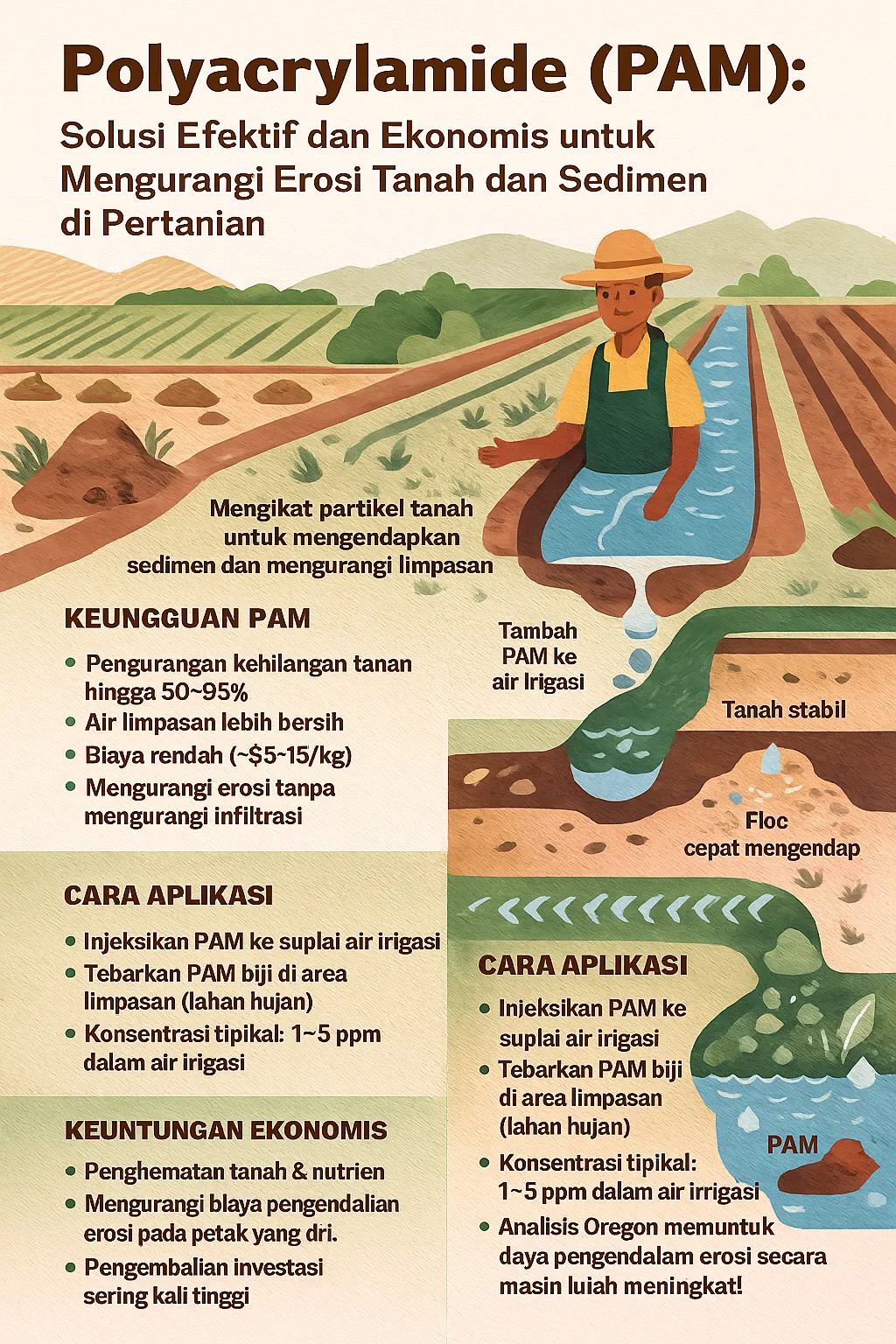
Irrigation systems give striking results. USDA research in Idaho found that adding just 3–7 lb/ac (3.4–7.8 kg/ha) of anionic PAM into furrows cut soil erosion by an average of 94% versus untreated furrows (ars.usda.gov). An Oregon State overview also reports 90–95% reductions in soil loss when PAM is applied with irrigation water. It also reports infiltration and uniformity gains of 20–60% (agsci.oregonstate.edu).
Nebraska trials under furrow irrigation showed a practical bonus. PAM allowed more water down each furrow without breaking the soil crust. Therefore more water reached the roots (extensionpubs.unl.edu).
Field performance: rainfall and runoff
The polymer still works under storm-driven runoff. A simulated‑rainfall study on a tropical Oxisol applied 40–60 kg/ha of granular PAM. It cut sediment yield by 35–90% depending on storm intensity (mdpi.com). An Indonesian Ultisol trial found that 20–40 kg/ha of PAM reduced erosion from ~210 to ~175–169 t/ha. That is a 15–20% drop in an extreme test (jtur.lppm.unila.ac.id).
Mixed practices help, too. Field comparisons, often combining straw mulch with PAM, show 40–70% erosion cuts (mdpi.com; extensionpubs.unl.edu). In one U.S. trial of erosion‑control blankets, a straw‑plus‑PAM mix reduced runoff volume by ~49% (versus 68% for an engineered mat), and removed sediment at ~$1.03 per kg compared with $6.36/kg for the mat (file.scirp.org; file.scirp.org).
Key figures and operating ranges
Across modern field studies, soil loss reductions of 50–95% are common in PAM‑treated plots versus controls (ars.usda.gov; agsci.oregonstate.edu). Application rates vary by system: a few kg/ha via irrigation water, up to tens of kg/ha for surface sprays. As little as 1 g of PAM in 1000 L of water — about 1 ppm (parts per million) — can significantly flocculate clays; a commonly cited surface rate is ~10 kg/ha (9 lbs/acre) (file.scirp.org)).
In engineering trials, farmers achieved 68% reductions in runoff volume and almost total sediment removal with combined straw+PAM “mulch2,” versus ~99% loss removal with high‑end mats (file.scirp.org; file.scirp.org). In furrow irrigation, seasonal infiltration gains of ~15% and near‑elimination of irrigation‑induced rill erosion have been reported (ars.usda.gov).
Flocculant options and safety profile
Most agricultural studies use anionic PAM. It binds well to soil and is considered the safest. Cationic PAMs are kept for specialized sludge work and are not used on crops. PAM comes as dry granular material, prills (small pellets), or concentrated liquid. The polymer itself is inert and non-toxic. The main hazard is any unreacted acrylamide monomer. Good-quality products contain ≤0.05% acrylamide monomer by weight, in line with U.S. drinking-water standards. Studies show virtually no plant uptake or food-chain accumulation with normal use (ars.usda.gov). USDA-ARS notes that commercial PAMs “are safely used in treatment of potable water, wastewater discharging to streams, and even FDA-sanctioned food-contact applications” (ars.usda.gov). In the field, any small fraction of monomer that detaches is rapidly biodegraded and not held in soil (same source).
Other options exist but are less common. Biopolymers like chitosan (from shrimp shells) can cut turbidity by about 20–40% in jar tests. Plant-based agents, for example Moringa oleifera proteins, coagulate clay but are less studied in mainstream agriculture (link.springer.com). Inorganic coagulants such as alum or ferric salts work for water treatment. However, they can acidify soil and usually need higher doses. In practice, PAM works at a low dose, so it is the flocculant of choice. For context, suppliers group these under coagulants and flocculants.
Irrigation delivery and mixing
In furrow or border irrigation, PAM is usually injected into the water supply at low concentration, for example 1–3 g per 1000 L, as the stream advances near the field head (ars.usda.gov; extensionpubs.unl.edu). A simple PAM feeder can sit upstream of the first furrow. In closed pipes, growers meter concentrated liquid with a small injector or dosing pump. This allows a run of pipe, for example ~100 feet, for mixing. Elbows and turbulence help dissolve the polymer (extensionpubs.unl.edu). For open ditches, dry granules can be broadcast at the ditch head or into an eductor. Nebraska guidelines suggest keeping the source away from splashing so it dissolves properly (same source). Agitation is important. Vigorous mixing fully hydrates polymer chains (same source).
Typical field use is ~1–10 kg PAM per hectare per irrigated event. One standard practice rate is 10 kg/ha in furrow irrigation (file.scirp.org), extensionpubs.unl.edu). PAM works at low concentration, so only a small constant feed is needed. Avoid over‑treating upper furrows. Advance water to the tail, then add PAM to water that has reached the end. Never pour dry polymer into tiny volumes. High‑strength mixes form “fish eyes” that don’t dissolve.
Rainfall-runoff treatment setups
For storm events, you can broadcast PAM and rake it lightly into bare furrows. You can also spray it at 50–100 ppm after the final cultivation, or just before forecast rain. Many farms use flocculation stations or sediment ponds, which are troughs or holding tanks. PAM is dosed continuously there so the suspended soil settles before release (mdpi.com). A compact settling tank or a small clarifier does the same job when space or detention time is limited.
Cost-effectiveness benchmarks
The polymer cost is modest compared with the benefits. Agricultural‑grade anionic PAM usually costs US$5–15 per kg. At about 5–10 kg/ha, that is about US$25–150/ha per treatment. Wider adoption has pushed prices down, and “PAM is a more economical BMP option” in irrigation contexts (agsci.oregonstate.edu). Years‑old reviews even cite polymer costs as low as “US$4–5/ha” with substantial economic benefits (researchgate.net).
On returns, one Idaho example reported ~$8 of benefit for every $1 spent (saved fertilizer, better yields) (ars.usda.gov). In Nebraska runoff tests, wheat‑straw + PAM removed sediment at ~$1.03 per kg versus $6.36/kg for a fiber mat — an 84% cheaper outcome per kilogram removed (file.scirp.org). PAM is most effective as part of a system: pairing it with no‑till or cover crops improves infiltration beyond PAM alone (ars.usda.gov; extensionpubs.unl.edu). Given recurring costs, many guidelines target the most erosion‑prone fields or critical bare‑soil periods.
Safe use parameters and monitoring
Product selection: use agricultural‑grade anionic PAM with certified low monomer content (<0.05% acrylamide). Do not use general‑purpose or cationic/crosslinked polymers on crop fields. Choose dry or liquid form based on your delivery infrastructure.
Preparation and application: keep dry PAM bagged until use. Apply granules into moving water at the upstream furrow inlet and create turbulence, for example with V‑notch weirs or splash boards, to help it dissolve (extensionpubs.unl.edu). Liquid PAM is best metered into pipelines using an injector or dosing pump. Allow ~30 m (~100 ft) of downstream pipe for mixing, and use elbows or recirculation to build turbulence (extensionpubs.unl.edu). Properly mixed water usually looks slightly opalescent, not cloudy. In tailwater ponds, inject at the inflow so settling happens before reuse or discharge.
Concentration and timing: working concentrations in irrigation water are usually 1–5 ppm. A practical rule of thumb is ~5–10 kg/ha per application. Use more on steep soils or soils that erode easily. Apply each time runoff flows, for example during furrow advance. For rainfall runoff, apply just before or during forecast rain. In no‑till or cover‑crop systems, treat the final seedbed to bind soil immediately after planting.
Safety: anionic PAM is low‑toxicity, but standard PPE (gloves, eyewear) is advised. Avoid breathing dust. Wet PAM is very slippery. For spills, mix with dry soil to bind and ease cleanup (extensionpubs.unl.edu). Dispose of wash water responsibly. Avoid discharging very concentrated PAM mixes to drains. No strict international limits govern field PAM, but never exceed label rates or monomer limits. In Indonesia, observe provincial chemical‑handling rules. Some jurisdictions may treat flocculants as controlled substances.
Monitoring: check outlet drainage with simple sediment traps. Turbidity and visible sediment should drop within minutes of dosing. Over months, track changes in soil crusting and infiltration. If rilling persists in the first meters of furrow, raise the dosage or improve initial mixing at the head.
Bottom line
Polyacrylamide is a proven, low‑dose tool to keep sediment on the land. Case studies across arid furrows and humid tropics report 50–95% (and 90–95% under irrigation) erosion reductions, ~15% seasonal infiltration gains in furrows, and strong ROI — including ~$8 benefit per $1 in one Idaho example (ars.usda.gov; agsci.oregonstate.edu). It complements conservation practices rather than replaces them. With anionic PAM, thorough mixing, and attention to safety and timing, farms can integrate flocculation into runoff and irrigation management to preserve topsoil — a practical response as soil loss pressures rise globally (EU projection: 30–66% increase by 2070; current losses ~USD 8 billion/year, joint-research-centre.ec.europa.eu) and in Indonesia specifically (mean ~4.1 million tons/year; 97.5–423.6 t/ha·yr, link.springer.com).