

Article
Coal mines are drowning in wash-bay sludge. Beds and geobags offer a low-tech, high-impact fix.
Industry: Coal_Mining | Process: Equipment_Washing_Stations
Equipment-wash stations at coal mines produce oily sludge loaded with sediment, industrial detergent and petroleum residues. An Indonesian study of heavy‑equipment washing described the material as a mixture of soil, water, detergents and lubricants (researchgate.net). The sludge usually keeps high moisture (usually >90%). It can also concentrate hydrocarbons and trace metals from engine oils and brakes.
Disposal depends on what is inside the cake. If metal or hydrocarbon concentrations pass the regulatory thresholds, the dried sludge is classified as hazardous (B3) waste under Indonesian law (comparable to used oil and grease). It must then be tightly controlled (ppid.menlhk.go.id). Mines usually remove free oil first with oil–water separators or gravity skimmers. This lowers the hydrocarbon load before dewatering (researchgate.net). The sequence is close to the screens, oil removal and primary units grouped under waste-water physical separation.
Drying beds: passive sand-and-sun dewatering
Open drying beds are a low‑cost, passive method. Sludge is spread 20–30 cm deep over sand and gravel layers and left to drain and evaporate (waterandwastewater.com). Design guidelines suggest loading on the order of 100–250 kg of dry solids (DS) per m²·yr (kilograms of dry solids per square meter per year). That is roughly 0.5–1.2 m³ of wet sludge. Higher loading causes ponding (waterandwastewater.com).
In warm, dry climates, beds usually yield a semi‑solid cake with moisture <70–80%. A U.S. EPA sludge manual notes that in fair weather a small polymer dose (~0.5 lb per dry ton) can cut drying time from ~13 days to ~5 days (nepis.epa.gov). Sand‑bed systems can capture >90% of solids and produce drained effluent that can be recycled simply (gssb.com.my, nepis.epa.gov). Maintenance involves periodically scraping out the dried cake (usually 4–6 weeks in humid climates, shorter in arid zones) and replenishing media.
Geotextile bags: portable, modular dewatering
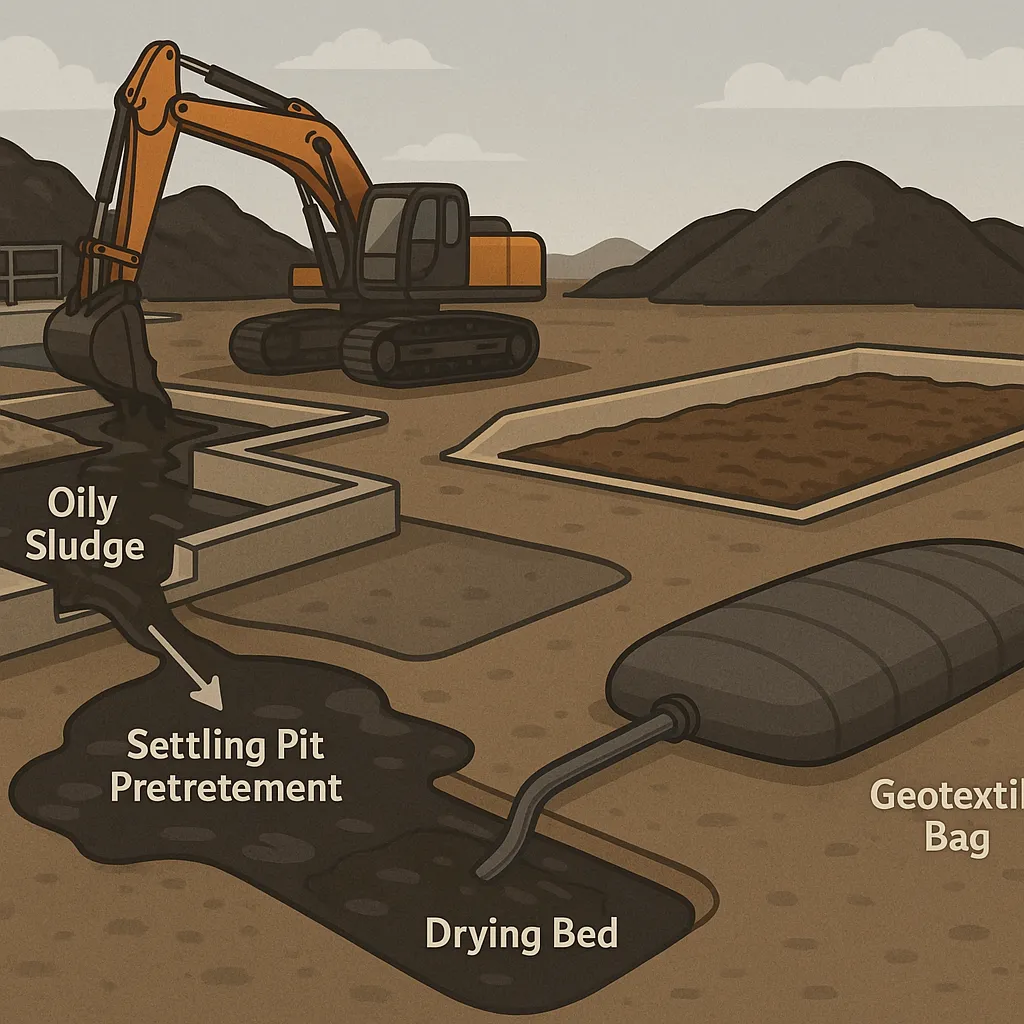
Geotextile “bags” or tubes (woven polypropylene sacks) offer a portable, modular option. Sludge is pumped in. Water passes through the fabric while solids form a cake inside. Filtration efficiency can be very high (usually ≳90% solids retained) because a filter cake quickly builds up in the fabric (gssb.com.my).
Drainage is slower, usually several days. One report notes geotubes draining about 70% of the water in about 7 days (gssb.com.my). The dried sludge inside consolidates (volume reductions of perhaps 50–80% over several days are typical). Bag size is chosen to match the projected sludge volume and the site footprint. The method avoids leveling a large area. However, the dried cakes still need handling at the end, the same as drying beds.
Pretreatment and conditioning steps
Small oil/water separators (API skimmers, compact oil–water devices) and settling pits remove free oil and heavy sediment before dewatering. For the oil phase, mines use separation equipment such as oil removal systems. These systems bring free oil down to <10 ppm. This fits the skimming-first approach described above (researchgate.net).
Coagulation and flocculation ahead of geobags or sand beds is common. Adding cationic polymer (for example, 0.2–1 kg per tonne of sludge) improves drainage and final cake solids (nepis.epa.gov). Mines use precise chemical feeds via a dosing pump and choose from flocculants to get the best result. In practice, a train of treatments is used. First coarse settling and grit removal, then oil‑skimming, then dewatering (bed or geotube) to get the most water back.
Volume reduction and design metrics
Field data show a large drop in volume. Passive solar drying beds in sewage treatment usually shrink raw sludge by 80–90% by volume during drying. In mining wash bays, gritty solids help the water drain and strong sunlight in Indonesia helps the drying.
Key design metrics: if a mine produces 5 mgd (a flow-rate unit common in water engineering, ≈5700 L/min) of washwater with ~500 mg/L TSS (total suspended solids), that is ~86 kg TSS/hr. At 250 kg DS/m²·yr loading, one m² of drying bed could handle roughly 10 kg DS/day, so ~8.6 m² per 86 kg. In other words, each m² of bed removes ~10 kg dry solids a year, or ~5–10 m³ of sludge a year. These are rough engineering guidelines taken from municipal protocols (waterandwastewater.com). However, they show that modest bed areas can handle a lot of sludge if it drains over weeks.
In well‑dried conditions, final cake solids usually reach 20–30% (w/w, meaning weight fraction). Therefore more than 70% of the weight is removed as water/effluent.
B3 classification and disposal routes
Indonesian regulations (PP101/2014 and follow‑ons) require all hazardous (B3) waste to be treated or disposed in controlled facilities: generators must use licensed B3 transporters and send it to a certified B3 landfill or incinerator (ppid.menlhk.go.id). Used oil from mining is designated category B105d, necessitating managed disposal. In practice, mines often contract specialist waste firms for oily sludge removal, ensuring strict chain‑of‑custody and final incineration or stabilization in engineered B3 landfills (ppid.menlhk.go.id).
Reuse, circular options, and water recapture
Where possible, recycled uses are pursued: the Indonesian environment agency encourages “circular” reuse of mining residues (ppid.menlhk.go.id). High‑carbon sludge with low metals could be co‑processed (e.g., burned as fuel adjunct). Used lubricants are sometimes repurposed as fuel in explosives (ANFO) for blasting (ppid.menlhk.go.id), and coal tailings have been used in paving blocks or road base. One mining company reported saving ~27.5 billion IDR (~USD1.9 million) in 2019 by recycling used oil and grease (cutting oil use by ~1000 tonnes) (ppid.menlhk.go.id).
Even where equipment‑wash sludge is dirtier, clean fractions can be diverted: clarified effluent from dewatering (typically >90% of the volume) can often be reused for wash water (researchgate.net), saving fresh water and reducing net waste.
Figures, outcomes, and scheduling
Simple dewatering steps can shrink wash‑bay sludge volumes by roughly an order of magnitude. Geotube systems see effluent loss of ~70–90% (implying volume reduction >70%) (gssb.com.my; gssb.com.my). Drying‑bed solids loading guidelines (100–250 kg DS/m²·yr) mean a 1000 m² bed might process 100–250 tonnes of dry sludge annually (waterandwastewater.com).
Each 1 tonne of sludge contains hundreds of kilograms of water. One dewatering cycle usually removes hundreds of litres of water per m² of bed. Operator case studies show that adding a small amount of polymer (0.5 lb/ton DS) cuts drying time by >60% (nepis.epa.gov). Therefore schedules and equipment footprints can be much smaller.
Bottom line: sequence, size, and certify
For mining operations, gravity separation followed by either sand beds or geotextile bags can greatly reduce sludge volume and water content. This lowers disposal costs and frees up water for reuse. All treated sludge must be tested. If heavy metal/hydrocarbon tests exceed limits (per Indonesian B3 thresholds), it must be sent to authorized hazardous waste facilities (ppid.menlhk.go.id). Otherwise, even dewatered “non‑B3” sludge needs containment.
The data‑driven recommendation: install pretreatment (settling + oil trap), then dewatering beds or geobags sized per design loads (100–250 kg DS/m²·yr) (waterandwastewater.com), monitor sludge hydrocarbon/metal levels, and dispose of cakes at licensed B3 facilities if needed—or pursue approved recycling under circular‑economy initiatives (ppid.menlhk.go.id). From a business‑case perspective, large Indonesian coal mines report savings in the multi‑million‑dollar range by recycling oil and water rather than disposing them (ppid.menlhk.go.id; researchgate.net).
Sources and design manuals: drying beds and loading rates (waterandwastewater.com); U.S. EPA sludge manual with polymer guidance (nepis.epa.gov); Indonesian regulatory guidance and industry reports (ppid.menlhk.go.id; researchgate.net); geotextile dewatering performance (gssb.com.my; gssb.com.my).