

Article
Cement’s quiet efficiency play: the tiny chemicals that lift raw‑mill
Spray‑on grinding aids—amines, glycols, and similar surfactants—are nudging cement raw mills to do more with less power, typically adding 5–25% throughput and trimming specific energy. The gains are measurable in both ball mills and VRMs and often pay back fast.
Industry: Cement | Process: Raw_Milling_&_Blending
Electricity is a major cost in cement. A typical plant uses on the order of 100–110 kWh per tonne of cement, with about 40% of that for clinker grinding (nbmcw.com). Raw milling (preparation of raw meal) alone can consume 20–30 kWh/t of raw feed; one survey of Chinese plants put raw mills at an average 25.2 kWh/t (2014–2019 data) (mdpi.com). Large modern lines achieved as low as roughly 12–16 kWh/t by 2019 (mdpi.com) (mdpi.com).
The efficiency lever that many operators now reach for is chemical grinding aids. These spray‑added admixtures—typically amines, glycols, and similar surfactants—adsorb onto freshly generated particle surfaces and reduce interparticle attraction, discouraging agglomeration of fines and letting the material bed grind more efficiently (nbmcw.com) (zaf.sika.com).
In practice, suitable grinding aids (for raw or clinker) are reported to increase mill output by 5–25% while lowering specific energy consumption (scribd.com) (zaf.sika.com). One trial injecting a raw‑meal grinding aid (Fosroc 360RM) at 350 g/t raised raw‑mill throughput from 79 to 83 tph (≈+5%) with slightly improved fineness (scribd.com). Vendors likewise advertise 8–20% higher throughput in raw mills when dosing ~0.04–0.10% (ru.scribd.com).
Raw‑mill power and cost baseline
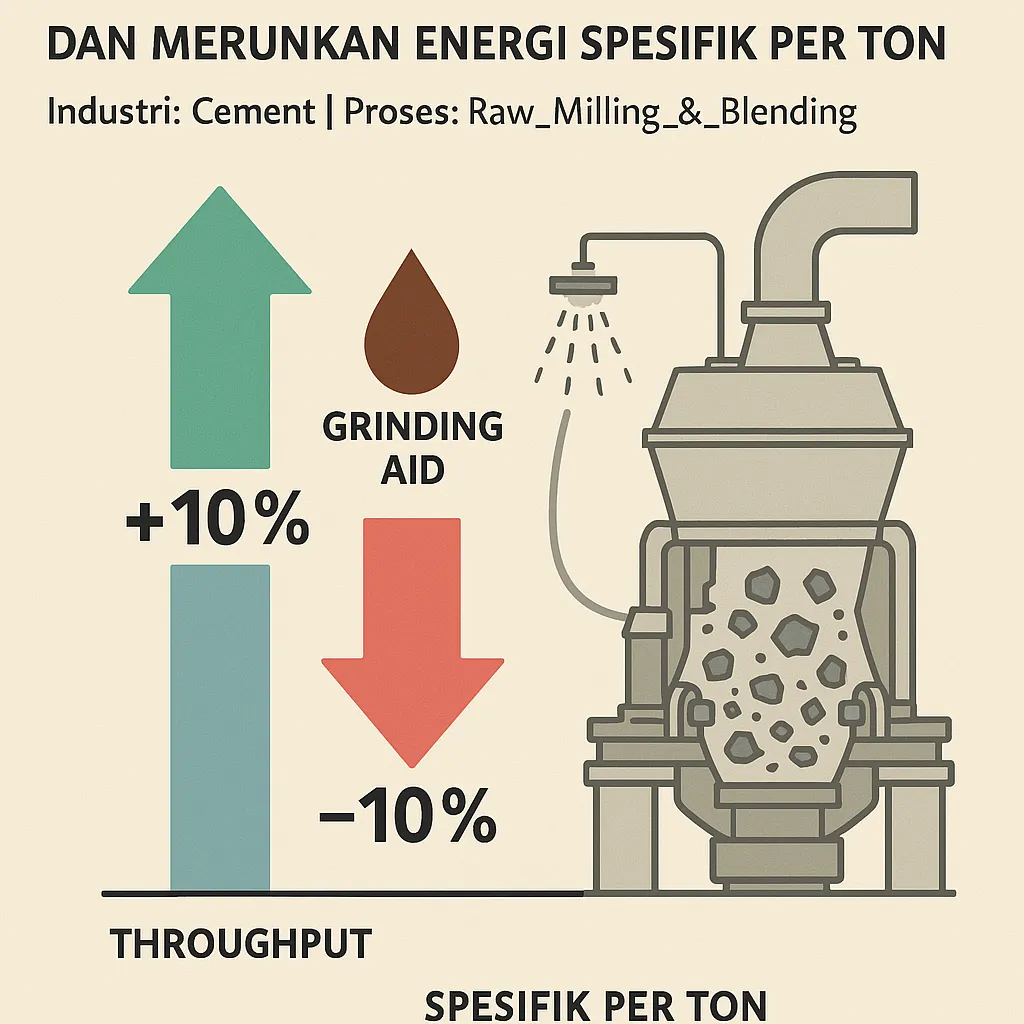
Electricity is a major cost. Therefore even a small efficiency gain is worth having. A throughput gain also saves energy directly. At constant mill power, 10% more tonnage means about 9% lower kWh/ton (kWh/t, a unit of specific energy use). For example, a raw mill that runs at 25 kWh/t would drop about 2–3 kWh/t with a +10% throughput gain.
Studies note that using grinding aids “improves raw mill output” and reduces energy needs, sometimes recouping hundreds of thousands of dollars per year in electricity cost (scribd.com) (nbmcw.com). Industry reviews summarize: “Grinding aids … enable increased production and decreased energy consumption” (nbmcw.com) (zaf.sika.com). In vertical roller mills (VRMs, a mill type using rollers to crush material on a rotating table), they also reduce vibrations and water spray needs, further stabilizing operation (zaf.sika.com).
Chemical grinding aids mechanism
Grinding aids are typically organic molecules (amines, glycols, ethers, etc.) that adhere to particle surfaces. Under weak electrostatic adsorption forces, the additive molecules impart repulsive or steric hindrance between particles (nbmcw.com) (zaf.sika.com).
In a ball mill, this breaks up fine‑particle agglomerates and prevents “slurry” effects; in a VRM it reduces surface polarity and fines’ tendency to pack around coarser grains (zaf.sika.com) (nbmcw.com).
The net effect is finer and more uniform powder, higher internal circulation/de‑agglomeration, improved mill flow with reduced “false air,” and lower mill vibration. Lab and plant tests report smaller Blaine residue (a fineness metric; lower residue indicates finer grind) and larger surface area with grinding aid use at equal energy (scribd.com). In a VRM, fines are more readily expelled rather than recirculated, stabilizing the material bed and allowing a coarser (more permeable) bed to persist while still grinding efficiently (zaf.sika.com; See Figure 1). Powder flowability improves; in VRMs this typically raises production and lowers mill differential pressure (ΔP) (zaf.sika.com). Especially in VRMs, the more stable material bed and improved flow reduce vibration and allow grinding at a steadier load (zaf.sika.com) (zaf.sika.com).
In summary, grinding aids transform particle–particle interactions so that mills grind more tons for the same power, with a finer target grind. Providers note “even a small addition” (e.g., 0.01–0.1% by weight of feed) can boost grinding efficiency by 15–25% (scielo.org.za). This aligns with field data (+5% throughput on one test, scribd.com) and vendor claims up to +25% (zaf.sika.com) (scielo.org.za).
Throughput and specific energy outcomes
Typical raw‑mill throughput increases of 5–15% are common at optimal dosing; some reports cite up to 20–25% in favorable cases (scribd.com) (zaf.sika.com). The Turkish raw‑mill trial using Fosroc’s 360RM at 350 g/t raised output from 79 to 83 tph (+5%) (scribd.com). Vendor datasheets claim 8–20% boost with 0.04–0.1% dosing (ru.scribd.com). In ball mills, even single‑digit percentage increases are significant; in VRMs, larger relative gains can occur since they are more sensitive to bed conditions.
Higher throughput at the same motor load means lower kWh/t. Plants usually see a 5–15% drop in kWh/t. If a VRM raw mill runs at about 20 kWh/t, a 10% jump in throughput saves about 2 kWh/t. In one analysis, better raw‑meal burnability from grinding aids gave thousands of dollars in annual electricity savings (scribd.com). Industry articles list lower energy consumption as one of the main benefits (nbmcw.com). The gains come in both electricity and heat. A finer raw mix also needs slightly less kiln fuel because it burns more easily.
Fineness, PSD, and kiln effects
Apart from throughput, grinding aids often enable a finer particle size distribution (PSD) at equal energy. In the cited trial, residues on 90 μm, 45 μm, and 32 μm sieves all dropped slightly with aid use (e.g., 90 μm from 14.9% to 14.3%) (scribd.com). A finer raw mix tends to increase chemical reactivity in the kiln (i.e., easier burnability), further multiplying the benefits (scribd.com) (scribd.com). Operators still need to keep raw meal chemistry in spec; grinding aids do not correct poor raw recipes. In short, aids can raise capacity and/or allow reduction of mill energy while achieving target fineness (nbmcw.com) (scribd.com).
Selecting grinding aid chemistries
Selection hinges on feed chemistry, mill type, and goals. Common adjuvant classes include alkanolamines (e.g., TEA, DEIPA), polyalcohols (mono/di‑glycols, glycerins, polyethylene glycol ethers), surfactants and ethers (e.g., polyglycol phenol ethers), and, less commonly, lignosulfonates or fatty acids (scielo.org.za) (scielo.org.za).
There is no one‑size‑fits‑all formula. Sticky or humorous raw (for example, high clay content) responds well to glycols or polyol soaps. Extremely fine or very charged dust may need stronger amine chemistry. VRMs and ball mills react differently. Sika notes over‑lubrication in a ball mill can cause material to shoot through too quickly (zaf.sika.com). VRMs have a short residence time and high internal friction, so they usually tolerate higher doses. For maximum throughput (looser fineness), many plants target a heavy‑duty aid (for example, a polyol + amine blend). For optimizing fineness or downstream burnability, milder aids usually suffice. Environmental constraints also matter. Some aids contain volatile organics or amines. Local chemical handling and emissions rules apply. In Indonesia, companies should follow safety (“B3”) regulations and limit worker exposure (provide MSDS, ventilation, PPE). Many grinding aids evaporate harmlessly or are trapped in dust. However, any specific VOC or toxicity limits still govern.
Typical range: most raw‑mill aids are effective at 0.01–0.10 wt% of feed (about 100–1000 g per tonne). One manufacturer’s data sheet shows Cemax RM for raw mills dosed ~0.04–0.10% (ru.scribd.com). Trials usually find an optimum at several hundred g/t (scribd.com). Dosing too low yields no effect. Dosing too high may cause over‑lubrication.
Dosing hardware and implementation protocol
Lab or pilot trials usually come before plant rollout. Plants use a lab mill or pilot setup with representative feed. They measure fineness and torque to find promising chemistries and dose levels. FLSmidth and other vendors usually offer laboratory grindability tests with small doses to screen products. On site, a calibrated dosing system feeds the aid evenly into the mill inlet or hot gas stream. Many aids are water based. Plants usually meter with a skid that includes an accurate chemical metering pump. A dosing pump helps keep the 0.01–0.10% window and gives stable addition.
Operationally, a gradual dose ramp starts around 0.01–0.03% and goes up in 0.01–0.02% steps. This allows steady state evaluation at each point. Key monitors include throughput (tph, tons per hour), power draw (kW), VRM ΔP, product fineness (for example % >90 µm), and downstream kiln feed chemistry indices such as LSF and SR. LSF is the lime saturation factor and SR is the silica ratio. Both relate to burnability. Improved throughput must align with acceptable product quality.
Operating window and optimization curve
When you plot output vs. dose and specific energy vs. dose, a plateau usually appears. Output rises quickly at first, then levels off or declines if material begins to bypass (a risk in ball mills at high dose). The selected point usually sits near the “knee” of the curve: maximum throughput without sacrificing fineness. In one trial, +5% throughput was achieved at 0.035% aid (scribd.com), while the manufacturer recommendation of 0.04–0.10% is a good target window (ru.scribd.com).
Process monitoring and economics
VRM indicators such as ΔP, fan load, and vibration usually drop with the right dosing. You can then feed tighter and keep throughput. Where available, circulating load or separator efficiency trends are useful corroborators. Raw‑mill aids usually exit in the clinker and have little impact on final cement. However, occasional checks on cement flowability and set times confirm no adverse effects.
On costs, grinding aids usually cost a few dollars per tonne of cement at a dose of about 0.05%. A 5% electrical saving (let’s say 1–2 kWh/t) at Indonesian industrial rates (about USD 0.1/kWh) can cover the additive cost. The net saving is more than that. Write down the baseline consumption and the improved consumption. Then you can work out the return.
Safety, regulation, and quality control
Storage and handling follow the Safety Data Sheets. In Indonesia, we expect compliance with Ministry of Environment/Industry rules on chemicals. Serious hazards are rare with modern polyol/amine aids. However, label checks, ventilation and PPE are still needed. Some amines can irritate the skin or give off vapors.
Quality control confirms that the cement properties (setting time, strength) stay within spec. Raw-mill aids do not enter the final cement in significant amounts. Aids based on propylene or glycerol have a negligible effect on strength.
Continuous optimization and control
Raw feed composition and moisture vary, especially in the rainy season. Adjust the dose from time to time so performance stays on track. Modern dosing skids can tie the dose to mill load or to pressure alarms and adjust it automatically. Keep a log of mill performance against additive usage. This helps you see drift and decide if you need to switch the aid type.
Capacity and kWh/ton headline effects
Across field data and industry experience, appropriate grinding aids can raise mill capacity by roughly 5–20% and cut kWh/ton by a similar order, translating into lower unit costs and improved kiln performance via finer, more burnable raw meal (scribd.com) (mdpi.com).
Key takeaways for managers
Choose proven aid chemistries, usually those recommended by mill vendors or chemical suppliers. Start at a low dose and ramp up. Monitor mill power and output closely, and check that the raw mix stays stable. Typical dosing is a few hundred grams per ton. When applied correctly, grinding aids are one of the most cost-effective ways to cut energy consumption and lift throughput in raw-mill circuits (nbmcw.com) (zaf.sika.com).
Sources and further reading
Published industry and research sources underpin the figures and case references above, including nbmcw.com, mdpi.com (also mdpi.com and mdpi.com), detailed case notes at scribd.com, vendor dosage data at ru.scribd.com, supplier technical notes at zaf.sika.com and zaf.sika.com, and the mechanistic review at scielo.org.za (also scielo.org.za).