

Article
Breweries weigh a DE‑free future: Cross‑flow vs lenticular, by the numbers
Industry: Brewery | Process: Filtration_&_Carbonation
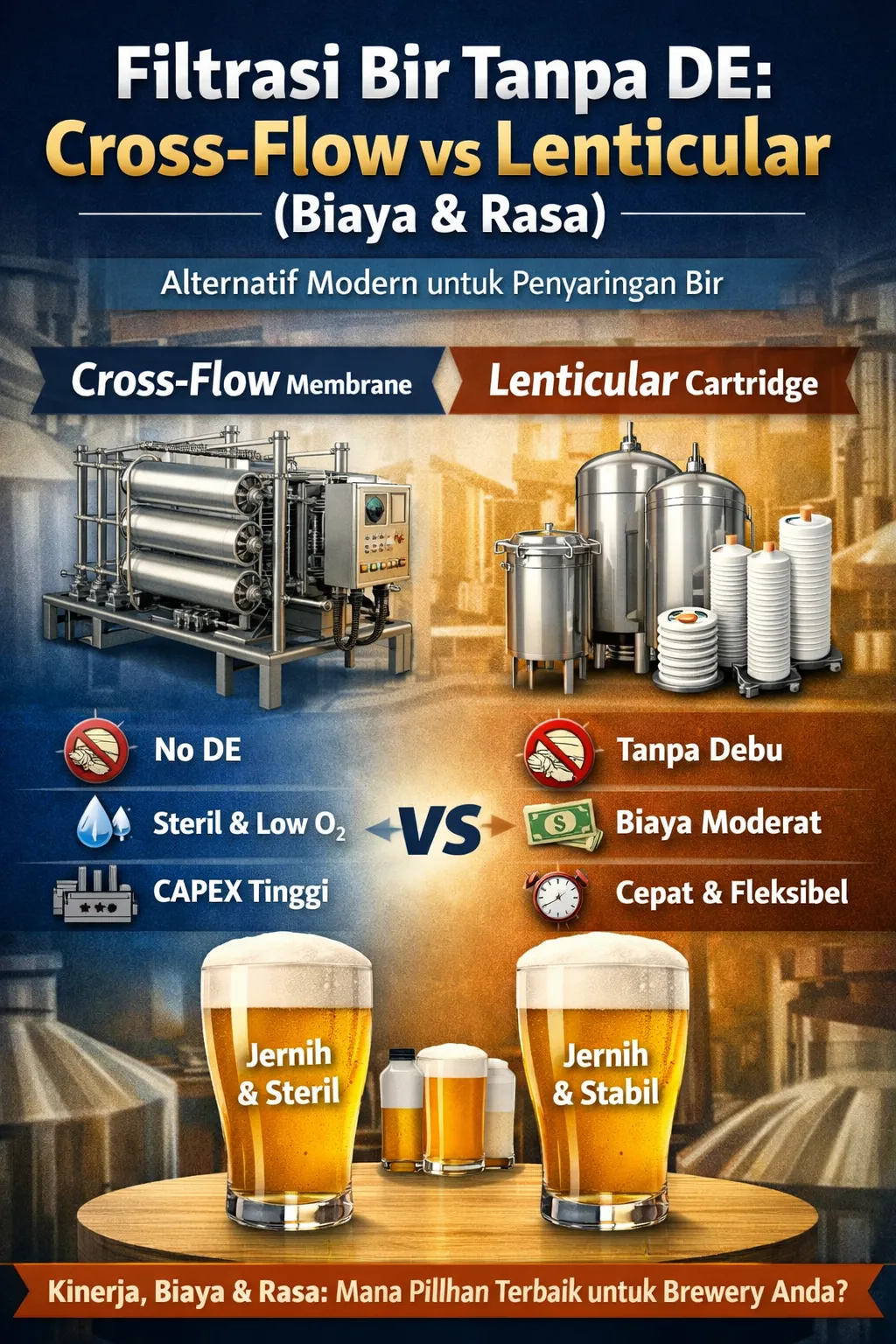
Classic pre-coat filters with diatomaceous earth (DE, “kieselguhr”) do the job. However, they make hazardous solid waste, they cost money for media on every run, and they can add dissolved oxygen and metal contaminants. Modern breweries are looking more and more at two alternatives: cross-flow (tangential) membrane filtration and pleated depth/lenticular cartridges.
DE pre‑coat filtration context
DE filtration works. However, every run makes a spent cake that you have to handle and send to landfill. Operators also mention the risk of oxygen pickup and trace metal contaminants from spent DE, plus the ongoing cost of filter aid and disposal fees.
Cross‑flow membrane filtration design
Cross-flow systems circulate beer tangentially across a micro- or ultrafiltration membrane. The membrane is usually hollow-fiber or ceramic, with a pore size of about 0.45 µm (“µm” means micrometers). They remove yeast and solids without pre-coat aids, and give clarified beer in a closed loop (ResearchGate). If you specify sanitary UF modules, references like ultrafiltration help you set the pore size and hygiene requirements.
Filtration flux (throughput per membrane area) is lower than DE: roughly 50–100 L/m²·h, about one-fifth of a good DE pre-coat at 250–500 L/m²·h (ResearchGate). In practice, typical cross-flow reaches on the order of 0.5–1.0 hL per m²·h under cold conditions. New designs, such as Krones/Steinecker Phoebus, use series-connected modules and targeted back-flushing to raise throughput and reduce fouling (Krones).
High cross-flow velocities (4–6 m/s) with CO₂ backpulsing can reach ~100 L/m²·h on rough lager, but the energy input is higher (ResearchGate).
Cross‑flow yield and oxygen control
Unlike batch DE filtration, cross‑flow continuously recirculates beer. Losses are minimal, mostly the small retentate and primer. Breweries usually recover yeast‑slurry beer separately. One yeast‑recovery cross‑flow unit recovers beer that would otherwise be ~2–3% of volume lost in yeast (COROSYS). Cross‑flow can also filter directly from fermentation to bright tank. This eliminates extra settling and pump passes (Brewer Magazine).
Cross‑flow beer quality and stability
Multiple studies found no detectable sensory difference versus DE. In a parallel trial, a Weihenstephan tasting panel reported “no significant difference in taste” between cross‑flow‑ and kieselguhr‑filtered samples (Brewer World). Standard analytical parameters (pH, extract, color, fermentation by‑products) also showed no appreciable change (Brewer World, Brewer World).
Membrane systems routinely achieve final turbidity <0.5 EBC (EBC is a turbidity/color scale) and remove spoilage organisms (bacteria/yeast) entirely, often eliminating the need for pasteurization (Brewer World). The closed‑loop design greatly limits oxygen pickup; a vendor notes “extremely low oxygen pick up” and no contamination by spent DE’s iron or manganese (Brewer World). In short, cross‑flow is at least as gentle as DE on flavor and aroma (Brewer World, Brewer World).
Cross‑flow capex, opex, and automation
The equipment costs a lot. A mid‑sized (~100 hL/h) skid usually costs in the hundreds of thousands of USD. Manufacturers say craft brewers get a fast ROI, but they do not publish list prices. The systems are skid‑mounted and automated. They usually replace a whole DE filtration train plus a yeast separator (Brewer World). Such systems filter more than 150 million hL/yr worldwide. Therefore the market is growing fast even with the high capex (Brewer World).
Operating cost centers are utilities (pumping energy, heating caustic for cleaning‑in‑place, CIP) and periodic membrane replacement. A feasibility study estimated optimized cross‑flow opex at ≈€0.40–0.50 per hL of beer, including electricity (~66.5 Wh/L of beer) and cleaning chemicals/water (ResearchGate, Krones). Modern series module layouts cut pump power. Targeted backflushing can also reduce CIP volume and chemical use a lot (Krones). Cross‑flow forgoes DE altogether, so it saves on filter‑aid purchases and waste disposal (no hazardous silica). By contrast, DE filtration usually consumes 1–3 kg DE per hL. Multiple brewery comparisons found cross‑flow’s opex per hL can be comparable to or even lower than DE filtration (Brewer World).
Membranes last several years, depending on the material, and they are cleaned in place. Automation is high, and the CIP is programmable, so less labour is needed. Chemical dosing for a consistent CIP can be integrated with metering equipment such as a dosing pump.
Lenticular depth cartridge systems
Lenticulars are pleated depth filters (stacked disc cartridges) inside a pressure vessel. They work much like a plate‑and‑frame filter, but in a closed, vertical housing. They are usually run as multi‑stage dead‑end filters. A coarse depth stage (usually using diatomite or perlite billets) removes bulk solids and yeast. Polishing cartridges (cellulosic or bonded‑fiber media, β‑rated) then yield clear beer. Final sterile filters (0.45–0.65 µm membrane cartridges) are usually applied after the liquid is quite clear, to make sure it is microbially stable (ProBrewer). Systems are modular. A typical 16″‑diameter housing holds 1–6 cartridge modules, and brewers can chain primary, trap, and fine cartridges as needed (see table below).
Food‑grade housings matter in beverage service. 316L stainless designs such as an SS cartridge housing are usually specified to keep hygiene and pressure integrity.
Lenticular throughput and clarity
Lenticular cartridges deliver moderate flux with high per‑unit throughput. A 16″×1‑high Suprapak module (~5 m² area) can process ≈7–9 bbl/hr (≈800–1050 L/h) during fine polishing (Scott Labs). Larger modules (32–48 m² Suprapak columns) can handle 14–40 bbl/hr depending on grade (Scott Labs). That is roughly 2–4 hL/hr per 32 m² module, that is ~200–400 L/m²·h. That is much higher per area than hollow‑fiber membranes (ResearchGate), though still lower than full DE flow. Breweries usually size 1–3 housings to filter a batch in reasonable time. Performance depends strongly on incoming clarity and media grade (coarser media flow faster but retain less haze).
Depth filtration removes haze-causing particles and most yeast. With the right media it gives brilliant beer (turbidity <1 EBC). On its own it does not guarantee sterile beer. We recommend a final membrane cartridge to remove bacteria and remaining yeast (ProBrewer). Industry casework reports that modern pleated microglass cartridges pass rigorous flavor tests. A large brewer switched to 0.45 µm microglass filters and saw no flavor impact (Global Filter). They do not change beer chemistry by themselves, because depth media adsorb very little of the flavor-active solubles.
For the polishing stage, breweries usually rely on sanitary cartridge filters that slot easily into existing housings and validated sterile‑membrane steps.
Lenticular cost profile and operations
Capex is relatively low. A stainless 16″×3‑high housing (~15–20 m²) is on the order of $10–20k USD, plus pumps and plumbing. Each cartridge module (5″ or 8″ diameter) ranges from a few hundred to a thousand dollars depending on media. A typical 16″ Suprapak module (~10 m²) may cost ~$1k–$2k. A multi‑module setup usually totals ~$20–50k. Figures are rough. Actual quotes vary by vendor. No complex skids or automation are needed.
Opex centers on filter media and disposal. Cartridges must be replaced after each brew, or every few brews depending on ∆P (pressure drop). A polisher pack (β‑rated depth media) might filter ~60–100 hL before exhaustion. At 10 m² at $1000 each, that is ~$10 per hL just for media (compared to ~€0.50/hL for cross‑flow). In practice, lenticular media costs can exceed DE if high flow or a very fine final “saltation” (fine cutoff) is needed. There are no hazardous dust issues (unlike open DE powder), and spent cartridges are non‑toxic (though bulky). Water and CIP chemicals are still used, usually every batch. Overall, lenticular opex tends to be moderate. It is higher than a single DE run (multiple consumable stages) but usually lower than cross‑flow’s energy/CIP cost when operations are scaled.
Head‑to‑head economics and throughput
Capital: a small craft cross‑flow skid (tens of hL/h capacity) usually runs ~$150k–300k+, while lenticular setups delivering similar output sit in the mid‑five‑figures (ResearchGate, Scott Labs). You can weigh cross‑flow outlays against eliminating DE infrastructure and obviating trap/fine steps. These may offset some lenticular capex and vessel space.
Operating expense: cross‑flow removes consumables (no DE, no pads) but adds energy/CIP. A detailed study puts optimized cross‑flow at ≈€0.40–0.50 per hL (ResearchGate). Lenticular opex varies with media life. A representative case at $1k per 10 m² replaced after ~100 hL yields ~$10/hL in media alone. In practice, lenticular opex usually sits between DE and cross‑flow: higher than single‑pass DE, but usually lower (especially at scale) than power/CIP‑intensive cross‑flow. Waste disposal fees (only for DE) and environmental compliance (DE is silica, cartridge waste is inert) factor in.
Throughput: lenticulars usually give higher throughput per m² of media than hollow-fiber membranes, because the dead-end flow is coarser (ResearchGate, Scott Labs). Cross-flow runs continuously and closed, so it can replace multi-stage depth filtration in one step. Guidelines show a 0.65 µm cross-flow unit replacing a primary DE filter and both trap and fine lenticular polishing steps (ProBrewer). In practice, this can speed up packaging.
Beer quality: both deliver excellent clarity. Cross‑flow repeatedly matches DE in taste (no significant difference) and offers superior microbial sterility without oxygen pickup (Brewer World, Brewer World, Brewer World). Lenticulars reach DE‑grade clarity and, with final membranes, ensure sterility; tests show no adverse flavor impact from cartridge filtration (Global Filter). The main differences are process‑driven. Cross‑flow’s CO₂‑inert, closed loop offers a subtle edge in yield and stability; dead‑ended lenticulars benefit from extra care (e.g., CO₂ blanketing) to limit oxidation (Brewer World).
Environmental and health: cross-flow removes DE entirely. There is no siliceous dust hazard and no cake disposal. Lenticulars remove open DE dust exposure but still make solid waste (used cartridges). Neither method uses fresh filter aids after the initial setup. In cross-flow, water use is designed down with internal recycle and staged backflush to keep rinse volumes low (Krones). Lenticulars need rinsing between heads, but they use moderate water and CIP, about the same as DE filters.
Data at a glance (example metrics)
- Cross‑flow opex: ~€0.40–0.50 per hL (power/CIP) (ResearchGate).
- Lenticular media cost: e.g., ~$10/hL (using $1k per 10 m² per 100 hL) (est.).
- Beer flux: cross‑flow ≈50–100 L/m²·h (ResearchGate); lenticular ≈200–400 L/m²·h (Scott Labs).
- Global scale: >150 million hL beer/yr now filtered by cross‑flow worldwide (Brewer World).
Equipment integration notes
Breweries that upgrade filtration usually standardize on sanitary components across the skid and cellar. Ultrafiltration modules, as referenced under ultrafiltration, align with cross‑flow pore‑size targets. Cartridge‑based sterile steps pair cleanly with a hygienic stainless cartridge housing, and polishing elements are straightforward with a validated cartridge filter.
Bottom line and sources
In side‑by‑side terms, cross‑flow offers high‑quality, sterile beer with minimal yield loss, comparable or lower per‑hL costs once amortized, and major labor/waste savings via closed, automated operation. However, it needs higher capital and higher energy/CIP inputs (ResearchGate, Brewer World). Lenticular depth filtration is low‑capex, high‑throughput, and proven, with recurring cartridge costs, more labor, and step‑wise stages as trade‑offs. Microbreweries seeking easy retrofits usually favor lenticulars, while larger or fast‑growing breweries find cross‑flow’s long‑term economics and consistency justify the investment. Today more than 150 million hL/yr are filtered by cross‑flow worldwide (Brewer World, Brewer World). Relevant regulatory notes (for example, DE hazards) underline the trend toward alternative methods.
Technical references used throughout include brewing institute studies and industry white papers: Brewer World, ResearchGate, Brewer World, Krones, Scott Labs, Brewer World, ProBrewer, Brewer Magazine, COROSYS, and Global Filter.