

Article
Breweries Are Ditching Wet Conveyor Lube. The Payback Looks Dry, Clean — and Quick.
Industry: Brewery | Process: Packaging
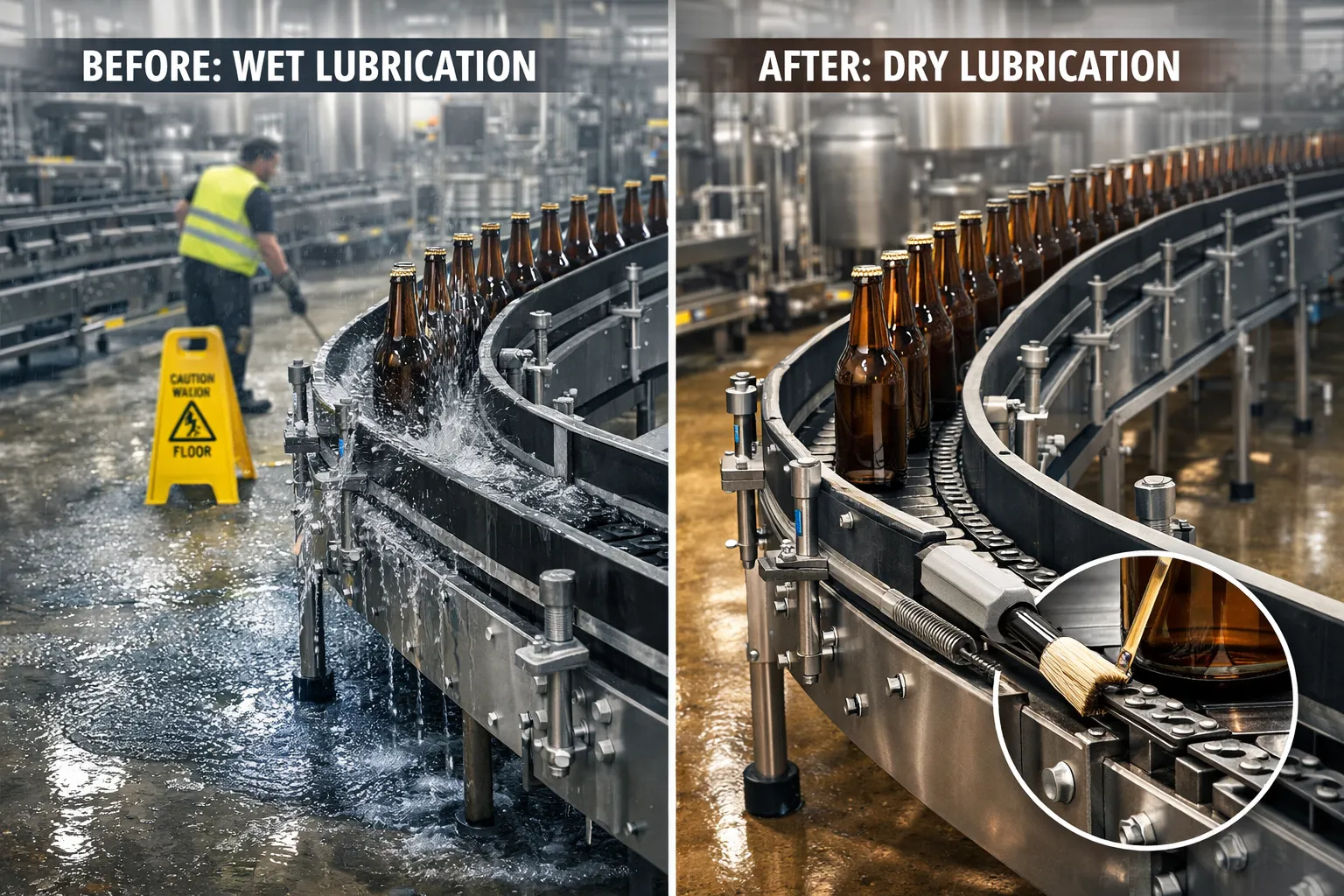
On a bottling line in Germany, the conveyor’s “lubrication” was basically a hose: 800–1,000 liters per hour of water mixed with chemicals, running 15 hours a day, and pooling on the floor (Klüber). That is the traditional wet conveyor lubrication program in action. It works, but it comes with washdowns, slippery aisles, and the kind of residues that invite microbes.
Dry lubrication uses a small, targeted oil film or a solid coating, usually applied by brush. This changes the way the line is lubricated. Diversey’s DryFormance, for example, uses an NSF‑approved oil applied by brush. The oil does not mix with water. Lubrication stays on the chain guides and the product flow zones, and there is no overspray (Diversey).
The shift is about more than greener optics. In breweries and dairies it means fewer slips, less effluent, and lower bills. Some lines report five-figure annual savings. Here is how the math and the mechanics stack up.
Conveyor lubrication categories and media
Industry practice falls into four categories (Traktech):
-
Wet lubrication: water dosed with low‑concentration, food‑grade lube (old standard). Systems continually dose soaps or biocides.
-
Semi‑dry: more concentrated wet formulas (less common) (Traktech).
-
Dry lubrication: only oil‑based coatings or thin films. Examples include brush‑applied silicone oils and aerosol PTFE (polytetrafluoroethylene, usually known as Teflon) sprays. PTFE solids in the liquid carrier are usually 1% by weight or less (Traktech).
-
Micro‑dry (CHP): high‑solids systems (up to ~6% PTFE) with precision routing and minimal over‑spray (Traktech).
Water, chemical and energy reductions
High‑speed beverage lines used millions of liters of lubricating water every year. One large canning line can use 2.5 million liters per year for wet lubrication. Returnable‑glass lines are usually higher (Diversey). Ecolab reports that plants have cut conveyor water use by up to 97%. That saves as much as one million gallons (3.8 million liters) per line every year (Machinery Lubrication).
At Craft Brew Alliance’s Redhook brewery, a switch to a low‑friction, dry‑running conveyor chain eliminated 111,000 gallons per year of water and 675 gallons per year of detergent — a 60% net cut in line water use even before a site‑wide retrofit (Packaging Digest) (Diversey).
Dry lube also cuts the chemical load. With wet lube, constant soap or biocide dosing drives chemical purchases and effluent treatment. Dry-lube effluent carries almost no chemical load. Therefore it eases biological oxygen demand and avoids contamination risk in waste streams (Diversey). Energy use also falls, because less friction load-reduces the conveyor motors. Field data show about 10% lower motor power draw in plastic-belt lines (7% for stainless steel) (Diversey).
Let’s put numbers on it. A line that saves 3.8 million liters per year (one million gallons) avoids around $3,800 in utilities if raw water and sewage each run $0.50 per kiloliter. Removing about 2,500 liters of detergent at $2/liter adds about $5,000. A 10% motor energy drop (for example a 5 kW base, 8 hours/day, 300 days/year at $0.10/kWh) saves only a few hundred dollars. Taken together, a typical line can save on the order of $5,000–$10,000 per year in direct utility and chemical costs alone. This is consistent with an industry case of a 24,000 cph canning line saving >$12,000/year (Food & Beverage Business).
Quality adds more upside. Without a water or soap film on primary containers, sites report fewer broken bottles and fallen packages when friction is controlled zone by zone (Diversey).
Hygiene, safety and PFAS considerations
Dry lubrication keeps machines and floors drier and cleaner. About 90% of slip accidents in food plants trace to wet or contaminated floors, so eliminating conveyor spray “creates a safer working environment” (Diversey). One East Africa brewery reported clean, dry floors with no slip hazards after conversion (Innovations Food) (Food & Beverage Business). At Redhook, teams stopped cleaning the conveyor after every shift once on dry lube (Packaging Digest).
Removing the lubricating water film reduces the conditions for biofilm growth and makes sanitation better (Diversey). In that Tanzania case, no “biological growth on the floors” was seen after conversion (Innovations Food). Regulatory expectations (NSF H1/ISO 21469 food‑grade lubricants, and the ISO/FDA emphasis that conveyor surfaces be easy to clean) fit dry systems that do not tack or drip. In Indonesia, food‑safety laws (BPOM) mean incidental‑contact lubricants need such approvals. Dry systems that use trace amounts of compliant oil fit that hygiene stance.
One caveat: PTFE (Teflon) is a common dry‑film additive, and it is a PFAS (per‑ and polyfluoroalkyl substance). This class is durable and stays in the environment and in human tissue. Packaging experts warn that PTFE residue can build up on bottles and conveyors and need extensive cleaning. Teflon does not biodegrade and can contaminate soil and water (Innovations Food). Modern dry conveyor oils usually avoid PFAS. DryFormance is PFAS‑free by design (Innovations Food).
Dry lubricant families and cleanability
Silicone‑based oils (polydimethylsiloxanes) are clear, inert fluids, usually NSF‑H1, and they leave thin hydrophobic films. Silicones are siloxanes, not PFAS, so they do not bioaccumulate like Teflon. Too much oil can cause buildup. However, modern systems meter precisely.
PTFE‑based lubes (Teflon powders or emulsions) provide extremely low friction — often 20–50% lower than oil alone — but, as PFAS, they can be harder to remove and come with environmental concerns (Innovations Food). Some “microlub” systems use up to ~6% solids to balance performance and cleanability (Traktech).
Oil-based lubes (synthetic or mineral) act “dry” because they are applied in tiny, targeted doses (brushes or direct injection). Diversey’s DryFormance uses H1-approved oil, with no water in the mix (Diversey). Vegetable-oil derivatives can be used the same way. However, they may oxidize faster and need more frequent replenishment than synthetics. Graphite or other solid powders are rare in beverage lines and are usually avoided because of grit.
The balance to strike is lubricity versus cleanability: any film must not smear onto bottles or packages. Suppliers like Matrix promote NSF‑H1 silicone or PTFE dry‑film sprays for conveyors (Matrix Lubricants). The safest designs meter lubricant only at the chain‑and‑guide interface via brush contact, preventing overspray onto packages or floors (Diversey) (Traktech).
Cost model and ROI illustration
Utility savings add up quickly. Eliminating 3.8 million liters/year (one million gallons) of conveyor water can save roughly $1,900 in raw water and $1,900 in sewage treatment at $0.50 per kiloliter each (local tariffs vary, see reference on industrial wastewater pricing, Porvoo). Chemical cuts add more. Redhook saved ~675 gallons of lube soap per year, worth a few thousand dollars. A conservative estimate of 2,500 liters at $2/liter gives another $2,000–$5,000/year (Packaging Digest).
Energy paybacks are smaller but they add up. A ~10% friction drop can trim drive power. For a 10 kW motor running two shifts, 240 days/year, that is 1 kW saved, about $200/year at $0.10/kWh. Energy comes second to water and chemical savings (Diversey).
Maintenance can improve, too. Diversey reports more than 200% increase in plastic chain life under dry lube (that is, doubling lifetime). Bearings and sensors last longer when they are not drenched. Fewer stops from chain issues or floor spillage also boost throughput. Ecolab notes dry lube “can increase conveyor speeds and reduce broken bottle counts,” which means fewer losses (Diversey) (Machinery Lubrication). Safety and compliance impacts are positive but harder to monetize. Some manufacturers link such gains to lower insurance and OSHA costs (no public data cited).
Investment varies. A retrofit usually adds a dispensing system (brushes, pumps, controls) and sometimes new chains or belts. Redhook swapped an entire conveyor to a dry-running design. However, many plants convert existing conveyors with metered applicators. Industry anecdotes range from tens to a few hundred thousand dollars depending on scope (Packaging Digest).
One reported brewery in Tanzania (24,000 cans/hour) saved more than $12,000/year from water, lube and effluent alone, with a 36-month payback. That implies roughly $36,000 invested (Food & Beverage Business). In markets with cheaper water but higher usage, ROIs of 2–4 years are plausible. For example, if total annual savings are $8,000 and the upgrade costs $20,000, payback is 2.5 years (ROI ~40%/year).
We built a simple ROI model. Water saved is 3.8M L × ($0.50 + $0.50)/1,000, about $3,800. Detergent saved is 2,500 L × $2/L, about $5,000. Energy saved is about 1–2 MWh × $0.10, about $200. Maintenance spares go down by about $1,000 (assumed). Total annual savings are about $10,000. If installation costs $30,000, payback is about 3 years. Water scarcity and sustainability pressures are rising. Case studies from Packaging Digest and Food & Beverage Business show this. Many breweries see dry lube as both an environmental and financial win (Packaging Digest) (Food & Beverage Business).
Sources and further reading
Industry case studies and product data (Diversey, Ecolab, Klüber, ChemTreat, Packaging Digest) report water/chemical savings, slip‑prevention, and ROI with dry conveyor lubrication (Packaging Digest) (Diversey) (Innovations Food) (Machinery Lubrication) (ChemTreat). Figures cited above are representative to inform cost–benefit analyses in brewery packaging lines.