

Article
Auto plants are slashing sludge bills by squeezing a few more points of dryness
Industry: Automotive | Process: Industrial_Wastewater_Treatment_(Oily_&_Metals)
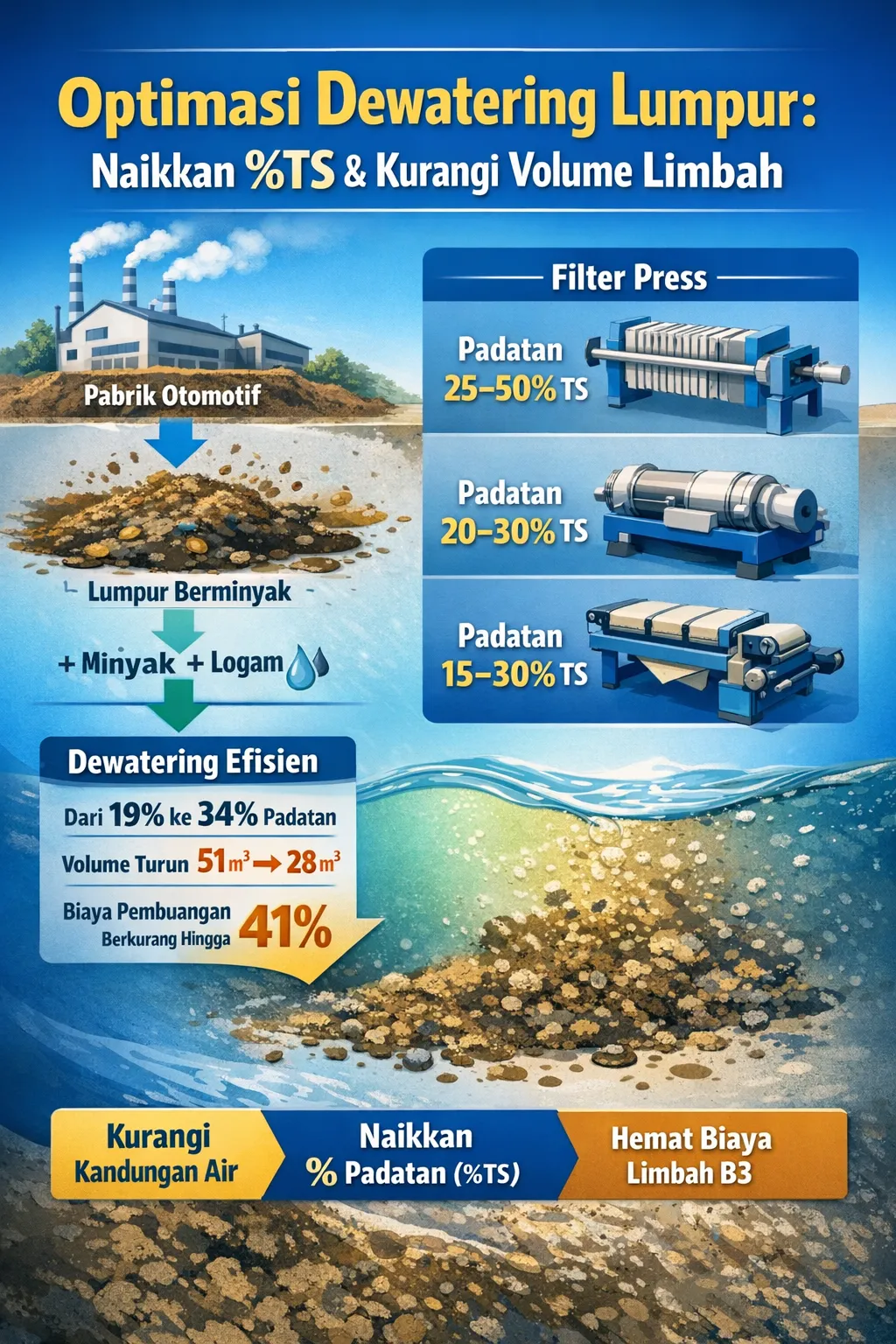
Automotive wastewater plants deal with sludges that are more than 90% moisture, mixed with oil/grease and metal hydroxides. Good dewatering is not optional. Each 1% increase in cake solids can cut sludge volume by about 3–5% by mass. That directly lowers hazardous-waste disposal costs. In one retrofit, dryness rose from 19% to 34% solids. Cake volume halved (51→28 m³/mo) and landfill fees fell by about 41%, from £9693 to £5719 per month (MDPI; MDPI).
Regulation raises the stakes. Oily or metal-laden sludges usually fall under Indonesia’s B3 (hazardous) rules, so they need specialized landfill or incineration (for example, KLHK Peraturan 68/2016). Under PP 22/2021, poor dewatering risks non-compliance. Therefore any moisture savings give immediate cost and environmental benefits.
Plants usually start upstream with primary separation. This knocks down debris and free oil before dewatering. Many specify compact front-end units such as screens and oil removal systems for this duty.
Automotive sludge profile and regulation
Paint booth residues, machining oils and metal hydroxides are mixed together. The result is compressible sludge that resists gravity drainage. The B3 designation makes disposal more complex and more expensive. Therefore dryness is the main cost lever. Any technology choice is judged by cake % total solids (%TS), filtrate clarity and capture.
Where free oil is present, a dedicated oil step can protect downstream filters and belts. Plants frequently add an upstream oil removal stage to stabilize feeds to the dewatering train.
Filter press performance and trade‑offs
Plate/frame filter presses are batch systems that squeeze sludge at high pressure for maximum dryness. Typical cake solids are 25–50% by weight (ResearchGate; MDPI), including 34% DS in one case (MDPI) and 32–36% DS in another (ResearchGate). With well‑conditioned sludge, >40% solids is possible.
Filtrate turbidity is very low (high solids capture). However, the method needs a lot of capital and runs in batches with 20–60 minute cycles (fill/press/clean). Maintenance of hydraulic systems and operator intervention are significant. The resulting cake is dry and friable, which simplifies disposal logistics.
Belt filter press throughput and footprint
Continuous belt presses use gravity and pressure zones. They handle large flows at moderate dryness (~15–30% solids). In practice, a vacuum belt press on one sludge reached ~19% DS with standard polymer. A filter press on the same sludge delivered 34% (MDPI).
Belts automate well and need lower capital per unit throughput. However, they need significant floor area and 20–30 minutes of residence (with belts 1–3 m wide). Solids capture can slip if conditioning is poor, and filter areas foul without cleaning systems. Polymer consumption is usually similar to filter presses (a few kg per tonne solids). Throughput can reach ~5–20 kg DS/m belt·h depending on belt width and zone design.
Centrifuge dryness and control
Decanter centrifuges spin at >3,000 rpm and develop 1,000–2,500 G for separation. They run continuously, have a compact footprint and use enclosed housings for odor control. Typical cake dryness is ~20–30% solids. However, staged polymer injection (pre‑ and in‑bowl) has reached 30–32% DS consistently and up to 34% in trials (ResearchGate).
Without optimization, many plants see ~22–29% DS, as reported in the referenced study (ResearchGate; ResearchGate). Energy use is higher (for example, several kW per m³·h) and speed control is important, but solids capture usually exceeds 90% with proper flocculation. In one trial, 12–18 lb/ton (6–9 kg/ton) of a gel polymer optimized yield (ResearchGate).
Other dewatering options
Screw (auger) presses are compact. They usually give about 20–30% solids with moderate polymer use. They work well on fibrous sludges but are less suited to purely inorganic slurries. Vacuum disc or chamber presses are used for smaller flows. The trade-offs: screw presses use very little energy but can clog, and vacuum systems give a moderate 20–25% cake at low pressure.
Comparative metrics and operating ranges
Cake solids: Filter press ≈25–50% (often >30% per MDPI); centrifuge ≈20–30% (30–34% with optimal floc per ResearchGate); belt press ≈15–30% (19% in one case per MDPI, ~20–25% typical).
Capacity: belts and centrifuges run continuously and handle thousands of kg DS/day per unit. Filter presses are modular (plate count) and limited by cycle time. Energy and O&M: centrifuges use a lot of energy (usually 1–2 kWh/m³-sludge). Belts draw moderate power. Filter presses mainly power the hydraulics but need more labor and maintenance. Footprint: belts need the most area, centrifuges the least, and filter presses are moderate (stacked plate banks).
Polymer conditioning as the performance lever
Chemical conditioning is important. Specialty polymer flocculants (usually high‑molecular‑weight polyacrylamides) agglomerate colloids and oil. They overcome the electrostatic repulsion that is common in automotive sludges. The correct polymer type matters. Cationic grades target negatively charged metal hydroxides or emulsified oil. Anionic polymers pair with positively charged sludges.
Plants standardize on dedicated polymer supplies. They usually specify high‑molecular‑weight flocculants for predictable floc formation. Dosing is usually via a dilution/mixing system to make sure the contact is uniform.
Optimization is powerful. Splitting the dose and the injection points, for example 50/50 between a pre‑flocculator and the fine‑screen inlet, has raised cakes to 30–32% and up to 34% in trials (ResearchGate). One plant reported that a new polymer lifted belt‑press cake from ~28–32% to ~36% solids (a 4–8% increase) (ResearchGate). These gains usually outweigh the incremental chemical costs.
Typical dosing rates are ~5,000–15,000 mg/kg (pp100-3000) — equivalent to 1–5 kg polymer per dry tonne (EPA NEPIS). Higher‑solids feeds and pre‑thickening reduce polymer demand; improper selection (charge, molecular weight) degrades capture (EPA NEPIS).
Automation is a trend. Precise metering and feedback keep floc quality steady. Plants are deploying metering pumps for polymer feed and online sensors tied to centrifuge torque and dilution control to keep capture above 95% and cakes up to 34% DS (ResearchGate). If conditioning slips, capture drops and the cake turns sticky (EPA NEPIS).
Pre‑thickening and front‑end stability
Pre-thickening reduces the load on downstream equipment and can cut polymer consumption. Plants add gravity steps or dissolved-air flotation where feeds are dilute. This is usually done with a DAF unit in oily service, or with sedimentation in a clarifier when solids settle easily.
Where fine screening is part of the train, injection points are usually placed just ahead of the screen. This can be synchronized with an automatic screen to stabilize floc size before the belt or centrifuge.
Economics and environmental impact
Dewatering efficiency drives cost directly because transporting water is expensive. Filter-pressed sludge at ~34% solids needs roughly half the disposal volume of the same sludge at 19% solids (MDPI). In the cited case, landfill fees fell from £9693 to £5719 per month, a 41% cut (MDPI), before any filtrate treatment savings.
In dollar terms, disposal can run to tens or hundreds of dollars per ton of wet sludge. Cutting cake volume by 30–50% returns the investment quickly. Drier cakes reduce truck trips and, where permitted, may support beneficial routes like incineration energy recovery or soil adjuncts. However, poor dewatering can prompt regulatory action under PP 22/2021 and B3 provisions.
Technology choice and integration trends
No single machine is best for every plant. The right fit depends on sludge character, flow rate, and economics. Filter presses give the highest dryness, which matters when disposal costs are high or the cake goes to incineration. However, they need higher CAPEX and more labor. Belt presses suit large, continuous flows where moderate dryness and space are acceptable. Centrifuges fit tight footprints or enclosed, odor‑controlled operation.
Combinations are common. Some plants run two stages (for example a belt press followed by a small centrifuge) to get more water out. New trends include automated polymer control, dual-polymer or hybrid inorganic-organic coagulants for stubborn sludges, and real-time filtrate monitoring. Ancillary equipment choices are usually listed under wastewater ancillaries so that monitoring and controls are integrated.
What best‑in‑class looks like
For an Indonesian automotive WWTP, good dewatering means high-solids technologies and the right polymer conditioning. Filter presses give the driest cakes (>30–40% DS: MDPI), but capital and labor cost more. Belt presses run continuously at ~20–30% DS. Centrifuges balance space and energy at ~25–30% DS, and can go above 30% with the right dosing (ResearchGate).
Engineers size systems by cake %TS, filtrate clarity and recovery rate. Empirical data show that optimizing these levers can halve sludge disposal expense (MDPI). In practical comparisons, a filter press at 34% cake solids gives ~40–50% less waste volume and cost than a belt press or centrifuge at 19–25%.
Sources: Case studies and reviews of sludge dewatering report cake solids, capture rates, and operating costs under different technologies (MDPI; ResearchGate; ResearchGate; EPA NEPIS). Academic and industry analyses document typical polymer dosages and the 5–10 wt% cake‑solid gains from optimized conditioning (ResearchGate; ResearchGate). EPA and Euro reports emphasize that polymer conditioning (1–5 kg/ton) directly enables >90% solids capture (EPA NEPIS), which fundamentally determines disposal volumes.