

Article
Aquaculture’s solids problem, solved three ways: drum filters vs radial settlers vs belt filters
Industry: Aquaculture | Process: Solid_Waste_Removal_&_Sludge_Treatment
In recirculating aquaculture systems (RAS), solids control affects water quality, energy use and sludge handling. The workhorse is the microscreen drum filter with 30–100 µm openings. Gravity-based radial-flow settlers use almost no water to operate. Inclined belt filters are usually paired with coagulant/flocculant chemistry, and they can push total suspended solids (TSS) removal close to complete. Peer-reviewed trials show the trade-offs. A practical selection guide follows for small, medium and very large systems.
Microscreen drum filters (30–100 µm)
Drum (microscreen) filters are rotating cylinders wrapped in fine cloth, usually with 30–100 µm openings. Spray nozzles clean them automatically. Under normal loading they remove about 70–80% of TSS. Johnson & Chen (2006) estimated about 72% TSS removal for a microscreen (60–90 µm) (source). In practical trials a drum filter alone captured about 40–45% of the daily solids mass in a trout RAS (source).
Capture efficiency by particle size is high. Drums trap most solids larger than the mesh size. In one comparison, microscreens (“propeller-wash bead filters”) removed >85% of particles >55 µm (>85% >50–60 µm were retained) (source). Removal falls for finer silt (<20 µm) unless filters are used in series or with flocculation. This is usually slightly lower than a comparably-loaded clarifier. However, drums remove much smaller particles.
Backwash water use is moderate. Drum filters spray jets over the screen continuously. Cleaning usually needs only about 1–3% of total flow. The jets fire briefly when the screen contacts a backwash arm. Vendors usually specify only a few percent of system flow, and modern drums are designed for low water use. No continuous bulk flush is needed (unlike a cartridge filter).
Running costs are moderate. A drum filter (a few meters across) can serve a small farm (10–50 m³/h). It costs several thousand dollars, and the price goes up with size. Energy use is modest: a small pump, a motorized drum drive and the nozzle supply. Maintenance is limited to checking the sprays and nozzles and replacing the cloth from time to time. No chemicals are used. The filter cloth usually lasts months of operation. Drums run automatically and need little maintenance, so they are cost-effective for RAS.
Use cases: drum filters work well when very fine bio-solids must be removed, for example in larval or juvenile culture. They are widely used in RAS worldwide (source). In one Danish model trout farm, a single 40–60 µm drum reduced TSS by ~72% (source. A coarser mesh is optional and can spare small fry. However, removal then drops.
Radial‑flow settlers (gravity clarifiers)
Radial-flow settlers are circular clarifiers that use quiet gravity settling. Water goes in at the side of a large cylinder, usually with a conical hopper bottom. The solids settle and are flushed from time to time. These devices remove mainly large solids that settle on their own. They have no media and need almost no continuous backwash.
Capture efficiency is moderate to high for coarse solids. In Johnson & Chen (2006), a prototype radial clarifier gave 82% mean TSS removal and captured large flocs. The influent mean particle diameter was ~340 µm and dropped to ~176 µm in the effluent (source). Davidson & Summerfelt (2005) found that a radial settler removed ~77.9% TSS (±1.6%) in a 150 m³ RAS test (source). A swirl concentrator removed only ~37% under the same conditions (same source). So radial clarifiers halve the volume of particulate matter by settling the coarsest fraction (source). They do not capture very fine solids (<20–30 µm) well. Most very small particles stay in suspension.
Backwash water use is negligible. Solids collect at the bottom of the hopper and are removed from time to time, for example by siphon or pump. Once the unit is optimised, only a “minimal volume of water” is needed to flush the settled solids. An initial sludge purge used about 70 L, and later flushes used about 15 L each, over a flow of more than 0.3 m³/min (source).
Operational costs are low. The capital cost per unit volume is modest, because the unit is essentially a concrete or fiberglass settling tank with piping. There are no moving parts and no pumps, apart from possibly a low‑speed sludge pump. Energy use and maintenance are minimal. However, settlers need a lot of space, several square meters per m³/h of flow, and this can raise the site cost. Very large flows need several settlers or a very large tank. For procurement, many operators use a clarifier for this duty.
Johnson & Chen concluded that radial clarifiers are a “water‑efficient, low cost alternative solids collection device” in RAS (source). Settling basins in flow‑through hatcheries or raceways work on the same principle.
Inclined belt filters with flocculation
Inclined belt filters (for example, ISIS/Hydrotech belt filter systems) use a slowly moving perforated belt. Vacuum runs under the belt and spray wash bars clean it. They were first used for thickening microscreen backwash and sludge. However, they can also be used on raw effluent with flocculation. In aquaculture they usually follow a flocculation tank. Coagulant (alum or polymer) is added and the solids flocculate. Then the mixture flows over the filter belt. Chemical aids are standard for high removal of fine particles. Coagulant and flocculant supply can be managed with standard consumables such as coagulants and flocculants.
Flocculation makes capture efficiency very high. We dosed 15 mg/L cationic polymer before the belt filter and got 96% overall TSS removal (effluent <30 mg/L) (source). Adding alum plus polymer gave up to ~99% removal (source). Even without fine mesh cloth, the flocculated slurry is almost entirely trapped as filter cake. The resulting sludge may be dewatered to ~10–15% solids dry matter (source). Without flocculation, belt efficiency drops sharply on fine solids, especially for particles <50 µm.
Backwash water use is low to moderate. Cleaning relies on vacuum dewatering, mechanical scrapers and intermittent spray bars. Continuous vacuum means the water largely drains out and does not need rinsing. Only short bursts of rinse water are usually used to unclog the belt at the discharge end. No published “percent flow” is given. However, a belt filter in principle uses only a small rinse flow (usually <1% of feed flow), because mechanical scraping and vacuum handle most of the solids. In practice, usage is comparable to or slightly higher than a drum filter. A radial settler needs only a “minimal” flush (source). A belt filter does need built-in cleaning sprays, but these are intermittent.
Operational costs are high. A belt system is a complex machine. It has a long filter cloth, vacuum pumps and a conveyor drive. It also needs a lot of chemicals. Coagulants are dosed at grams per cubic meter. Ebeling used tens of mg/L of polymer (and alum) (source) (source). It uses more energy than a drum because the vacuum blower runs continuously. It also costs more to buy than a simple drum or clarifier. However, a belt gives very thick sludge (10–15% solids). Therefore it can cut hauling costs. In short, it is expensive but very effective.
Performance comparison: size, water, cost
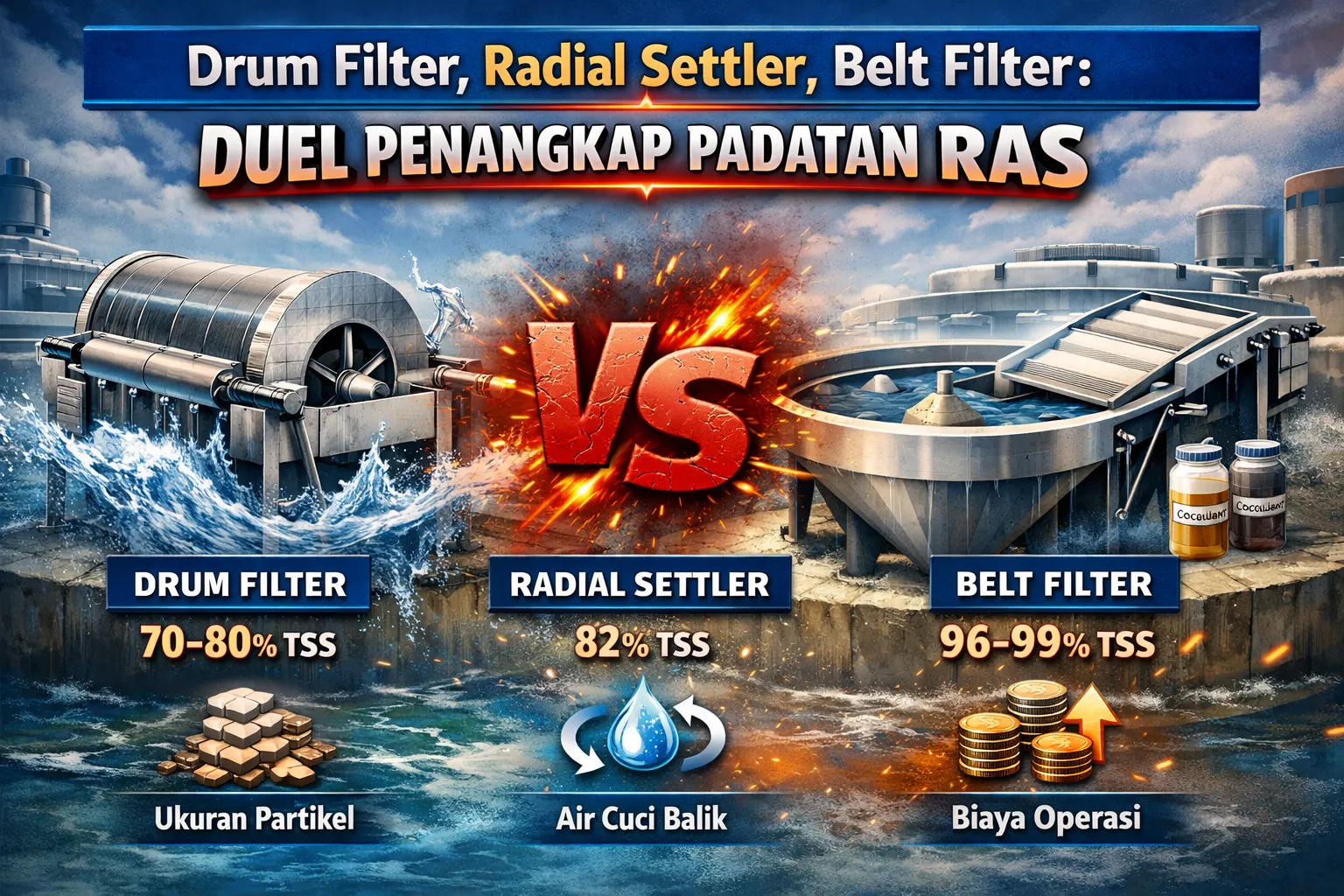
Solids capture by size. Radial settlers work best on very coarse solids (hundreds of µm). Johnson & Chen found the clarifier roughly halved the typical floc size (340→176 µm) and removed 82% TSS (source). Drum filters capture a mix. For example, a microscreen caught ~85% of particles >55 µm and usually removed ~72% of TSS (source) (source). Belt filters (with floc) can capture essentially all particle sizes and reach ~96–99% TSS removal (source) (source), including very fine (<20 µm) ones when coagulants are used. In other words, drum < radial < belt in nominal percentage (without coagulants, drum ≈ radial < belt. With coagulants, belt ≫ drum).
Water consumption: radial settlers use almost no washwater (flush volumes ≪1% of flow) (source). Drum filters usually use only a few percent of system flow for periodic backflush sprays. Belt filters also use only light spray (plus vacuum). This is usually comparable to or slightly higher than drum usage. In practice, the only filter needing significant wash water is a media or cartridge filter, which is not considered here.
Operational costs: radial settlers are the cheapest to run (almost no energy or chemistry). Drums are moderate. Belts are the costliest. Drums have built-in automation (a pump and <1 kW motor) but no chemistry. Belt filters have multi-kW vacuum and hydraulic systems, plus coagulant use. All systems need routine maintenance (spray nozzles on drums and belts, sludge removal on clarifiers).
Selection by system type and size
Recirculating Aquaculture Systems (RAS): the standard approach is a fine microscreen (drum or disc) as the first treatment. For a small RAS (tens of m³/h), a single drum filter (mesh ~30–60 µm) usually suffices to remove ~70–80% of TSS (source), with high ease‑of‑use and a small footprint. Larger RAS (hundreds of m³/h) usually use multiple drums or vertical‑disc filters in parallel. When extremely high solids or regulatory discharge limits exist, a radial settler may be added ahead of the drum to catch coarse settleables. For example, a drum plus clarifier can achieve ~88% removal (source). A belt filter is seldom used as primary in RAS unless very fine polishing is needed. It is sometimes added to thicken or press the waste stream, for example drum backwash, for easier disposal. In practice: <50 m³/h, one drum filter. 50–500 m³/h, multiple drums (30–100 µm) plus or minus a final disinfection. >500 m³/h, drums plus a radial clarifier to stage solids removal, and/or a polishing belt if TPSS targets are very low.
Flow-through (pond and raceway systems): if solids removal is needed, clarifiers are typical. A radial settler (or a rectangular settling basin) is cost-effective. It can capture ~80% of settleable waste (source) at almost zero energy cost. Drum filters are usually not used on open systems (unless the water is being reclaimed into an RAS). If very high fine-particle removal is needed (for example, for discharge to a sensitive water), a belt filter (with flocculant) could be used, but this is rare due to cost. Small flow-through (<10–20 t/hour): usually gravity draining to earthen baffled ponds (no filter needed). Medium (>20–100 t/h): a radial/lamella clarifier is recommended. Large biomass farms with limited outflow: clarifier + disinfection or microscreen can be used. Belt filters are usually only used if a farm wants to recover and compact pond sludge (coagulant dosing plus inclined belt to minimize sludge volume).
System size considerations: for small farms, simplicity and low cost matter most. A single drum filter (for RAS) or nothing (for extensive flow-through) is common. Medium farms may justify a clarifier (to avoid saturating a single drum) or multiple drums. Very large farms need staged systems. For example, a large circular clarifier followed by multipump drum filters. The economies of scale reward passive settlers and automated drums. Belt systems are justified only by very stringent discharge rules or if sludge disposal costs are extreme.
Overall patterns
Overall, RAS managers choose fine microscreens (drums/discs) for low RGB and high removal efficiency (source) (source), and accept the small backwash flow. Flow-through systems tend to rely on simple settling (radial clarifiers) for coarse solids, because water can be exchanged freely. Belt filters (with flocculants) are reserved for high-end polishing or sludge-thickening because of their high cost and chemical needs.
Sources
Peer‑reviewed engineering trials and reviews were used. Johnson & Chen (2006) report ~82% TSS removal in a radial clarifier (source); Davidson & Summerfelt (2005) similarly found ~78% for a radial settler (source). Drum filters gave ~72% (modeled) removal (source) and accounted for ~40–45% of total solids capture in a RAS study (source). Ebeling (2006) shows inclined belt filters with coagulant achieve ~96–99% TSS removal (source) (source) and concentrate solids to ~12–13% dry matter (source). Radial clarifiers “require only a minimal volume” of flushing water (source). These data guide system selection for Indonesian or international aquaculture operations.
References
Johnson & Chen 2006 (source) (source); Davidson & Summerfelt 2005 (source) (source); Ebeling 2006 (source) (source).