

Kendal Industrial Park Phase 1B WWTP (Stage 1: 16,200 m³/day)
Updated
PT Beta Pramesti Asia is designing and building the new Phase 1B wastewater treatment plant (WWTP) for PT Kawasan Industri Kendal (Kendal Industrial Park) in Central Java, Indonesia. Stage 1 capacity is 16,200 m³/day. The plant uses the activated-sludge process with coagulation-flocculation, primary and secondary clarification, and polishing. Our scope covers design, civil works, mechanical-electrical-process (MEP) work and maintenance chemicals. Construction runs 2025-2026, with start-up in 2026.
This is our latest large-scale WWTP reference, built for an industrial estate.
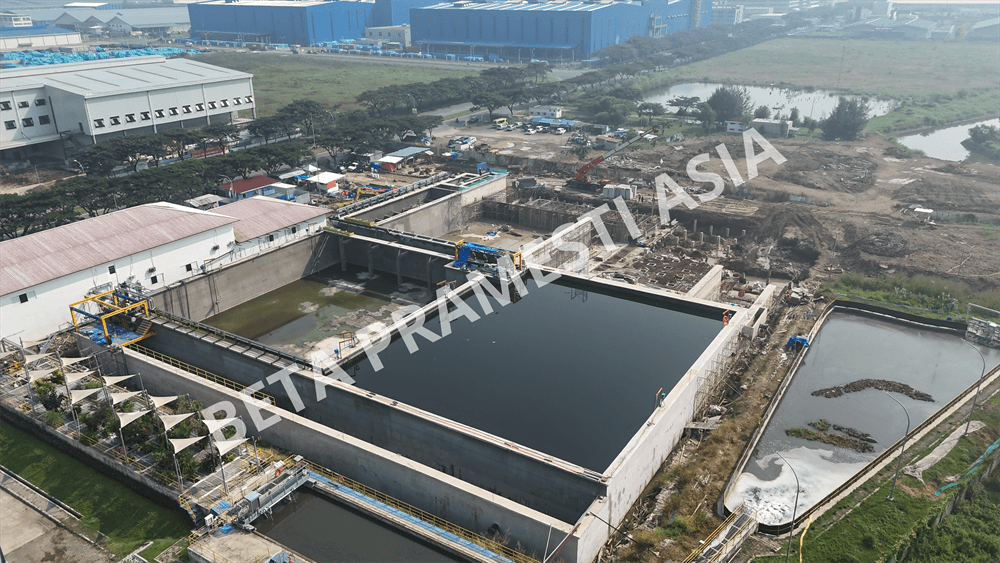
Project summary
| Item | Detail |
|---|---|
| Client | PT Kawasan Industri Kendal (Kendal Industrial Park) |
| Location | Kendal, Central Java, Indonesia |
| Sector | Industrial estate |
| Contract | Design and construction of the new Phase 1B WWTP |
| Capacity | Stage 1: 16,200 m³/day |
| Process | Activated sludge, with physical-chemical treatment ahead of and polishing after the biological stage |
| Beta Pramesti Asia scope | Design, civil works, mechanical-electrical-process (MEP) and maintenance chemicals |
| Schedule | Awarded mid-2025; piling from September 2025; construction 2025-2026; bacterial seeding and biological start-up in the second half of 2026 |
| Status | Under construction; start-up scheduled for 2026 |
How is the Kendal WWTP process train arranged?
The train below follows the equipment installed on the project. Each step has one clear job, so performance can be checked unit by unit during start-up.
| No. | Step | Main equipment | Purpose |
|---|---|---|---|
| 1 | Buffer and equalisation | Buffer/equalisation ponds with submersible mixers and lift pumps | Even out flow and load from many tenants before treatment |
| 2 | Coagulation and flocculation | Coagulation and flocculation tanks with chemical dosing | Agglomerate colloidal solids and part of the organic load |
| 3 | Primary clarification | Primary clarifier with chain-and-flight scrapers and scum skimmer | Settle the floc and remove surface scum and oil |
| 4 | Aeration (activated sludge) | Aeration tanks with fine-bubble diffusers and variable-speed screw blowers | Bacteria break down dissolved organic load with an adjustable oxygen supply |
| 5 | Secondary clarification | Two secondary clarifiers with return (RAS) and waste (WAS) sludge pumping | Separate biomass from treated water and return part of the sludge to aeration |
| 6 | Polishing | Polishing clarifier with tube settlers | Capture remaining fine solids before discharge |
| 7 | Sludge treatment | Screw press with automatic polymer preparation | Reduce sludge water content before final handling |
| 8 | Control and utilities | Redundant PLC with SCADA; online flow, turbidity and organic-load instruments; standby generator | Monitor the process continuously and keep it running through power interruptions |
Why activated sludge rather than MBBR or MBR?
The Kendal WWTP is a conventional activated-sludge plant with clarifiers. It is not an MBBR (moving-bed biofilm) plant and not an MBR (membrane) plant. For a large central industrial-estate WWTP with land available, activated sludge with large equalisation, physical-chemical treatment upstream and polishing downstream is a common train to evaluate. The MBBR vs MBR vs activated sludge article explains how the three processes differ.
What is specific to an industrial-estate WWTP?
- Many wastewater sources. Tenants discharge different loads, pH and schedules, so equalisation and online monitoring come first.
- Influent acceptance limits. The estate operator needs pretreatment rules for tenants so toxic or oily discharges do not upset the bacteria.
- Long-term operation. Control redundancy, a standby generator and a maintenance chemical programme keep the plant running when load rises or power fails.
- Staged biological start-up. Bacteria are seeded and load is raised step by step while DO, pH, MLSS and settling are tracked; see WWTP bacteria seeding service.
Related pages
- Industrial and industrial-estate WWTP contractor
- Beta Pramesti Asia project portfolio
- Activated sludge systems
- Water and wastewater treatment chemicals
- Sludge treatment and dewatering
Kendal WWTP project FAQ
What is the capacity of the Kendal Industrial Park Phase 1B WWTP?
Stage 1 capacity is 16,200 m³ per day. This is the first-stage capacity within the Phase 1B works.
Which process does the Kendal WWTP use?
The biological process is activated sludge with fine-bubble aeration, two secondary clarifiers, and return and waste sludge pumping. Equalisation, coagulation-flocculation and a primary clarifier come before the biology; a polishing clarifier with tube settlers comes after it. The plant is neither MBBR nor MBR.
What is Beta Pramesti Asia’s scope on this project?
Design, civil works, mechanical-electrical-process (MEP) work and maintenance chemicals.
When does the Kendal WWTP start up?
Construction runs 2025-2026. Bacterial seeding and biological start-up are scheduled for the second half of 2026.
We operate an industrial estate. How do we start a WWTP discussion?
Send average and peak flow, a list of tenant types, influent analyses, the effluent target and Technical Approval, available land and expansion plans through the contact page. Our team will map missing data before defining the scope.