

Article
The textile industry’s dirtiest secret is color. Engineers are finally designing it out of the water.
Textile finishing effluent is loaded with recalcitrant dyes and surfactants. A data‑driven train combining coagulation–flocculation, biology, and either advanced oxidation or membranes is delivering reuse‑quality water — with case studies showing 90–99% removal ranges across key pollutants.
Industry: Textile | Process: Finishing
Textile finishing (dyeing and printing) effluent carries a lot of soluble dyes, surfactants and auxiliary chemicals. Typical figures are COD (chemical oxygen demand) 300–800 mg/L, BOD (biochemical oxygen demand) 100–400 mg/L, and strong colour in the hundreds of Pt‑Co units (a colour measurement), at pH 6–11 (iwaponline.com). By volume, this wastewater is about 20% of global industrial effluent (iwaponline.com). The literature is blunt: “color removal from textile wastewater by cheaper, environmentally friendly technologies is still a major challenge” (pubmed.ncbi.nlm.nih.gov).
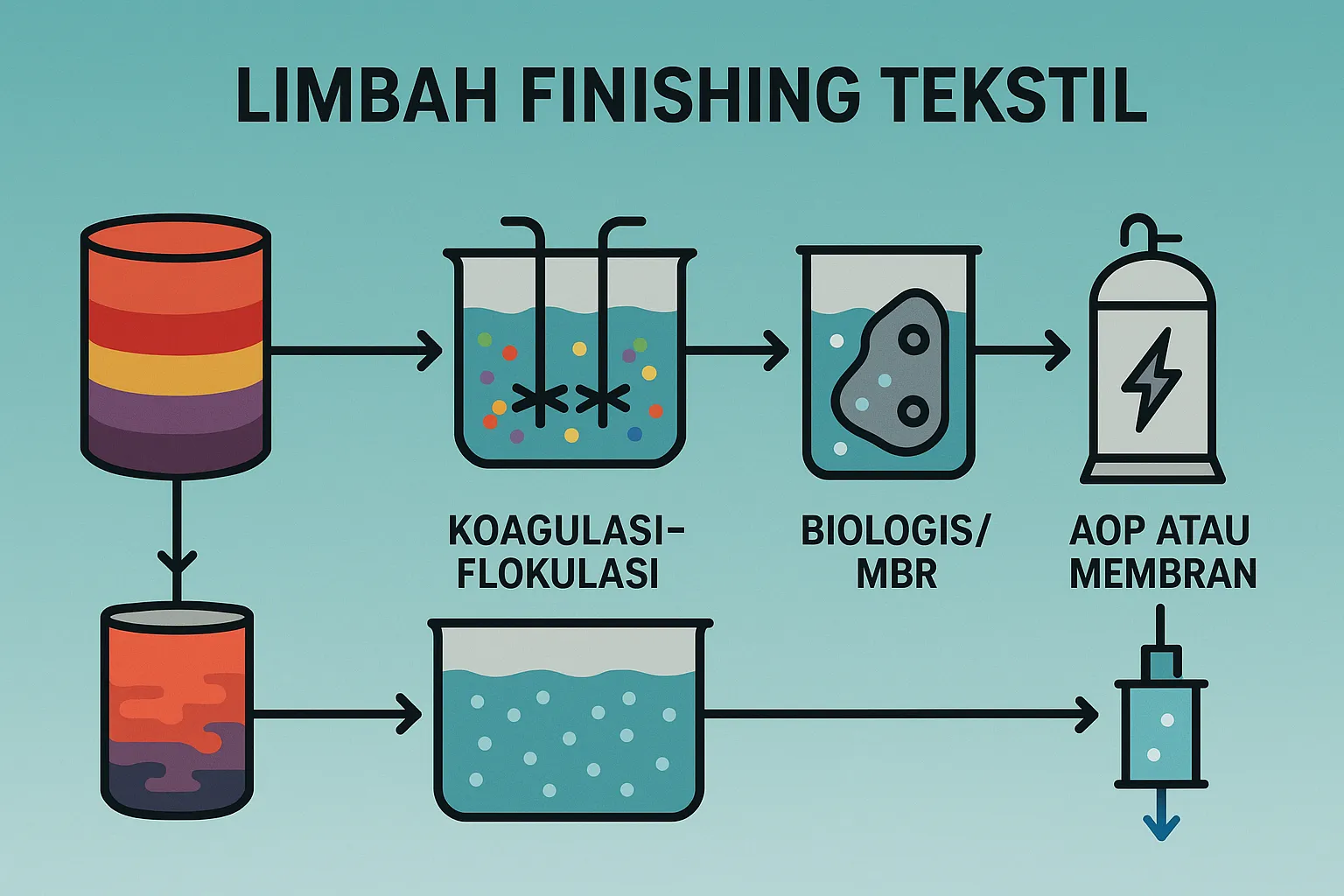
To meet regulatory limits (for example, Indonesian baku mutu for BOD/COD and color), full-scale plants usually end up with the same steps. First, pretreatment and equalization. Then chemical coagulation and flocculation to remove most of the color and suspended solids. Then biological oxidation or a membrane bioreactor (MBR) for soluble organics. Last, a final polish for the last dyes and toxic organics, either an oxidation process (AOP) or tight membranes (iwaponline.com, pubmed.ncbi.nlm.nih.gov).
Membrane options run from UF (ultrafiltration) to NF (nanofiltration) and RO (reverse osmosis). They are used more and more as modular membrane systems for industrial and municipal water treatment. This is especially true when water reuse is the target.
Influent profile and compliance targets
The load that matters in finishing wastewater blends soluble dyes, salts, surfactants, and auxiliaries. COD sits at 300–800 mg/L, BOD at 100–400 mg/L, color in the hundreds of Pt‑Co, and pH swings between 6–11 (iwaponline.com). With roughly 20% of global industrial effluent implicated (iwaponline.com), uncontrolled discharge brings ecological risk because dyes are stable and often toxic, and reviewers underline how persistent color is to remove at low cost (pubmed.ncbi.nlm.nih.gov).
Engineering responses usually start with bar screening and equalization to buffer flow and pH swings (not explicitly cited, but standard in design). Then they go to chemistry and membranes or AOPs to reach discharge or reuse.
Preconditioning and flow equalization
Front-end physical treatment removes debris and evens out shock loads before the chemistry. Continuous screening is common. In practice, plants use equipment like an automatic screen to remove debris larger than 1 mm. Equalization is paired with pH adjustment and nutrient control as needed. Accurate chemical feed is supported by a metering device such as a dosing pump.
Chemical coagulation–flocculation design
Coagulation–flocculation is the usual first step to remove colloidal dyes and TSS (total suspended solids). Aluminum salts (alum, polyaluminum chloride) or iron salts are dosed, usually with polymeric aids. The pH is moved toward neutral or slightly acidic so the metal hydroxide forms well. In bench “jar tests,” dyes are precipitated by charge neutralization and sweep floc by Al(OH)₃ or Fe(OH)₃ aggregates (link.springer.com). Typical coagulant doses are in the tens to a few hundred mg/L.
Performance is robust when optimized. Color removal can reach 90–95% with alum; for example, Merzouk et al. achieved ~94% Reactive Red dye removal with just 40 mg/L alum (link.springer.com). Even low‑cost water‑treatment sludge, rich in Al/Fe hydroxides, hit ~55% color removal and ~35% COD reduction on a real textile effluent in batch tests (link.springer.com). Color removal generally improves at acidic pH (~3–5) when Al/Fe species precipitate effectively (link.springer.com, link.springer.com).
Suspended solids removal usually exceeds 80–90% of turbidity/TSS. However, COD removal is only partial at 10–50% because many organics stay soluble. In the water-treatment-residuals study above, coagulation gave about 35% COD reduction (link.springer.com). Plants capture flocs in settlers or flotation. A clarifier such as a conventional clarifier handles the solids, while some facilities use dissolved-air flotation.
Reagent choice runs from alum to polyaluminum chloride. In many plants, operators specify a PAC such as a polyaluminum coagulant, then tune it with polymeric aids from a catalog of flocculants. This step produces a metal-hydroxide sludge with a sizable volume (usually 2–5% of wastewater by volume). The sludge must be thickened and dewatered. Al/Fe residuals must be managed with pH adjustment to avoid high Al, etc. Despite the handling burden, design targets usually assume ≥90% TSS and ≥60–90% color removal via coagulants (link.springer.com, link.springer.com).
Advanced oxidation processes (AOPs) for recalcitrants
Even after coagulation and biological steps, recalcitrant dyes and organics can persist. Oxidation with Fenton/photo‑Fenton, ozone, UV/H₂O₂, or photocatalysis generates very reactive radicals that break down complex molecules. Pilot studies show >90% degradation of residual dyes and COD. A photo‑Fenton system (Fe²⁺ + H₂O₂ + UV/sunlight) recorded ≈75–93% removal of complex dyes within 1–2 hours (iwaponline.com, iwaponline.com).
In one test, photo‑Fenton achieved 75.3% COD removal — driving final COD to ≈12 mg/L from ~49 mg/L — in 90 minutes using sunlight (iwaponline.com); another study found >93% decolorization of a dye mixture under photo‑Fenton, and combining AOP with a brief adsorption step produced ≈98% removal of color and organics in about 60 minutes (iwaponline.com, iwaponline.com).
Process fundamentals matter. Fenton/photo-Fenton tends to run best around pH≈3. UV/H₂O₂ is effective on azo bonds but needs power. Catalytic variants (for example, catalytic ozonation and electro-Fenton) can improve rates. Typical operating figures include H₂O₂ in the tens to hundreds of mg/L, reaction times of 30–90 minutes, and energy of 0.5–2.0 kWh/m³ for power-intensive UV processes (iwaponline.com). Plants usually pair UV equipment such as an ultraviolet system with oxidants. They then follow with adsorption media like activated carbon to capture any intermediates that form.
Membrane filtration and reuse options
Membranes physically remove fine solids and many dissolved organics. UF (0.01–0.1 µm) removes more than 90% of turbidity and TSS reliably. However, it removes only a limited amount of color. In one pilot, UF gave more than 90% turbidity reduction on a light-shade effluent but only about 7–35% color removal (www.scielo.org.za). Many plants use UF as a pretreatment, like an ultrafiltration module, to protect tighter membranes.
NF and RO push further. NF at ~8–15 bar can reject 80–95% of COD/color; a polyamide NF90 membrane cut feed COD from ~486 mg/L to ~24 mg/L (≈95% removal), with color rejection >90% across tests (www.scielo.org.za, www.scielo.org.za). A looser NF (SR90) produced acceptable reuse quality only on the light‑shade sample. RO, typically run at 15–25 bar, can reach up to 99% COD reduction, with permeate TDS/salinity dropping accordingly and enabling reuse (www.scielo.org.za).
Designers must deal with fouling. Dye adsorption and pore blocking can drive flux down by >25–60% in a few hours (www.scielo.org.za). Therefore coagulation pretreatment is important. The membranes also need chemical cleaning from time to time. In practice, teams standardize a regime supported by specialized membrane cleaners. Tight designs use nanofiltration to meet reuse standards. If a higher cut on COD and salts is needed, they use a brackish‑water RO unit.
Membrane bioreactors and biological oxidation
An MBR (membrane bioreactor) combines biological degradation with membrane separation. It keeps the biomass in the tank while it oxidizes soluble organics. Textile MBR studies report COD removal around 90–95% with virtually complete solids capture. One pilot logged 91% COD removal (effluent ≈170 mg/L) and 99.6% TSS removal (www.mdpi.com, www.mdpi.com). Color removal is moderate (~50–70%), so MBR effluent usually still needs polishing. The main design factors are a long sludge age (months), a low hydraulic retention time (~1–2 days), and UF membranes near 0.08 µm (www.mdpi.com).
Where space is tight or the feed varies a lot, we use packaged membrane bioreactors. In other cases a conventional activated sludge unit or a moving bed bioreactor (MBBR) sits upstream of the membrane or the AOP polishing step.
Integrated train and expected performance
A comprehensive treatment train for finishing effluent stacks four steps: (1) preconditioning — bar screens/grit and an equalization basin to buffer flow and pH swings (not explicitly cited, but standard in design); (2) coagulation/flocculation — rapid mix, flocculation basins, and a clarifier or dissolved‑air flotation using alum or FeCl₃, designed for ~90% TSS capture and substantial color removal (link.springer.com, link.springer.com); (3) a biological reactor — an aerobic MBR or activated sludge/MBBR to degrade soluble organics; for instance, a 24–48 h SRT MBR can reach ~90% COD removal with near‑100% solids retention (www.mdpi.com, www.mdpi.com); and (4) polishing — either AOP (e.g., Fenton/ozonation) to oxidize remaining chromophores (iwaponline.com, iwaponline.com) or nanofiltration to finish off color/COD (www.scielo.org.za, www.scielo.org.za), with UV/hypochlorite disinfection sometimes used to break color.
Expected outcomes with this cascade include BOD <20–50 mg/L, COD <100 mg/L, TSS <50 mg/L, and color “non‑detect” (clear water). Case studies show feasibility: coagulation plus photo‑Fenton/decolorizing delivers >97% dye removal (iwaponline.com), and NF‑treated water can be directly recycled to dyeing (www.scielo.org.za, www.scielo.org.za). Modern systems in Indonesia and worldwide increasingly adopt MBRs and AOPs; one industrial MBR upgrade in Indonesia boosted capacity 2.5× while meeting direct‑discharge standards (including color) using coagulation + MBR + chlorine polish (supremewatertech.com).
For membrane polishing and possible ZLD (zero-liquid-discharge) through brine recovery, teams use modular membrane systems. Energy for high-pressure operation is a line item. Think pumps of 10–25 bar. However, the payoff is permeate good enough for reuse and, with RO, up to 99% COD reduction (www.scielo.org.za).
Design verification and optimization
Design backed by data gives the performance. Jar-test curves set the coagulant dose. Pilot assays define the biological kinetics and the membrane flux. Lab tests (or RSM models) set the AOP reagent levels (link.springer.com, iwaponline.com). High removal rates are achievable, but they cost money and involve tradeoffs. This approach keeps the plant within Indonesian effluent rules and recovers as much water and energy as feasible.
Sources: Peer‑reviewed studies of textile effluent treatment (link.springer.com, link.springer.com, iwaponline.com, www.scielo.org.za, www.mdpi.com, iwaponline.com), regulatory guides, and industry reports have been synthesized to produce these design guidelines.