

Article
Textile Finishers Are Wrestling With Dye‑Heavy Effluent. Engineers Are Building a Treatment Train That Works.
Color‑rich wastewater from finishing and coating can push COD into the thousands and test regulatory limits. A staged design—coagulation/flocculation, advanced oxidation, and membranes—now sets the compliance and reuse playbook.
Industry: Textile | Process: Finishing_&_Coating
Textile finishing and coating produce a strong mix of suspended solids, surfactants, waxes, stubborn dyes and trace metals. If this mix is not treated, chemical oxygen demand (COD, a measure of the oxidizable organic load) can reach hundreds to thousands of mg/L, and the colour is intense [mdpi.com]. Indonesia’s standards are tight. For textile mills, BOD must be ≤60 mg/L, COD ≤150 mg/L and TSS ≤50 mg/L (see BSR guideline excerpt, additional excerpt, additional excerpt). If a plant does not comply, Law No. 32/2009 allows fines up to IDR 15 billion (~USD 950,000), loss of the permit, or criminal charges [has-environmental.com].
That enforcement backdrop, and corporate “zero discharge” goals, has pushed plants toward multi-stage treatment that works. The train combines physical separation, chemical clarification and polishing.
Effluent composition and treatability
Typical finishing and coating effluent (batik wastewater is a close analog) contains suspended and dissolved solids, high BOD/COD, dyes, surfactants, waxes and trace metals from pigments such as Cr, Cu and Ni [mdpi.com]. A low BOD/COD ratio (≈0.1–0.2) is common. It shows that biological degradation is slow because of complex aromatics and resins [mdpi.com].
For planning, designers assume COD >1000 mg/L, TSS >200 mg/L, and residual color (no numerical color limit is specified in the cited regulation). Early headworks usually start with debris control. Packaged wastewater physical separation systems handle screens and primary removal. You can also use an automatic screen for continuous debris control.
Coagulation/flocculation for color and solids
Purpose: Coagulation/flocculation (C/F) neutralizes colloidal charges. Then insoluble dyes and particulates aggregate and settle. The standard coagulants are inorganics: aluminum sulfate (alum), ferric chloride/sulfate, polyaluminum chloride (PAC) and polyferric sulfate (PFS). Cationic polymer aids such as polyDADMAC are added as needed [mdpi.com]. Dosing usually works at pH ≈5–7. A dose of 100–500 mg/L is common, but the jar test decides. Natural coagulants such as chitosan are under study. They see modest industrial use.
In practice, C/F can remove a large fraction of solids and much of the color. Reported outcomes include COD removal up to ≈83% and color removal up to ≈82% on textile wastewater [mdpi.com]. More broadly, turbidity and TSS reductions of 80–95% are typical. However, COD removal is usually 30–60% because soluble organics remain [mdpi.com].
Operation notes: rapid mix then gentle flocculation, followed by settling and sludge handling. Dosing is nonlinear and overdosing can leave residual metals. Therefore jar tests are important. Plants usually meter aluminum‑ or iron‑based coagulants such as PAC with an accurate dosing pump, and add polymer flocculants to build flocs that settle well.
Outcome: after C/F, effluent turbidity can fall below 5 NTU with TSS <100 mg/L and a large color reduction (~70–90%) [mdpi.com]. Settling usually takes place in a clarifier before the downstream processes.
Advanced oxidation for recalcitrant dyes
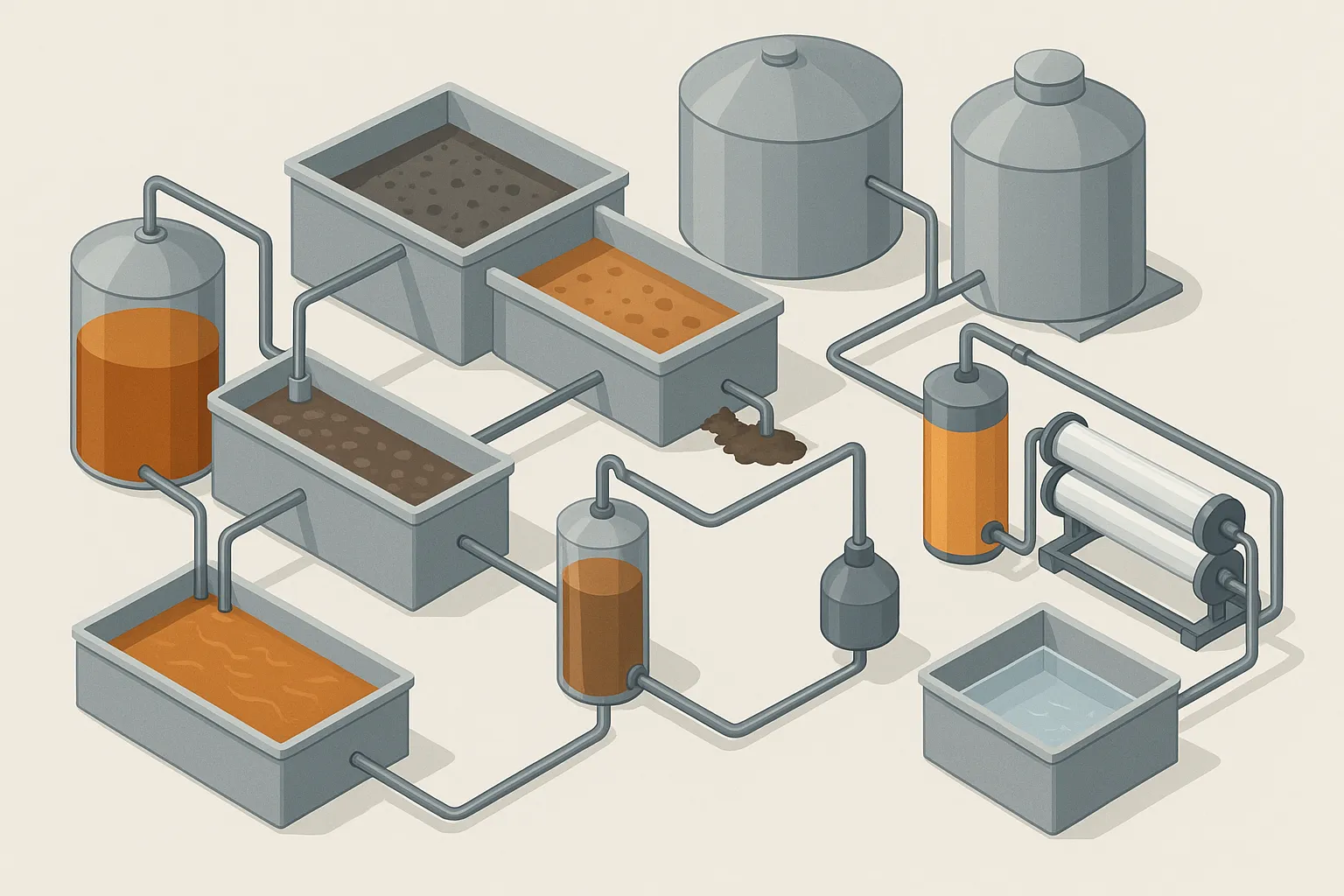
Advanced Oxidation Processes (AOPs) make hydroxyl radicals (•OH). These radicals break down chromophores and organics that are hard to oxidize. Fenton’s reagent (Fe²⁺ + H₂O₂ at pH ~3) is a workhorse. Studies report roughly 50–80% COD and color removal, depending on dose and contact time. One test on real dyehouse wastewater used electrochemical Fenton and achieved ~70.6% COD and 72.9% color removal in 60 minutes. The chemical Fenton cost was ~$8.6 per kg COD removed, about half that of the electro‑Fenton variant [pmc.ncbi.nlm.nih.gov].
Photo‑Fenton or UV/H₂O₂ can speed up oxidation. When optimized, Fenton‑based treatments have achieved >90% COD and color removal in lab tests. One hybrid Fenton/UV run reported ~93.7% COD and 89.5% color removal [researchgate.net]. UV irradiation can be delivered through inline ultraviolet systems for controlled exposure.
Ozonation (O₃) targets dye chromophores and organics and works well on color. One pilot fully decolorized Reactive Black 5 in 5 minutes at ~25 mg/min ozone with ~75% COD removal [researchgate.net]. Typical practice doses ozone in the tens of mg/L. COD removal usually lags color, at 60–80% during the same contact. Ozone does not add solids. However, bromate formation is a consideration where bromide is present.
Design notes: AOP reactors go after any biological treatment and before final polishing. pH and residence time are important (low pH for Fenton, higher for ozone). Radicals can leave intermediates. Therefore a short biological step or activated carbon polish sometimes follows. Energy and chemical costs (H₂O₂, electricity for UV or ozone) are material. Outcome: combined systems usually exceed 90% color removal, usually to “visibly clear,” and drive COD down quite far. Post‑AOP COD may usually fall below 200 mg/L (depending on intensity). That is far below the 150 mg/L limit if mild polishing follows [researchgate.net] [pmc.ncbi.nlm.nih.gov].
Membrane polishing and reuse
Membrane filtration provides the physical barrier to mop up residual solids, dyes, salts, and low‑molecular organics. Microfiltration/ultrafiltration (MF/UF, MF pore size ~0.1–1 μm, UF ~0.01–0.1 μm) clear colloids and high‑MW solutes and are usually used as pretreatment. UF has removed >90% turbidity and TSS in studies, but only 7–35% of dissolved dyes (color) [scielo.org.za]. For this duty, plants deploy skid‑mounted ultrafiltration systems ahead of tighter barriers.
Nanofiltration (NF) targets dyes and divalent salts. It usually achieves 60–90+% removal of residual color and COD. An NF90 membrane rejected >90% of dye in a reactive‑dye effluent [scielo.org.za], with COD rejection around 76–83% on lighter loads [scielo.org.za]. Plants usually standardize around packaged nano‑filtration for decolorization and partial organics removal.
Reverse osmosis (RO) is the tightest barrier (<0.001 μm equivalent). It removes virtually all dissolved salts, metals, dyes and organics. Tests report >95–99% removal of turbidity, organics and most salts. In comparative tests, RO was the only process that reached ~99% COD removal [scielo.org.za] [watertreatmentmagazine.com]. For industrial reuse targets, engineers specify brackish‑water RO trains sized to TDS and recovery.
Sequence and operations: An integrated train usually runs UF (or MF) → biological A/O (optional) → C/F → AOP → NF → (RO). In some designs, NF can partly replace AOP for color if the dose is increased. Membrane fouling is real. One textile NF trial saw 20–60% flux decline within hours. It needed chemical cleanings that restored ~76–82% flux [scielo.org.za] [scielo.org.za]. Plants manage this with membrane cleaners and dose antiscalants to control mineral deposition. NF usually runs at ~10–20 bar, RO at ~15–60 bar.
Outcome: sequential membranes can polish effluent very well. In one pilot, NF drove conductivity down to <100 μS/cm from ~8,300 μS/cm and cut total organic carbon by ~65–85% [scielo.org.za]. Many systems meet textile wash‑reuse criteria after NF. RO is added when deionized‑grade reuse is the goal [scielo.org.za] [watertreatmentmagazine.com].
Integrated train for Indonesian mills
A full plant layout combines screening and sedimentation with chemical clarification, oxidation and membranes. One example: screening and sediment removal first, then C/F in a flash tank with alum or ferric at ~200–400 mg/L and pH ~6. After that comes a settling step in a clarifier. If the BOD calls for it, you can add an optional biological stage with packaged wastewater biological digestion modules.
Polishing uses an AOP reactor (Fenton at pH 3–4 or an ozone contactor) and a membrane stack (UF/MF + NF/RO). This multi‑stage approach can give ~85–95% overall COD reduction, BOD near‑zero, TSS <10 mg/L, and effectively remove color [mdpi.com] [scielo.org.za]. Coagulation alone has removed ~82% of color in reported cases [mdpi.com]. Membranes plus oxidants have driven COD reductions above 90% in studies [researchgate.net] [scielo.org.za].
Results reported from textile plants show that C/F + AOP + NF/RO cuts COD below 100 mg/L and makes water suitable for partial reuse, for example for cooling or rinsing [scielo.org.za] [watertreatmentmagazine.com]. That fits well within the cited Indonesian BOD/COD/TSS limits of 60/150/50 mg/L (sources: BSR excerpt, additional, additional).
Operations and optimization checkpoints
The jar test sets the coagulant and the pH. The oxidant dose and the residence time set the AOP. The transmembrane pressure and the flux set the membrane. These are the main settings. Membranes need backwash and chemical cleaning from time to time. In one NF trial the flux dropped 20–60% within hours. Chemical cleaning brought back ~76–82% of the flux [scielo.org.za] [scielo.org.za]. Plants usually standardize on integrated membrane systems so pretreatment and cleaning protocols are harmonized.
The stakes are clear. Meeting the standards prevents penalties of up to IDR 15B (~US$950k) and aligns with sustainability commitments [has-environmental.com]. The staged approach has repeatedly produced colorless effluent with BOD near zero and TSS <10 mg/L in reported designs. The stages are screens and sedimentation, chemical C/F, AOP, and membrane polishing. This is now the reference path for finishing and coating wastewater [mdpi.com].
Selected sources: Zakaria et al. (2023) on composition and coagulation performance [mdpi.com] [mdpi.com]. Eslami et al. (2013) on Fenton removals and cost [pmc.ncbi.nlm.nih.gov]. Ima W. N. et al. (2021) on ozonation of Reactive Black 5 [researchgate.net]. Chollom et al. (2015) on UF/NF/RO performance and fouling [scielo.org.za] [scielo.org.za] [scielo.org.za] [scielo.org.za] [scielo.org.za] [scielo.org.za]. Behl (2025) on RO capabilities [watertreatmentmagazine.com].