

Article
Seismic surveys are loud: The data on whale impacts—and what mitigation actually delivers
Industry: Oil_and_Gas | Process: Exploration
Seismic airguns are arrays that map the seafloor. They fire powerful, low‑frequency sound pulses every few seconds. The impulses can reach up to ~200–260 dB re 1 µPa @ 1 m (underwater decibels referenced to 1 microPascal, level at 1 meter from source). They propagate for kilometers and raise ambient noise levels (pubs.usgs.gov). Measurements indicate ambient ocean noise has risen by ≈12 dB in some regions over 30 years (www.mdpi.com).
Concern has moved into policy. Indonesia now needs an environmental impact plan (UKL‑UPL) for marine seismic surveys. Marine fauna, especially whales and dolphins, depend on sound for navigation, communication and foraging (www.frontiersin.org). Therefore the effects range from acoustic masking and stress to behavioral disturbance and even hearing damage, with possible consequences for the population.
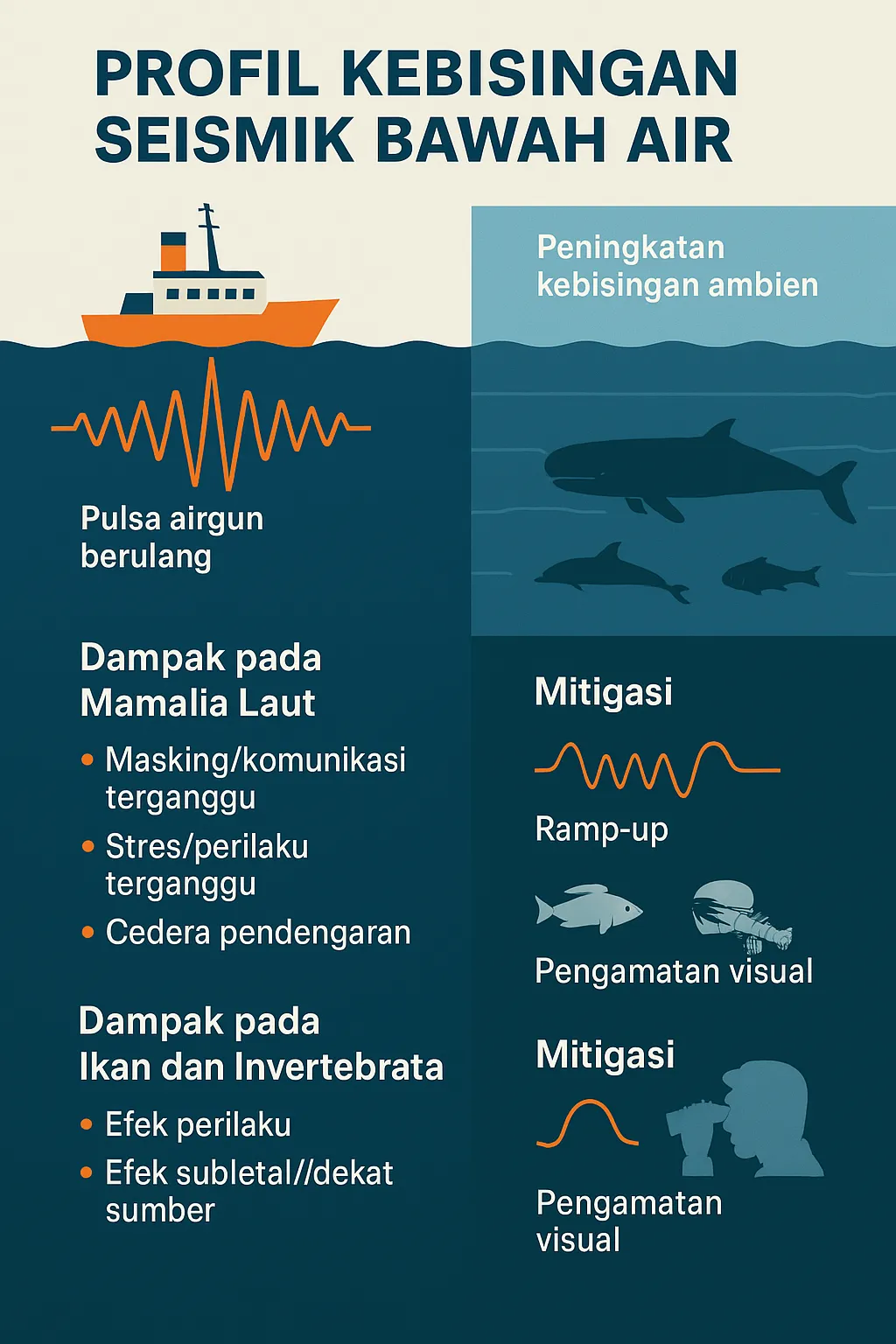
Documented effects on marine mammals
For cetaceans and pinnipeds, seismic pulses can mask whale calls and echolocation, disrupt feeding or migration, and induce behavioral changes such as startle responses, avoidance, and altered dive patterns (www.frontiersin.org) (www.frontiersin.org). At high received levels, animals can suffer auditory injury—temporary or permanent threshold shifts (TTS/PTS) that reduce hearing sensitivity. Regulatory practice (e.g., U.S. NMFS) typically treats ~180 dB re 1 µPa (rms, a root‑mean‑square metric used by regulators) as the injury threshold for cetaceans (pubs.usgs.gov).
Many studies report behavioral effects (e.g., whales avoiding an area) but relatively few measure clear hearing loss. In one debated case, a 2002 3D seismic campaign off Brazil coincided with an unusual spike in humpback whale strandings, prompting Brazil’s regulator to ban seismic during the whales’ breeding season (www.researchgate.net) (www.researchgate.net). Causality remains contested: experts note seismic surveys may damage cetacean sonar organs but lack definitive proof of strandings (jakartaglobe.id) (jakartaglobe.id).
Observer records from the U.S. Gulf of Mexico show how animals and surveys intersect. Of ~194,000 survey‑hours logged (2002–08), there were 3,963 cetacean sighting records (≈28,000 individual animals). Sperm whales (1,136 records) and small dolphins dominated. Many animals swam within prescribed exclusion zones, so operators interrupted shooting (www.researchgate.net).
Baca juga:
Mengapa Sterilizer Horizontal & Kontrol Otomatis PLC/SCADA Jadi Pilihan Utama di Pabrik Kelapa Sawit
Fish and invertebrate exposure evidence
All teleost fish detect low frequencies (<500 Hz), so airgun pulses can startle them or disrupt schooling and spawning (www.mdpi.com). Early concerns led Norway (1980s–90s) to close fish spawning grounds to seismic surveys. Controlled experiments later found direct mortality only at very close range: for cod larvae, lethal effects were confined to ~2 m from the airgun, yielding a worst‑case 0.45% larval mortality per survey—far below natural daily mortality (5–15%) (www.mdpi.com). Norway lifted some restrictions, keeping only critical spawning/migration corridors closed (www.mdpi.com) (www.mdpi.com).
Reviews conclude seismic impacts on fish recruitment are negligible at population scale: lethal or sublethal effects occur only within a few meters of the source (www.mdpi.com) (www.mdpi.com). For invertebrates, experimental work on crustaceans (lobsters, crabs) and zooplankton similarly shows no widespread mortality beyond very close distances; one large review found no invertebrate deaths except larval krill very near the source (www.frontiersin.org).
Some field studies cite physiological stresses in lobsters (impaired righting reflex, sensory hair damage) when exposed at close range (www.frontiersin.org). Overall, review articles note that masking and disturbance occur at much greater distances than outright physical injury, but long‑term population effects are largely unmeasured (www.mdpi.com) (www.frontiersin.org). In short, seismic pulses generate masking and stress for many organisms and acute impacts if animals are very near the guns; marine mammals are the most studied group, showing avoidance and, rarely, injury at high levels, while fish and invertebrates generally suffer effects only within a few meters (www.mdpi.com) (www.frontiersin.org).
One systematic review notes: “Seismic surveys did not result in invertebrate mortalities except larval krill,” and that any physiological effects varied by species and age (www.frontiersin.org). Precautionary assessments usually assume zones of risk. (Note: Many regulatory analyses use thresholds like 160 dB re 1 µPa (rms) as behavioural harassment for cetaceans and 120 dB for fish, with injury assumed at 180–190 dB, although such criteria are coarse proxies.)
Ramp‑up (soft start) procedures
To reduce risk, operators use ramp‑up (“soft start”). They turn on a single small gun and add others over 20–40 minutes. Therefore sound levels climb slowly and animals have a chance to move away before full power. In practice, the law needs ramp‑ups, usually 20–40 minutes, when airgun firing begins or resumes (www.researchgate.net). However, expert panels note that the effectiveness is uncertain (www.conservationevidence.com).
Controlled trials with humpback whales found ramp-ups reduced peak received levels by only ~3 dB on average compared with an immediate blast. Only about half the whales reacted to move away (pmc.ncbi.nlm.nih.gov). Gulf of Mexico records suggest ramp-ups slightly reduced dolphin sightings (9% fewer in ramp-up vs silent periods) and pushed dolphins a few meters farther from the source (www.researchgate.net). Ramp-ups inevitably extend total survey time, but observed downtime has been modest. Over six years of U.S. surveys, 32 ramp-up delays (mainly due to dolphins in exclusion zones) cost ~18.5 hours of airgun inactivity (www.researchgate.net). By contrast, reducing source levels gradually can reduce stress on responsive animals who depart early (pmc.ncbi.nlm.nih.gov). However, if animals do not respond to faint initial sound, ramp-ups mainly prolong noise exposure.
Baca juga: Pengolahan Limbah Secara Kimia
Visual observers and exclusion zones
A primary mitigation is continuous monitoring by trained marine mammal observers (MMOs). They scan exclusion zones, usually several hundred meters to over a kilometer in radius, set by expected sound levels. For example, one 1999 survey off California needed three visual observers at all times (pubs.usgs.gov). If a protected species enters the safety zone, airguns must shut down. The zone is usually where the received level would exceed ~180 dB, or it is a fixed radius.
In practice, MMOs usually cause delays. In the Gulf of Mexico dataset, observers logged 144 airgun shutdowns because whales were in the exclusion zone (97% were sperm whales). Each shutdown averaged ~58 minutes, which totals ~125.7 hours over six years (www.researchgate.net). Observers also keep a pre-shoot watch (usually 30 minutes) before any ramp-up. The BOEM report found ~86% compliance with the 30-minute pre-survey check (www.researchgate.net). Other protocols usually include no ramp-ups at night or in poor visibility, so animals are not missed, and vessel maneuvering if protected species are nearby (www.researchgate.net).
Spatial and seasonal avoidance
Planning around biology may be the most effective tool. The MMO Observer Association says the “single most important mitigation” is avoiding important habitat and seasons, for example calving areas and migration corridors (mmo-association.org). In practice, that means scheduling surveys outside known breeding periods and staying away from marine protected areas. After the Brazilian whale strandings, seismic surveys were prohibited in the Abrolhos Bank during July–November (humpback whale season) (www.researchgate.net) (www.researchgate.net). Indonesian scientists have also urged limiting surveys in regions like the Savu Sea to outside peak cetacean migration periods (jakartaglobe.id). Such time controls can work better and cost less than shutdowns.
Other “soft” mitigations include repeated down-detector systems, for example passive acoustics, to give an alert if whales vocalize at night. They also include keeping wildlife exclusion corridors when mobilizing.
Additional mitigation practices
Guidelines usually call for detection zones that match the species, for example larger zones for baleen whales and smaller zones for dolphins, based on frequency sensitivity (mmo-association.org). Observers may use binoculars, infrared, or night‑vision for night watches. In some countries, passive acoustic monitoring (PAM) adds to visual observers, though its use under seismic survey conditions is still developing. Nozzle or bubble barriers (used in construction) are not practical for commercial surveys.
All mitigation practices raise operating costs, for example paying for observers and downtime. However, the data collected shows these costs are quite small. In one large multi-year survey program, downtime from all mitigation, pre-survey delays plus shutdowns, was only about 0.06% of total survey hours (www.researchgate.net).
Baca juga:
Measured performance and trends
Ramp‑ups: Out of ~32,939 documented ramp‑ups across many surveys, 90% complied with the mandated 20–40 minute duration. Individual vessels averaged about 2.5 ramp‑ups per day; 57% of ramp‑ups began in daylight, enabling effective pre‑ and during‑ramp monitoring (www.researchgate.net) (www.researchgate.net) (www.researchgate.net). Only ~3% of ramp‑ups lacked a full 30‑minute pre‑watch; when animals were present, ramp‑ups were delayed, totaling 18.5 hours over six years, and 75% of such delays were due to small cetaceans (www.researchgate.net) (www.researchgate.net).
Shutdowns: Whales in exclusion zones forced 144 seismic shutoffs in the Gulf of Mexico data. Sperm whales alone caused 97% of the triggers. Each shutdown averaged about 58 minutes, for a total of about 125.7 hours over six years (www.researchgate.net).
Behavioral responses: Dolphin sighting rates were 9% lower during ramp-up than during silent periods. Dolphins also kept a greater average distance during full-power firing than during ramp-up, and the shortest distance during silent intervals. This suggests the animals may steer clear of the loudest pulses. However, most dolphins stayed visible near operating guns, and few made large avoidance moves. Therefore mitigation buys only incremental protection unless the animals leave the zone entirely (www.researchgate.net).
Operational and regulatory takeaways
Quantitative impacts are small but real: mitigation (ramp-ups, observers, shutdowns) causes measurable delays. For example, the cited Gulf of Mexico data show about 0.02–0.06% of total survey time. For a typical 3D survey (100+ days), this might mean several hours lost. That is usually acceptable against the ecological risk. Industry data show high compliance with mitigation protocols, but effectiveness varies by species catch rates (www.researchgate.net).
No single measure is foolproof. Soft starts have limited effect unless the animals respond, as experimental trials show (pmc.ncbi.nlm.nih.gov). Visual monitoring can fail at night or in poor conditions. Therefore many guidelines do not allow ramp-ups in darkness (www.researchgate.net). Combining methods, observers plus avoiding high-use periods, gives the best results.
Plan for the site and the species. Do not run surveys in whale calving areas (as in Brazil) or during mass migrations (as recommended in Indonesia’s Savu Sea) (www.researchgate.net) (jakartaglobe.id). Use the latest research. For example, regulators in New Zealand and the EU use acoustic data on local whale densities to set dynamic zone sizes.
Regulatory context is evolving. In Indonesia, seismic surveys must follow national environmental standards (BSILHK Form UKL‑UPL) that mandate management measures. International best practice (IAGP, IMOA) emphasizes avoidance of critical habitats and detailed monitoring plans (mmo-association.org) (mmo-association.org).
Baca juga:
Kondensat Sterilizer Sawit: Limbah Panas yang Bisa Diubah Jadi CPO dan Penghematan Energi
Bottom line for exploration teams
Loud airgun noise can disturb marine mammals through masking, stress and behavioral change. It also affects fish and invertebrates, but to a much lesser extent. The worst hearing injuries and mortalities happen very near the source. Broad population effects are still unproven, except through habitat exclusion or chronic stress. In industry practice, measures like ramp-up and visual monitoring reduce the risk of incidental injury. Operators usually delay or shut down if protected animals approach.
Watchdog reports from large offshore surveys show that mitigation takes only a small part of the time, tens of hours over thousands of operating hours (www.researchgate.net). However, these procedures are important for license compliance and social license to operate. Project planners should allow time and cost for mitigation, apply site-specific EIA guidance (as per Indonesian standards), and consider scheduling surveys to avoid peak marine mammal presence to minimize conflict.